- AI enables small businesses to automate operational processes, reduce costs, and personalize the customer experience at scale.
- There are various tools, from generative assistants to agentic systems and AI-powered ERPs, that optimize daily productivity.
- A successful implementation requires a strategy based on specific use cases, team training, and a secure data infrastructure.
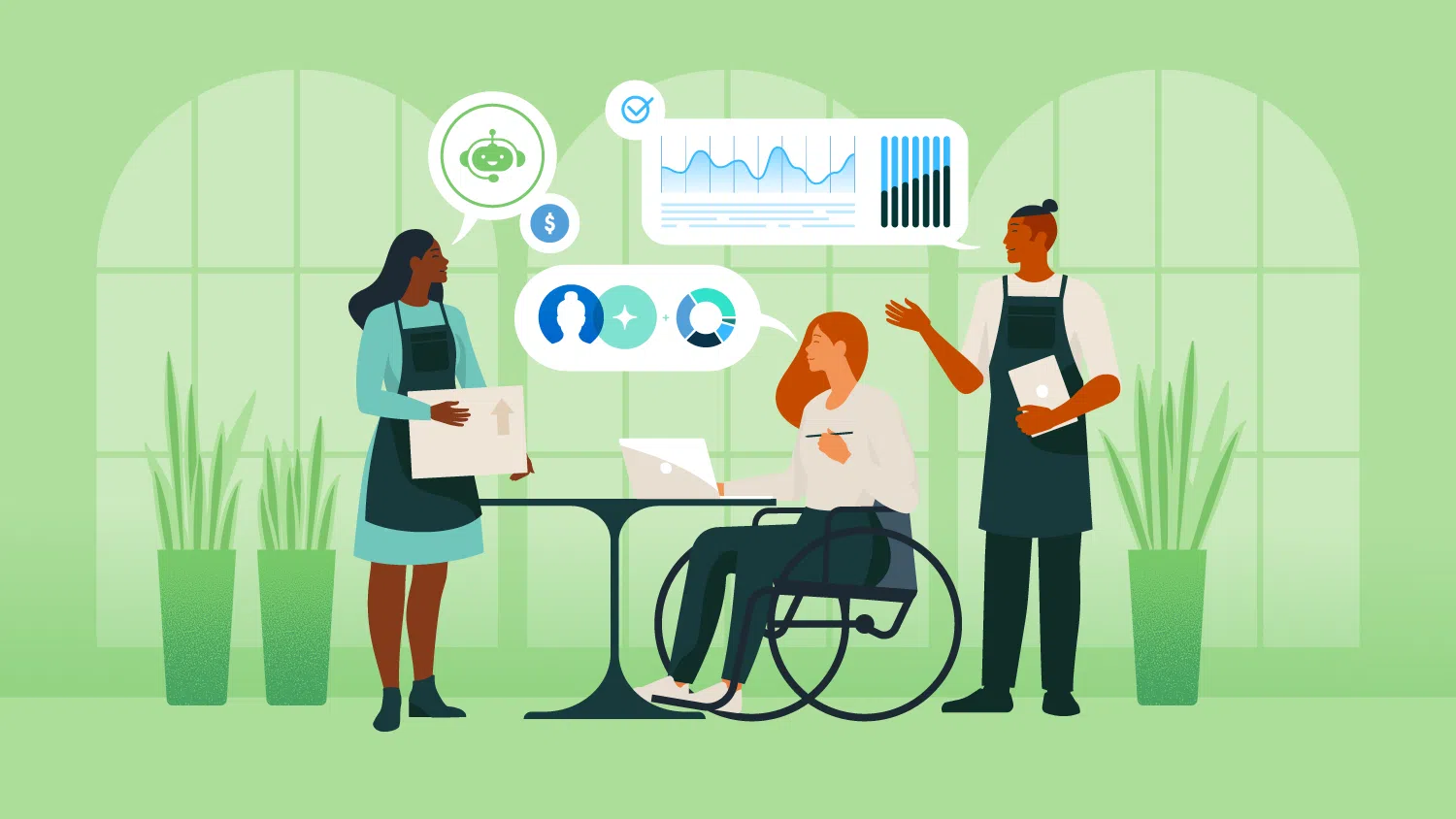
Today, artificial intelligence is no longer a tool reserved for tech giants; it has permeated the daily operations of even the smallest businesses. It's not just a passing fad, but a strategic advantage that allows SMEs to compete on equal footing with large corporations, optimizing their resources and improving the quality of their services without requiring astronomical budgets.
For any business owner, the goal is clear: to do more with less. AI acts as a capability multiplier, helping to eliminate tedious tasks and allowing the human team to focus on what truly adds value, such as creativity or close customer relationships. Adapting to this change is not optional if you want to avoid being left behind in an increasingly digital market.

What exactly is AI applied to the world of small businesses?

When we talk about AI for SMEs, we're not referring to creating complex robots, but rather to using software capable of mimicking human intelligence to process data and make quick decisions. These are solutions that automate corrective tasks that typically consume a lot of time and money, allowing for much smoother and more professional management.
Many of these capabilities are already integrated into the programs we use daily, such as CRM or invoicing software. Therefore, the key isn't developing technology from scratch, but rather choosing the tools that best fit the real-world business challenges, whether it's managing inventory or answering customer questions via chatbots.
Tangible benefits of investing in AI
Implementing these technologies brings a number of advantages that directly impact the bottom line. One of the most obvious is improved customer service . Thanks to chatbots trained with machine learning, companies can offer immediate responses 24/7, adapting to user preferences and generating long-term loyalty.

In terms of operations, the increase in productivity is massive. By automating data entry or document verification, staff can dedicate their time to developing new products or designing more aggressive marketing campaigns. This translates into a reduction in operating costs , as human error is minimized and processes that don't require constant supervision are optimized.
Furthermore, marketing has taken a qualitative leap with generative AI. It's now possible to create content for blogs, emails, and social media in the blink of an eye. However, it's essential that a human review the texts to prevent the content from becoming repetitive or losing the essence and unique voice of the brand.
Practical use cases by department

For AI to move beyond mere experimentation, it must be applied to concrete problems. In marketing and communications , it's used to segment audiences and personalize offers based on actual consumer behavior, supported by key email marketing strategies for SMEs . In sales, dynamic pricing can be implemented , adjusting prices according to real-time market demand—a vital tool in the hospitality and tourism industries.
Logistics also benefits enormously. AI can optimize delivery routes by considering traffic and priorities, preventing trucks from making unnecessary detours. It also helps control stock levels to prevent product shortages or warehouses being filled with unsold items.

In the human resources department, technology facilitates candidate filtering and the detection of absenteeism patterns, allowing for faster hiring of the most suitable candidates. Even in accounting, invoice automation and payment tracking reduce the administrative burden to a minimum, facilitating adaptation to mandatory electronic invoicing regulations.
The arsenal of tools: From chatbots to agentic AI
There are options for all levels of digital maturity. Tools like ChatGPT, Google Gemini, and Microsoft Copilot are ideal entry points for writing copy, summarizing documents, and organizing schedules. For those seeking something more specialized, Jasper AI is a gem for marketing, while Notion AI is perfect for centralizing documentation for a small team.
For in-depth business management, solutions like Odoo Enterprise or Sage 200 integrate AI across the board, helping to manage daily workflows seamlessly. Meanwhile, Google Notebook LM allows companies to transform their own documents into an interactive knowledge base.
The latest trend is agentic AI . Unlike traditional chatbots, autonomous agents not only answer questions but also plan and execute entire processes. They can coordinate customer acquisition, manage orders, and organize after-sales service without constant supervision , bringing the efficiency of a multinational corporation to a small office.
Roadmap for a flawless implementation

Launching into AI without a plan is the fastest route to failure. Ideally, you should identify a high-impact problem , such as a customer service bottleneck, and launch a pilot project. Once you measure the return on investment (ROI) and verify that the solution works, you can then scale the tool to other departments.
Paying attention to data security is crucial . GDPR compliance in Europe is non-negotiable. SMEs must ensure that their customer information is encrypted and anonymized to prevent data breaches that could damage the company's reputation.

Finally, the human factor cannot be overlooked. Training the team is vital so they don't see technology as a threat, but rather as an ally that frees them from boredom . Establishing clear rules about what data can be used and how to interact with AI ensures that the process is ethical and efficient.
Challenges and the path towards modernization
The biggest obstacle for many SMEs is the lack of specialized talent and the disorganization of their data. Many companies believe they are digitized, but their information is scattered across outdated files that don't communicate with each other. For AI to truly shine, data needs to be high-quality and flow smoothly in the cloud.
The infrastructure also needs to be updated. Migrating to modern operating systems or upgrading storage with AI-ready hardware allows applications to run faster and more securely. In cybersecurity, AI is the best defense, as it can detect attack patterns in real time and respond much faster than any human.
Digital transformation is an iterative process. Simply installing a program isn't enough; you have to adjust the prompts , review the results, and continuously improve your strategy. Businesses that ignore this evolution will not only stagnate but will fall behind competitors who already offer 24/7 personalization and speed.
The integration of artificial intelligence and data analysis has become the backbone of today's competitiveness, allowing any business, regardless of size, to optimize costs and boost productivity through intelligent automation and much more robust and secure information management.