- Dependencies are relationships of need between tasks, equipment, and components that, if not managed, become risks of delay and blockage.
- Classifying and visualizing dependencies (matrices, Kanban boards, schedules) allows for prioritizing, coordinating teams, and planning with greater accuracy.
- Organizations with multidisciplinary teams, DevOps culture, and fewer cross-functional teams reduce asynchronous dependencies and improve time to market.
- The combination of appropriate tools, review events, and good communication is key to managing dependencies with a proactive approach.

Dependency management is one of those issues that everyone struggles with daily, but few organizations address systematically. When it's not controlled, delays arise, seemingly inexplicable roadblocks occur, emergency meetings are held to "put out fires," and ultimately, projects are either late or never arrive at all.
Conversely, when dependencies are identified, visualized, and managed effectively, teams work more autonomously , deadlines cease to be a gamble, and collaboration between departments becomes much smoother. In this article, we'll examine in detail what dependencies are in projects and digital products, the different types that exist, and how to manage them in practice using agile approaches, frameworks like Kanban, and tools such as Jira or project management software.
What do we mean by dependency in project and product management?
In the context of projects and product development, a dependency is a relationship of necessity between two elements of work: a task, a team, a technical component, or even an external supplier. For something to begin, progress, or end, something else must happen first.
From a very practical point of view, a dependency can be either a functional requirement (for example, having a shopping cart on a website) or a purely technical requirement (having a ready API, access to an environment, or the deployment of a release). Even when the "actor" consuming the result is not a person but another service, we still refer to it as a dependency.
In project management, a task is often described as dependent when its execution is conditioned on the completion, start, or progress of another task. If "Task B" needs "Task A" to reach a specific point in order to proceed, then you have a dependency.
Dependencies are not just a nuisance: they constitute real risks . They increase the likelihood of delays, cost overruns, and even the cancellation of an initiative before it even reaches production. By default, every dependency is a risk with a certain probability and impact that should be managed, not ignored.
Types of dependencies: a complete overview
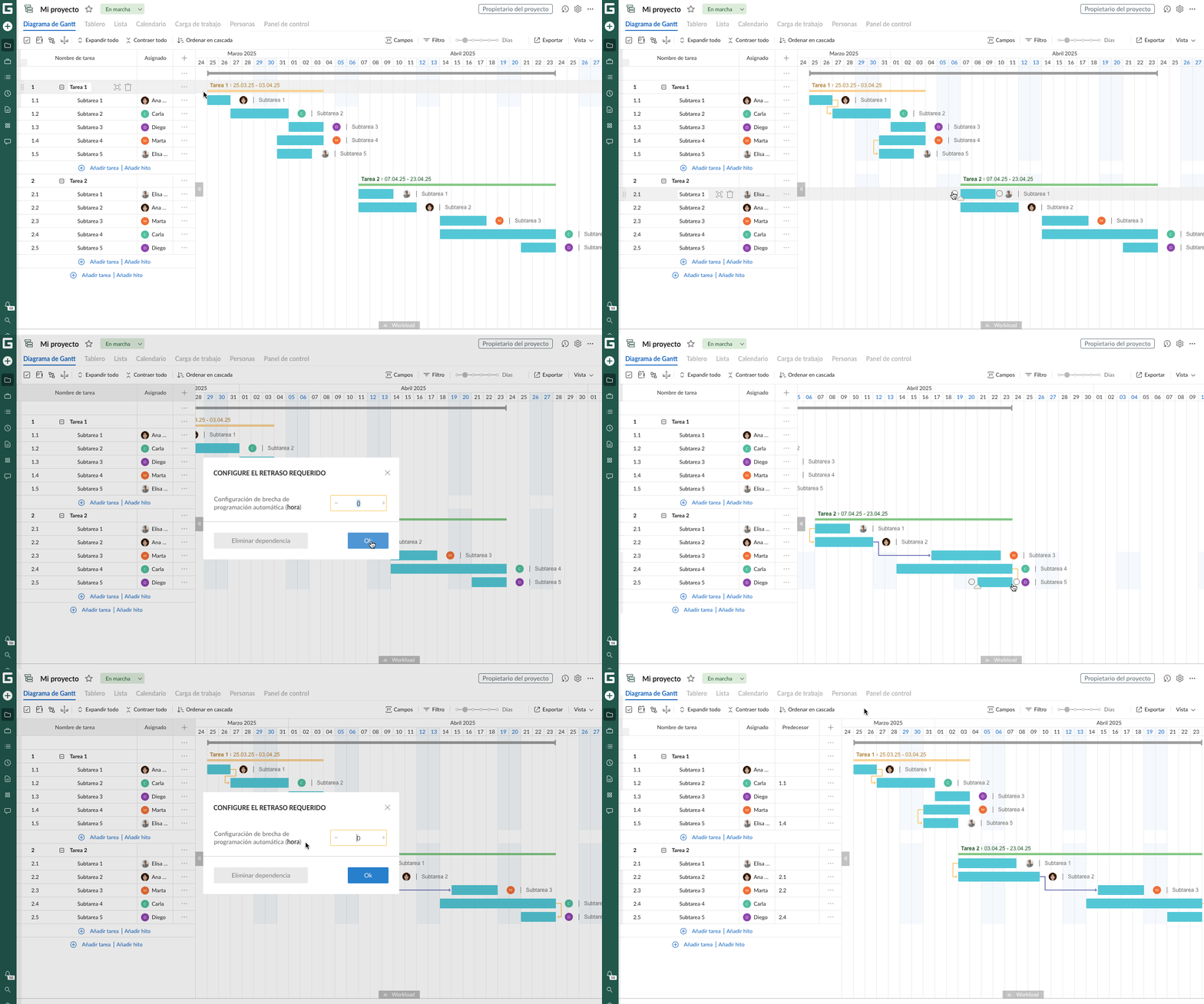
To manage dependencies effectively, they must first be classified and named . Project management literature and product practice typically distinguish several axes: according to their nature (logical, resource-based, external, preferential), according to the relationship between tasks, and according to the organizational scope.
Departments according to their nature
Logical or causal dependencies are those that follow an inevitable sequence of steps . You can't paint a wall if you haven't built it first; you can't test a feature if it hasn't been developed first. They are the most intuitive.
Resource dependencies arise when multiple tasks or projects compete for the same limited resource : a key person, a single designer, a single back-end team, a testing machine, etc. Work progress is determined not so much by the logical order, but by the actual availability of those resources.
Preferred dependencies are those that stem from internal procedures or best practices but are not strictly necessary to complete the deliverable. For example, an extra editorial review or an additional QA step that the team decides to keep because it reduces errors, even though the project could be formally "closed" without it.
External dependencies occur when the team is tied to factors it does not control : a supplier that has to deliver material, a legal department that must approve a contract, weather that affects a project, or a third-party payment gateway that must certify its service.
Task dependencies: classic temporal relationships
When going down to the planning level, task dependencies are usually modeled with four basic relationships that you will see in schedules or Gantt charts:
In a Finish-to-Start (FS) relationship, the successor task cannot begin until the predecessor task has finished. This is the most common relationship and the one used by default by most tools.
In a finish-to-finish (FF) relationship, the next task cannot complete its work until the previous task has also finished . This often occurs when a task is actually the sum of several interdependent subtasks.
In the case of Start-to-Start (SS), both tasks must be activated in parallel . The successor task cannot start before its predecessor, even though they then proceed at their own pace.
The start-to-finish (SF) relationship, less frequent but still existing, implies that task A cannot be considered finished until task B has begun. A typical example is a shift change in customer service: one person cannot leave until the next one arrives.
Internal, external and inter-team dependencies
In addition to their nature, it is important to distinguish between internal dependencies within the project (between tasks or resources that the team itself controls) and external dependencies, which depend on third parties.
In medium and large organizations, inter-team dependencies become increasingly important: when multiple squads, departments, or vendors need to coordinate to deliver a shared result. This includes dependencies between product teams, between squads and cross-functional teams (HR, Procurement, Legal), and between technical teams such as back-end, front-end, mobile, and operations.
Proactive vs. reactive dependency management
The way an organization addresses dependencies makes the difference between a "firefighting" culture and a much healthier environment. We can talk about two basic strategies : proactive and reactive.
Reactive management involves responding to a dependency only when it explodes : when a permission, access, component, or API is missing, and the team is stuck. This is the typical situation of continuous downtime, on-the-fly replanning, and broken commitments.
Proactive management, on the other hand, involves dedicating effort from the outset to identifying and planning for dependencies . Needs are anticipated, capacity is reserved, commitments between teams are clarified, and risks are identified before they become problems.
Although there will always be a reactive component (you can't foresee everything), a healthy dependency management strategy must have a strong proactive component : analyzing, prioritizing, preparing alternative scenarios, and establishing recurring events to review the status of those dependencies.
Visualizing dependencies: from Kanban to matrices in Jira
The first serious step in managing dependencies is making them visible to everyone . What isn't seen isn't managed; it's suffered. This is where Kanban practices, program boards, and various visualizations come into play.
In a Kanban system, one of the fundamental practices is visualizing the work . This includes making it very clear which tasks depend on others, as well as those that are blocking other teams. Clearly marking which items are "waiting for dependencies" helps prevent surprises.
In tools like Jira, a very practical approach is to leverage the issue links field to connect tasks that block each other . You can use "blocks" or "depends on" relationships, differentiating between strong dependencies (preventing the dependent task from starting) and weaker ones (allowing parallel progress while the other is being resolved).
If the task that should resolve the dependency doesn't yet exist, you can choose to tag the issue with a specific marker that indicates this outstanding need. This tag will then allow you to group and display these unresolved dependencies in panels, roadmaps, backlogs, or boards.
With this information, it's possible to build a dependency matrix where one dimension represents the organization's teams or squads , and the other represents the timeline. This shows who depends on whom and when, facilitating capacity allocation and priority negotiation.
Before the widespread adoption of remote work, these matrices were often drawn on physical boards. Today, Jira plugins and modules like Advanced Roadmaps, BigPicture, and Structure allow for the visual representation of these dependency networks in hybrid or fully remote environments.
Reservation classes and reservation board in Kanban
Once you have a global view of dependencies at the product or organizational level, you can go a step further and apply the concept of reservation classes , from the Kanban Method, to assign different service levels to dependency resolution.
A reservation class is used to classify work according to priority, urgency , or required delivery time. To use this approach with dependencies, a calendar is used to allocate capacity slots dedicated to resolving them, whether by days, weeks, or iterations (for example, Sprints in Scrum teams).
There are typically three main types of reserves. First, there are guaranteed resources, which have capacity specifically reserved to ensure that, if the need arises, they are available on a specific date. These usually correspond to unforeseen but critical tasks.
Second are reserved dependencies: these are tasks that already have a committed timeframe for completion. They are often used for strong dependencies whose resolution enables another team to begin work.
Finally, standby dependencies fall into a category where they will only be addressed if there is sufficient capacity . These are usually dependencies that can be temporarily avoided, postponed while progress is made on other parts of the work.
This model closely resembles how airlines manage their tickets: there are very expensive guaranteed seats, standard reservations, and waitlisted tickets that depend on there being no overbooking. A waitlisted seat can even change status over time , moving from "waitlisted" to "reserved" or "guaranteed" as a target date approaches and the risk increases.
Events to review dependencies and coordinate teams
Having a reservation board or a dependency matrix is not enough if it is not integrated into regular review rituals . It is crucial to have, within the current workflow, at least one event where these dependencies are reviewed and adjustments are made.
It doesn't have to be a new meeting; it can be integrated as a fixed point in the agenda of existing meetings: for example, in an iteration planning meeting, in a SAFe-style PI Planning, or in an inter-team coordination session.
What's truly important is that all parties involved in creating and resolving dependencies are present during this review . Without this face-to-face (or screen-to-screen) conversation, it's easy for false expectations, unilateral commitments, and promises that can't be kept to arise.
Good and bad dependencies: synchronous and asynchronous
It may sound counterintuitive, but not all dependencies are bad. Some dependencies foster healthy collaboration , while others create silos and constant friction. A useful way to distinguish between them is to talk about synchronous and asynchronous dependencies.
Asynchronous dependencies are those in which teams do not work at the same time or cadence. A Scrum team that intends to integrate into its current Sprint a development that another team will do in the next Sprint, or an urgent request for access to a resource that depends on a third, overloaded team, are examples of problematic asynchronous dependencies.
Synchronous dependencies, on the other hand, occur when work happens within the same time frame . For example, several teams sharing a development and testing environment, or a common software library open to contributions from any developer in the company.
These types of dependencies encourage people to actively collaborate and share context . Without them, it would be easier for each team to isolate itself in its silo. And silos, besides limiting the overall perspective, tend to erode empathy between departments and complicate decision-making at the organizational level.
The long-term strategy should aim to minimize asynchronous dependencies and enhance synchronous ones, favoring teams with greater end-to-end autonomy and more open collaboration practices.
Designing organizations and squads to reduce dependencies
The organizational structure directly influences the number and type of dependencies. As a product grows and teams multiply, more friction, overlaps, and bottlenecks emerge . Typically, problems begin to surface with as few as two squads and intensify with each new team created.
In vertically integrated, product-oriented organizations, the goal is typically to create multidisciplinary teams that are as autonomous as possible , very much in line with the "stream-aligned teams" topology described in Team Topologies. These teams are responsible for a business domain or subdomain from start to finish.
Even with autonomous squads, alignment levers are still needed to ensure product consistency and prevent team collaboration from breaking down: global roadmap arbitration instances, joint planning events inspired by PI Planning, program boards that visualize dependencies, shared design systems, and communities of practice, among other mechanisms.
In practice, many companies end up with hybrid models where not all skills can be found in every squad . Cross-functional teams emerge, covering Product Design, Data, QA, Mobile, Back-end, or Operations, which serve multiple product teams, introducing additional dependencies that need to be managed effectively.
Departments with cross-functional teams: HR, Purchasing, Legal…
In addition to technical areas, many squads rely on cross-functional corporate teams such as Human Resources, Procurement, or Legal departments. These dependencies often manifest as key hires, capacity building through external vendors, budget management, or legal reviews.
When a squad needs to sign or strengthen its roster and doesn't control that flow , its time to market is affected and predictability suffers. Several levers can be activated to mitigate these situations.
One option is to delegate certain activities traditionally managed by HR or Purchasing to squads (for example, part of the selection process or the operational relationship with suppliers), with clear governance but less bureaucracy.
Another way is to negotiate service budgets so that each squad has an autonomous decision margin on which profiles or services to hire and when, within agreed limits.
It is also possible to use the occasional integration of HR, Purchasing or Legal experts within the squads to accelerate critical decisions , especially during times of strong growth or relevant strategic changes.
Typical technical dependencies: back-end, operations, and mobile
On a more technical level, there are three particularly common sources of dependencies: separate back-end teams , isolated operations (Ops) teams, and independent mobile teams.
When a centralized back-end team serves multiple front-end teams, it creates a difficult-to-manage client-vendor relationship . The back-end team has to build APIs for everyone, balance external priorities it doesn't control, and withstand the pressure. Meanwhile, the product squads experience delays and frustration from not knowing when the capabilities they need will be ready.
As palliative measures, back-end developers can be temporarily integrated into squads , clear interface contracts between back-end and front-end can be defined, or microservices architectures can be evolved where each team is responsible for its own services, accepting that new dependencies will appear, but much more manageable ones.
In the case of operations teams, the dependency is usually concentrated on environment and deployment management . Squads finish their development, but they need Ops to deploy to each environment. If Ops is overloaded, releases pile up, are prioritized opaquely, and the risk of late or rushed delivery increases.
To improve in this area, a Kanban-type visual management of the delivery flow can be implemented, user stories specific to Ops requirements can be integrated into the squads' backlog, and "software-as-a-service factories" that automate a large part of the pipeline can be offered.
Even so, the truly significant leap comes when a mature DevOps culture is adopted , where development and operations collaborate closely, testing and deployments are automated, and teams have the ability to safely bring their changes into production.
Something similar happens with independent mobile teams: their highly specific skills (iOS, Android, mobile design, platform guidelines) lead many organizations to group them into a single team, which ends up serving multiple squads. This creates queues, complex prioritization, and bottlenecks when all the teams request mobile changes simultaneously.
One possible strategy is to maintain those mobile teams with an explorer team logic that accompanies the squads, marking patterns, reusable components and good practices, and dissolve that unit when the mobile functional scope equals the web version.
Software dependency management: libraries, frameworks, and security
Beyond organization, in software development the word dependency usually refers to external libraries, frameworks, and components that your application needs to function. Here we're talking about dependency managers like Maven, Gradle, npm, or Composer.
Poor management of these dependencies can lead to version conflicts , integration problems, long-term maintenance difficulties, or security vulnerabilities. That's why it's so important to use tools that automate downloading, version resolution, and controlled updates.
It's advisable to keep dependencies reasonably up-to-date , striking a balance between security and stability. Obsessive updates can introduce unexpected errors, but infrequent updates leave the project vulnerable to known vulnerabilities or malicious versions on npm.
It's also good practice to minimize the number of dependencies: before adding a new library, it's worth asking yourself if it truly adds value or if it's something that could be handled more simply. Each added dependency means more maintenance surface, potential conflicts, and, in many cases, a performance impact.
All of this should be accompanied by clear documentation of which dependencies are used, with which versions, and for what purpose, as well as rigorous automated testing to verify that an update does not break existing functionality. Security analysis tools also help detect known vulnerabilities in the added dependencies.
Practical tips for managing dependencies in projects
In the day-to-day management of projects, there are a number of practices that greatly facilitate keeping dependencies under control . Several tools (Asana, Wrike, Jira, etc.) agree on recommending certain approaches.
First, it's crucial to organize tasks in a robust project management tool that allows you to model task dependencies, visualize timelines, and quickly see what's blocked and why. This reduces the risk of overlooking important connections.
Visualizing dependencies clearly, using Gantt charts, roadmaps, or Kanban boards , is also very helpful . Seeing the order of execution and the blocking points helps the team better understand why certain tasks come before or after them and how they affect their colleagues.
Another critical aspect is monitoring potential risks related to dependencies. In the initial phases of the project plan, it's advisable to brainstorm specific dependency risks : overloading of key personnel, external suppliers, pending permits, or outstanding business decisions.
Finally, open communication between stakeholders is essential. Communication is never superfluous when dealing with dependencies: if someone knows they will be delayed on a task that others depend on, it's best to notify them as soon as possible so that everyone else can adjust their plans and avoid being hit hard.
Impact of dependencies on project success
Mastering dependency management has a direct impact on a project's success. On the one hand, it allows for more comprehensive control and better-informed strategic planning , as the project manager can see how all the pieces fit together and define a realistic work order.
On the other hand, it significantly improves time management and delay prevention . By understanding critical task sequences and dependencies, deadlines can be adjusted more precisely, truly critical tasks can be prioritized, and the consequences of a task being moved can be instantly detected.
Furthermore, good dependency management helps reduce errors and optimize resources . It avoids duplication of effort, minimizes unnecessary rework, and creates an execution order that limits the margin for costly mistakes.
All of this results in greater flexibility and adaptability: when changes are inevitable, having a clear map of dependencies allows you to reorganize the plan with less suffering , anticipating impacts and reconfiguring priorities with more judgment.
Overall, effectively managing dependencies between tasks, teams, and technical components becomes a key success factor in both one-off projects and the ongoing development of complex digital products. Organizations that prioritize autonomous teams, clear visualization, coordination rituals, and a strong technical culture reduce bottlenecks, improve their time to market, and enable their teams to work with less friction and greater focus on delivering real value to the end user.