- AI detectors analyze writing patterns and signatures in automatically generated texts.
- The reliability of the tools varies by AI model, language, and length of the text analyzed.
- There are free detectors and add-on features, such as text humanizers, that enhance authenticity.
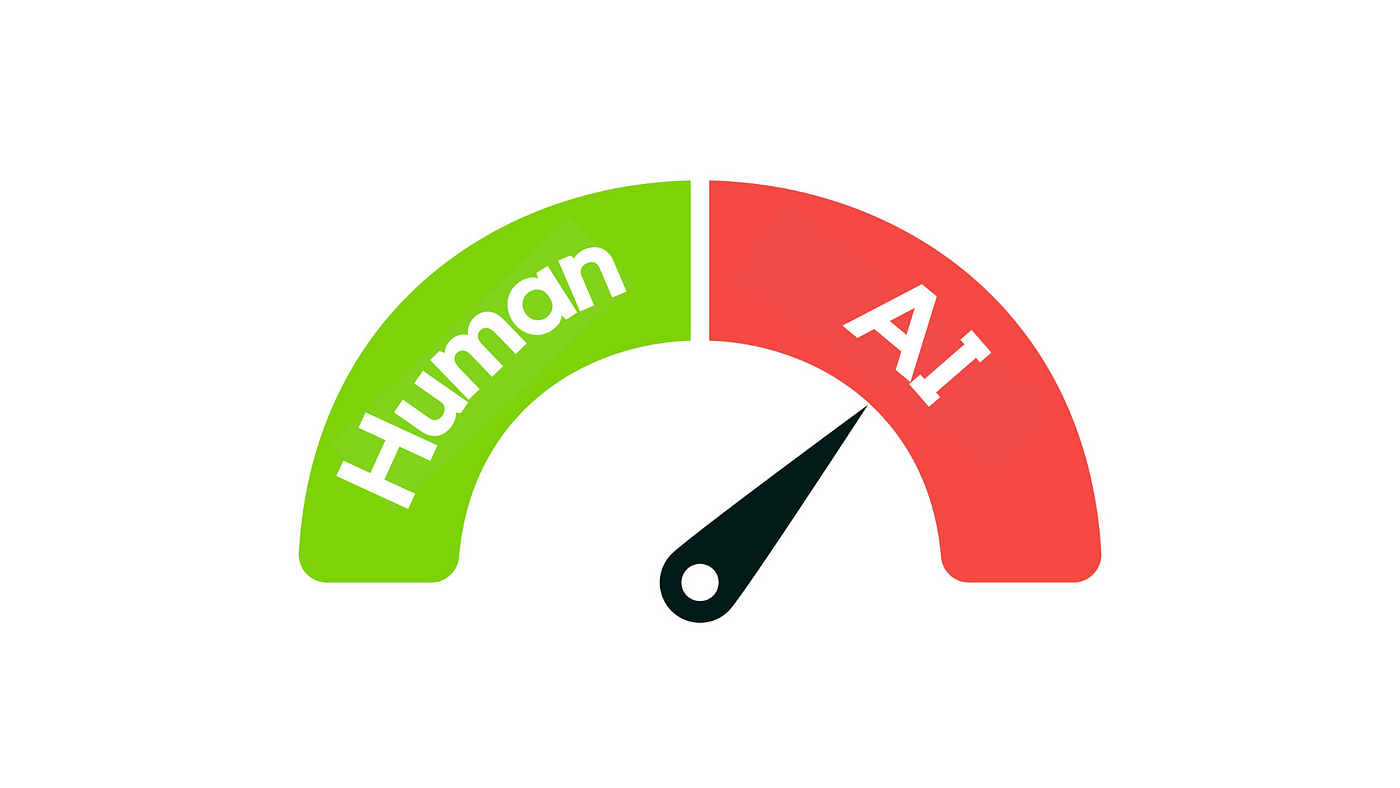
We've been hearing for a while now about how artificial intelligence (AI) is revolutionizing our daily lives. From virtual assistants to platforms that write texts in seconds, AI is no longer science fiction, but a reality that seeps into every corner, even into the content we consume. You've probably wondered at some point whether what you read was written by a person or a robot, right? It's logical, because the line is increasingly blurred and AI tools are improving by leaps and bounds.
In this context, a key question arises: How can we distinguish between content written by humans and that created by artificial intelligence? This is where AI detectors come in—tools designed to analyze, compare, and provide a reliable estimate of whether a text has been generated by a machine. If you work in marketing, education, communications, or are simply interested in knowing if what you read has that genuine human touch , this article is for you. Here you'll discover how these detectors work, their strengths, their limitations, and the most useful free solutions on the market.
Why is it important to know if a text has been written by AI?
Artificial intelligence is everywhere these days , and while it doesn't pose a problem in many cases, there are situations where verifying a text's authenticity is crucial. For example, if you need an academic paper to be original , if you want to validate content created for clients, or simply if you want to ensure your publications have a distinct human voice . This is where AI detectors have become indispensable, as they analyze texts and indicate whether they were generated by AI.
What exactly is an AI detector?
An AI detector is a specialized tool that scans text and determines, through advanced analysis, whether it was written by a person or by an automated generation system, such as ChatGPT, Gemini, Copilot, Claude, or Llama. To reach a conclusion, it compares writing patterns, repetitions, coherence, and other characteristics typical of AI . Its applications are very broad: they range from reviewing articles and academic papers to validating texts in marketing campaigns and filtering content on digital platforms.
How do artificial intelligence detectors work?
These tools rely on machine learning models trained to recognize the subtle differences between human and AI-generated style. Their algorithms examine aspects such as:
- Repetition of structures and phrases that often appear in AI-generated texts.
- Abundance of generic terms and absence of specific or specialized terms.
- Lack of grammatical errors, irony or emotional expressions typical of a truly human writing.
- Perfect transitions between paragraphs or excessive linearity in the speech.
This analysis isn't foolproof , but it offers a fairly reliable first impression. Some detectors display results in percentages (“probably AI”), while others classify the text as either human or automatically generated.
What models and platforms are currently detected?
Most reliable detectors can identify texts produced by popular models such as ChatGPT, Gemini, Copilot, Claude, LLaMa, Grok, Mistral, and GPT-4, among others. For example, tools like Scribbr recognize texts generated from GPT-2 to GPT-4 (although in the latter case, still experimentally). Others, such as isgen, boast an accuracy of 96,4% compared to 81% for other leading solutions, and guarantee a false positive rate close to 0%.
It's important to remember that AI is evolving rapidly: according to the latest studies, text generation models are constantly being updated , making them increasingly better at mimicking human writing style . Therefore, the detectors are also periodically retrained to keep pace and improve their results.
Accuracy levels: every detector has its limits
While detectors are very useful, it's important to remember that accuracy is never absolute . AI technologies are constantly improving, which means detection tools must be continuously updated. No tool offers 100% accurate results , so you should always interpret their diagnoses as guidelines , not absolute truths.
There are important differences between the tools. For example:
- Some They work better in Spanish than others, since many multilingual detectors exhibit inconsistencies and unreliable results in languages other than English.
- La length of the text influences: The greater the number of characters, the greater the reliability.
- Models like GPT-2, GPT-3, and GPT-3.5 are often easier to identify than GPT-4, whose recognition is still experimental on some platforms.
What requirements must a text meet to be analyzed?
For a detector to function correctly, a minimum text volume is required . Generally, the longer the text, the greater the reliability in pattern recognition and confidence rating. Here are some illustrative examples from different tools:
- Minimum extension for browser extensions: 350 characters. Maximum limit: 25.000 characters.
- AI detection web platforms: minimum 255 characters, maximum equivalent to 2000 pages, without a clearly defined character limit.
The larger the fragment you analyze, the better the results will be . Excessively short texts can yield inaccurate or unrepresentative results.
Most common use cases
Detectors have become an indispensable tool for:
- Students who want to verify the originality of academic works.
- Teachers and educators which seek to combat plagiarism and ensure the true authorship of the writings.
- Content creators and copywriters who want to provide differentiating value and avoid the label of 'automated content'.
- Companies and agencies who must review texts before publishing press releases or articles, ensuring that their communication has an authentic tone.

The best free tools and their features
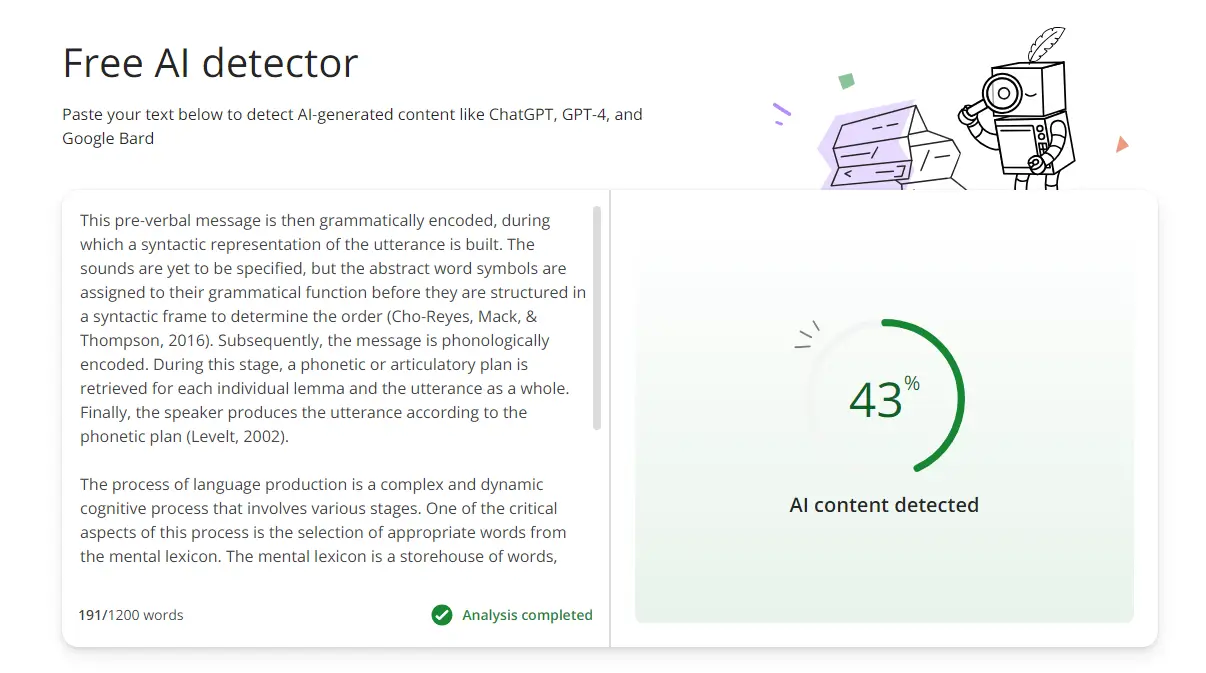
The market for free detectors is vast and varied: there are options integrated into platforms, browser extensions, bots for WhatsApp and Telegram, and multilingual and cross-platform solutions. Some stand out for the type of report they generate and the intelligence of their interface.
Let's review some of the most recommended references:
Scribbr Detector AI
Recognized for its high reliability with Spanish texts and its ability to detect the most common models. It detects GPT-2, GPT-3, and GPT-3.5 with high accuracy , and GPT-4 text experimentally. Although its accuracy is not absolute, it is considered one of the most robust options on the market.
ZeroGPT
One of ZeroGPT's key advantages is its integration with instant messaging applications, allowing you to analyze and detect AI directly from WhatsApp and Telegram . It also offers features such as summarization, paraphrasing, grammar correction, and translation, all within the chat. Simply register your WhatsApp number or Telegram code from its control panel to start using all its features.
isgen AI Detector
It is presented as one of the most accurate multilingual detectors and boasts a near-zero false positive rate . It is suitable for identifying texts generated by both open-source and closed-source models, such as GPT-4, ChatGPT, Claude AI, Gemini, Copilot, LLaMa, Grok, and Mistral. It stands out for the reliability of its reports and the clarity with which it differentiates between human-generated and AI-generated content, even presenting the results through graphs and visual summaries.
Decopy AI
This suite goes beyond a simple detector, including an AI text ' humanizer ' that rewrites automatically generated content to make it sound more natural . Its philosophy is based on transparency and authenticity , allowing users to detect traces of AI, reformulate texts, and analyze snippets without registration and free of charge , although with a low character limit. An added advantage: it doesn't discriminate between users, facilitating access and equal opportunities.
Can artificial intelligence detectors be fooled?
The short answer is yes, but it's not easy . As AI models learn to write in a more human-like way, so do the detection tools. The key to "fooling" these tools usually lies in modifying the AI-generated text: changing structures, adding spelling or stylistic errors, or alternating phrases and expressions typical of spontaneous conversation. In fact, there are programs called text humanizers that serve precisely this purpose.
However, it's becoming increasingly difficult to pass off automated text as human as the detection systems evolve. The use of original expressions, cultural references, irony, or basic human errors are still their Achilles' heel, but the gap is steadily closing.
How you can identify yourself if a text looks AI-generated
There are some tricks you can put into practice in your daily life:
- Identity and tone: If the text doesn't convey a unique voice or brand style, it may have been generated by AI.
- Overabundance of technical terms: Texts that use too many complex or technical terms can be revealed as automated.
- Lack of emotion and personal stamp: If the content seems too perfect or lacking in expressiveness, something doesn't add up... red alert!
- Excessive consistency: If all of a brand's texts sound the same, AI probably helped.
Many experts recommend comparing several texts by the same author and analyzing whether there are variations in tone and expression. If everything sounds flat and overly correct, you may be dealing with automatically generated content.
Limitations and future challenges for AI detection
The biggest challenge for detectors is that AI is advancing as rapidly as the detection technology itself . It's important to remember that no detector offers a complete guarantee . Generative models like ChatGPT, Gemini, and others receive frequent updates that make them harder to track, while detectors need time to adapt and retrain themselves with new patterns and styles.
Furthermore, the results vary considerably depending on the language , with English generally providing the most accuracy. In Spanish, although accuracy improves, there is still room for error.
On the other hand, the future seems geared not only toward identifying but also understanding the risk posed by the proliferation of automated content and its impact on originality, online trust, and communicative quality.