- Deep Work allows you to concentrate deeply and achieve better professional results.
- There are various strategies and routines to adapt it to any work or personal environment.
- Controlling distractions and conscious time management are essential to practicing it.

In today's digital age, maintaining uninterrupted focus has become a real challenge. Messages, social media, constant interruptions in the office, and multitasking make it difficult to work efficiently and, above all, to connect with the tasks that truly add value. This is where the concept of deep work shines as an effective solution for the modern professional.
Cal Newport, professor and bestselling author, revolutionized our understanding of productivity by introducing deep work , a strategy that encourages us to disconnect from distractions to achieve a level of concentration capable of boosting performance, creativity, and personal satisfaction. In this article, I'll explain in detail what deep work is, how you can integrate it into your daily routine, its benefits, and the techniques some of the world's most influential people and companies have used to achieve it.
What is Deep Work and why is it so relevant?
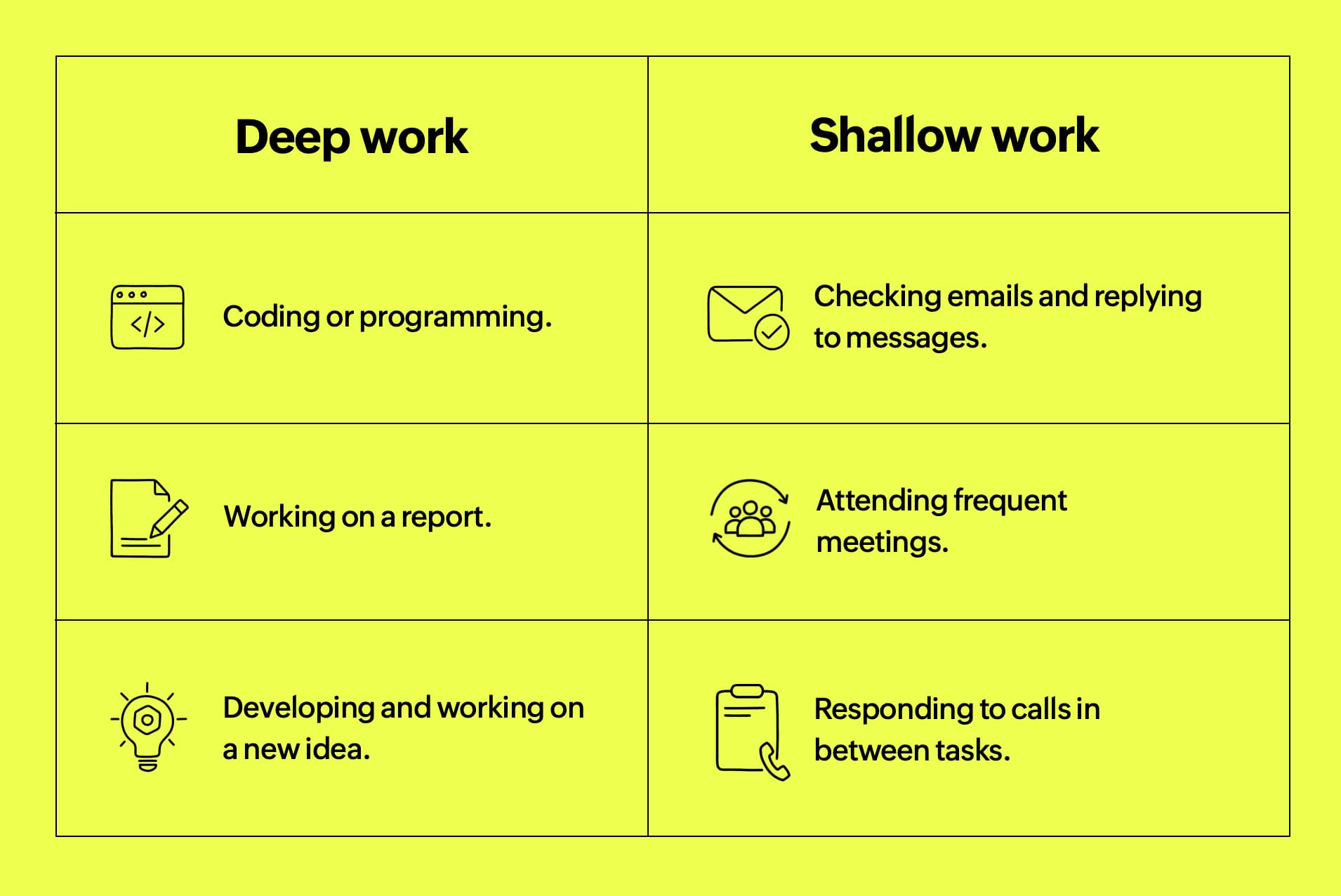
Deep work is the ability to focus uninterruptedly on cognitively demanding tasks, rejecting any distractions and immersing yourself in a state of intense concentration. Unlike surface work , which consists of simple, repetitive, or administrative tasks, deep work allows you to develop complex skills, complete high-quality projects, and maximize efficiency in less time.
For Newport, deep work is much more than a productivity technique: it's practically a professional lifestyle , essential in a world where the attention economy has made concentration a scarce and valuable resource. The results of those who practice deep work speak for themselves and are responsible for names like Elon Musk and Bill Gates being synonymous with innovation, impact, and success.
Definition and key fundamentals
Deep work involves working in predefined, distraction-free sessions , rejecting multitasking and any interruptions. This allows professionals to connect deeply with their work, achieving what psychologist Mihály Csíkszentmihályi called the flow state : that feeling of being absorbed, motivated, and performing at their peak. The key lies in both the intensity and quality of attention during these work periods.
Contrary to popular belief, it's not just a matter of natural talent. The ability to concentrate intensely can be trained. Therefore, it's not only about maintaining focus , but also about actively avoiding distractions that cause the mind to wander.
Clear advantages of deep work
Radically improved concentration and focus
Those who practice deep work experience a noticeable increase in their ability to tackle complex tasks. The more this skill is trained, the easier it becomes to enter a state of optimal concentration . This translates into greater quality and depth in the final result.
More creativity and innovation
Deep work isn't just about efficiency; it also enhances the ability to connect ideas and find creative solutions . For example, geniuses like Einstein are known to alternate periods of intense concentration with moments of leisure or rest to allow ideas to flow.
Productivity multiplied
You can set aside specific, distraction-free time for key tasks and improve work efficiency. This allows you to complete tasks in less time and with better results, in contrast to the distractions caused by multitasking.
Greater satisfaction and motivation
When you become deeply involved in a task, you experience what's known as flow or optimal experience. This state not only produces personal satisfaction but is also associated with happiness and a deeper intrinsic motivation. You feel like you're making progress and that your work has meaning.
Better quality and stress reduction
Focusing on the task at hand helps ensure it's done correctly the first time . Mindfulness not only improves performance but also fosters greater awareness of the effort involved, which helps reduce stress and the feeling of rushing through life.
Distractions: the great enemy of deep work
The main obstacle to deep work is digital distraction : notifications, social media, constant email, unnecessary meetings, etc. We live surrounded by stimuli that seek to capture our attention every minute, which weakens our ability to concentrate for long periods.
Newport himself warns that interrupting a task to check your phone or switch activities teaches our brain to constantly seek novelty . This erodes the "muscles" of concentration and makes it increasingly difficult to immerse ourselves in projects that require real thinking.
Philosophies and strategies for practicing Deep Work
There is no single way to integrate deep work into your routine. Depending on your environment, personality, or needs, you can choose from different philosophies:
- Monastic: It involves eliminating or minimizing superficial tasks for long, uninterrupted periods. Ideal for creative projects or when complete isolation is needed.
- Bimodal: It combines extended blocks of deep work with periods during which more routine tasks are resumed. It's perfect for those who can't always be isolated, such as those with management or family responsibilities.
- Rhythmic: Establish deep work as a daily habit by setting regular schedules or routines to avoid having to decide when to focus. For example, work for two hours each morning before opening your email.
- Journalistic: He takes advantage of every available opportunity to immerse himself in deep work, just as journalists do on tight deadlines. It requires a great deal of discipline and experience to instantly activate focus.
Practical techniques to achieve Deep Work
Eliminate distractions and organize your environment
To achieve true concentration, identify and eliminate common sources of interruptions : put your phone in airplane mode, turn off notifications, and close unnecessary tabs. Additionally, choose a clean and organized workspace that facilitates focus.
Plan your day in blocks of time
Set aside specific time slots for deep work , preferably during your peak energy hours. Some experts suggest applying the four-hour rule : dedicating a maximum of four hours a day to tasks requiring intense concentration, to avoid burnout and maintain productivity.
Set clear and measurable goals
Before starting each session, define the specific objective you want to achieve . Having a specific goal helps you stay focused and evaluate your progress, which increases motivation.
Include breaks and disconnection in your routine
The brain needs changes of pace to maintain concentration. Alternating deep work sessions with short breaks or leisure activities promotes mental recovery and prepares you for the next block. Techniques like the Pomodoro Technique (25 minutes of work and 5 minutes of rest) are effective for training attention.
Accept boredom and just do nothing.
Learning to tolerate boredom and disconnect from work may seem counterintuitive, but it helps recharge your ability to concentrate. Allow yourself moments of complete disconnection and avoid constantly checking social media or notifications.
Social media is designed to capture your attention for as long as possible. Schedule its use for specific times and avoid letting it fragment your attention during important tasks. Grouping routine tasks into blocks also helps minimize distractions.
Take an assessment and keep improving
At the end of each work period, review which deep work sessions were most effective and adjust your strategy accordingly. Continuous improvement will allow you to optimize your approach and solidify the habit of deep work.
Examples of Deep Work in large figures and companies
It's no coincidence that figures like Elon Musk and Bill Gates have made deep work a constant in their routines. Bill Gates, for example, dedicates a week each year to reading and reflecting in isolation, while Musk sets aside blocks of time to analyze information, make decisions, and plan.
In the business world, more and more companies are encouraging deep work: limiting meetings, promoting flexible schedules, designing quiet spaces, and using tools that block distracting websites or quantify work-rest cycles. Extensions like Stayfocusd or apps like Forest help reinforce the habit of concentrating on important tasks.
How to implement Deep Work in teams and companies
Deep work isn't just an individual matter; fostering this practice in teams can improve collective performance. Some effective strategies include:
- Delimit blocks of deep work and communicate it clearly to reduce interruptions.
- Reduce unnecessary meetings and emails, promoting more efficient and asynchronous communication.
- Design spaces or concentration zones for those who require a quiet environment, even when working remotely.
- Recognize and reward achievements related to concentration and quality work.
Common difficulties and how to overcome them
Getting into deep work mode requires practice and patience. It's advisable to create rituals and cues that clearly indicate when it's time to focus, as JK Rowling did when she stayed in a hotel to write. Perseverance in maintaining these routines is key.
It's also important not to underestimate the need for breaks and disconnections. Mental recovery is essential for maintaining a high level of concentration and preventing burnout.
Ultimately, the best way to learn how to practice deep work is to experiment with different techniques, adapting them to your style and always seeking a balance between productivity and well-being.
Deep work has established itself as a fundamental skill for those who want to excel in a world saturated with stimuli and distractions. The consistent application of these strategies and periodic evaluation of the results allow us to regain control of our time and achieve levels of productivity, creativity, and satisfaction that seem unattainable with traditional methods.