- VibeVoice is a Microsoft TTS model capable of generating long, expressive, multi-speaker audio, ideal for podcasts and audiobooks.
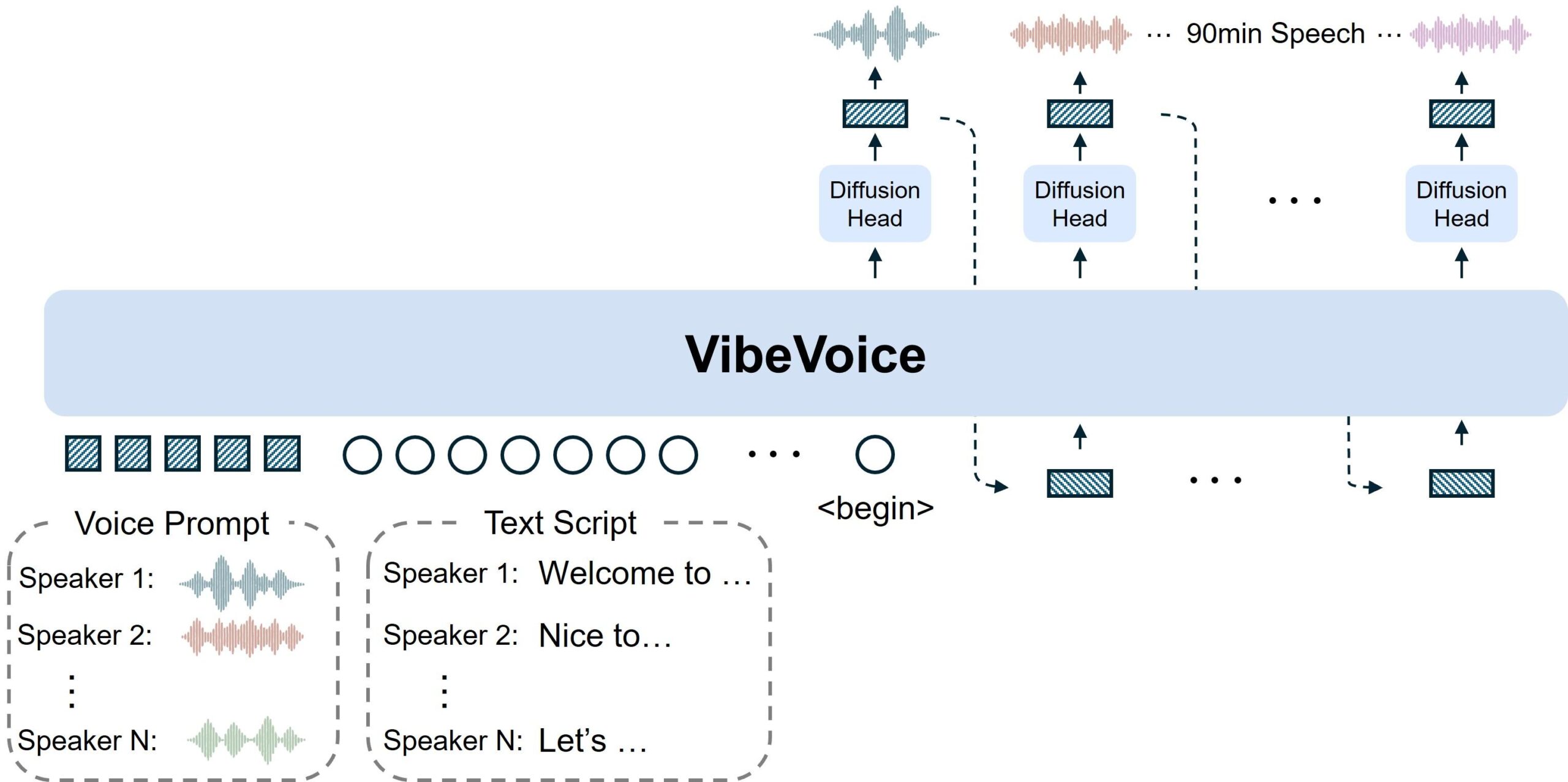
- Its architecture combines speech tokenizers, a large language model, and diffusion to achieve natural voices even in audio recordings up to 90 minutes long.
- It allows for near real-time responses with slight variations, but requires responsible use due to the risks of voice cloning and deepfakes.
- It has been released as an open source research framework, although Microsoft has temporarily limited the repository due to concerns about misuse.

The arrival of Microsoft's VibeVoice is revolutionizing the way podcasts and long-form audio content are created using artificial intelligence. This open-source TTS (text-to-speech) model not only generates hyper-realistic voices, but also allows for the production of conversations with multiple speakers and durations that can reach up to 90 minutes without awkward cuts or drops in quality.
VibeVoice's goal is to provide anyone with a virtual recording booth capable of professionally producing podcasts, audiobooks, or narrations from a computer. All you need is a script and some basic technical knowledge to set up the model, and AI takes care of the rest: intonation, naturalness, voice changes, and continuity throughout the audio.
What is VibeVoice and why is it so important for podcasts?
The model is based on TTS (Text-to-Speech) technology, meaning it directly transforms text into speech , but with a level of fluency and nuance that closely resembles human speech. VibeVoice was initially released in versions with 1.5B and 7B parameters , designed to balance quality and the ability to generate long audio streams without excessive resource consumption.
One of its greatest strengths is its ability to continuously record up to 90 minutes of audio , maintaining voice consistency and intonation throughout. This makes it especially useful for full podcasts, audiobook chapters, or long educational content episodes where multiple recording sessions with human voice actors were previously required.
Furthermore, VibeVoice is designed to handle up to four different voices in a single audio recording , enabling simulated interviews, panel discussions, dialogues between characters, or episodes narrated by different voice actors. This multi-speaker capability is key to making AI-powered podcasts more dynamic and engaging.
How VibeVoice works: advanced speech synthesis and low latency
Beyond the eye-catching headline, what makes VibeVoice special is its technical architecture designed for long audio recordings and conversations . Microsoft combines several components to make the voice sound natural, adapt to the text, and be generated in or near real-time.
The system uses continuous acoustic and semantic speech tokenizers that operate at a very low frequency, around 7,5 Hz. This means it condenses audio information into fewer "steps" per second than other models, preserving sound fidelity while significantly reducing computational cost when working with long sequences.
On top of this compressed representation, a large language model (LLM) comes into play, which is responsible for interpreting the script's content, the flow of the conversation, and who is speaking at any given moment. In this way, it understands whether it is a question, an answer, an ironic comment, or a change of topic, and adapts the voice output accordingly.
Finally, a diffusion head is used to reconstruct high-quality acoustic details: timbre, vocal texture, subtle breaths, and other nuances. This LLM + diffusion combination ensures that the resulting audio is consistent, expressive, and pleasant to listen to for extended periods.
In parallel, Microsoft has launched a specific variant called VibeVoice-Realtime-0.5B , designed for extremely fast responses: this model can begin emitting voice around 300 milliseconds after receiving the text. That is, practically in real time, ideal for voice agents, conversational assistants, or applications where latency must be minimal.
Available versions: models, parameters and recommended uses
Within the VibeVoice ecosystem, several versions have been introduced with different model sizes and orientations , designed for both long audio and interactive applications.
On one hand, we have the main variants with 1.5B and 7B parameters , designed to handle extensive content such as full podcasts, simulated radio programs, audiobook chapters, or audio courses. A higher number of parameters allows for greater capacity to capture nuances and manage complex dialogues, although it also increases the hardware demands.
On the other hand, the VibeVoice-Realtime-0.5B version prioritizes response speed over model size. Although it has "only" 0,5B of parameters , a modest amount compared to giants like ChatGPT or Gemini, this is precisely what allows it to generate up to 90 minutes of continuous audio while maintaining a clear voice and stable intonation.
This real-time variant is especially attractive for voice agents, chatbots, virtual assistants , and any application where the user expects AI to respond immediately with voice rather than just text. With latencies close to 300 ms, the experience is very similar to talking to someone on the other end.
In all cases, the model is intended for use from local or research environments , since Microsoft initially decided to release it as an open source project, accessible from GitHub and platforms like Hugging Face, making it easy for the community to test it, adapt it, and build tools on top of it.
Practical applications: how to create a podcast with VibeVoice
One of VibeVoice's flagship applications is undoubtedly the creation of podcasts without the need for human voice actors . For anyone with ideas, scripts, or written content, but who doesn't dare to get in front of a microphone, this model opens up a huge opportunity.
The general workflow for producing a podcast with VibeVoice typically involves preparing a well-structured script : introduction, content blocks, potential interviews (real or fictional), transitions, and closing. The clearer the text, the better the model can capture changes in tone, pauses, and the roles of each "person" in the conversation.
Then, using tools built on the model (scripts, graphical interfaces, or integrations with other apps), each part of the text is assigned to one of the available speakers . We can, for example, use one voice for the presenter, another for a recurring guest, another for questions read from the audience, and a fourth for informational notes or sponsored segments.
The model generates continuous audio while respecting the script's order, voice transitions, and the rhythm of the conversation. From there, the result can be refined in a traditional audio editor, adding background music, sound effects, transitions, or making minor adjustments to volume and equalization.
Thanks to the ability to generate up to 90 minutes of content without losing coherence , we can create a complete episode in one go: there's no need to record in small blocks or worry about voice fatigue, diction errors, or background noise, something that in a physical booth is a constant headache.
AI voice cloning and voice personalization
One of the most delicate yet powerful advances in this technology is "voice cloning" or AI-powered voice cloning . It involves synthesis techniques based on deep learning that allow for the replication of the timbre, speech patterns, and nuances of a specific voice.
In practice, these systems analyze unique characteristics of the target voice, such as timbre, formants, speech rhythm, and prosodic patterns (pauses, accents, question intonation, etc.). With just a few seconds of sample, they are able to generate a synthetic voice that closely resembles the original.
In the case of VibeVoice, it's mentioned that it's possible to achieve very accurate simulations with just 10 seconds of original audio , capturing the emotional impact and texture of the voice quite well. For a podcast, this opens up possibilities such as maintaining the "brand voice" even after the real person has stopped recording, or creating recurring characters with a consistent vocal identity.
However, this capability comes with very serious ethical risks and the need for detection of synthetic audio :
For this reason, Microsoft emphasizes that VibeVoice is being released within a research framework and with clear warnings: it should not be used for identity theft, fraud, manipulation, or disinformation campaigns. Responsible use is a key component of this entire ecosystem.
Advantages for content creators and small projects
With a computer capable of running the model and some time to write scripts, it's possible to convert long texts into professional audio in a matter of minutes. This applies to informative podcasts, news bulletins, fictional stories, serialized novels, or even narrated technical manuals.
It is also a great help in recycling existing written content : blog articles, newsletters, social media threads or reports can be transformed into audio episodes that broaden the reach of the message and offer a more convenient way for those who prefer to listen rather than read.
Another advantage is the consistency of quality over time . While a human voice actor can vary their energy, intonation, or clarity depending on the day, AI maintains a constant level, which facilitates serial production: several episodes recorded in one take will maintain the same voice presence and style.
In the educational field, VibeVoice is a perfect fit for audio courses, guided readings, and accessible materials for people with visual impairments or those who simply prefer to learn by listening while doing other tasks. The ability to generate spoken versions of lessons or lengthy documents offers a wealth of possibilities.
Risks, limitations, and Microsoft's decision regarding the repository
The other side of the coin is that AI capable of mimicking human voices and generating realistic speech raises serious ethical and security concerns. The risk of malicious use is real, and major tech companies are increasingly aware of it.
In the launch text itself, Microsoft explicitly states that VibeVoice should not be used for deepfakes, identity theft, or illegal activities . It also directly prohibits its use in disinformation or fraud contexts, precisely because its level of realism could easily deceive unsuspecting listeners.
Although the voice it generates is very convincing, the model's creators point out that it still doesn't capture all the subtleties of a real human voice : breaths, emotional micro-variations, certain natural pauses, and changes in rhythm are still richer in a person than in AI. This "imperfection" can help, in part, to detect that we are dealing with a synthetic voice, but the line is becoming increasingly blurred.
Following the release of the project as an open-source research framework , Microsoft detected instances where the model was being used in ways that did not align with its original intent and principles of responsible use. In response, the company announced that it had been forced to temporarily disable the repository until it could ensure that these out-of-scope uses could no longer occur.
The statement emphasizes that responsible AI use is a core principle for Microsoft , and that they prefer to pause and review rather than maintain a tool that could facilitate serious abuse. Even so, the documentation, demos, and technical materials have already served to inspire the community and continue advancing the field of speech synthesis.
Other applications beyond podcasting
Although media attention has focused primarily on podcasts, VibeVoice opens up a fairly wide range of use cases within the world of AI-generated audio. Many of these also fit into digital content and automation strategies.
One of the most obvious examples is audiobooks and narrated stories , where having expressive voices capable of holding attention for tens of minutes is crucial. Multi-speaker capability allows each character to have their own voice, greatly improving the listening experience compared to a single narrator.
In the field of voice agents and conversational assistants, VibeVoice's real-time version is ideal. A bot that responds with a delay of just 300 ms feels much more natural than one that takes several seconds to speak, making interactions with customer service, chatbots, or voice interfaces much smoother.
Another very interesting area is that of automated content : news summaries, market updates, periodic reports or even email readings and notifications can be generated without human intervention, maintaining a voice consistent with the brand image.
Finally, there are more experimental applications, such as the creation of fictional dialogues, simulated interviews, or entertainment programs created entirely by AI . Here, language models for scriptwriting are combined with VibeVoice for voice acting, resulting in formats that recently seemed like science fiction.
Looking at the whole picture, VibeVoice stands out as a key player in the new wave of AI-generated audio , capable of combining natural voices, multi-participant conversations, very long audio clips, and near-instantaneous responses. Used responsibly and within established ethical boundaries, it can become an incredibly powerful tool for anyone looking to launch or scale a podcast, produce audiobooks, or add professional voiceovers to their digital projects without always relying on a traditional recording studio.

Table of Contents
- 1 What is VibeVoice and why is it so important for podcasts?
- 2 How VibeVoice works: advanced speech synthesis and low latency
- 3 Available versions: models, parameters and recommended uses
- 4 Practical applications: how to create a podcast with VibeVoice
- 5 AI voice cloning and voice personalization
- 6 Advantages for content creators and small projects
- 7 Risks, limitations, and Microsoft's decision regarding the repository
- 8 Other applications beyond podcasting