- JUPITER is the first exascale spacecraft in Europe and the fourth in the world, operating in Jülich.
- Architecture with 24.000 GH200, InfiniBand Quantum-2 and Green500-leading JEDI module.
- Applications in climate, AI, biomedicine, quantum mechanics, and open access via EuroHPC.
In the midst of the digital revolution and with artificial intelligence advancing by leaps and bounds, supercomputing has become the yardstick by which the technological capacity of a country or continent is measured. On this playing field, Europe has just made a landmark move: JUPITER, its first fully operational exascale system , is now up and running in Germany.
We're not talking about just another machine. We're talking about a game-changer. While the United States has led the way in recent years with facilities like Frontier, Aurora, and El Capitan, and with China playing its hand with less transparency, Europe is finally launching its first exascale computer. JUPITER has been installed at the Jülich Supercomputing Centre , and it's not here to go unnoticed: it's here to train massive AI models, simulate the atmosphere in great detail, and advance key research in biomedicine, physics, and energy.

What is JUPITER and why does it change the game?
JUPITER stands for Joint Undertaking Pioneer for Innovative and Transformative Exascale Research. It is currently the most powerful supercomputer in Europe and the fourth most powerful in the world, according to the Top500 ranking of June 2025. Entering the exascale league means surpassing the quintillion-operations-per-second threshold, a figure that clearly demonstrates what this system can accomplish in the blink of an eye.
The project represents a significant investment of €500 million, co-financed by the European Union and Germany , and falls within the EuroHPC program, which aims to strengthen the continent's high-performance computing capabilities. The ambition is clear: to advance science and industry without relying on third parties.
Where it is and who built it
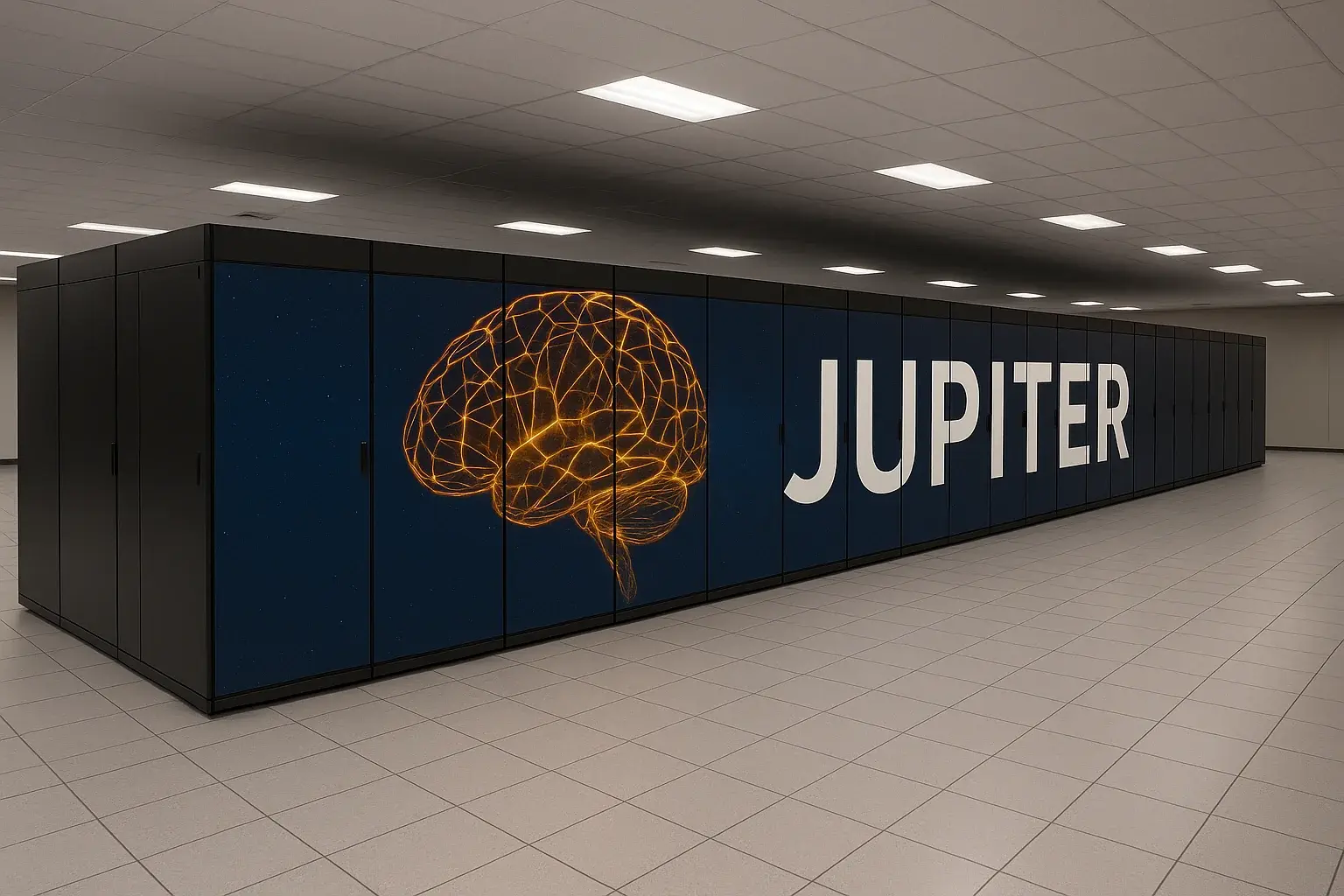
The machine resides on the research campus in Jülich , North Rhine-Westphalia. The location is no coincidence: Jülich has been a hub for supercomputing for decades and collaborates with top-tier scientific networks in Europe.
Several companies collaborated on the construction and delivery of the system. Eviden (the Atos Group's product brand) led the BullSequana XH3000 direct liquid cooling architecture; ParTec contributed its approach to dynamic modular supercomputing; and key technology partners such as NVIDIA and SiPearl also participated. The result is a facility designed to grow over time through a modular design that facilitates expansions without having to build everything from scratch.
The system is organized into two main partitions to cover very different scenarios. On one hand, there's a GPU-accelerated Booster Module for scaling massively parallel applications (ideal for AI and large simulations). On the other, there's a general-purpose Cluster Module with SiPearl Rhea1 processors , the European chip designed for HPC that provides bandwidth and memory for versatile workloads.
Architecture, size and figures that impress
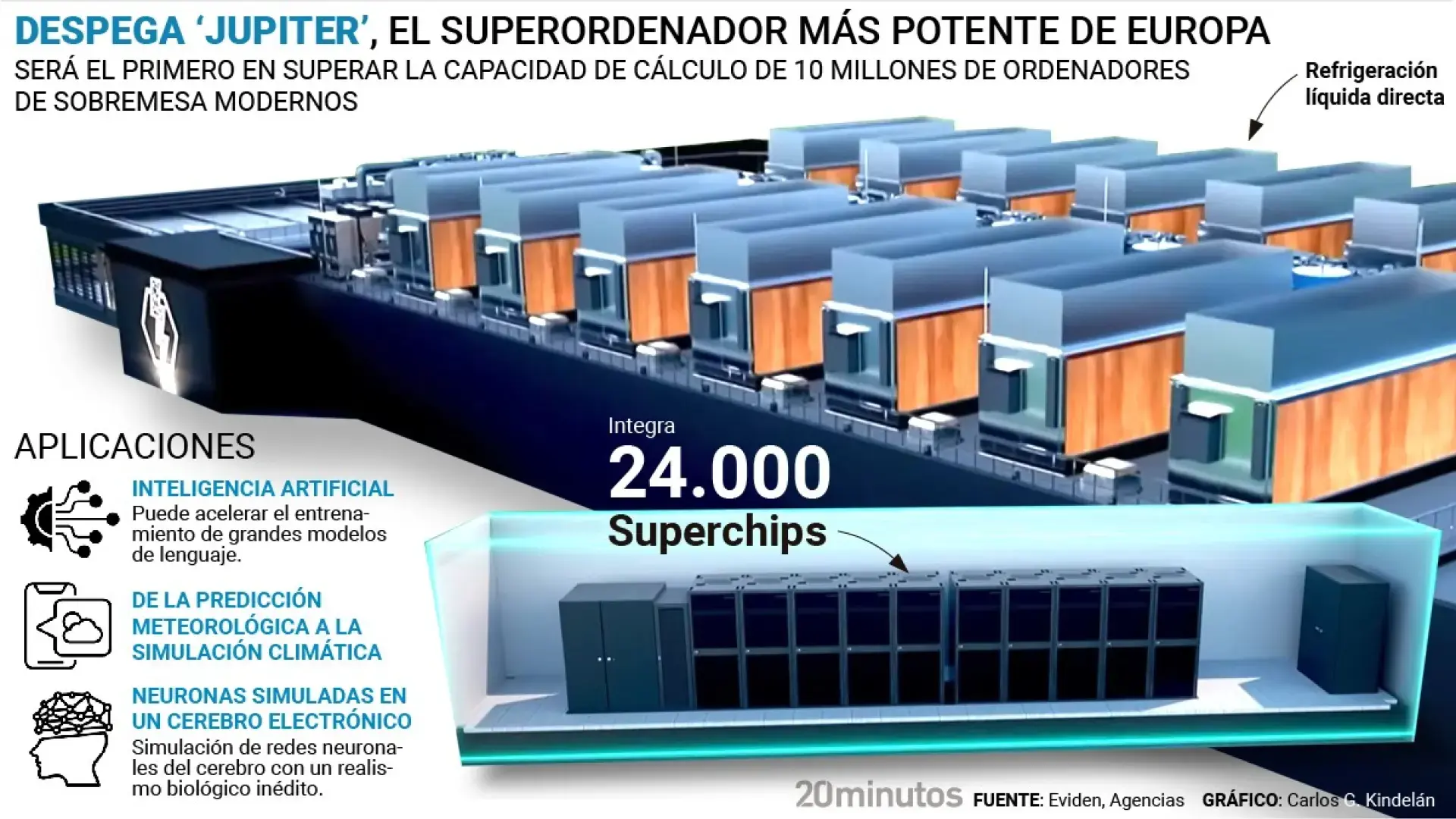
At the heart of JUPITER is the NVIDIA Grace Hopper platform, which translates to 24.000 interconnected NVIDIA GH200 superchips . This generation combines CPU and GPU on a single superchip to process massive amounts of data in parallel with efficiency that is noticeable in AI training and ultra-high-resolution simulations.
The interconnection is handled by the NVIDIA Quantum-2 InfiniBand network , with approximately 51.000 connections in the system, a high-speed web designed to allow nodes to communicate with minimal latency and maintain performance when scaling to tens of thousands of processors.
In terms of storage, JUPITER boasts a capacity approaching one exabyte , an essential resource when working with digital twins, kilometer-resolution climate models, or large corpora for multilingual AI. This subsystem is matched by an internal throughput capable of moving around 2.000 terabytes per second, an astronomical figure that, as a point of reference, is equivalent to thousands of copies of Wikipedia traveling across the internet in a single second.
The installation is modular and has been deployed in 50 specialized containers . In physical space, the size is impressive: a surface area comparable to four tennis courts , crisscrossed by more than 260 kilometers of high-capacity cabling so that everything fits together like clockwork.
Peak electricity consumption is around 17 megawatts , equivalent to the use of approximately 11.000 homes. This peak is mitigated by Eviden's direct liquid cooling design, which reduces losses and also allows for the use of residual heat to heat and cool buildings on the campus itself.
In terms of actual performance, the European Union emphasizes that the system aims for up to 90 exaflops in artificial intelligence workloads . This figure places the machine in a particularly competitive position for training and refining foundational models and massive simulations.
To provide an everyday reference, JUPITER's aggregate power has been compared to the equivalent of about 10 million desktop computers , an image that helps to give an idea of the leap in scale compared to conventional equipment.
Official opening and recognition in rankings
The inauguration ceremony was held in Jülich on September 5th, attended by German government officials, European leaders, and prominent figures from the technology industry. Within this institutional framework, the pioneering nature of the project for Europe was emphasized , both in terms of its power and its implications for strategic autonomy.
On the Top500 list, JUPITER already appears as the fourth most powerful supercomputer on the planet , behind only El Capitan, Frontier, and Aurora in the United States. Added to this is a clear focus on environmental impact: the system runs entirely on renewable energy through green supply contracts with the German grid, and its JEDI module achieved first place in the June 2025 Green500 ranking, which measures energy efficiency in supercomputing.
Energy efficiency that sets the pace
The BullSequana XH3000 architecture not only boosts performance, but also reduces power consumption. Thanks to direct liquid cooling , losses are minimized, keeping a machine with thousands of nodes stable—a machine that would otherwise require even more energy to dissipate heat. This approach, combined with a renewable power supply, places JUPITER at the forefront of efficiency, an increasingly important factor in data centers of this size.
The JEDI module 's role as a Green500 leader is the most visible proof of this commitment. Beyond the award itself, it demonstrates that very high-level computing can be scaled up without skyrocketing energy costs, and that supercomputing can be an ally in achieving climate goals.
What will be done with Jupiter: science, industry, and public services?
What makes JUPITER stand out is its variety of use cases. The machine opens doors to new simulations, the validation of quantum computing proposals, the creation of digital twins, and, of course, the training of large-scale, multilingual artificial intelligence models with a European focus.
- ClimateECMWF works with kilometer-scale simulations that capture extreme storms and feed the Destination Earth project, which provides digital twins of the planet.
- European AI: The TrustLLM consortium trains language models in multiple European languages for industrial and scientific applications.
- Neuroscience: The Arbor simulator will model the behavior of neurons at the subcellular level, useful for therapies against Alzheimer's and other pathologies.
- Quantum: aims to break the record of 50 qubits in simulation, a step towards practical quantum computing.
- AstrophysicsThe Max Planck Institute is researching cosmic reionization, the stage in which the first stars and galaxies were born.
- Particle Physics: The University of Wuppertal raises the resolution of muon calculations, potentially opening new doors in fundamental physics.
- Video Templates: The University of Munich is exploring compression and diffusion architectures, with applications ranging from medicine to autonomous driving.
- Multimodal models: The University of Lisbon scales open and multilingual models by integrating different fields of science and machine learning.
Beyond that initial wave, in artificial intelligence, the power of the Booster Module will accelerate the development of large, multilingual models like OpenGPT-X, a European initiative seeking to compete with leading proposals in the United States. Meanwhile, the climate field will see improvements in the prediction of extreme weather events and in the analysis of climate change scenarios with the ICON atmospheric model running at unprecedented resolutions.
In biomedicine , the ability to simulate the brain's neural networks at the level of individual neurons and create digital twins of organs like the heart opens new avenues for studying neurodegenerative diseases and designing treatments that are safe for patients. There will also be room to accelerate discoveries in materials science and advance sustainable energy.
Access, calendar and lifespan
JUPITER is part of the EuroHPC network, so any European university, public research center, or company can request machine hours. There will be calls for proposals twice a year to allocate resources competitively, prioritizing projects with scientific and industrial impact.
There is already real activity. Dozens of projects have been launched ; some sources mention around thirty active projects, while others raise the figure to more than a hundred initiatives selected to be rolled out in stages. In any case, the flow is constant, allowing the infrastructure to be used from day one.
The expected lifespan is at least six years , providing stability to research teams that require continuity and to companies that need to plan developments with realistic deadlines in fields as competitive as AI and scientific simulation.
Europe as a supercomputing hub
With JUPITER now operational, the EuroHPC Joint Undertaking is strengthening its ecosystem, which already includes machines such as MareNostrum in Spain, LEONARDO in Italy, LUMI in Finland , Discoverer in Bulgaria, MeluXina in Luxembourg, Vega in Slovenia, Karolina in the Czech Republic, and Deucalion in Portugal. This array positions the continent as a global power in supercomputing and, above all, provides sovereign capacity for strategic projects.
This approach aligns with a priority shared by governments, industry, and the research community: sovereign control of data and infrastructure . In practical terms, this means that Europe can train models, run critical simulations, and manage sensitive information without depending on the policies of third countries.
What the project's protagonists say
Eviden highlights the milestone of delivering the first exascale system in Europe using its BullSequana XH3000 platform; for the company, it is a step that consolidates its role in the economic and industrial sovereignty of the continent and puts an extraordinary machine made in Europe into the hands of the scientific community.
ParTec highlights its dynamic modular architecture, developed in collaboration with Jülich and European partners, as the foundation for the efficiency and speed demanded by sophisticated AI algorithms . The company believes that winning the contract strengthens the competitiveness of German and European suppliers in the construction of supercomputers.
NVIDIA, for its part, emphasizes that its accelerated computing powers the first European exascale supercomputer, enabling research to advance in climate and meteorology, materials science, pharmaceutical discoveries, engineering, and quantum computing technologies. SiPearl celebrates its Rhea1 processor powering the Cluster Module, interpreting it as validation of the European Processor Initiative, with a direct impact on technological sovereignty and reducing the carbon footprint of supercomputing and AI.
JUPITER is not just a display of technical prowess: it's a strategic move that positions Europe in the exascale league with an efficient, scalable infrastructure open to its scientific and business community. Between the power of the AI Booster Module, the versatility of the Cluster Module with Rhea1, the efficiency leadership of the JEDI module, and a constantly growing EuroHPC ecosystem, the continent secures a top-tier tool to tackle climate, health, industrial, and scientific challenges with its own ambition.