- The Pythagorean theorem establishes the relationship between the sides of a right triangle.
- Its applications range from construction to navigation and interior design.
- It allows you to calculate distances, heights and lengths using the relationship between legs and hypotenuse.
- It is crucial in various disciplines such as engineering, gardening and sports.
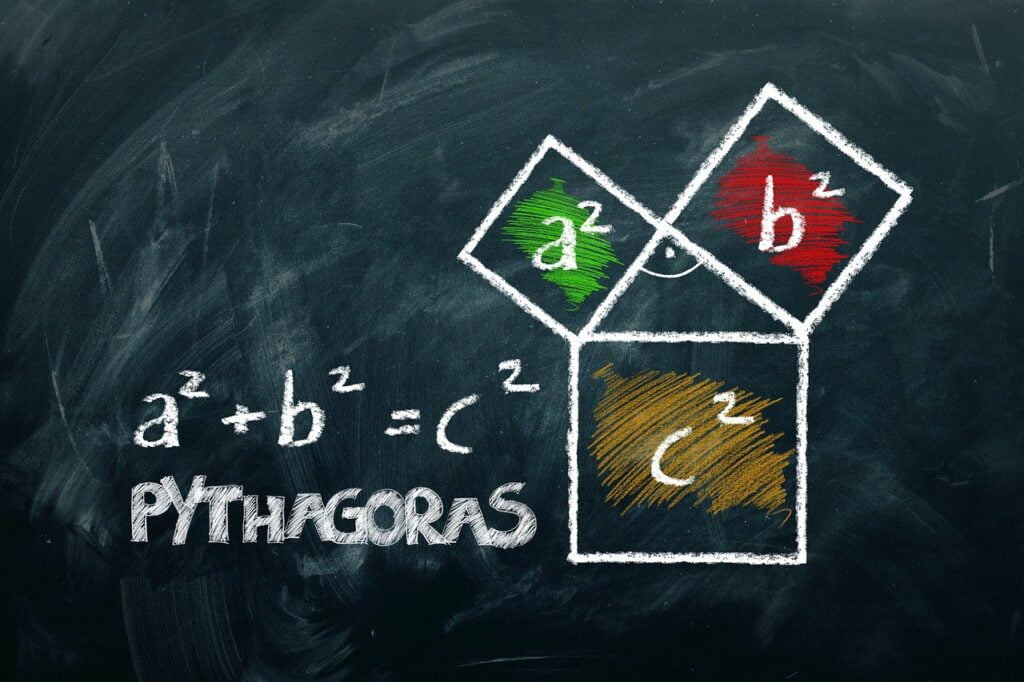
Introduction – Pythagorean Theorem Formula and Example
Explanation
- Determine distances: In real life, like the length of a ladder needed to reach a certain height.
- Navigation and geography problems: To find the shortest distance between two points.
- Applications in physics: Calculate displacements and trajectories.
Example
The Pythagorean Theorem in Everyday Life
1. The Pythagorean theorem in construction
1.1. Calculating the length of the stairs
1.2. Design of sloping roofs
1.3. Determining the height of buildings


2.1. Calculating distances at sea
2.2. Determining the height of the headlights

3. The Pythagorean theorem in interior design
3.1. Calculating the diagonal of a room
3.2. Furniture design
3.3. Placing pictures and decorations

4. Applications of the Pythagorean theorem in gardening
4.1. Plot and garden design
4.2. Calculation of hose length
4.3. Determining tree height

5. The Pythagorean theorem in sport
5.1. Calculating distances in golf
5.2. Determining the trajectory of the ball in baseball
5.3. Athletics track design
Frequently asked questions about the Pythagorean Theorem in everyday life
- What is the Pythagorean theorem? The Pythagorean theorem is a mathematical principle that states that in a right triangle, the square of the length of the hypotenuse (the side opposite the right angle) is equal to the sum of the squares of the lengths of the other two sides (legs).
- How is the Pythagorean theorem formulated? The formula for the Pythagorean theorem is expressed as: a^2 + b^2 = c^2, where "a" and "b" are the lengths of the legs, and "c" is the length of the hypotenuse.
- What types of triangles can be solved with the Pythagorean theorem? The Pythagorean theorem applies specifically to right triangles, that is, triangles that have one right angle (90 degrees).
- Is it possible to use the Pythagorean theorem on shapes other than right triangles? No, the Pythagorean theorem only applies to right triangles. However, it is possible to decompose other geometric shapes into right triangles to apply the theorem.
- How can the Pythagorean theorem be applied in everyday life? The Pythagorean theorem has many applications in everyday life, such as construction (for calculating the length of stairs or the design of pitched roofs), navigation (for calculating distances), interior design (for calculating room diagonals), gardening (for designing plots and gardens), and sport (for calculating distances in golf or the trajectory of the ball in baseball).
- What other fields, besides those mentioned in the article, use the Pythagorean theorem? In addition to the fields mentioned in the article, the Pythagorean theorem is used in many other areas, such as astronomy (to calculate distances between celestial bodies), engineering (to design structures and machinery), physics (to analyze vectors and forces), cartography (to create accurate maps), and computer science (for the design of graphics and video games).