
If you've ventured into the world of data analysis, you've surely encountered the headache of multicollinearity. Essentially, it occurs when your independent variables are too closely related, which can cause your regression model to malfunction and produce unreliable results. To bring order to this chaos, the Variance Inflation Factor (VIF) comes into play —a key tool for identifying which variables are causing the problem.
While powerful libraries exist in languages like R or Python, implementing this concept in C# requires a solid understanding of the underlying mathematics and how to structure the code for maintainability. It's not just about throwing a function at a time, but about organizing the programming logic so that the software is readable and efficient, preventing the code from resembling a cryptic jumble of letters.

Understanding VIF and Multicollinearity
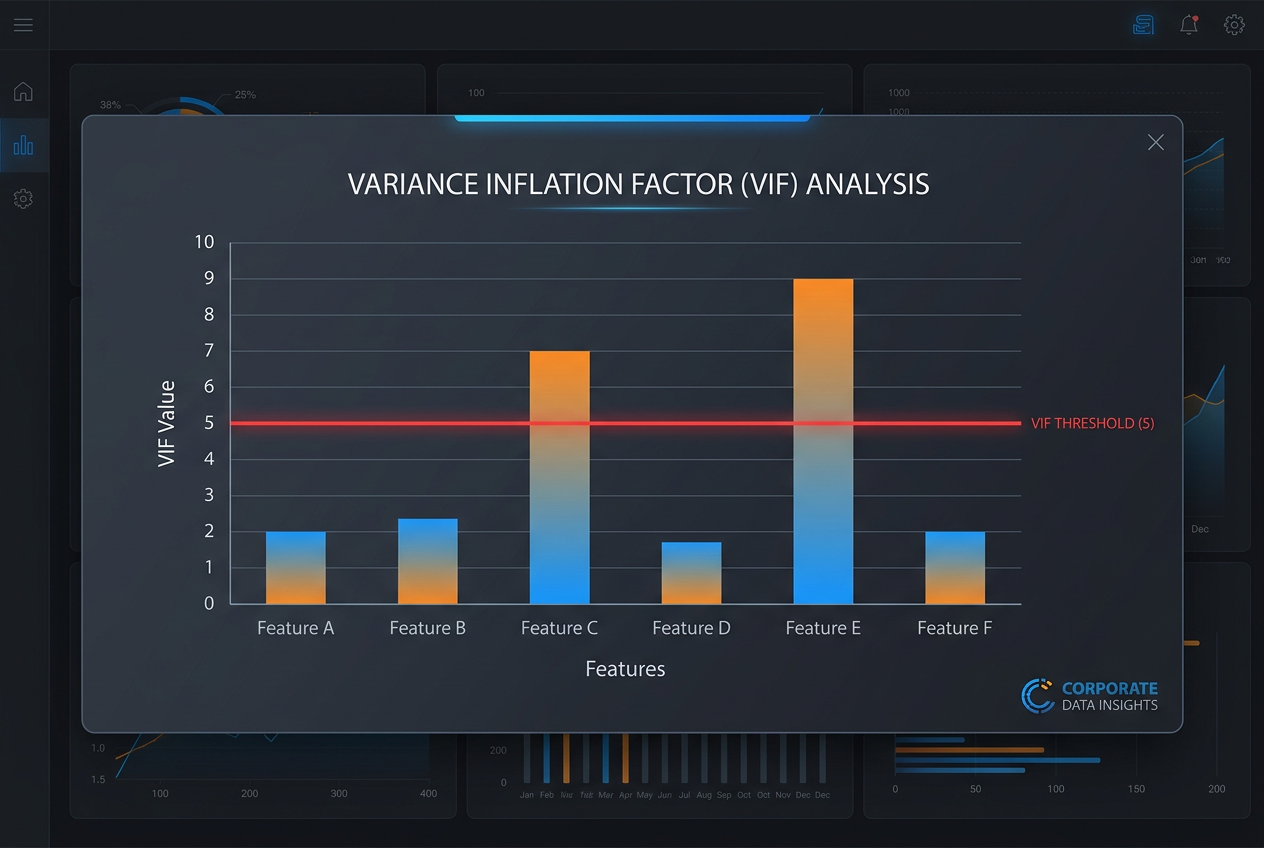
The Variance Inflation Factor (VIF) is a measure that indicates how much the variance of an estimated coefficient increases due to its correlation with other variables in the model. Simply put, if a variable has a very high VIF , it means that much of its information is already covered by other variables, causing standard errors to skyrocket and making it very difficult to determine which variable is actually influencing the result.
The rule of thumb that many analysts follow is that if the VIF value is greater than 5 , we are dealing with a case of concerning multicollinearity. In more extreme situations, a value above 10 is a clear sign that the variable should be reviewed or removed from the dataset to clean the model and improve numerical stability.
Technical and Logical Implementation in C#

To calculate the VIF of a specific variable in a design matrix, the process involves treating that variable as if it were the dependent variable and performing a linear regression using all other independent variables as predictors. The result is the coefficient of determination R², and the VIF is calculated using the formula 1 / (1 – R²).
When programming this in C#, it's crucial to pay attention to numerical stabilization . A best practice is to standardize the columns of the design matrix, setting the mean to 0 and the standard deviation to 1. This is vital when working with data on very different scales or nonlinear transformations, as it prevents the program from crashing due to decimal precision errors.
Clean Code Design Principles
Beyond the formula itself, the way we write code in C# makes all the difference. A common mistake is creating objects that do things they're not designed for; for example, a "Ball" class having a "Throw()" method, which doesn't make sense since a ball doesn't throw itself. Code should read like well-written sentences , where the subject performs a coherent action on an object.
- External Resources: They should be handled at a separate level of abstraction, ideally through Dependency Injection.
- Status and Data: Data-centric code should follow the principles of Object-Oriented Programming (OOP).
- Behaviors: Logic and algorithms should function as pure functions, taking data and resources as parameters.
To organize the project, a hierarchy is suggested that starts with the namespace, progresses through static classes as complexity increases, and ends with regular classes. It's preferable to group related classes in the same file if they share the same concern, which helps the compiler optimize the binary and improves runtime performance by better managing the cache and CPU registers.

Alternatives and Data Visualization
Although C# is robust for implementation, tools like R are often used in rapid exploration environments. In this language, libraries like "car" allow for near-instantaneous calculation of the VIF. Once the values are obtained, it's ideal not to rely solely on the numbers, but to use bar charts to visually identify the sources of multicollinearity.
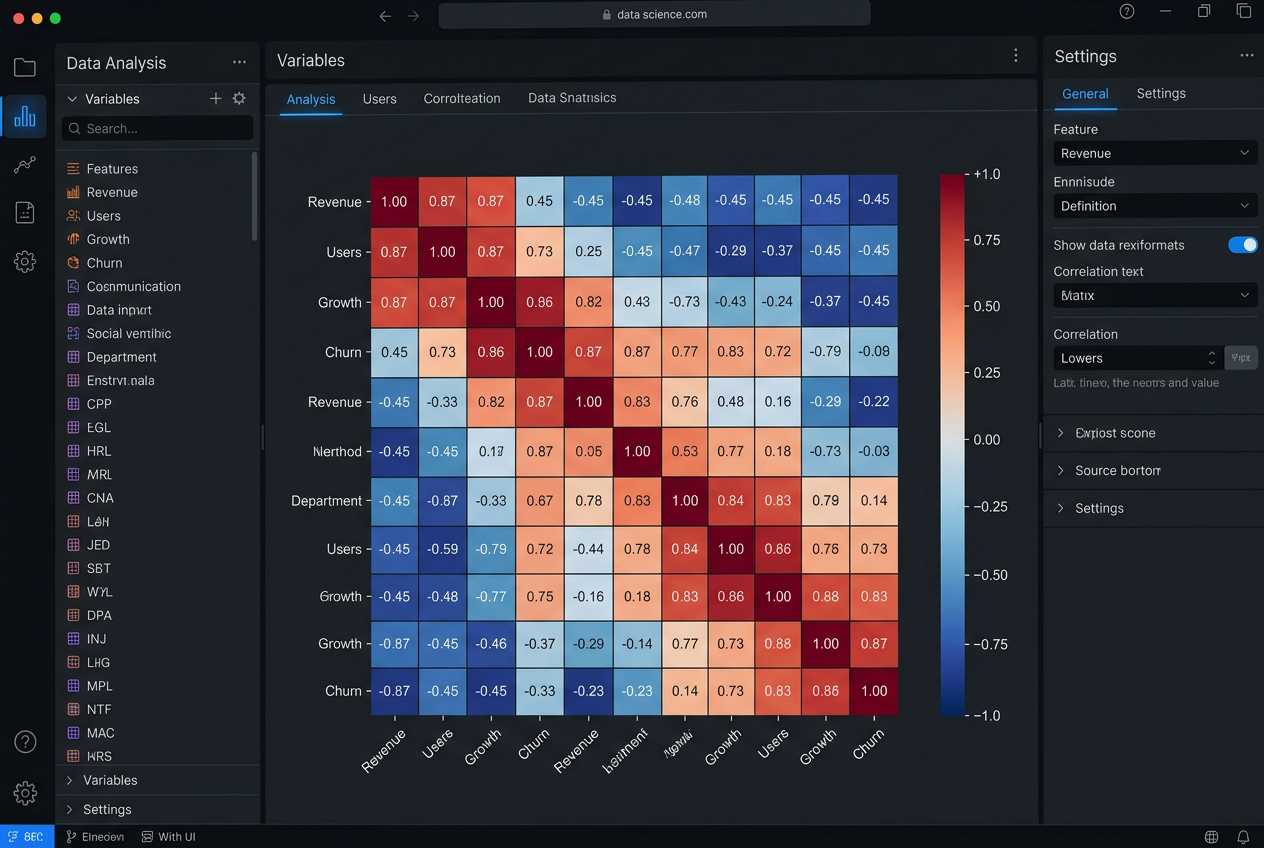
Supplementing the analysis with a correlation matrix is a crucial step. Visualizing how variables relate to each other using colors allows us to understand not only that there is a VIF problem, but also precisely which pair of variables is causing the conflict. This combination of statistical analysis and visualization is what ensures that the final model is accurate and not simply a house of cards.
Proper VIF management, combined with a software architecture based on single responsibility and a standardized data structure, enables the creation of C# analysis tools that are both powerful and easy to maintain. By eliminating data redundancy and applying consistent design principles , we transform cryptic code into a professional solution capable of handling complex regressions with complete reliability.