- LiteRT replaces TensorFlow Lite as Google's universal framework for running AI on mobile, desktop, and IoT devices.
- It optimizes inference by using NPU, GPU, and CPU, achieving speed improvements of up to 100x compared to traditional CPUs.
- LiteRT-LM specializes in orchestrating LLMs and generative models like Gemma, improving memory management and local context.
- It offers full compatibility with PyTorch, JAX, and TensorFlow, facilitating the frictionless conversion of models to the .tflite format.

Generative artificial intelligence is taking an incredible leap forward, and it's no longer just about sending data to the cloud and waiting for a response. Now, the masterstroke is running everything directly on the device , whether it's a mobile phone or an edge environment, so that the experience is instantaneous and, above all, so that data privacy doesn't depend on external servers.
In this context, LiteRT emerges, Google's new standard designed to replace the veteran TensorFlow Lite. It's not a simple patch, but a universal infrastructure designed to allow developers to deploy powerful AI models on any platform, from a smartwatch to a Windows PC, maximizing the use of available hardware.

What is LiteRT and why is it a game-changer?

LiteRT is essentially the successor to TensorFlow Lite and was created to address the challenges of hardware fragmentation. While traditional machine learning focused on simple tasks like image recognition, GenAI requires much more aggressive resource management . This framework enables reproducible and efficient inference, regardless of whether the device is Android, iOS, macOS, Linux, or even a web application.
For those building startups or developing technology products, this is a complete paradigm shift. By running models locally, latency is drastically reduced and recurring third-party API costs are eliminated, allowing applications to function perfectly even without an internet connection.
The acceleration engine: CPU, GPU, and NPU power

LiteRT's true strength lies in its ability to squeeze every last drop of performance from each chip. Thanks to an engine called ML Drift , the system can manage GPU acceleration using various APIs such as Metal, OpenCL, OpenGL, and WebGPU. In fact, on Android, the runtime is smart enough to automatically prioritize OpenCL if available, resorting to OpenGL only as a backup.
But where LiteRT truly shines is in its NPU (Neural Processing Unit). Thanks to a collaboration with Qualcomm, the QNN accelerator enables speed improvements up to 100 times faster than a CPU and 10 times faster than a GPU in certain scenarios. This transforms AI from a slow experiment into a viable production tool.
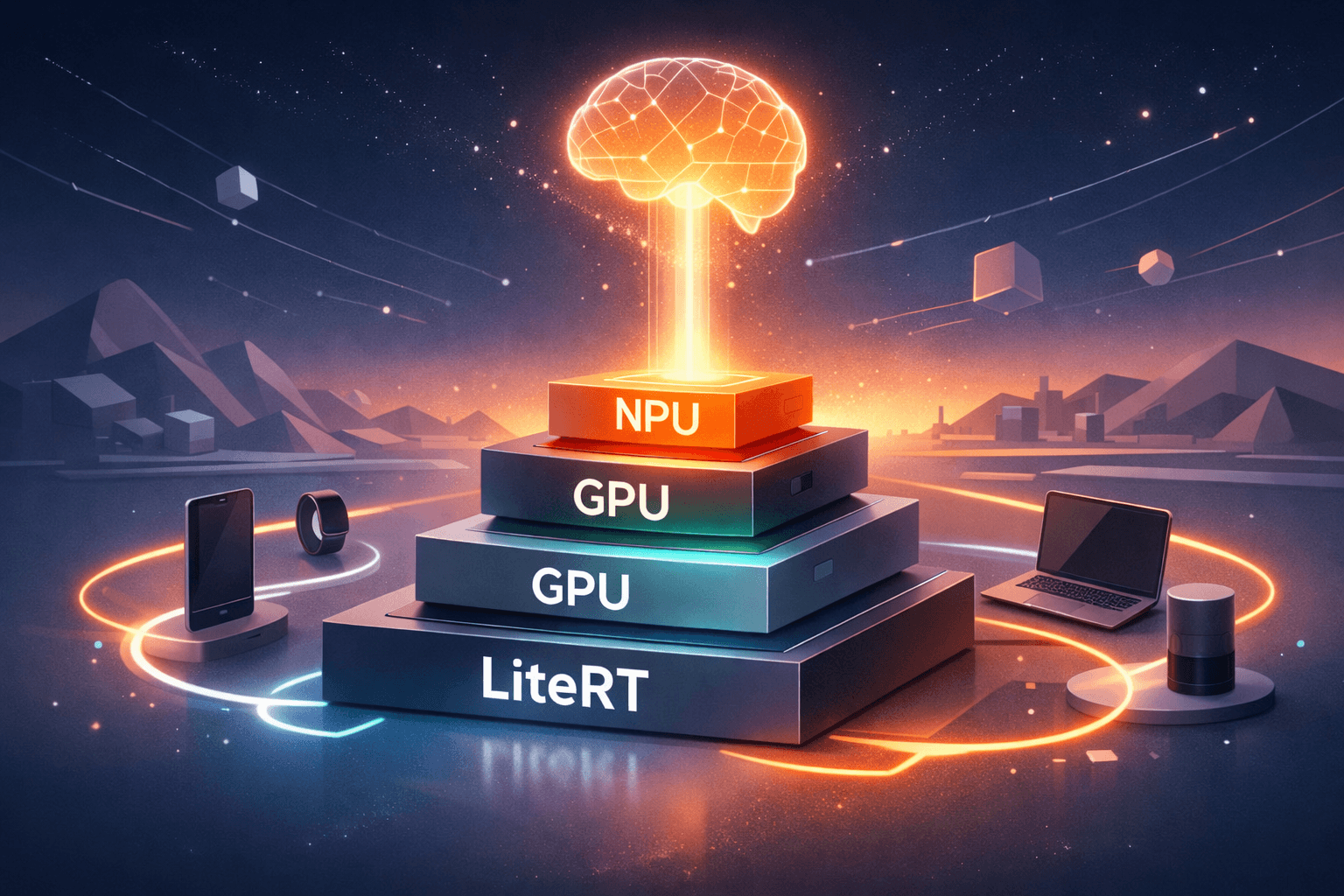
LiteRT-LM: Orchestrating Generative AI and LLMs
When we talk about large language models (LLMs), things get complicated because they aren't simple models, but rather complex pipelines. This is where LiteRT-LM comes in , a specialized orchestration layer that efficiently manages memory, buffers, and context. It's the same technology that powers Gemini Nano on Pixel Watch and Chrome.

To make life easier for programmers, Google has included the LiteRT Torch Generative API. This tool allows for the easy conversion of PyTorch-based models, enabling open models like Gemma to run ultra-fast on the device. In real-world benchmarks, LiteRT has proven to outperform llama.cpp in prefill and decode speed by making better use of the hardware.
Technical innovations: Zero-copy and asynchronous execution
One of the common bottlenecks in mobile AI is the movement of data between the CPU and the accelerator. LiteRT solves this with zero-copy buffer management , which prevents unnecessary data duplication in memory. It's as if the model reads the information directly from where it is, making tasks like background segmentation up to twice as fast.
Furthermore, the new CompiledModel API allows inferences to be launched asynchronously. This means the application doesn't freeze while the AI processes the data, improving the fluidity of the user interface. The system evaluates the hardware in real time and chooses the best accelerator without requiring the developer to write specific code for each chip.
Framework flexibility and strategic deployment
The best part is that it doesn't force you to stick with just one language. LiteRT is compatible with PyTorch, JAX, and TensorFlow . If you already have a training pipeline set up, you don't have to throw it away; you can convert your models to the .tflite format and deploy them on any supported operating system.
For businesses, implementing this requires a clear strategy. The model alone is not enough; it must be combined with custom software development and a cloud computing infrastructure for AI to scale if needed. Furthermore, when moving AI to the device, cybersecurity becomes critical , as it is essential to ensure that sensitive information never leaves the user's hardware.
Adopting this standard allows for the creation of autonomous agents that respond in real time , reducing reliance on expensive servers. Organizations that integrate local inference today will gain a significant competitive advantage in terms of cost, privacy, and response speed compared to those that continue to depend exclusively on the cloud.

Table of Contents