If you've been following the recent buzz about artificial intelligence, you've probably heard about tools that seem to do everything from writing poems to programming complex code. Behind all this magic lies a key concept: foundational modelsBasically, they're like a car chassis; a robust, general structure that can then be customized to be a sports car, a truck, or a utility vehicle, depending on what we need at any given time.
What makes these systems so disruptive is that we no longer design an AI for a single task, but instead create a digital giant entrenado con cantidades ingentes de datos que luego podemos «moldear». Este cambio de paradigma ha permitido que la IA pase de ser algo muy rígido a convertirse en una herramienta flexible que aprende patrones generales del mundo para luego aplicarlos a problemas concretos, lo que ha acelerado la innovación a un ritmo que, sinceramente, deja fría a cualquiera.

What exactly is a foundational model?

To put it simply, a foundational model is any AI system that is trained with a massive amount of data (usually through self-monitoring) and has the ability to adapt, through a process called fine-tuning, to a huge variety of applications. They are not entirely new, as they draw from deep learning and knowledge transfer, but the unprecedented scale Data and computing have led to the emergence of capabilities that no one had foreseen.
It is essential not to confuse them with the LLM (Large Language Models)Although often used interchangeably, the relationship is one of genus and species: all LLMs are foundational models, but not all foundational models are LLMs. While LLMs focus on text and code, foundational models can be multimodalprocessing images, audio, video, or even sensory signals from robots.

The technical pillars: Transformer and training

The architecture that has made all this possible is the Transform. Este sistema utiliza un mecanismo llamado «autoatención», que permite al modelo entender la importancia de diferentes partes de una secuencia, sin importar que estén lejos unas de otras. Consta habitualmente de un codificador y un decodificador que generan vector representations (embeddings) that capture the deep meaning of language or images.
The creation process is usually divided into several stages:
- Pre-workout: Es la fase más costosa. El modelo «devora» internet, libros y bases de datos para aprender la estructura general de la información. Aquí es donde se definen el number of parameters, the number of tokens and the context window.
- Fine-tuning: Once the model is generalist, it is trained with specific data and supervised by humans to become an expert in an area, such as medicine or law.
- Adaptation to the task: This is the final step, where the model is optimized for a very specific function, such as creating a case law search engine or a technical report generator.

Outstanding models that have shaped history

Since 2018, we have seen a procession of models come and go, shaking things up. BERT He was one of the pioneers, notable for his bidirectional ability to understand context. Then came the family. OpenAI GPT, evolving from GPT-1 to GPT-4, demonstrating that the greater the scale, the more emergent capabilities, such as zero-shot learning.
But they are not alone. We have Claude from Anthropicwith versions like Sonnet, Opus, and Haiku that seek a balance between intelligence and speed. On the other hand, Amazon Nova It offers a range that goes from multimodal understanding to creative video generation. We cannot forget to stable diffusion, which brought the power of the foundational models to the world of images, or BLOOM, a multilingual and collaborative effort that demonstrates that open source also has its place.
Capabilities and real-world applications
These models don't just write emails. Their impact extends to critical sectors:
- Health: They help in the drug discovery and the analysis of medical images, although they require full explainability to avoid fatal errors.
- Straight: They facilitate the review of contracts and the analysis of lengthy legal narratives, reducing the costs of accessing justice.
- Education: They allow a personalized learning and adaptive, although they pose challenges regarding plagiarism and the technological gap.
- Robotics: The aim is to create generalist robots that don't have to be programmed from scratch for each task, but instead use a base model to interact with the environment physical.

The Dark Side: Risks, Ethics, and the Environment
It's not all sunshine and roses. Homogenization is a serious risk: if everyone uses the same basic model, any bias or intrinsic error se propagará por todas las aplicaciones derivadas, creando un «monocultivo algorítmico». Además, están las alucinaciones, esos momentos en los que la IA inventa datos con una seguridad pasmosa, lo que obliga a una constant human verification.
From an ethical and legal point of view, there is an open battle over the intellectual propertyThis is because many models are trained with data without the explicit consent of their creators. Added to this is the environmental toll; training these giants consumes a enormous amount of energy and water, which necessitates the search for more efficient architectures and sustainable data centers.

The future and governance of AI
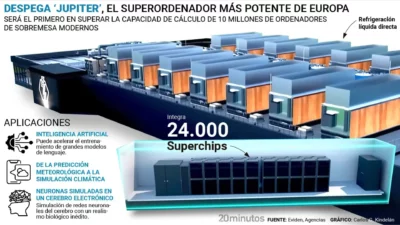
The way forward passes through the democratization of accessCurrently, the training of the most powerful AI models is centralized in a few companies due to the cost of the hardware (GPUs). It is vital that universities and governments invest in public infrastructure to prevent the power of AI from falling into the hands of a few. technological oligopoly.
The key will be transparency and independent audits. It's not enough for a company to say its model is secure; we need regulatory frameworks (such as the EU AI Act) and professional standards that ensure these tools are used to improve society and not to enhance mass surveillance or disinformation.
The artificial intelligence ecosystem has shifted toward a structure where a few core models support thousands of specialized applications, combining the power of massive processing with the precision of human-level tuning. This advancement, while raising profound ethical dilemmas and concerning energy consumption, redefines the relationship between humans and machines by transforming AI into a general-purpose infrastructure capable of reasoning, creating, and learning across multiple domains simultaneously.