- Prim: algorithm to obtain the Minimum Spanning Tree (MST) in connected, undirected, weighted graphs, minimizing the sum of edge weights.
- Operation: It starts at a node and expands the tree by iteratively selecting the lowest weight edge that connects processed nodes with unprocessed ones, avoiding cycles.
- Complexity: O(n²) with adjacency matrix or O(a log n) with heaps; Prim is usually better on dense graphs than Kruskal.
- Applications: network design, electrical systems, water/gas distribution, machine vision and bioinformatics, optimizing costs and resources.

Prim's algorithm is one of the most popular methods for solving the Minimum Spanning Tree (MST) problem. This type of problem arises in many fields, such as the design of telecommunications networks , electrical systems , and distribution networks. If you're interested in understanding in depth how this algorithm works, you've come to the right place. Here, we'll break down everything about Prim's algorithm, from its history to its technical implementation and practical applications.
Although the algorithm was originally developed in 1957 by Robert Prim , its relevance has not diminished over time. It is an essential algorithm in graph analysis, especially when it comes to finding an efficient solution to connect all the nodes of a graph at the lowest possible cost. Furthermore, its ease of implementation makes it ideal for learning about graph optimization techniques in our comprehensive guide for programmers.
What is Prim's Algorithm?
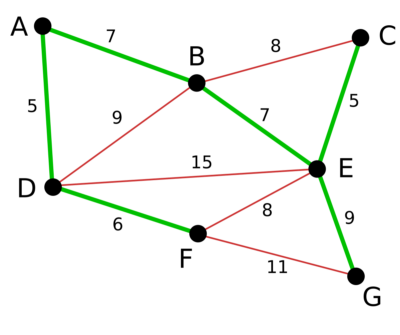
Prim's algorithm is a technique for finding the Minimum Spanning Tree (MST) of a connected, undirected, weighted graph. The MST is a tree that connects all the nodes of the graph using the smallest possible sum of the edge weights . This problem is crucial in fields such as network optimization, as it helps minimize resources such as cabling , pipes , or even transportation routes.
The main idea of the algorithm is to divide the nodes of a graph into two sets: processed and unprocessed . Then, the shortest edge connecting both sets is iteratively selected, ensuring that no cycles are formed. In the end, the set of selected edges forms the MST of the graph.
History and Context
Robert Prim developed this algorithm in 1957, but its origins date back even further, to 1926, when Otakar Boruvka worked on an electrification problem in Czechoslovakia. Also in 1956, Joseph Kruskal introduced his own method for solving the Minimum Spanning Tree problem. Although both algorithms solve the same problem, Prim's is particularly effective for dense graphs.
During the 1960s and 1970s, the algorithm was studied and improved by mathematicians at Bell Labs , who contributed to the development of advanced techniques for combinatorial optimization problems.
Algorithm Operation
The algorithm begins by selecting any initial node in the graph and adding its edges to the set of possible connections. Then, at each step:
- You choose the shortest edge that connects an already processed node with an unprocessed one.
- The unprocessed node connected by the selected edge is marked as processed.
- The process continues until all nodes are processed.
The final set of edges forms the Minimum Spanning Tree, related to other methods such as Wilson's algorithm.
Complexity and Comparison with Kruskal
One of the most studied aspects of Prim's algorithm is its efficiency . In a graph with n nodes and a edges, its complexity can vary depending on the implementation:
- Using an adjacency matrix: O(n²)
- Using mounds: O(a log n)
In comparison, Kruskal's algorithm has a complexity of O(a log n) , although this depends on the sorting technique used. Prim's algorithm is generally more efficient for dense graphs, while Kruskal's is preferable for sparse graphs.
Algorithm Pseudocode
A clear way to understand the algorithm is through its pseudocode and examples of mathematical algorithms :
Prim (graph): Start processed set with an initial node While there are unprocessed nodes: Find the shortest edge connecting the two sets Add the edge to the MST Mark the node as processed Return the MST
Practical applications
Prim's algorithm has multiple real-world uses, including:
- Telecommunication network design: Determine the most efficient way to connect a network of servers or base stations.
- Electric systems: Reduce the cost of wiring in electrical installations.
- Water or gas distribution: Optimize pipeline infrastructure.
For example, a cable television company can use this algorithm to minimize the length of cables needed to connect all customers in a residential area.
It has also been used in more complex areas, such as image analysis in computer vision , protein folding in bioinformatics, and approaches to NP-Hard problems such as the traveling salesman problem.
Thanks to its versatility and adaptability , Prim's algorithm remains a fundamental tool in the optimization of graph-related problems.