- Technology and science are drivers of progress, redefining possibilities and improving our quality of life.
- The relationship between science and technology is symbiotic, driving discoveries and practical solutions.
- Innovations in fields such as artificial intelligence and biotechnology are transforming diverse industries and societies.
- The ethical challenges arising from technological progress require ongoing dialogue and careful consideration of their implications.

Technology and science: The dynamic duo that is reshaping our future
The transformative impact of technology and science
In the dynamic landscape of the 21st century, technology and science have become the primary engines driving human progress. This powerful duo is constantly redefining the boundaries of what is possible, offering innovative solutions to global challenges and improving our quality of life in ways we could only previously imagine.
The symbiosis between technology and science has accelerated the pace of technological advancement, generating a virtuous cycle of discoveries and innovations. From the digital revolution to breakthroughs in medicine and space exploration, we are witnessing an era of unprecedented change. But how exactly do these two fields intertwine? What are the differences between technology and science , and how do they collaborate to reshape our future?
In this article, we will explore in depth the symbiotic relationship between technology and science, analyze the most revolutionary advances in various areas, and reflect on the ethical and social implications of this rapid progress. Get ready to immerse yourself in a fascinating journey across the frontiers of knowledge and innovation.

Technology and science: An unstoppable synergy
The interaction between technology and science is fundamental to understanding the progress of our society. Although often used interchangeably, these terms represent distinct but closely related concepts. Let's take a closer look at the definition of technology and its relationship to science.
Definition of technology and its relationship with science
The definition of technology encompasses the set of knowledge, techniques and tools used to solve problems and satisfy human needs. It is the practical application of scientific knowledge to create devices, systems and processes that improve our daily lives.
On the other hand, science focuses on fundamentally understanding how the natural world works through observation, experimentation, and analysis. Science seeks to discover the laws and principles that govern the universe, while technology applies that knowledge to create practical solutions.
The relationship between technology and science is symbiotic. Science provides the knowledge base that enables technological development, while technology offers more advanced tools and methods for scientific research. This positive feedback loop has greatly accelerated the pace of progress in both fields.
The differences between technology and science: A detailed analysis
Although they are closely related, there are key differences between technology and science that are important to recognize:
- Objective: Science seeks to understand and explain natural phenomena, while technology focuses on creating practical solutions.
- Methodology: Science uses the scientific method, based on observation, hypothesis and experimentation. Technology employs design and engineering processes to develop products and systems.
- ResultsScientific results are theories and laws that explain how the world works. Technological results are tangible devices, processes, and systems.
- Market validation: Scientific theories are validated through reproducibility and consensus of the scientific community. Technology is validated by its effectiveness and practical utility.
- Evolution: Science progresses through paradigms and conceptual revolutions. Technology evolves more incrementally, although it can also experience disruptive leaps.
Understanding these differences between technology and science is crucial to appreciating how both disciplines contribute to the advancement of our society. The synergy between them has led to astonishing innovations that are transforming every aspect of our lives.

Advancement in technology: 5 key areas
Advancement in technology is happening at a dizzying pace on multiple fronts. Let’s look at five key areas where the confluence of technology and science is bringing about revolutionary changes.
Artificial Intelligence and Machine Learning
Artificial Intelligence (AI) and Machine Learning are at the forefront of today's technological revolution. These fields are transforming entire industries, from healthcare to manufacturing and financial services. In this context, emerging technologies such as AI innovation are playing a crucial role in these advancements.
- Medical diagnostic systems:AI is improving the accuracy and speed of medical diagnoses, analyzing medical images and patient data with an efficiency that rivals that of human experts.
- Autonomous vehiclesMachine learning is driving the development of driverless cars, promising to revolutionize transportation and improve road safety.
- virtual assistantsTechnologies like Siri, Alexa and Google Assistant are making human-machine interaction more natural and intuitive.
Advances in AI technology raise fascinating questions about the future of work and human intelligence. How will our society change when machines can perform complex cognitive tasks?

Biotechnology and personalized medicine
The convergence of biology and technology is opening new frontiers in healthcare and our understanding of life itself. Technologies like Moore's Law help us better understand these advances, such as gene editing and personalized medicine, which are transforming healthcare.
- Gene editingTechnologies such as CRISPR-Cas9 allow DNA to be modified with unprecedented precision, offering the possibility of curing genetic diseases and improving crops.
- Personalized medicine: Individual genome analysis is enabling medical treatments tailored to the unique genetic characteristics of each patient.
- Artificial organs: 3D printing and tissue engineering are advancing towards the creation of functional organs for transplantation.
These innovations raise profound ethical questions. Where do we draw the line on genetic modification? How do we ensure equitable access to these revolutionary technologies?
Renewable energies and sustainability
The urgency of addressing climate change has driven significant advances in clean energy technologies. To understand these developments in renewable energy, we can examine how green steel and other clean technologies are helping to reduce our ecological footprint.
- More efficient solar energy: New materials and designs are dramatically improving the efficiency of solar panels.
- Energy storage: More powerful and longer-lasting batteries are making renewable energy more viable on a large scale.
- Nuclear fusion:Although still in the experimental phase, it promises a practically unlimited and clean source of energy.
Advances in clean energy technology are crucial for a sustainable future. Can we make the transition in time to mitigate the worst effects of climate change?
Virtual and augmented reality
These technologies are blurring the lines between the physical and digital worlds, offering new ways to interact and experience the world. Innovation in virtual and augmented reality is revolutionizing fields such as entertainment, education, and design.
- training and education: Immersive simulations are revolutionizing how we learn and prepare for complex tasks.
- Entertainment: Virtual reality games and experiences are creating new forms of narrative and entertainment.
- Design and prototypingAugmented reality is transforming how we design and visualize products before they are manufactured.
How will these technologies affect our perception of reality and our social interactions?
Internet of Things (IoT)
The interconnection of everyday devices is creating a smarter and more efficient world. The role of IoT in digital transformation is reflected in smart cities and connected homes.
- smart cities: Sensors and real-time data analysis are optimizing traffic, energy consumption and waste management in urban environments.
- Precision farming: Sensors and drones are allowing farmers to monitor and optimize their crops with unprecedented precision.
- Connected HomesFrom smart thermostats to automated security systems, IoT is transforming our living spaces.
The proliferation of connected devices raises concerns about privacy and security. How can we reap the benefits of IoT while protecting our personal data?

The role of science in technological development
Science plays a fundamental role in technological advancement, providing the theoretical and experimental foundations upon which innovations are built. However, the relationship between science and technology is not unidirectional; it is a continuous feedback loop where advances in one field drive progress in the other. To further explore how technological advancement relies on scientific discoveries, it is helpful to understand how basic and applied research work together.

Basic vs. applied research
Scientific research is generally divided into two categories:
- Basic investigation: It focuses on expanding fundamental knowledge without an immediate practical objective. For example, the study of quantum physics or molecular biology.
- Applied research: It seeks to solve practical problems or develop new technologies based on existing scientific knowledge.
Both types of research are crucial to technological progress. Basic research provides the revolutionary discoveries that can lead to unexpected technological leaps, while applied research translates that knowledge into practical solutions.
A classic example of how basic research can lead to revolutionary technological advances is the development of quantum mechanics. What began as an attempt to understand the behavior of subatomic particles has led to technologies such as lasers, magnetic resonance imaging, and transistors, which are the basis of all modern electronics.
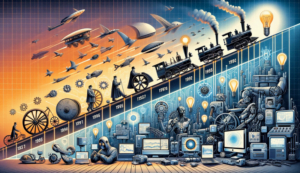
Ethical challenges at the intersection of technology and science
The rapid advance in technology and science not only brings benefits, but also significant ethical challenges that we must address as a society.
- Privacy and data security: With the increasing amount of personal data collected by digital devices and platforms, how do we protect individual privacy?
- Artificial Intelligence and Decision Making: As we rely more on algorithms to make important decisions, how do we ensure they are fair and transparent?
- Genetic modificationTechnologies like CRISPR raise questions about the ethical limits of genetic manipulation. Should we “design” babies or modify our genes to enhance capabilities?
- Automation and unemployment: Advances in technology are replacing many traditional jobs. How do we manage the transition and ensure an equitable distribution of benefits?
- Equitable access: How do we ensure that the benefits of technological and scientific advances are available to everyone, not just the most privileged?
These challenges require ongoing dialogue among scientists, technologists, policymakers, and the general public. The distinctions between technology and science become blurred in these ethical discussions, as both disciplines must consider the broader implications of their work.
The future: Technological and scientific convergence
Looking ahead, we can expect even greater convergence between different technological and scientific fields. This convergence promises innovative solutions to some of humanity’s most pressing challenges.
- Nanotechnology and medicine: Manipulating materials at the atomic scale could revolutionize the treatment of cancer and other diseases.
- Neurotechnology: A direct interface between the brain and computers could help treat neurological conditions and expand human cognitive abilities.
- Quantum computing: It promises to revolutionize fields such as cryptography, drug discovery and logistics optimization.
- Climate technologies:The convergence of biotechnology, AI and environmental engineering could offer innovative solutions to mitigate climate change.
Advancement in technology and science will continue to accelerate, driven by synergy between different disciplines. The key to fully harnessing this potential will be our ability to navigate the ethical and social challenges that arise with each new advance.
Frequently asked questions about technology and science
What is the main difference between technology and science?
The main difference lies in their objectives: science seeks to understand and explain natural phenomena, while technology focuses on applying that knowledge to create practical solutions. Science discovers, technology invents.
How has technological advancement impacted scientific research?
Technological advances have revolutionized scientific research by providing more powerful and precise tools. For example, supercomputers enable complex simulations, while advanced instruments like China's artificial sun facilitate previously impossible experiments.
What is technological convergence and why is it important?
Technological convergence refers to the combination of different technologies to create innovative solutions. It is important because it allows complex problems to be addressed from multiple angles, leading to advances that would be impossible within a single discipline.
How is artificial intelligence changing the scientific and technological landscape?
AI is transforming both science and technology by speeding up data analysis, automating complex tasks and uncovering patterns that humans might miss. It is driving advances in fields as diverse as drug discovery, climate prediction and materials design.
What are some of the most pressing ethical challenges at the intersection of technology and science?
Some of the most pressing ethical challenges include data privacy and security in the digital age, the implications of gene editing, the impact of automation on employment, and how to ensure equitable access to technological and scientific advances.
How can we better prepare for the technological and scientific future?
To better prepare ourselves, we must:
- Promote continuing education and adaptability.
- Develop critical and creative skills that complement, rather than compete with, AI and automation.
- Actively participate in discussions on ethics and technology policy.
- Keep us informed about scientific advances and their implications.
- Cultivate a lifelong learning mindset to adapt to rapid changes.
Technology and science will continue to be the driving forces reshaping our world. By staying informed, adaptable and ethically aware, we will be able to navigate this exciting future and contribute to shaping a better world for all.
Conclusion: Technology and science: The dynamic duo that is reshaping our future
Technology and science are reshaping our world at an unprecedented pace. From personalized medicine to artificial intelligence and renewable energy, we are on the threshold of a new era of possibilities and challenges.
To successfully navigate this future, we need to:
- Promote STEM (Science, Technology, Engineering and Mathematics) education to prepare future generations.
- Promote open dialogue on the ethical implications of new technologies.
- Ensure equitable access to the benefits of technological and scientific advances. 4. Invest in basic and applied research to maintain the momentum of innovation. 5. Develop flexible regulatory frameworks that can adapt to the rapid pace of technological change.
The synergy between technology and science will continue to be the primary driver of our progress. By understanding the differences between technology and science , as well as their interrelationship, we will be better equipped to harness their potential and address emerging challenges.
The future ahead is exciting and full of possibilities. With a combination of scientific curiosity, technological ingenuity and ethical consideration, we can shape a better world for generations to come. Long live technology and science!
Table of Contents
- 1 Technology and science: The dynamic duo that is reshaping our future
- 1.1 The transformative impact of technology and science
- 1.2 Technology and science: An unstoppable synergy
- 1.3 Advancement in technology: 5 key areas
- 1.4 The role of science in technological development
- 1.5 Ethical challenges at the intersection of technology and science
- 1.6 The future: Technological and scientific convergence
- 1.7 Frequently asked questions about technology and science
- 1.8 Conclusion: Technology and science: The dynamic duo that is reshaping our future