- Gemini Coder is free for individuals and integrates deeply with Google Cloud and Workspace.
- Advanced reasoning and broad context for code generation, debugging, and documentation.
- Standard and Enterprise editions with security, customization in private repositories, and cloud integrations.
- Privacy and data control with encryption, compliance, and granular deletion and permission options.
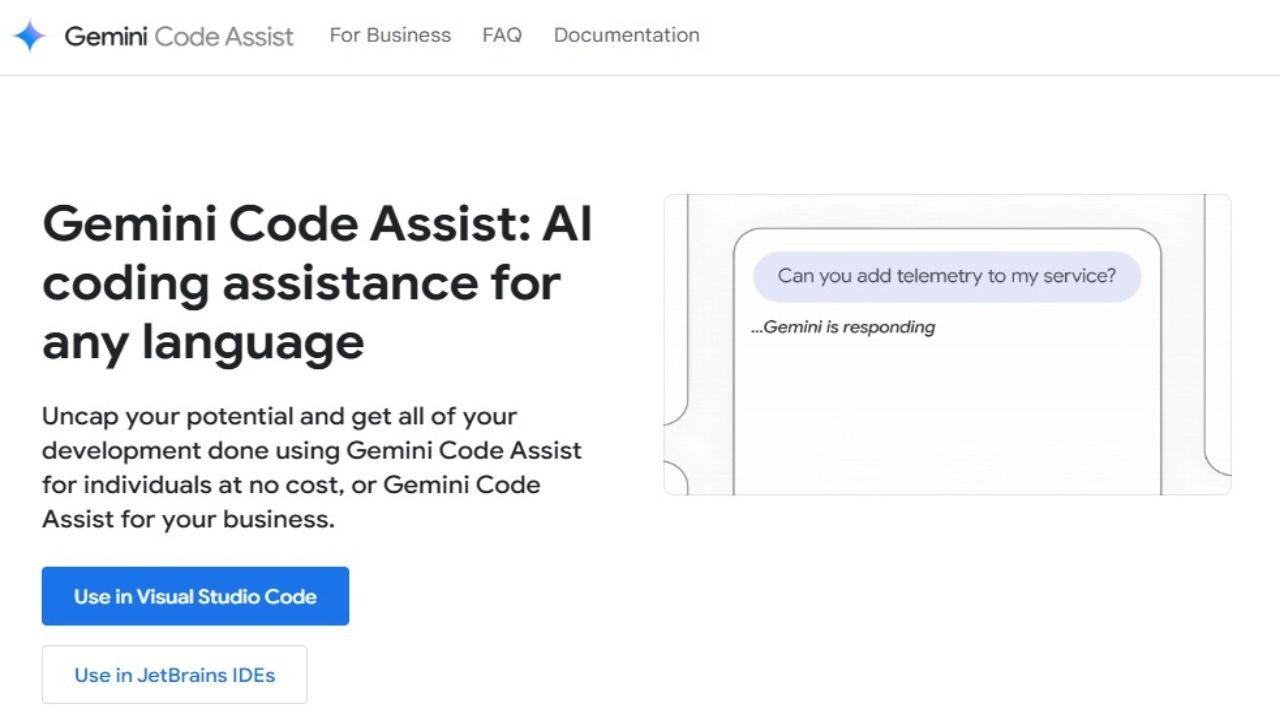
The rise of AI assistants has transformed the daily landscape of software development and productivity, and in this context, Gemini Coder (Gemini Code Assist) has become the main competitor . Meanwhile, the Gemini ecosystem, as a general-purpose assistant, boasts hundreds of millions of monthly active users and demonstrates reasoning and coding capabilities that are already comparable to solutions like OpenAI's GPT-4.5 or Anthropic's Claude 3.7 Sonnet. These differences matter significantly: choosing the right assistant can boost performance on tasks by around 66% , according to research cited in the reference sources.
Beyond the label, the key is understanding exactly what Gemini Coder offers compared to alternatives like GitHub Copilot, and what role the rest of the Gemini ecosystem plays (from the conversational assistant to integrations with Google Cloud and Workspace). This analysis gathers and rewrites all the available material to give you a complete overview : features, advantages, limitations, Standard/Enterprise editions, privacy, comparisons with other assistants (both programming and general-purpose), and a roadmap.
What is Gemini Coder (Gemini Code Assist) and why does it matter?
Gemini Coder is Google's programming assistant, based on the Gemini model family , specifically tuned for code generation, explanation, optimization, and debugging. Unlike its main competitors, it stands out for an aggressive strategic decision: it's free for individual users , making it a very accessible option for students, freelancers, and small teams looking for real help without any upfront costs.
On a practical level, it works within IDEs like VS Code, Android Studio, and JetBrains, offering contextual completion, feature generation from comments, unit test creation, and assistance in documenting and understanding codebases. Furthermore, it integrates natively with Google Cloud , which is a major draw for those already working in that environment due to the seamless integration between development, deployment, and operations.
Key features of Gemini Coder that make a difference
In its most straightforward mode, Gemini Coder offers predictive autocompletion and code block generation based on project context and natural language prompts. This accelerates repetitive tasks and reduces friction during implementation.
Another tangible benefit is the detection of errors with suggested fixes , as well as performance and security suggestions. Simultaneously, the assistant provides natural language explanations of complex snippets, facilitating learning for junior users and accelerating comprehension for senior teams.
Multi-language support is extensive: Python, JavaScript, Go, C++, Java, and more. And, as an added bonus, integration with IDEs and Google Cloud services allows for seamless workflow without context switching—a productivity advantage that shouldn't be underestimated.
In corporate contexts, the broad context window and advanced reasoning (Deep Think in Gemini 2.5)** drive tasks requiring multiple logical steps, analysis of large codebases, and guided refactoring, with less back-and-forth. The model, trained on public code, technical material from Google Cloud, and datasets from the base models, includes citations when reusing entire passages and recommends validating results because it is an evolving technology.
Gemini Coder vs GitHub Copilot and other programming assistants
The most direct comparison is with GitHub Copilot . In terms of price, Gemini Coder takes the lead: it's free for individuals , compared to Copilot's monthly subscription. Technologically, Gemini Coder relies on Gemini models optimized for programming , while Copilot uses OpenAI models like GPT-4. Regarding compatibility, both work with VS Code and JetBrains , although each shines brightest in its natural ecosystem: Google Cloud for Gemini Coder and the Microsoft/GitHub constellation for Copilot.
If we broaden our focus to other useful AI tools in programming, ChatGPT is an outstanding all-rounder for conversation and text generation, but its generalist approach can fall short in automating development workflows. Claude excels in reasoning and predicting results; Copilot dominates the coding workflow within Microsoft; Perplexity provides quote-based information retrieval; and Grok offers quick responses in social contexts. Gemini Coder shines when you want to combine coding, extensive context, and deep integration with Google.
Keep an eye on PageOn.ai: although it appears in assistant comparisons, its focus is on AI-powered search and presentations , automated storytelling, and visualization. It's brilliant for communicating ideas, but it doesn't compete head-to-head in the realm of AI-assisted coding.
Specific competitive advantages of Gemini Coder
The first advantage is obvious: zero barrier to entry for individuals . With no cost, it's incredibly attractive for learning, prototyping, or accelerating small, personal projects without any fees.
The second advantage is its integration with Google Cloud and Workspace . From BigQuery Studio to Firebase, and including Cloud Run and Database Studio, the assistant brings AI to where you already work , reducing context switching and improving real-world adoption across teams.
Third, support for broad context and multi-step reasoning drives complex tasks: test generation, documentation, framework migrations, and performance analysis with actionable recommendations. Here, the leap forward in Gemini 2.5 (Deep Think, improvements to context memory, and audio streaming) advances pair programming and live support scenarios.
Finally, regarding privacy and security, Google employs encryption, granular control, and compliance with standards (GDPR/CCPA) . Furthermore, the assistant does not use your data for advertising purposes and allows you to delete your information at any time, disable location or voice recording, and adjust permissions on a per-app or per-file basis.
Limitations and considerations before adopting it
Like any AI tool, it's not infallible . It can generate suboptimal or erroneous fragments in edge cases, so validation is advisable. It also relies on an internet connection for many functions, and its support for some specific languages/technologies is still expanding.
In terms of compatibility, it shines brightest within the Google ecosystem . If your organization is 100% Microsoft, Copilot can be integrated with less friction. And, despite its power, it's a newer product than others, so the "maturity curve" for templates, recipes, and extensions is still being filled.
Standard and Enterprise Editions: What a team gains
For businesses, there are Gemini Code Assist Standard and Enterprise editions . The Standard edition includes code completion and generation, AI chat, IDE compatibility, deep local codebase awareness through a large context window, and enterprise-grade security (data management, secure infrastructure, and hint compensation). It also adds extended integrations with Firebase, Colab Enterprise, BigQuery data analytics, Cloud Run, and Database Studio.
Enterprise includes all of the above and customization with private repositories for tailored suggestions, plus expanding support to more Google Cloud services (e.g., Apigee, Application Integration, and Gemini Cloud Assist) to build, operate, and optimize end-to-end applications and infrastructure.
Beyond the IDE, the feature catalog includes Gemini Cloud Assist in the Google Cloud console , API support in Apigee , workflows with Application Integration , utilities in BigQuery Studio (such as queries generated from metadata and assisted SQL/Python support), Colab Enterprise , generation and optimization of statements in databases , and conversational and quality support in Firebase (from fault analysis to data exploration with Data Connect).
For individual users, there is the option to increase daily request limits by purchasing a Google AI Pro or Ultra subscription, which is shared between Gemini Code Assist, the Gemini CLI , and agent mode.
How to get the most out of it in your IDE and workflow
Getting started is simple: install the Gemini Code Assist extension in your compatible IDE, adjust preferences, and integrate your tools if needed. From there, receive real-time completions, generate functions , and use the conversational panel to assign tasks.
It works very well with specific and structured prompts . For example, select a block and ask: “Write unit tests for this module , ” “Help me debug this concurrency error,” or “Make my code more readable and secure .” If your case is more complex, propose instructions in several steps : this reduces ambiguity and improves results.
Tip: When the task allows, use clear formats (lists, pseudocode, or well-defined blocks). This improves accuracy and avoids confusion in technical analyses and refactoring.
Gemini as a generalist assistant: context, data, and productivity
Gemini Coder's "big brother," the Gemini AI Assistant , has grown rapidly to 350 million monthly active users . It distinguishes itself by maintaining conversational context, integrating productivity tools (Workspace), and analyzing data in real time with actionable results. In benchmarks like MMLU, it has achieved around 90% accuracy , indicating sound reasoning across diverse areas.
Among its strengths are high-level natural language understanding , seamless messaging, customizable workflows, and prioritized privacy (permission controls, data erasure, encryption, and regulatory compliance). Companies like Bell Canada and Best Buy report improved satisfaction and efficiency based on this secure platform.
Compared to Google Assistant, Alexa, Siri, or Cortana, Gemini focuses on richer, more analytical interactions . Google Assistant excels in everyday productivity and home control; Alexa in shopping and audio; Siri stands out for its Apple integration but still struggles with in-depth analysis; and Cortana is useful in Microsoft environments for calendars and email, though less versatile outside the suite.
In internal tests and demos, Gemini navigates websites, retains context, and acts proactively (for example, by suggesting itineraries or systematizing multi-step tasks), which fits perfectly with technical and business scenarios that demand continuity and sound judgment.
Privacy, security and data control
Data handling is a sensitive issue. Gemini uses encryption in transit and at rest , minimizes data collection to what's necessary for the function, and doesn't use your data for advertising purposes . Furthermore, you can revoke permissions, delete information by interaction or in bulk, and disable features like location or voice recording.
Note: Periodically review your privacy settings and app and file access permissions. This will help you maintain control and an experience tailored to your comfort level.
Choose the best assistant according to your needs
For programming tasks, Gemini Coder and Copilot are the most straightforward options; if you prioritize zero cost and integration with Google Cloud , Gemini comes out on top. For research with real-time citations, Perplexity is very useful ; for general conversation and creativity, ChatGPT remains a versatile choice ; and Claude is popular in regulated environments for its emphasis on security and accuracy.
If your focus is on daily productivity (emails, meetings, documents), the Gemini Assistant integrated into Workspace is especially valuable: it suggests automations, summarizes, drafts, and continues lengthy conversations without losing track. In smart homes, Google Assistant and Alexa maintain their dominance due to device compatibility and voice response.
Gemini vs. Google Assistant: A qualitative leap
Gemini leverages the Pathways architecture and a dynamic semantic framework that detects latent needs in ambiguous commands. A typical example: “Order the key points mentioned by the client last week.” Gemini can cross-reference Meet, Gmail, and Drive to create a structured summary and trigger follow-up tasks, going beyond the classic command-response paradigm.
With incremental learning, intent recognition improved from 82% to 94% in three months (data cited from the 2024 developers conference). In enterprise settings, Forrester reports indicate that its use reduces collaboration costs by 35% and decreases repetitive work by 40% in programming scenarios . Meanwhile, Google Assistant remains strong in consumer adoption but has less organic integration into business infrastructure.
Pricing, plans, and API access
The Gemini app offers a free version with access to models like Flash and Thinking for agile responses and creativity (with a shorter context window and load limits). The advanced option unlocks the Gemini 2.0 Pro API with more context, more data types, and third-party integrations. Third-party providers sell API access at reduced costs: for example, fees of around $0,3088 per million incoming tokens and $1,2352 per million outgoing tokens have been cited , with an initial promotional balance. Always verify the provider's terms and conditions and usage policy.
Within the Google Cloud ecosystem, the Gemini API in Vertex AI allows you to discover, tune, and deploy models at scale, with support for text, code, images, and video. To get started quickly, Google AI Studio is a convenient web-based tool for prototyping and launching requests from your browser.
Gemini ecosystem updates and their impact
In 2025, Google announced Gemini 2.5 Pro and Gemini Flash with Deep Think , audio streaming improvements, and context memory. Alongside this, the multimodal strategy expanded to include Image 4 (image generation), Veo 3 (video), and Lyria 2 (music), creating a coherent and proactive ecosystem that integrates with Workspace and Android.
For enterprises, there's Gemini Enterprise , which centralizes ready-to-use agents, no-code automations, and a conversational interface to outsource tedious tasks to AI . In the cloud, Gemini Cloud Assist (currently in preview) helps design, deploy, and operate workloads with contextualized performance and cost recommendations, while in BigQuery and Looker it accelerates assisted analytics, visual data preparation, and intelligent visualizations.
Gemini and text generation: advantages and comparison with ChatGPT
Gemini was born multimodal, and this is evident in its contextualized text generation with image, audio, or video inputs . In long-form writing, its extended context (up to ~1 million tokens) is invaluable for reports, technical documentation, or extensive analysis. GPT-4-turbo has also announced extended context support in its API, but its full availability across all interfaces varies, giving Gemini a practical advantage in some environments.
In conversational scenarios, ChatGPT continues to shine for its fluency and creativity , a reason for its massive adoption (presence in a large number of companies and a huge weekly user base). Gemini, for its part, is driving proactive automation through projects like Mariner and Astra , moving from "talking" to "doing" within the Google ecosystem.
At I/O 2025, Google introduced multimodal streaming and personalized "Gems" (modules adaptable to tasks without complete retraining), opening up new use cases in customer service, legaltech, and consulting. In terms of KPIs, this helps reduce TMR, improve NPS, and scale personalization in marketing and support.
Other attendees and their fit
To complete the picture, it's worth remembering the key strengths summarized above: ChatGPT (versatile; paid add-on), Gemini (Workspace collaboration; business and enterprise plans), Copilot (productivity and coding in Microsoft; premium plans), Claude (security and reasoning; pro plan), Perplexity (search with quotes; Pro plan), and Grok (quick chat; social focus). The choice depends on your workflow , the tools you already use, and your budget.
Beyond the code, tools like Gmelius improve email collaboration in Gmail (shared inboxes, automation, and tracking), which pairs well with AI assistants to eliminate team communication bottlenecks.
Best practices for successfully implementing Gemini Coder
Start with clear objectives (what tasks to automate, what metrics to move), design stable, versioned prompts , and create internal guidelines: when to trust suggestions, when to require peer review, and how to log AI-driven changes . In enterprise teams, leverage customization with private repositories to align coding style with your standards.
Finally, encourage continuous improvement: audit the quality of suggestions , measure time saved, and adjust workflows. When the feature allows, enable source citations to audit reused snippets and document decisions in your knowledge base.
All of the above paints a clear picture: Gemini Coder offers a rare balance of cost, power, and integration with Google Cloud/Workspace , while the Gemini ecosystem raises the bar in reasoning, multimodality, and proactive automation. If your organization lives (or wants to live) on Google, here's an ally that accelerates development, analytics, and collaboration, without losing sight of privacy, security, and data control.
