- Analog systems represent signals continuously, capturing subtle variations in sound and light.
- Digital systems use binary representation, offering high precision, noise resistance, and efficiency in data storage and processing.
- Both coexist: analog provides fidelity in audio and video; digital dominates in AI, telecommunications and massive information management.
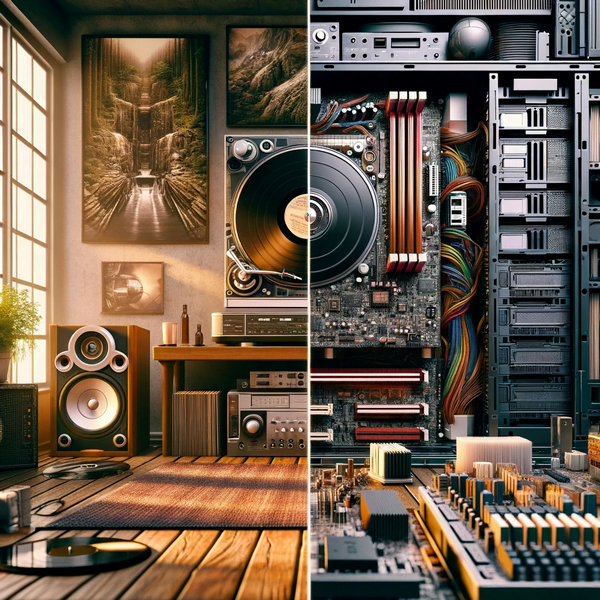
In the world of electronics and telecommunications, analog and digital systems play crucial roles. The evolution of technology has brought with it an ongoing debate about the advantages and disadvantages of each of these systems. This article provides a comprehensive understanding of analog and digital systems, exploring their differences, applications, advantages and disadvantages, and how they coexist in today's technological landscape, adapting and evolving to meet the demands of an increasingly digitalized world.
Defining Analog and Digital Systems
What are Analog Systems?
Analog systems represent information continuously, allowing them to handle signals with an infinite number of possible values. This characteristic facilitates the capture and reproduction of subtle variations in physical signals such as sound and light. Analog applications are common in audio and video devices, as well as microphones and loudspeakers, where signal fidelity and richness are essential.
Key Features
- Continuous Data RepresentationAnalog systems capture and process data in a continuous stream, allowing for a more natural representation of physical signals.
- Continuous (Infinite) Values: They can assume an infinite range of values, which gives them the ability to handle signals with very fine variations.
- Susceptibility to noise and lower accuracy: The continuous nature of these signals makes them more vulnerable to interference and noise, which can result in decreased signal quality.
What are Digital Systems?
In contrast, digital systems use discrete signals, commonly represented as zeros and ones, to process and store information. They are ideal for applications that demand high precision and stability, such as telecommunications, advanced data processing , and computing. Their ability to handle large volumes of data efficiently and accurately has transformed numerous fields, from medicine to engineering.
Key Features
- Discrete Representation in Zeros and Ones: This binary representation facilitates the processing, storage and transmission of data.
- Discrete (Finite) Values: They limit the possible values to a finite set, usually zeros and ones, which reduces processing complexity.
- High Precision and Lower Noise Susceptibility: The digital nature significantly reduces the influence of noise and improves signal fidelity.
Comparison: analog and digital system difference
Main Differences
- Precision: Digital systems offer far superior accuracy and reliability than analog ones, which is crucial in applications such as medicine and aviation.
- Representative Values: While digital systems use a limited spectrum of values, analog systems capture a much wider and continuous range.
- Noise Susceptibility: Digital systems have an inherent advantage in terms of resistance to noise and external interference.
- Need for Conversion:To integrate with modern technology, analog systems often require conversion to digital formats, which can involve a loss of the original richness of the signal.
Analog and digital systems examples
- digital: Computers, smartphones, GPS navigation systems.
- Analog: Vinyl records, acoustic musical instruments, mercury thermometers.
Advantages and disadvantages of analog and digital systems
Analog Systems
Advantages
- Sound and Video QualityIn certain aspects, such as the warmth of sound, analog systems can outperform digital ones.
- Bandwidth Efficiency: In some scenarios, analog systems may be more bandwidth efficient.
Disadvantages
- Noise Susceptibility: They are more vulnerable to interference, which can degrade signal quality.
- Signal Degradation: Over time, analog signals can degrade, affecting the quality of the content.
Digital systems
Advantages
- Superior Precision and Stability: They offer unmatched consistency and accuracy in data processing.
- Data Storage and Processing Capacity: They allow large volumes of information to be managed efficiently.
Disadvantages
- Cost and Complexity: They can be more expensive and complex to design and maintain.
- Connectivity Dependency: Some digital systems rely heavily on internet connectivity, which can be a limitation in certain environments.
Modern Applications
In the digital age, most analog systems have been replaced or enhanced with digital technology. However, in areas such as analog audio and video recording, the fidelity and richness of the analog signal is still highly valued. On the other hand, digital systems dominate in fields such as artificial intelligence, machine learning, advanced image processing, and quantum computing, leading the way to a future where precision and efficiency are paramount.
Conclusion
Analog and digital systems, with their distinctive features, coexist and complement each other in the broad spectrum of modern technology. Understanding their differences and applications allows us to better appreciate technological advancement and choose wisely according to our needs. Share this article to foster a greater understanding of analog and digital systems.