- Mathematics is essential in computing to develop efficient algorithms and solve complex problems.
- Graph theory and Boolean algebra are fundamental to digital logic and relationship analysis.
- Cryptography and information theory ensure the protection and efficient transmission of data.
- Complexity analysis allows us to evaluate the performance of algorithms based on their resources and execution time.
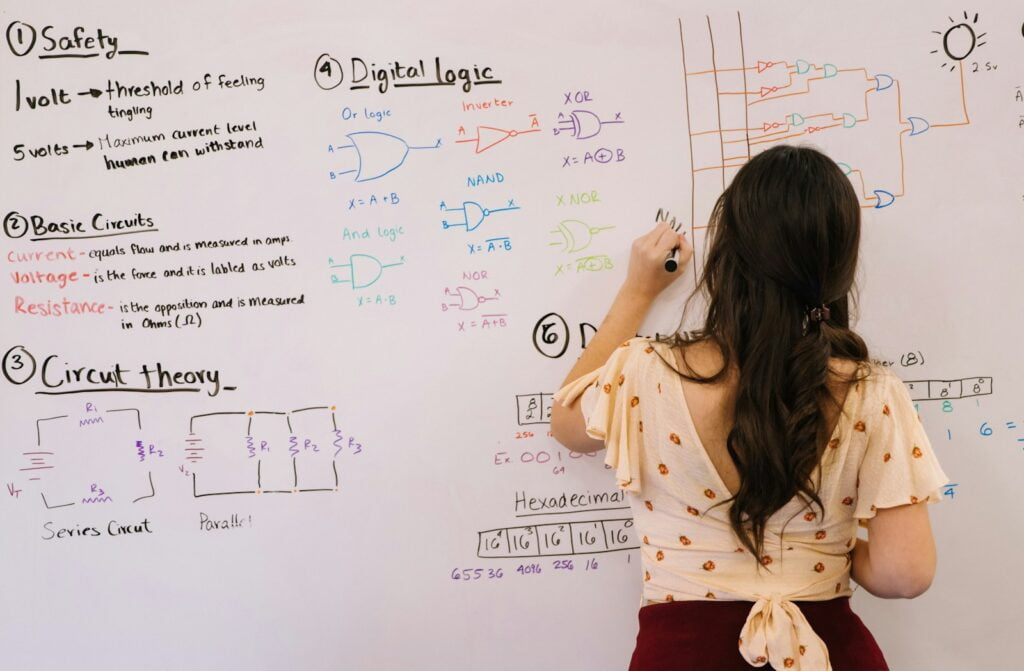
Mathematics and computing are closely intertwined, forming a symbiosis that drives advancements in the digital world. Understanding the underlying mathematical concepts is essential for computing professionals, allowing them to develop efficient algorithms, design robust systems, and solve complex problems. In this article, we will explore the basic concepts and applications of mathematics for computing, unraveling its importance in the field of technology and revealing how it is applied in various areas. As you dive into this journey, you will discover how mathematics can broaden your horizons in the world of computing and open up new career opportunities for you.
Mathematics for Computing: Basic Concepts and Applications
Computational mathematics refers to the mathematical theories, methods, and tools used in the field of computing. This mathematics underlies many fundamental aspects of computer science and is essential for algorithm development, data analysis, computer security, and much more. Below, we will explore some of the key concepts in basic computational mathematics and their practical applications.
Boolean Algebra: The Foundations of Digital Logic
Boolean algebra is one of the fundamental concepts in mathematics for computing. Developed by George Boole in the 19th century, it focuses on the study of logical operations and binary relations. This branch of mathematics is essential for the design of digital circuits and the development of computational logic. Boolean algebra uses the values "true" and "false" to represent logical states and operates through logical operations such as conjunction (AND), disjunction (OR), and negation (NOT). These concepts form the foundation of the digital logic used in the construction of modern computer systems.
Complexity Analysis: Efficiency of Algorithms
Complexity analysis is a key field in computer mathematics that focuses on measuring and evaluating the performance of algorithms. Algorithms are sequences of instructions designed to solve a specific problem. Complexity analysis allows us to determine the efficiency of an algorithm in terms of the time and space required to execute a task. This branch of mathematics is essential for programmers , as it enables them to select the most appropriate algorithm for a given situation and optimize the performance of their programs. Complexity analysis uses notations such as Big O (O(n)) to describe the complexity of an algorithm and establish upper bounds on its execution time.
Graph Theory: Modeling Relationships and Connections
Graph theory is a branch of mathematics that studies the relationships between objects using structures called graphs. A graph consists of vertices (nodes) and edges (connections) that represent the relationships between them. Graph theory has numerous applications in computing, such as representing computer networks, planning optimal routes, and analyzing social networks. Graphs are a powerful way to model and understand interconnections in complex systems. Using graph theory algorithms and techniques, computer professionals can solve optimization problems, find the best route on a map, and analyze the structure of a network, among other applications.
Calculus: The Basis of Data Science
Calculus is a branch of mathematics that deals with change and variation. In the context of computing, calculus is critical to understanding and applying data analysis techniques. Calculus is divided into two main branches: differential calculus and integral calculus. Differential calculus focuses on the study of rates of change and differentiation, while integral calculus deals with accumulation and integration. These concepts are essential in data science, where they are used to analyze patterns, model phenomena, and make predictions. Calculus enables computing professionals to extract valuable insights from large data sets and make informed decisions based on quantitative analysis.

Probability and Statistics: Data Analysis and Decision Making
Probability and statistics are branches of mathematics that deal with data analysis and decision-making under conditions of uncertainty. Probability studies random events and assigns numerical measures to their occurrence. Statistics, on the other hand , focuses on the collection, analysis, and interpretation of data to draw meaningful conclusions. These concepts are fundamental in data science, where they are used to model uncertainty, make inferences, and test hypotheses. Probability and statistics are powerful tools for computer professionals, enabling them to understand the inherent uncertainty in data and make evidence-based decisions.
Cryptography: Protecting Sensitive Information
Cryptography is a specialized field of computer mathematics concerned with protecting sensitive information using encryption and decryption techniques. Cryptography is widely used in computer security, where it ensures the confidentiality, integrity, and authenticity of data. This discipline uses mathematical algorithms to transform readable data into incomprehensible information, which can only be reversed with the correct key. Cryptography covers a wide range of techniques, from classical encryption to modern public key systems. Computer professionals working in computer security must have a solid understanding of cryptographic mathematics to ensure the protection of sensitive data.

Information Theory: Measurement and Communication of Information
Information theory is a branch of mathematics that deals with the quantification, storage, and communication of information. This theory was developed by Claude Shannon in the 1940s and laid the foundation for modern digital communication. Information theory uses concepts such as entropy and data compression to measure the amount of information contained in a source and to optimize its transmission and storage. Data compression algorithms, channel coding systems, and error correction algorithms are some of the practical applications of information theory in computing. This theory is essential for efficient data transmission over communication networks and file compression to save storage space.
Mathematical Logic: Fundamentals of Computing
Mathematical logic is a field that combines logic and mathematics to study formal reasoning and the foundations of computation. Mathematical logic uses symbols and rules to represent propositions and arguments, enabling a rigorous analysis of their validity. This discipline is essential in computer science, where it is used to prove properties of algorithms, establish the correctness of programs, and solve decision problems. Mathematical logic is the basis for the design of programming languages, compilers, and formal systems used in building reliable software.
Computational Geometry: Modeling Shapes and Spaces
Computational geometry is a branch of mathematics that deals with the study of geometric algorithms and structures in computing. This discipline uses geometric techniques to solve problems related to image processing, computer-aided design, robotics, and simulation of physical phenomena. Computational geometry covers areas such as distance calculation, collision analysis, and representation of three-dimensional objects. Computer professionals working in fields such as virtual reality, computer animation, and computer vision must have a solid understanding of computational geometry to model and manipulate shapes and spaces in virtual environments.

Neural Networks: Simulation of Human Intelligence
Artificial neural networks are computational models inspired by the workings of the human brain. These networks are composed of interconnected nodes (artificial neurons) and are used for machine learning and artificial intelligence. Mathematics plays a crucial role in the design and training of neural networks, as they are based on mathematical algorithms and optimization techniques. Differential equations, linear algebra, and calculus are some of the mathematical tools used in the analysis and development of neural networks. Neural networks have revolutionized fields such as speech recognition, computer vision, and natural language processing, and they continue to be an active area of research at the intersection of mathematics and computer science.
Databases: Organization and Manipulation of Information
Databases are structures used to efficiently store, organize, and retrieve large amounts of information. Mathematics plays a fundamental role in the design and manipulation of databases, as it is used to establish relationships, define data structures, and optimize queries. Relational algebra is a mathematical tool used to model and manipulate data in relational databases. Databases are present in almost all modern information systems, from websites and mobile applications to enterprise management systems. Computer professionals working with databases must have a solid understanding of the underlying mathematics to ensure the efficiency and integrity of the stored data.

Genetic Algorithms: Inspired by Biological Evolution
Genetic algorithms are search and optimization techniques based on evolutionary and genetic principles. These algorithms use concepts such as natural selection, reproduction, and mutation to find optimal solutions to complex problems. Genetic algorithms are especially useful in solving optimization and design problems and have proven effective in fields such as circuit design, route planning, and parameter optimization. These algorithms rely on mathematical operations, such as solution encoding, fitness evaluation, and the application of genetic operators. Genetic algorithms exemplify how mathematics and computer science combine to solve complex problems using principles inspired by nature.
Number Theory: The Science of Integers
Number theory is a branch of mathematics that deals with the study of the properties of integers and their relationships. Although this discipline has a long history dating back to ancient times, it is still relevant in modern computing. Number theory is used in fields such as cryptography, pseudo-random number generation, and data encryption. Computer professionals working in computer security must have a solid understanding of number theory to ensure the security of systems and the protection of information. Furthermore, number theory is essential in the design of efficient algorithms, such as Euclid's algorithm for computing the greatest common divisor and the integer factorization algorithm.
Optimization: Finding the Best Result
Optimization is a field of mathematics concerned with finding the best possible solution to a problem , given certain constraints. In the context of computing, optimization is used to solve linear programming problems, find the best path in a graph, optimize algorithm parameters, and much more. Optimization utilizes mathematical techniques such as linear programming, integer programming, nonlinear programming, and heuristic search methods . Computing professionals working in areas such as logistics, resource planning, and systems design need strong optimization skills to make informed and efficient decisions.
Linear Algebra: Transformations and Vectors
Linear algebra is a branch of mathematics that deals with the study of vector spaces, linear transformations, and systems of linear equations. This discipline is fundamental in computing, as it is used in areas such as computer graphics, image processing, machine learning, and artificial intelligence. Linear algebra allows for the efficient representation and manipulation of multidimensional data using matrices and vectors. Factorization algorithms, least squares methods, and singular value decomposition are some of the concepts used in linear algebra to solve complex computational problems.
Numerical Calculus: Function Approximation
Numerical computation is a branch of mathematics that deals with the study of methods and techniques for performing approximate numerical calculations. In computing, numerical computation is essential for performing mathematical operations on digital systems with finite precision. This discipline covers areas such as interpolation, numerical integration, solving differential equations, and function approximation. Numerical computation uses algorithms and techniques that allow obtaining numerical results close to exact values using a finite amount of computational resources. Computing professionals must have knowledge of numerical computation to perform efficient and accurate calculations in their applications and systems.
Automata Theory: Modeling Behaviors
Automata theory is a field of study at the intersection of mathematics and computer science that deals with the analysis and design of models of dynamic systems. Automata are mathematical models that represent systems that evolve over time through state transitions. These models are used in the design and analysis of digital circuits, the development of compilers, and the formal verification of systems. Automata theory is based on concepts such as finite automata, pushdown automata, and Turing machines, which are fundamental to the study of computability and computational complexity.
Game Theory: Strategies and Decision Making
Game theory is a field of mathematics that deals with the study of mathematical models of conflict and cooperation among rational agents. In the context of computing, game theory is applied in areas such as artificial intelligence, multi-agent systems, and computational economics. This theory uses concepts such as strategies, equilibria, and utility functions to analyze and predict the behavior of agents in interaction situations. Game theory allows computing professionals to develop algorithms and strategies that optimize outcomes in competitive or collaborative environments.
Linear Programming: Resource Optimization
Linear programming is a mathematical optimization technique used to solve problems involving maximization or minimization of a linear function subject to linear constraints. In computing, linear programming is applied in areas such as logistics, resource planning, and task allocation. This technique allows finding the best allocation of limited resources to maximize performance or minimize costs. Linear programming uses methods such as the simplex method and integer linear programming to find optimal solutions to linear optimization problems.

Numerical Analysis: Study and Approximation of Functions
Numerical analysis is a branch of mathematics that deals with the study of methods and techniques for approximating and studying functions by numerical calculations. In computing, numerical analysis is essential for solving problems that do not admit exact analytical solutions. This discipline uses methods such as interpolation, extrapolation, Newton's methods, and quadrature methods to approximate function values and calculate derivatives and integrals numerically. Numerical analysis allows computing professionals to perform accurate and efficient calculations in situations where analytical solutions are difficult or expensive to obtain.
Computer Networks: Interconnection and Communication
Computer networks are systems that enable the interconnection and communication between computing devices. In the study of mathematics for computing, computer networks are analyzed from both theoretical and practical perspectives. Graph theory and information theory are fundamental mathematical tools in the design and analysis of computer networks. These disciplines allow us to understand and model interconnections, data routing, communication protocols, and network security. Computer professionals working in the field of networking must have a solid understanding of the underlying mathematics to design and maintain efficient and secure networks.
Complexity Theory: Limits and Classification of Problems
Complexity theory is a field of mathematics and computer science that deals with the study of the computational difficulty of problems and the limits on algorithmic efficiency. Complexity theory uses concepts such as complexity classes, NP-complete problems, and polynomial reductions to classify and analyze the complexity of computational problems. Complexity theory provides tools for understanding which problems are inherently difficult to solve and how they can be classified according to their complexity. Computer science professionals working in algorithms, computation theory, and system design must have a solid understanding of complexity theory to understand the limits on algorithmic efficiency and develop optimal solutions.
Frequently Asked Questions about Mathematics for Computation
1. What is the importance of mathematics for computing?
Mathematics is fundamental to computing, providing the principles and tools needed for developing efficient algorithms, modeling complex problems, and analyzing data. Mathematics enables computing professionals to solve difficult problems, optimize systems, and understand the theoretical foundations of computer science. Without a solid understanding of mathematics, it would be difficult for computing professionals to advance in fields such as artificial intelligence, cryptography, data analysis, and optimization.
2. What branches of mathematics are relevant to computing?
Several branches of mathematics are relevant to computing, including Boolean algebra, complexity analysis, graph theory, calculus, probability and statistics, cryptography, information theory, mathematical logic, computational geometry, neural networks, number theory, optimization, linear algebra, numerical analysis, automata theory, game theory, linear programming, numerical analysis, computer networks, complexity theory, among others. Each of these branches provides specific mathematical tools and concepts that are applicable in different areas of computing.
3. Why is complexity analysis important in computing?
Complexity analysis is fundamental in computing, as it allows the performance of algorithms to be measured and evaluated. Understanding the complexity of an algorithm is crucial to selecting the best solution in terms of runtime and resources used. Complexity analysis provides an estimate of how much time and resources will be required to run an algorithm based on the size of the input data. This is especially important in large and complex problems, where the efficiency of the algorithm can make a difference in the feasibility of a solution. Furthermore, complexity analysis is also useful for comparing and ranking algorithms based on their performance.
4. How is graph theory applied in computing?
Graph theory has multiple applications in computing. First, it is used to represent and analyze relationships and connections between objects, such as in computer networks. Furthermore, graph theory is essential in the design of graph search, traversal, and optimization algorithms. For example, breadth-first search and depth-first search algorithms rely on graph theory to find specific paths or structures in a graph. Graph theory is also applied in optimal path planning, resource allocation, and social network analysis. In short, graph theory is a powerful tool for modeling and solving problems involving connections and relationships.
5. What is the relationship between mathematics and cryptography?
Mathematics plays a fundamental role in cryptography, providing the theoretical foundations and algorithms needed to protect sensitive information. Cryptography uses mathematical concepts such as modular operations, number theory, linear algebra, and information theory to securely encrypt and decrypt data. Cryptographic algorithms are based on mathematical principles that ensure the confidentiality, integrity, and authenticity of data. Without mathematics, cryptography would not be able to provide the levels of security needed to protect information in digital systems.
6. What is the role of information theory in computing?
Information theory is essential in computing, as it provides the theoretical basis for efficiently measuring, storing, and transmitting information. Information theory uses mathematical concepts such as entropy and data compression to quantify the amount of information contained in a source and to optimize its transmission and storage. Data compression algorithms, channel coding systems, and error correction algorithms are based on information theory to reduce data size, eliminate redundancies, and ensure the integrity of transmitted information. Information theory is fundamental in fields such as digital communications, file compression, and signal processing.
Conclusion of Mathematics for Computing
Mathematics is the universal language of computing, providing the theoretical foundations and practical tools for the development of computer science. From Boolean algebra to graph theory, from calculus to cryptography, mathematics is present in all areas of computing. Understanding the basic concepts and applications of computational mathematics is essential for computing professionals, as it allows them to solve complex problems, optimize algorithms, analyze data, and design efficient and secure systems. If you aspire to a successful career in the field of computing, I encourage you to explore and master the mathematical concepts underlying this discipline. Computational mathematics will open the doors to a world full of exciting possibilities and challenges!
