- Microservices allow you to develop modular and scalable applications by breaking down functions into independent services.
- They offer agility and speed in development, facilitating the incorporation of changes.
- Its adoption improves the resilience of the system, since a failure in one service does not affect others.
- They use heterogeneous technologies, allowing teams to select the best tool for each specific task.


Why are microservices important?
A brief history of microservices
What are microservices?
1. Definition of microservices
2. Key features of microservices
- Decoupling:Each microservice is independent and can be developed, deployed and scaled autonomously, without affecting other services.
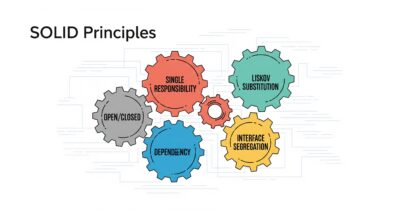
- Single responsibility: Each microservice is responsible for a specific task or functionality, following the single responsibility principle.
- Heterogeneous technologies: Microservices can be developed in different programming languages and technologies, allowing you to choose the best tool for each task.
- Resilience: Because they are decoupled, a failure in one microservice does not affect the entire system, improving overall resilience.
- Scalability: Microservices can be scaled independently as needed, optimizing resource usage.
Link to Wikipedia on microservices
Microservices architecture

1. Components of microservices architecture
- Microservices: The main components of the architecture, each responsible for a specific task or functionality.
- API Gateway: A centralized entry point that routes requests to the appropriate microservices and manages security, authentication, and routing.
- Service registration: A component that maintains an up-to-date record of all available microservices and their locations.
- monitoring and recording: Tools to monitor microservices performance, health, and logs.
- Communication between services: Mechanisms for microservices to communicate securely and efficiently, such as HTTP/REST, messaging, or event streaming.
2. Communication patterns between microservices
- Request/Response: One microservice makes a request to another and waits for a response, commonly using HTTP/REST.
- Asynchronous Messaging: Microservices communicate through a messaging system, such as message queues or event streaming systems. In this approach, a microservice sends messages to a queue or topic, and other microservices consume those messages asynchronously. This pattern allows for greater decoupling and scalability.
- Event streaming: Microservices publish and consume continuous streams of real-time events using event streaming systems, such as Apache Kafka or Amazon Kinesis. This approach is suitable for use cases that require real-time data processing and high scalability.
- Choreography of events: Instead of direct communication between microservices, a centralized event bus is used where microservices publish and listen for relevant events. Each microservice reacts to events independently, promoting greater decoupling.
- Remote Procedure Calls (RPC)Microservices can communicate via RPC protocols, such as gRPC, which provide more efficient, binary-oriented communication compared to HTTP/REST.
- Shared database queriesIn some cases, microservices can access and query shared databases for relevant data, although this approach can introduce increased coupling and should be handled carefully.
Advantages of microservices
1. Agility and speed of development
2. Scalability and resilience
3. Ease of maintenance
4. Adoption of new technologies
5. Challenges of microservices
6. Management complexity
7. Distributed monitoring and logging
8. Testing and deployment
9. Security and compliance
Microservices vs. Monolithic Architecture
Comparison of approaches
- Monolithic Architecture: An application is built as a single unit, where all components are tightly coupled and deployed as a single package.
- Microservices architecture: The application is divided into smaller, independent services, each focused on a specific task or functionality and deployed individually.
When to choose microservices?

Microservices use cases

1 Electronic commerce
2. Financial services
3. Medical care
4. Entertainment and media
Popular tools and frameworks
1. Container management (Docker, Kubernetes)
2. Service orchestration
3. API Gateways
4. Monitoring and recording
Best practices for implementing microservices
1. Cohesive service design
2. Infrastructure automation
3. Proactive monitoring
4. Distributed data management
The future of microservices
Trends and advances in microservices
- Event-driven microservicesEvent-driven communication patterns such as event streaming and asynchronous messaging are expected to gain more popularity in microservices architectures.
- Serverless Services: The combination of microservices and serverless services is gaining ground, allowing for greater scalability and efficiency in resource usage.
- Artificial Intelligence and Machine LearningIncorporating AI and Machine Learning capabilities into microservices can enable smarter, more adaptive applications.
- Service MeshService meshes, such as Istio and Linkerd, make it easy to manage and monitor microservices in complex environments, providing features such as intelligent routing, traffic management, and resiliency.