- Definition: physical devices with sensors and connectivity that collect, exchange, and process data to make autonomous decisions.
- Key components: sensors, connectivity (Wi-Fi, Bluetooth, 4G/5G, LPWAN), analytics platforms, and cloud or edge storage.
- Applications: smart homes and cities, industry 4.0, connected health, improving efficiency, security and personalization.
- Risks and challenges: security, privacy, interoperability and standardization; require regulations, robust measures and education.
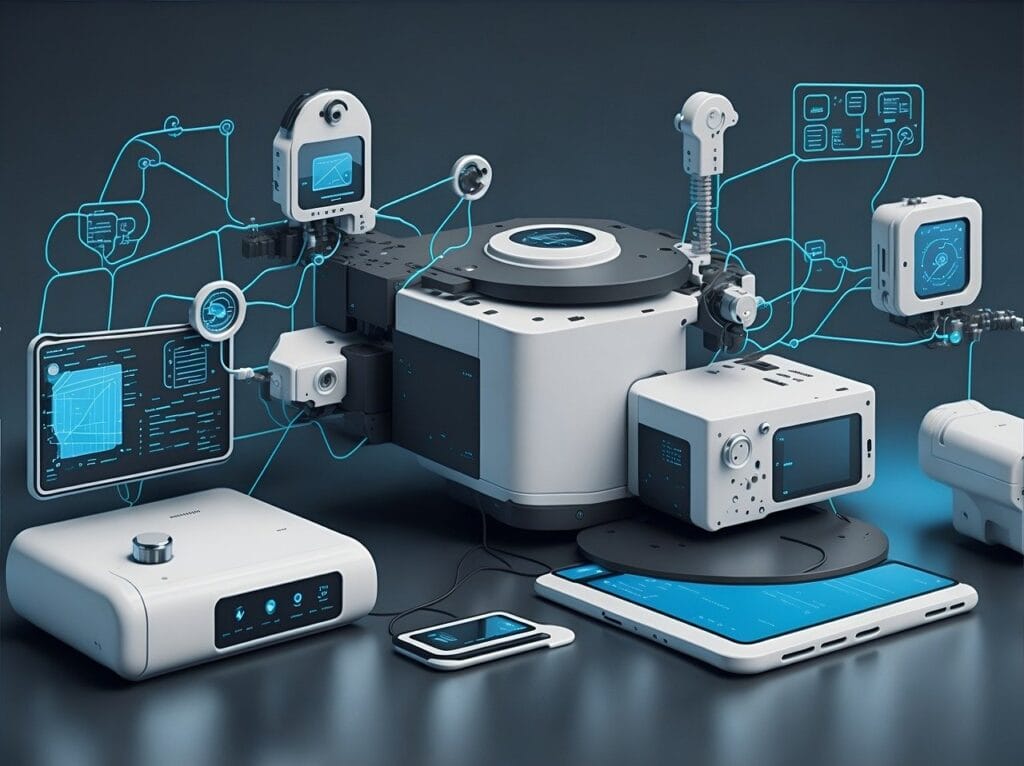
In the 21st century, we are experiencing an unprecedented technological revolution. Devices that were once “dumb” are now “smart,” and everyday objects are becoming nodes in a global network. This fascinating phenomenon has a name: the Internet of Things (IoT). But what does this technology really entail and how is it changing our world? What is the Internet of Things?
In this text, we'll unravel the mysteries of the IoT, from its fundamentals to its most innovative applications. Prepare for a journey to the heart of modern connectivity that will open your eyes to a future that's already here.
What is the Internet of Things?
The Internet of Things refers to the interconnected network of physical devices, vehicles, appliances and other items embedded with electronics, software, sensors and network connectivity, allowing these objects to collect and exchange data. But how does it actually work?
Imagine your fridge sending a message to your smartphone to let you know you’re out of milk. Or your car communicating with traffic lights to optimize your route to work. That’s IoT in action: everyday objects becoming “smart” and working together to make our lives easier and more efficient.
The key to IoT lies in its ability to create a digital ecosystem where devices communicate with each other and with us, making autonomous decisions based on the data they collect. This interconnection not only improves the efficiency of our daily tasks but also opens the door to innovations that previously seemed like science fiction.
Have you ever wondered what it would be like to live in a world where everything is connected? Well, we are already on the way to that reality. The IoT is transforming entire industries, from manufacturing to healthcare, and redefining concepts like “home” and “city.”
What is the Internet of Things: History and evolution of IoT
The concept of the Internet of Things did not emerge overnight. Its history is fascinating and goes back further than many people think. Did you know that the idea of interconnected objects was already being discussed in the 1980s?
It all started with a simple Coca-Cola vending machine at Carnegie Mellon University in 1982. Programmers could connect to the machine via the Internet to check if cold drinks were available. Although it may seem rudimentary, this was the first Internet-connected device that wasn't a computer.
But the term “Internet of Things” wasn’t coined until 1999, when Kevin Ashton, co-founder of MIT’s Auto-ID Center, used it in a presentation to Procter & Gamble. Ashton envisioned a system where Internet-connected sensors could manage inventories.
Since then, the IoT has experienced exponential growth:
- 2000-2010: The proliferation of smartphones and tablets laid the groundwork for ubiquitous connectivity.
- 2011-2015: The rise of wearables like Fitbit and Apple Watch popularized the idea of connected personal devices.
- 2016–present: The arrival of voice assistants like Alexa and Google Home brought IoT into the homes of millions of people.
Today, there are an estimated 30 billion connected IoT devices worldwide. And this is just the beginning. With the advent of 5G and advances in artificial intelligence, the potential of IoT seems limitless.
Key components of the Internet of Things
To truly understand how the IoT works, it's crucial to know its main components . It's like putting together a puzzle: each piece plays a vital role in creating the complete picture.
Devices and sensors
At the heart of the IoT are devices and sensors. These are the “eyes and ears” of the system, collecting data from the physical world and converting it into digital information. They can be as simple as a temperature sensor in your fridge or as complex as the navigation systems in a self-driving car.
Sensors can measure a wide range of conditions:
- Temperature
- Humidity
- Movement
- Pressure
- Energy
- And many more
¿.
Connectivity and networks
Once sensors collect data, they need a way to transmit it. This is where connectivity technologies come into play. Depending on the specific needs, IoT devices can use various forms of connection:
- Wi-Fi: Ideal for home devices that need to transfer large amounts of data.
- Bluetooth: Perfect for short-range, low-power connections.
- Cellular networks (4G, 5G): Great for mobile devices or in areas without Wi-Fi.
- LPWAN (Low-Power Wide-Area Network): Designed specifically for IoT, they enable long-range communications with low power consumption.
The choice of connectivity technology depends on factors such as the range required, the amount of data to be transmitted and power consumption.
Data and analytics platforms
Data alone is not useful. It needs to be processed, analyzed, and transformed into actionable information. This is where IoT data and analytics platforms come in.
These platforms are the brains of the operation. They receive data from connected devices, process it using advanced algorithms and machine learning, and generate valuable insights. For example, an IoT platform could analyze your home’s energy consumption patterns and suggest ways to reduce your electric bill.
Some of the most popular IoT platforms include:
- AWS IoT
- Google Cloud IoT
- Microsoft Azure IoT
- IBM Watson IoT
These platforms not only process data, but also manage the security, scalability and interoperability of IoT systems.
Practical applications of IoT
The Internet of Things is not just a futuristic technology; it is here and now, transforming various aspects of our daily lives. Let's look at some of its most impactful applications:
Smart homes
Have you ever dreamed of a home that adapts to your needs? With IoT, that dream is becoming a reality. Smart homes use connected devices to improve comfort, energy efficiency, and security.
Examples of smart home applications:
- Thermostats that learn your preferences and adjust the temperature automatically.
- Lighting systems that adapt to your daily routine.
- Smart locks that you can control from your smartphone.
- Voice assistants that manage your appliances and answer your questions.
Imagine coming home on a hot day to find the air conditioning turned up to the perfect temperature, the blinds drawn to block out the sun, and your favorite playlist playing softly. All of this is possible thanks to IoT.
connected cities
Cities are using IoT to become more efficient, sustainable and livable. Smart cities use sensors and data analytics to improve services such as transportation, waste management and public safety.
Some fascinating applications in smart cities include:
- Smart traffic lights that adjust their timing based on real-time traffic flow.
- Garbage containers that warn when they are full to optimize collection routes.
- Public lighting systems that adjust according to natural light and the presence of people.
- Smart parking that guides drivers to free spaces.
Can you imagine a city where you never have to drive around in circles looking for parking? With IoT, this could soon be a common reality.
Industry 4.0
The IoT is revolutionizing industry, giving rise to what is known as Industry 4.0 or the fourth industrial revolution. Smart factories use sensors and data analytics to optimize production, reduce downtime, and improve product quality.
Examples of IoT in industry:
- Predictive maintenance: Machines can predict when they will need repairs before they break down.
- Real-time inventory management: Systems can automatically place orders when supplies are low.
- Supply Chain Monitoring: Real-time tracking of products from factory to consumer.
Imagine a factory where machines communicate with each other to optimize production, detect problems before they occur, and automatically adapt to changes in demand. That’s the power of IoT in action.
Health & Wellness
The healthcare sector is undergoing a radical transformation thanks to IoT. From wearable devices that monitor our vital signs to smart hospital systems, IoT is improving patient care and medical efficiency.
IoT applications in health:
- Connected glucose monitors that help diabetics control their blood sugar levels.
- Smart pillboxes that remind patients when to take their medication.
- Telemedicine systems that allow remote consultations with doctors.
- Tracking devices for seniors that can alert caregivers in case of falls or emergencies.
Can you imagine a world where your doctor could detect health problems before you even realize something is wrong? With IoT, we are closer than ever to making this vision of preventative, personalized healthcare a reality.
Advantages and opportunities of the Internet of Things
The Internet of Things is not just a technological trend; it is a paradigm shift that is creating endless opportunities and benefits. Let's look at some of the most significant advantages:
- Improved efficiency: IoT optimizes processes in various sectors. For example, in agriculture, sensors can monitor soil conditions and activate irrigation systems only when necessary, saving water and improving harvests.
- Cost savingsBy providing real-time data, IoT enables businesses and consumers to make more informed decisions. Imagine a heating system that automatically adjusts based on the weather forecast, thereby reducing your energy bill.
- better decision making: With access to more data and real-time analytics, individuals and organizations can make faster, more informed decisions.
- Improved quality of lifeFrom more comfortable homes to safer and cleaner cities, IoT has the potential to significantly improve our quality of life.
- New business models: IoT is creating opportunities for innovative services and products. For example, insurers can now offer customized policies data driven real-time driving.
- Sustainability: IoT plays a crucial role in creating more sustainable solutions, from smart waste management to optimizing energy consumption in buildings.
- Personalization.: With the IoT, products and services can be tailored to individual preferences more than ever before. Imagine a car that automatically adjusts the seat, mirrors and temperature depending on who is driving.
The potential of IoT is truly limitless. Have you ever wondered how it could improve your daily life or your business? The possibilities are fascinating.
Challenges and concerns surrounding IoT
Despite its many advantages, the Internet of Things also poses significant challenges that we must address to fully harness its potential. Let's look at some of the main obstacles:
Security and privacy
Security is undoubtedly one of the biggest concerns in the world of IoT. With billions of connected devices, each one is a potential entry point for cyberattacks.
Main security issues:
- Device vulnerabilities: Many IoT devices have weak or non-existent security measures.
- Denial of Service (DDoS) attacks: IoT devices can be hijacked to launch massive attacks.
- Data theft: IoT devices collect large amounts of personal data that could be subject to theft.
- Privacy: The constant collection of data raises concerns about how it is used and who has access to it.
Have you ever wondered how much information your smart devices are collecting about you? It's a question that many privacy experts are asking.
To address these concerns, it is crucial to:
- Implement robust security measures on all IoT devices.
- Educate users on security best practices.
- Develop regulations that protect consumer privacy in the context of IoT.
Interoperability and standardization
Another major challenge is the lack of uniform standards in the IoT industry. With so many different manufacturers and protocols, getting all devices to “speak the same language” is a significant challenge.
Interoperability issues:
- Difficulty integrating devices from different manufacturers.
- Complexity in managing heterogeneous IoT ecosystems.
- Obstacles to scalability of IoT solutions.
Imagine having a smart home where your thermostat can’t communicate with your lighting system because they use different protocols. Frustrating, right?
To overcome this challenge, the industry is working on:
- Development of open standards such as MQTT and CoAP.
- Creating industrial alliances to promote interoperability.
- Implementation of IoT platforms that can act as “translators” between different devices and protocols.
The future of the Internet of Things
As we move towards an increasingly connected world, the future of IoT is shaping up to be exciting territory full of possibilities. What does tomorrow hold for the Internet of Things universe?
- Integration with AI and Machine Learning: The combination of IoT and artificial intelligence promises to create even smarter and more autonomous systems. Imagine a home that doesn't just respond to your commands, but learns and anticipates your needs.
- Edge Computing:To reduce latency and improve efficiency, we will see more data processing at the “edge” of the network, close to where the data is generated, rather than in the cloud.
- 5G and beyond: 5G and future generation networks will provide the speed and capacity to support billions of simultaneously connected IoT devices.
- Large-scale Industrial IoT: We will see massive adoption of IoT in the industry, taking automation and efficiency to new levels.
- Omnipresent smart citiesSmart cities will move from pilot projects to large-scale implementations, transforming urban life as we know it.
- Advanced wearables: Beyond the Watches smart, we will see clothing and accessories with integrated sensors that continuously monitor our health and well-being.
- Connected autonomous vehicles:Cars will not only be autonomous, but will communicate with each other and with road infrastructure to create a safer and more efficient transportation ecosystem.
Can you imagine a world where your car communicates with your home to make sure dinner is ready when you get home? Or where cities can predict and prevent traffic problems before they happen? This is the kind of future that IoT is making possible.
How to prepare for a hyperconnected world
With the rapid advancement of IoT, it is crucial to be prepared for a future where connectivity will be omnipresent. Here are some tips to help you navigate this new world:
- Educate yourself: Stay informed about the latest trends and developments in IoT. Knowledge is power in the digital age.
- Prioritize safety: Learn about IoT device security best practices and apply them in your daily life.
- Be aware of your privacy: Understand what data your devices are collecting and how it is being used.
- Embrace technology, but judiciously: Don’t adopt IoT technology just because it’s new and shiny. Evaluate how it can truly improve your life or business.
- Develop relevant skills: If you're in the professional world, consider learning about data analysis, programming, or cybersecurity—skills that will be crucial in an IoT world.
- Join the debate: The ethical and social implications of IoT are profound. Join in discussions and debates about how we want this technology to become part of our lives.
Are you ready for the hyper-connected future? The key is to be proactive and adaptable.
Conclusion of what is the Internet of Things
The Internet of Things is not just another technological trend; what is the Internet of Things is a paradigm shift that is redefining our relationship with the physical and digital world. From our homes to our cities, from our health to the way we work, the IoT is leaving its mark on virtually every aspect of our lives.
While the challenges are significant, especially in terms of security and privacy, the opportunities offered by the IoT are truly transformative. We are on the threshold of a world where technology seamlessly integrates into our environment, anticipating our needs and improving our quality of life in ways we can barely imagine.
The question is no longer whether the Internet of Things will change our world, but how we will navigate and shape that change. What is the Internet of Things if not an invitation to explore new possibilities? Are we prepared to embrace the possibilities and face the challenges that come with a hyper-connected world?
Ultimately, the true power of IoT lies in its ability to connect us not only with devices, but also with each other and our environment in more meaningful and efficient ways. What is the Internet of Things if not a tool that promises a future where we are all more connected? The future of IoT is, in essence, our future. And it's a future that promises to be as exciting as it is transformative.
And you, how do you think the Internet of Things will change your life in the coming years?