- France has initiated a digital sovereignty strategy that includes abandoning Windows in administration and adopting Linux and free software.
- DINUM coordinates an inter-ministerial plan that requires each ministry to submit a roadmap to reduce dependence on non-European suppliers.
- Tools like Tchap, Visio, and FranceTransfert are replacing Microsoft and Google services, as the health data platform migrates to solutions considered reliable.
- The goal is to regain control over data, infrastructure and key technological decisions, while supporting the European digital ecosystem.

France has decided to take a decisive step on digital sovereignty , placing at the center of the debate a decision that, for years, many governments had only half-heartedly considered: phasing out Windows on public administration computers in favor of Linux and other free software solutions. This is not simply a technical change, but a political, economic, and security strategy aimed at reducing dependence on large non-EU technology providers, especially those from the United States.
This move, led by the Interministerial Directorate for Digital Affairs (DINUM), is part of a broader offensive to regain control over the State's critical data, infrastructure, and tools . It's not just that public computers will stop using Windows: the plan also encompasses office suites, videoconferencing platforms, messaging, file transfer, databases, virtualization systems, cybersecurity tools, and even healthcare services. All of this is being coordinated at the interministerial level and aligned with the European agenda for digital sovereignty.
Why France wants to abandon Windows and switch to Linux
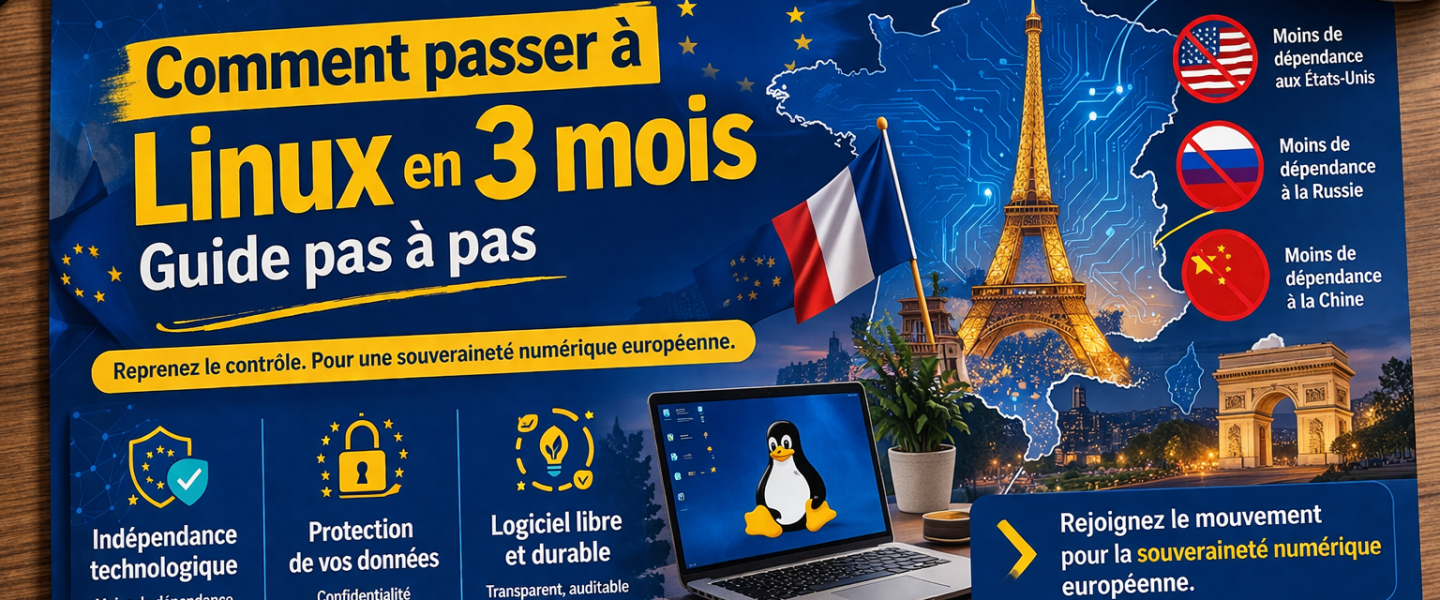
The starting point is clear: the French administration considers it unsustainable to rely on tools over which it has no control regarding regulations, pricing, or technological evolution . Windows, as a proprietary operating system developed by Microsoft, and tools like BitLocker have become the de facto standard in governments and businesses for years, but also a source of strategic vulnerabilities for those who lack the power to decide on their roadmap.
David Amiel, Minister of Public Action and Accounts, has expressed this concern very directly, stating that France can no longer accept that its data, infrastructure, and strategic decisions are dictated by solutions controlled from outside Europe . This includes both the operating system and the services that support it: data hosting, productivity suites, communications, and even artificial intelligence platforms.
From the government's perspective, the hegemony of large US technology companies creates a relationship of structural dependency . This dependency translates into a lack of room for maneuver on sensitive issues such as license costs, changes in subscription models, privacy policies, update management, and integration with other systems. By investing in Linux and free software, France seeks to build an ecosystem in which it can directly influence standards, development, and advanced security in Linux.
Added to all this is the geopolitical context: the European Union has been insisting for years on the need to strengthen its digital sovereignty , especially since the Trump administration, perceived as hostile to some EU interests and closely aligned with the US tech giants. The French decision did not arise out of thin air, but rather is part of this trend toward seeking more autonomous, auditable, and, as far as possible, European technologies.
The role of DINUM and the interministerial seminar
The main technical and organizational driver of this transition is the Interministerial Directorate for Digital Affairs (DINUM), the body that coordinates the French state's digital policies . It was precisely DINUM that, almost a year after announcing its intention to embrace free software, organized a key interministerial seminar to finalize the action plan.
The meeting brought together ministers, major public operators, state agencies, private companies, and other stakeholders in the French digital ecosystem . The aim was to move beyond discussing digital sovereignty as an abstract concept and bring the debate down to earth: what specific tools will be replaced, within what timeframe, with what alternatives, and under what methods of intersectoral collaboration.
The seminar, organized by DINUM in conjunction with the Directorate-General for Enterprise, the French National Cybersecurity Agency, and the Directorate-General for Public Procurement, resulted in an initial set of concrete measures. The most significant was the formal announcement of the phase-out of Windows in favor of Linux workstations within DINUM's own services , which will spearhead the migration within the administration.
This approach is not limited to changing operating systems in isolation. DINUM advocates a working method based on coalitions between ministries, large public operators, and private companies , relying on interoperability standards and what they call "digital commons," such as open projects like Open-Interop and OpenBuro. The idea is that technological modernization should not be fragmented by administrative silos, but rather advance in a coordinated manner.
In parallel, it has been agreed that each ministry and its main dependent agencies must develop their own roadmap to reduce dependence on non-European suppliers. These plans must be ready before autumn and will be integrated into a joint strategy, coordinated by DINUM, to prioritize and plan investments and avoid duplication.
Linux as the basis for the new state workstations
One of the points that has generated the most attention is the decision to adopt Linux as the operating system for the administration's computers. DINUM has officially announced its departure from Windows to switch to "workstations running the Linux operating system ," a wording that makes it clear that the intention is not a one-off trial, but a structural change.
For now, the government has not specified which Linux distributions are being considered or what the exact migration timeline will be . This caution makes sense: choosing a distribution involves decisions about support, security, compatibility with existing hardware, training for public employees, and relationships with vendors that can offer professional services on those platforms.
To prepare the ground, the State Procurement Department and the Directorate General for Business have been tasked with creating a comprehensive map of current dependencies . This includes identifying what critical software is currently in use, which applications are strictly tied to Windows, which can run seamlessly on Linux (or via compatibility tools), and what custom developments would need to be undertaken.
With that inventory in hand, a realistic transition schedule will be defined, with progressive phases. TechCrunch has indicated that the first wave of migration will begin with DINUM's own teams , which makes sense: they are the most accustomed to the technical environment and can act as a testing ground before extending the change to less technologically advanced ministries.
Although no firm dates have been set, the political messages are unequivocal. Both David Amiel and Anne Le Hénanff, Minister Delegate for Artificial Intelligence and Digital Technology, have reiterated that "digital sovereignty is not an option, it is a strategic necessity ." By placing Linux at the heart of this strategy, France seeks to gain room for maneuver, strengthen security, and foster development ecosystems that are not subject to the dictates of a single company.
Beyond the operating system: collaborative suite and communications
The French movement is not limited to the operating system. The government is also replacing tools from Microsoft, Google, and other American providers with its own or open-source solutions , especially in sensitive areas such as communication, collaboration, and document sharing.
A prime example is the decision by the Caisse Nationale d'Assurance Maladie (CNAM), the National Health Insurance Fund, to migrate tens of thousands of employees to the tools of the interministerial digital platform . These include Tchap for instant messaging, Visio for video calls, and FranceTransfert for secure file transfer.
These applications are part of a kind of "public suite" designed to replace services like Microsoft Teams, Zoom, Google Meet, or commercial file transfer solutions . Their aim is for internal government communications, and a significant portion of external communications, to take place over infrastructures that meet security standards defined by French authorities and that, ideally, are hosted and managed in Europe.
Minister Amiel himself revealed that Visio already had around 40.000 users and aimed to reach 200.000 within two years . Among the first to adopt this tool is the National Centre for Scientific Research (CNRS), whose researchers have had to abandon platforms like Zoom for their scientific and administrative video calls.
As Linux deployment progresses in the workplace, it is expected that these collaborative solutions will be natively integrated into public sector workstations , replacing traditional Office 365 or Google Workspace clients with free alternatives or those specifically designed for the public sector. Some local governments, such as Lyon, have already taken steps in this direction by installing Linux distributions and OnlyOffice in some of their public offices.
The health dimension and the management of critical data
The French strategy also focuses particularly on the healthcare sector, one of the most sensitive from a data protection perspective. The government has announced that the national health data platform will be migrated to a solution considered “reliable” in terms of cloud security , with the aim of maximizing confidentiality and control guarantees.
In this context, the CNAM has become a key use case to demonstrate that migrating to proprietary and open-source tools is viable on a large scale . Its initial 8.000 agents—a figure that in other press releases rises to 80.000 when discussing the deployment of the inter-ministerial platform of tools—are already working with Tchap, Visio, and FranceTransfert, allowing for real-world testing of performance, usability, and interoperability with other government systems.
One of the underlying messages of this policy is that simply changing the operating system is insufficient if the data remains stored in cloud storage platforms or software controlled from outside Europe . Therefore, the decision regarding the new solution for the healthcare platform is not solely a technical one, but also responds to criteria of sovereignty, regulatory compliance, and, likely, support for the European technology ecosystem.
French authorities link these decisions to recent circulars on digital public procurement, which seek to prioritize the adoption of solutions considered reliable and, where possible, open and auditable . This combination—Linux on workstations, proprietary collaborative tools, and data platforms under European control—aims to build a coherent framework of digital sovereignty where each piece reinforces the others.
Although the details of the final architecture have not yet been made public, it is clear that the French government is using the healthcare sector as a spearhead to consolidate best practices in security, data governance, and dependency reduction . The success or failure of these projects will largely determine the credibility of the strategy in other areas such as justice, defense, and education.
An inter-ministerial strategy for digital sovereignty
Beyond the specific announcements, what is truly relevant is that France has developed an inter-ministerial strategy to reduce its dependence on non-European suppliers . This strategy is based on the coordination of DINUM, but requires the active involvement of each ministry and its major public operators.
In practice, this means that each ministry must submit its own action plan before autumn , detailing which tools it uses, which vendors it relies on, and what European or open-source alternatives could be implemented. The priority areas extend beyond the operating system: workstations, collaboration tools, antivirus solutions, artificial intelligence platforms, databases, virtualization software, and even network equipment are all under scrutiny.
To facilitate this transition and prevent each organization from acting independently, the Government plans to organize the first “digital industry meetings” starting in June 2026. These meetings will allow ministries, technology companies, public operators, and other stakeholders to form coalitions and design a potential alliance for European digital sovereignty.
This coalition approach aims to position the government not only as a customer, but also as a driver of an industrial and technological ecosystem capable of offering real alternatives to the dominant platforms. If different ministries share needs and standards, it will be easier for reusable solutions, joint projects, and economies of scale to emerge, making change viable.
Ultimately, the French approach sends a powerful message: digital sovereignty is built as much through public procurement decisions as through policies that promote innovation and support free software . Switching from Windows to Linux is only part of the process; the essential step is to reconfigure the state's relationship with technology so that its critical infrastructure doesn't depend on external actors who can change the rules of the game overnight.
The combination of inter-ministerial seminars, sectoral roadmaps, and "industry" forums points to a long-term transformation, one that won't be resolved in a few months but has already taken irreversible steps . The announcement of Windows' withdrawal at DINUM has turned a theoretical debate into a concrete project, with technical, organizational, and political implications that other European countries will be watching very closely.
Looking at the set of measures and declarations, it is clear that France has decided to move from rhetoric to action on digital sovereignty, using Linux and free software as the backbone of its strategy. The switch from Windows to Linux on workstations, the adoption of tools like Tchap, Visio, and FranceTransfert, the migration of the healthcare data platform to solutions considered reliable, and inter-ministerial coordination mark a profound shift in how the State understands its relationship with technology. Although some questions remain—what the detailed timeline will be, which distributions will be chosen, what internal resistance will arise—the movement has already moved beyond mere announcements and become an ongoing process that, if successful, could reshape the technological landscape of the French public sector.