- AI applied to mathematics offers step-by-step solutions, personalization, and handwriting recognition for students of all levels.
- There are multiple applications and platforms, such as Julius AI, Photomath, or MathGPTPro, that cover everything from basic operations to advanced STEM problems.
- These tools facilitate autonomous learning, interactive visualization, and immediate access to personalized tutoring or educational resources.
Artificial intelligence is revolutionizing how we solve and learn mathematics , facilitating access to step-by-step solutions, personalized explanations, and educational resources tailored to students of all levels. Increasingly, platforms and applications are using advanced AI to transform complex math problems into clear and understandable answers, minimizing the time spent seeking help and fostering a deeper understanding of the concepts.
In this article, we'll delve into the world of the best artificial intelligence tools for mathematics , analyzing their functions, advantages, and application sectors, as well as offering recommendations for maximizing their potential in both educational and professional settings. If you're looking to enhance your learning, optimize your tasks, or simply explore the full potential of AI in this field, this guide will be invaluable.
How is AI changing mathematics education?
The emergence of AI-based tools has completely transformed how students approach math problems. It's no longer just about finding automatic solutions, but about accessing detailed explanations, interactive exercises, and personalized recommendations tailored to each user's pace and level. Platforms like Julius AI, Photomath, MathGPTPro, and Symbolab have taken center stage as virtual math assistants, enabling both elementary and university students to understand the underlying principles of each operation.
AI can recognize handwritten equations, solve word problems, and instantly generate complex graphs . This versatility not only improves accessibility—allowing any user to upload photos of their notes, exams, or screenshots—but also democratizes math learning by eliminating traditional barriers such as a lack of available teachers or limited resources in some educational settings.
Another major advantage is the immediate feedback . These solutions allow you to see not only the answer, but each step necessary to reach it, fostering understanding and autonomy , two key pillars for mastering mathematics at any level.
Top AI Tools for Mathematics: Analysis and Comparison
AI solutions applied to learning and solving mathematical problems range from free mobile apps and web platforms to browser extensions and specialized software. Below, we analyze the most relevant and highest-rated by users:
Julius A.I.
Julius AI positions itself as one of the most advanced math tutors, capable of solving complex equations and problems by scanning a simple photo . Its greatest strength lies in the fact that, beyond simply providing answers, it explains each procedure in detail to ensure the user understands the concept, significantly improving comprehension compared to other automated systems.
- More than 1,2 million users trust its accuracy and depth.
- It supports problems in algebra, calculus, trigonometry, and even mathematical sequences or series.
- Converts and solves text problems, graphs functions in real time, and helps visualize complex operations.
- Recognition of handwritten or captured problems from any device.
In various comparative studies, Julius AI stands out for its accuracy compared to options like GPT-4o, Mathway, and Symbolab, especially in advanced problems . Furthermore, its visual approach and explanations allow for ideal integration with self-directed learning.
GauthMath
GauthMath combines the best of both worlds: advanced AI and personalized human tutoring . It offers immediate solutions based on photos of problems , and if the AI can't solve the problem, it connects the user with mathematical experts 24/7.
- Detailed step-by-step explanations for each mathematical operation.
- It covers everything from calculus, geometry and trigonometry to statistics and text problems.
- Possibility of receiving personal help in real time for complex questions.
This platform is especially notable for students who want to understand the reason for each answer and seek extra support when the machine falls short.
Google Socratic
Socratic leverages the power of Google AI to answer math questions using voice, text, or images , tailoring results and resources to each student's specific needs. Furthermore, content curators and educators collaborate on the platform to ensure up-to-date materials, tutorials, and study guides aligned with official educational standards.
- Versatile input: photos, handwriting, text or voice.
- Coverage of multiple areas: math, science, literature, history, and more.
- Engaging visual guides and a user-tailored learning experience.
Its main value lies in the customization of content and the ease of finding exactly the resource or explanation needed at any given time.
Photomath
Photomath is probably the most popular mobile math app worldwide, with a computer vision engine that recognizes and solves scanned equations in real time . Its AI is trained on a vast number of handwritten images, achieving a near 98% accuracy rate, making it especially useful for students working with their own notes or traditional textbooks.
- Supports everything from basic arithmetic to advanced calculus.
- It offers step-by-step explanations and interactive graphics to visualize the resolution process.
- Recognizes handwritten or printed problems, breaking down operations to facilitate learning.
Its ease of use, breadth of topics, and accuracy of recognition make it an essential tool for both students and teachers.
MathGPTPro
MathGPTPro takes AI technology a step further, applying generative models similar to those in GPT-4 to solve math and STEM (science, technology, engineering, and mathematics) problems in real time. It can process both written input and images, expanding its range to include physics, chemistry, engineering, and biology.
- AI breaks down solutions, intermediate steps, and logical reasoning to facilitate comprehensive understanding.
- Photomathematical recognition technology for analyzing everything from simple equations to complex university problems.
- Animated tutorials and interactive resources for more immersive learning.
- Available as a kind of personal tutor 24/7.
This solution goes beyond a simple "solver" and becomes a complete digital learning environment for advanced students.
mathway
Developed by Chegg, Mathway is a classic among AI math solvers . Its strength lies in its versatility, accepting input via text, handwriting, or photographs , making it highly accessible. Mathway covers everything from basic math to advanced calculus and statistics , providing explanations to guide self-directed learning.
- Powerful graphing calculator for plotting and analyzing mathematical functions.
- Customizable solutions based on user level and preferences.
- Ideal for those looking for a fast, reliable, and adaptable resource for any type of mathematics.
symbolab
Symbolab excels at solving and explaining mathematical problems of varying levels step-by-step using AI algorithms . It recognizes everything from typed equations to handwritten expressions or photos of books, and is especially useful for students who need to practice through tailored exercises and quizzes.
- Covers pre-algebra, geometry, calculus, trigonometry, statistics, and more.
- Allows you to practice and track academic progress with premium resources.
- Includes interactive graphics and advanced graphing calculator.
GeoGebra
GeoGebra 's approach is to offer a visual and interactive experience for learning and practicing mathematics at all levels, from elementary school to university. It is especially valued in academia for integrating algebra, geometry, spreadsheets, graphing, and statistics into a single, intuitive interface.
- Allows you to create, explore and manipulate dynamic geometric constructions.
- Complete connection between algebra and geometry to visually understand complex concepts.
- Script sequences and resources for generating customized teaching materials and animated simulations.
GeoGebra is ideal for those who want to actively experiment and discover mathematical principles.
MathDaddy
MathPapa is an AI tool specializing in algebra , designed to guide students in understanding everything from linear and quadratic equations to systems of equations and factorization. Its calculator and built-in lessons allow users to practice key concepts, reinforce skills, and get instant answers to their questions.
- Detailed, step-by-step explanations, ideal for students new to algebra.
- Thematic lessons, practical exercises, and immediate feedback.
- Mobile app to study anytime, anywhere.
- Free option and premium subscription for unlimited resources and a personalized experience.
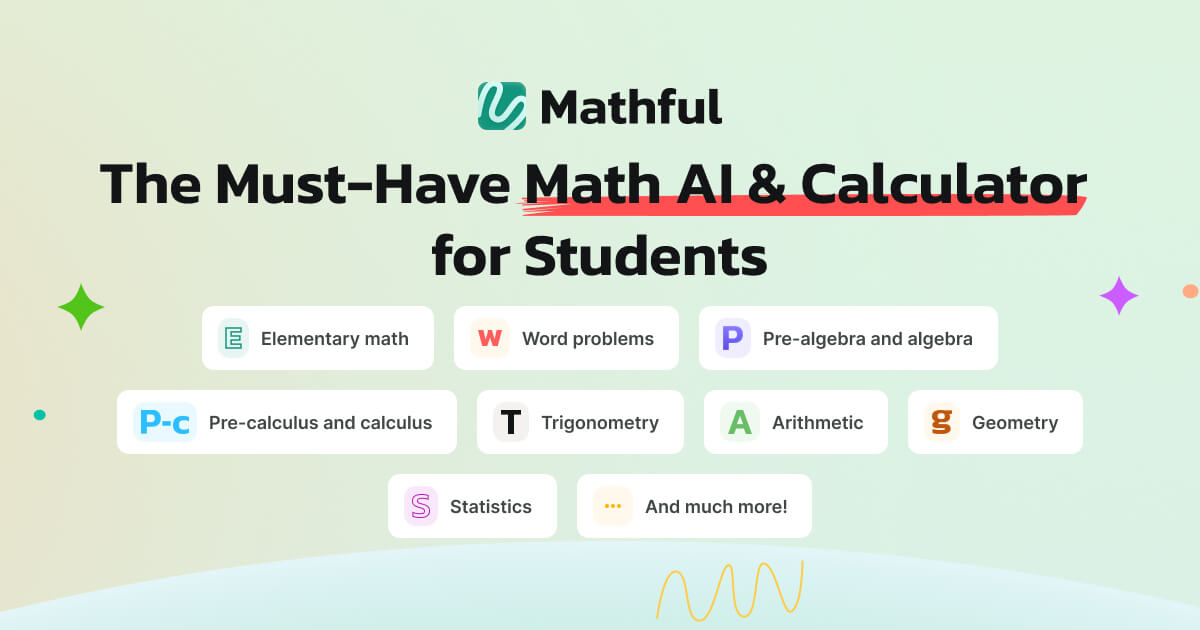
Mathful
Mathful stands out as a state-of-the-art photo math solver with a focus on accuracy and quality in its explanations. Its AI can interpret images of math problems and offers a fast and powerful alternative to other conversational chatbots.
What sets Mathful apart is its ability to analyze and explain each step in depth , providing clarity even in the most complicated operations.
Smodin Omni
The Smodin platform allows users to easily copy and paste equations or upload images of math problems, instantly solving them and providing simplified and detailed explanations. It's especially designed for those seeking quick and easy-to-understand solutions without the need for registration or downloads.
LearnFast AI
LearnFast AI is designed to solve problems in both mathematics and physics. It allows users to input questions via text, images, or documents, and generates detailed solutions based on one of the most advanced models, GPT-4 . Its approach focuses on breaking down problems into manageable parts and fostering long-term learning.
Common features of the best mathematical AI platforms
What these apps and platforms share is their commitment to facilitating independent learning and a genuine understanding of mathematics . We've listed their most valued features below:
- Step-by-step solutions: They allow you to understand the procedure of each operation, not just the final result.
- Multi-format recognition: They support written text, handwritten equations, images, photos, screenshots, or even PDFs.
- Multi-device support: They can be used from computers, mobile phones, tablets or through browser extensions.
- Interactive tutorials and visuals: They include graphics, animations, visual calculators, and teaching materials developed with AI.
- Coverage of a wide range of mathematical disciplines: From basic arithmetic and algebra to advanced calculus, including statistics, physics, chemistry, and related sciences.
- Personalization and tutoring: Some tools offer tailored help, recommendations tailored to your pace and level, and even real-time access to human tutors.
Advantages of using artificial intelligence to learn and solve mathematics
The impact of AI on mathematics education is increasingly evident, and the benefits of this type of resource can be summarized in several key points:
- Immediate access to knowledge: Students can resolve doubts and learn new concepts without having to wait for traditional tutoring.
- Greater motivation and autonomy: Seeing quick results and understanding the logic behind each solution fosters a proactive attitude and self-confidence.
- Overcoming specific difficulties: AI detects error patterns or unfamiliar concepts and suggests personalized reinforcement strategies.
- Adaptability and flexibility: The resources are available 24/XNUMX and can be used on any device, making it possible to study at home, on public transportation, or at the library.
When and how to choose the best mathematical AI tool for your needs?
Choosing the best artificial intelligence app for mathematics depends on several factors:
- Academic level: While MathPapa is ideal for high school students focused on algebra, platforms like MathGPTPro or GeoGebra may be more beneficial for university students or engineers. For a deeper look into related programming aspects, see This resource on imperative programming.
- Type of problem to be solved: Photomath and Mathway excel at instant solution of basic equations, while Julius AI and Symbolab excel at detailed explanations of advanced operations.
- Entry preference: If you usually work with handwritten notes, Photomath or Symbolab have the best handwriting recognition algorithms. If you prefer to practice with quizzes or learn through tutorials, Socratic and GeoGebra are very comprehensive.
- Need for additional support: If you're looking for real-time help from a human tutor, opt for hybrid platforms like GauthMath.
The key is to try out different platforms—most offer free versions—and choose the one whose workflow and resources best fit your routine and learning goals.
Real-life use cases of artificial intelligence in mathematical learning
The impact of AI is not limited to the academic environment. Professionals, university students, and self-taught individuals have incorporated these solutions into their daily lives , both in the educational and professional spheres.
- University students: They use MathGPTPro to solve multivariate calculus, advanced statistics, and applied physics problems, providing explanations that facilitate exam preparation or research papers.
- Mathematics teachers: They use GeoGebra to create simulations and interactive exercises, helping to visualize geometry or algebra dynamically in class.
- Engineers and scientists: They choose Julius AI or Symbolab to break down systems of equations or solve complex linear algebra and optimization problems, saving time on calculations and avoiding manual errors.
- Self-taught users: Photomath and Mathway are faithful companions for those who learn at their own pace, allowing continuous practice and reinforcement of weak points without the need for a personal tutor.
What new features does AI bring to mathematics compared to traditional methods?
Artificial intelligence has brought several differentiating innovations to mathematical learning:
- Advanced visual recognition: It allows you to analyze and solve problems from photos, PDFs, or screenshots, regardless of their format.
- Logical decomposition of complex problems: The user learns how to reach the solution thanks to detailed explanations.
- Gamification and interactive learning: Tools like GeoGebra or MathGPTPro introduce animated resources, simulations, and customizable exercises that make studying more entertaining.
Furthermore, the integration of AI in the cloud guarantees constant updates, accuracy in results, and the ability to collaborate in real time with other students, teachers, or experts through online forums and communities.
Current challenges and limits of artificial intelligence in mathematics
Not everything is perfect in the world of mathematical AI applications . Some current challenges include:
- False positives or errors in handwriting recognition, especially with poorly legible handwriting.
- Limitations when interpreting statements or problems that are too open, ambiguous, or do not follow standard formats.
- Dependence on Internet connection for access to many advanced features.
- Risk of students becoming accustomed to seeking only answers without understanding the underlying reasoning.
Despite these challenges, the overall trend is positive: the accuracy and adaptability of these tools are improving as they are fed with more data and feedback from real users.
Recommendations for the responsible use of AI in mathematics
To get the most out of AI in mathematics and avoid bad habits, it's a good idea to follow some recommendations:
- Use step-by-step solutions as a learning guide, not just a shortcut to homework.
- Combine AI resources with traditional materials, books, and self-practice exercises.
- Consult multiple sources when questions or discrepancies arise between different tools.
- Encourage reflection and analysis of the resolution process, especially at advanced levels.
The goal should always be to understand why a solution is correct and how it was reached , not just to get the fastest answer.

The horizon is really promising
As AI evolves, we will see even more accurate, intuitive, and adaptable tools . Some emerging trends include:
- Complete learning customization, with unique adaptive itineraries tailored to each student's pace and style.
- Integration of AI into institutional educational platforms, enabling real-time tracking and individual and group progress statistics.
- Intelligent conversational assistants capable of maintaining natural and contextualized dialogues on any mathematical or scientific topic.
- Augmented and virtual reality applications that will allow you to "experience" mathematics and physics in interactive three-dimensional environments.
Mathematics learning will become increasingly autonomous, practical, and personalized, ensuring that no one is left behind and that enthusiasm for numbers and science grows from an early age.
Artificial intelligence applied to mathematics has become an indispensable ally for students, teachers, and professionals alike. It offers immediate access to explanations, fosters deep understanding, and helps overcome difficulties through multi-format solutions, visual resources, and ongoing support. The key is to use these tools as a complement to, not a replacement for, traditional methods, leveraging their potential to learn, practice, and master any branch of mathematics at your own pace and according to your needs.