- Time control regulations require daily recording of the start and end of the workday, keeping the data for 4 years and facilitating access to it for employees, representatives and the Inspectorate.
- The regulatory trend points towards a mandatory, unalterable and traceable digital time record, leaving behind paper and Excel due to their poor evidentiary reliability.
- Suitable software should guarantee immutability, immediate export, payroll integration, and GDPR compliance, especially if it uses biometrics or geolocation.
- Implementing digital time tracking reduces legal risks, facilitates resource planning, and provides real data to improve productivity and work environment.
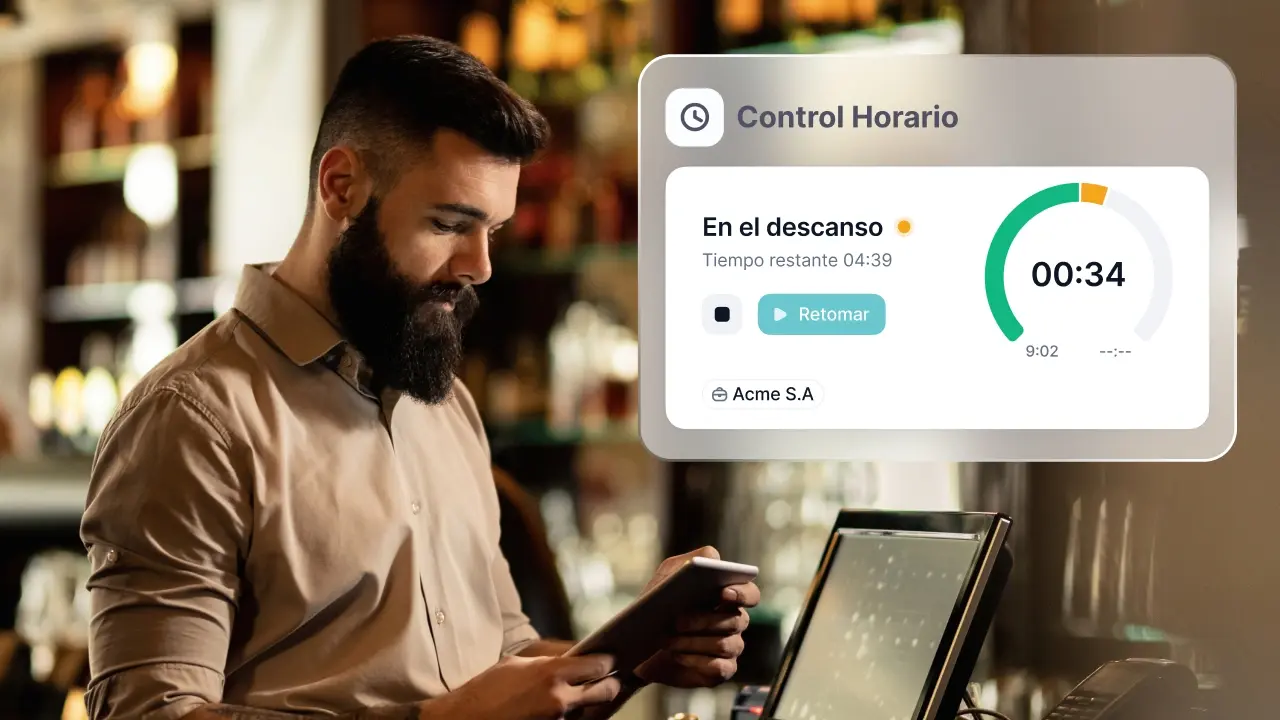
Time tracking and clocking in/out regulations have become one of the most challenging issues for companies, HR departments, and labor consultants. What began in 2019 as a requirement to record entry and exit times has evolved into a much more demanding, digital, and controlled model that will mark a turning point from 2026 onwards.
If you own a business, are self-employed with employees, or manage payroll, you'll want to fully understand the new regulations on digital time tracking , what's been mandatory since 2019, what's expected to change in 2025-2026, what penalties you could face, and what kind of software you'll need to avoid problems. We'll break down, calmly but concisely, everything you need to know about the law on time tracking and clocking in Spain and how it compares to what's being done in other countries.
Legal framework of mandatory signing and recent evolution
Since May 12, 2019, with Royal Decree-Law 8/2019 , all companies are required to keep a daily record of their employees' working hours , regardless of their size, sector, or type of contract. This reform amended Article 34 of the Workers' Statute, imposing on companies the responsibility of recording the start and end of each employee's workday on a daily basis.
The main purpose of this time record system is to monitor actual working hours , prevent the accumulation of unpaid overtime, facilitate work-life balance, and allow the Labor Inspectorate to verify compliance with working hours, rest periods, and vacation time limits. Furthermore, the company must keep these records for at least four years and have them readily available for any inspection.
From then on, practice showed that many employers made do with paper templates, Excel spreadsheets, or flimsy systems , which opened the door to errors, manipulation, or simply a chaotic mess of files impossible to review. The Labor Inspectorate, relying on case law and the doctrine of the Court of Justice of the European Union (judgment C-55/18) , has been pushing companies toward more objective, reliable, and traceable systems.
In parallel, the expansion of teleworking and hybrid models after the pandemic, as well as the generalization of HR software, has led the legislator and the Inspectorate to focus on a next step: the mandatory digital time registration , which is shaping up to be the standard for 2025-2026, especially for medium and large companies.
What does the current transfer law require and what changes are expected?

Currently, the law already requires that the specific start and end times of each employee's workday be recorded, at a minimum, regardless of whether there is flexible scheduling or an irregular work schedule. This record must be reliable, accessible, and kept for four years , and must be available to the employee, their representatives, and the Labor Inspectorate.
In recent years, both the Ministry of Labor and the Labor Inspectorate have been developing criteria and guidelines (such as the well-known guide for recording working hours) that emphasize the need for the system to be objective, immutable, and verifiable . This makes it increasingly difficult to argue before an inspector that a paper timesheet or an editable spreadsheet is a suitable means of reliably documenting working hours.
Drafts and announcements regarding the proposed new regulations suggest that, in the short term, the legislator will codify into law what is already standard practice in labor inspections: a mandatory digital timekeeping system that guarantees data immutability, traceability of any changes, and immediate remote access for labor authorities. Some texts even specify that, starting in 2025, companies with more than 50 employees will be required to use digital systems, with the requirement later being extended to all types of companies.
Furthermore, the current regulatory debate includes strengthening the obligation to record breaks and rest periods , which until now many organizations only recorded voluntarily or by agreement. The aim is to close any loopholes for manipulating overtime and ensure that rest periods are truly respected and not disguised within an unrecorded workday.
Key requirements of mandatory digital timekeeping
Regulatory trends and inspection criteria converge on a series of requirements that every digital timekeeping system must meet if it wants to be at ease in the face of an inspection or a legal claim.
In essence, the digital timekeeping system must ensure that:
- The start and end times are accurately recorded. of the day, and, predictably, also the breaks and rest periods.
- The data is automatically sealed, with a timestamp independent of the employee's device.
- It should not be possible to delete or overwrite entries without leaving a trace; any correction must generate a new entry associated with the original, with the reason, date and user making the change.
- The information can be exported immediately in machine-readable formats, so that the Inspection can analyze it without waiting.
- Records must be kept for at least 4 years on secure media, preferably located in the European Union and compliant with the GDPR.
This approach transforms digital timekeeping into a kind of "ledger" of hours worked , with a level of traceability similar to that of financial accounting. Companies will no longer be able to "prepare" documentation after an inspection visit, but will instead need to have everything updated in real time.
For this reason, systems that allow modifying cells, deleting lines, or recreating histories without a clear record are considered legally unsuitable. Shared Excel spreadsheets, scanned documents signed after the fact, and printed signature lists have become obsolete due to their low evidentiary reliability and ease of manipulation.
Who is required to sign players and what exceptions exist?
The obligation to record working hours generally applies to all companies, self-employed individuals with employees, and entities that have workers on their payroll. There are no exceptions based on the number of employees, revenue, or economic activity: it doesn't matter if it's an SME, a micro-enterprise, or a large organization.
This also includes people who work remotely, in hybrid work arrangements, on commutes, and on part-time contracts . In the latter cases, time tracking is even more important, because a lack of control can lead to the assumption that the contract is full-time if the actual hours worked are not documented.
However, the regulations include certain exceptions or exceptions . Generally speaking, these are not subject to the obligation to record working hours:
- El senior management staff with a special regime of free availability of time.
- The working people of family home.
- Certain special employment relationships: professional athletes, artists in public performances, prisoners in penitentiary institutions, people with disabilities in special employment centers, lawyers from law firms under its specific regulations, among others included in Article 2 of the Workers' Statute.
- People self-employed women and cooperative members with its own particular regime.
There are also specific registration regulations for sectors such as road transport, the merchant marine, and certain cross-border rail services , regulated by rules such as Royal Decree 1561/1995. In these cases, driving and rest time control systems act as a time record for legal purposes.
It should be made clear that, if any doubt arises during an inspection, it will be the company that must provide documentary justification as to why a specific person is exempt from clocking in or is governed by a particular system of control of working times.
Registration formats: paper, Excel, and digital solutions
For years, many companies have used traditional timekeeping methods : printed sheets where you sign in and out, paper schedules with stamps, basic electronic timekeeping with cards, or even charts drawn in Excel that each person fills in by hand.
These systems have several problems: they are prone to human error (a single poorly copied formula can ruin a month's totals), they lack safeguards against intentional manipulation , and they are very inefficient when it comes to consolidating or reviewing data from many workers, shifts, or centers.
Case law has begun to directly question the evidentiary value of paper records , especially when presented during inspections or labor trials. They are considered insufficiently reliable and traceable to reliably prove the actual hours worked.
Therefore, even though paper records are not yet formally prohibited by current law, practice is making their use increasingly risky . In companies with remote work, complex shifts, or many overtime hours, this option is, quite simply, a legal time bomb.
At the other end of the spectrum, we find digital time and attendance solutions : mobile applications, web portals, and physical terminals with fingerprint, card, or facial recognition, integrated with HR, payroll, and shift management software. These systems enable quick and easy clocking in and out from mobile phones, computers, tablets, or dedicated devices , facilitate change tracking, and generate automatic reports for employees, unions, and labor inspectors.
Time tracking and teleworking: specific challenges
The rise of remote work and hybrid models has completely changed how people clock in and out. The legal obligation to do so doesn't disappear when working from home: employees must still remotely record their start time, breaks, and end time of the workday.
In these cases, the most sensible solution is to use HR management software with a time tracking module , which works both as a web version and a mobile app. This way, employees can clock in from anywhere with a simple click, and the company has centralized, real-time data.
In more advanced environments, some organizations use systems that, in addition to other data, take into account parameters such as computer power on and off , keyboard and mouse activity, and time spent on specific applications. However, these mechanisms must be handled with great care, because excessive monitoring can generate stress, mistrust , and, in the worst-case scenario, conflicts with data protection regulations and the right to privacy.
The use of geolocation apps is also common , especially for mobile staff (salespeople, technicians, delivery drivers). In these cases, location tracking helps verify that clocking in and out is actually done from the workplace, but it requires justifying its necessity and proportionality in accordance with the GDPR.
Ultimately, the key to teleworking is balancing reliable and legal time tracking with respect for privacy, avoiding falling into a permanent "Big Brother" scenario that ends up being counterproductive to motivation and productivity.
Specific cases: hospitality, public sector and other groups
There are sectors where timekeeping presents additional challenges. One of the clearest is the hospitality and restaurant industry , where rotating shifts, part-time contracts, weekend reinforcements, and workdays that extend beyond the planned hours during peak times are commonplace.
In this area, the most practical solution is usually software that combines time tracking and shift scheduling , allowing companies to adjust schedules, avoid overlaps, and ensure that breaks and working hours are respected. Ideally, the system will offer a simple clock-in/clock-out app , useful in environments where staff are not seated at a computer.
Another common question revolves around civil servants and public employment . Many groups within the public administration have their own regulations and attendance systems, which don't always align perfectly with the private sector model. In some cases, there's no formal obligation to clock in and out using the same system as a regular company, but it can be advisable to have control systems in place to manage overtime, on-call duty, or availability.
In the case of special employment relationships or groups with unique regimes (professional athletes, artists, domestic staff, etc.), it will be necessary to analyze on a case-by-case basis whether there is a specific registration obligation or whether a particularity applies that modifies the general system of timekeeping.
Penalties for violating the timekeeping and attendance laws
Failing to keep proper records of working hours can be very costly. The Law on Infringements and Sanctions in the Social Order (LISOS) classifies various behaviors related to timekeeping as minor, serious, or very serious infringements.
Among the sanctions currently foreseen, we can find:
- Minor offenses: between 60 and 625 euros.
- Serious offenses: between 625 and 6.250 euros.
- Very serious offenses: between 6.250 and 187.515 euros, in the most extreme cases of non-compliance and violation of labor rights.
These fines can be imposed, for example, for not having a registration system , for not keeping the data for the required period, for not providing information to workers or representatives, or for disguising overtime under other salary concepts or contractual arrangements.
In the debates and proposals for reforming the digital timekeeping law, a model has also been proposed in which sanctions are applied per affected employee . This would mean that a company with many employees could see its financial risk multiplied if it fails to comply with timekeeping regulations, with proposed fines reaching up to €10.000 per employee in the most serious cases.
Beyond the administrative fine, non-compliance can have other consequences: claims for unpaid overtime , presumption of full-time work in unregistered part-time contracts, challenges to dismissals for not being able to prove absences or delays, and even criminal liability in extreme cases of fraud and labor exploitation.
Technical and organizational requirements of time control software
Simply implementing "any time-tracking app" isn't enough. For a digital time tracking system to be truly useful and compliant with regulations, it must meet a series of very specific technical and design requirements.
Essential features include:
- Automatic and unalterable recording of the signings, which prevents deleting or modifying data without a trace.
- Reliable timestamp, independent of the worker's device clock, to avoid manipulation by manual time change.
- Personalized access for each employee, with secure authentication.
- Immediate export of records in structured formats for inspections or internal audits.
- Integration with payroll and labor managementfacilitating the automatic calculation of ordinary, supplementary and extra hours.
- Data hosting in the EU and strict compliance with the GDPR and the LOPDGDD.
At an organizational level, the system must be accompanied by a clear internal protocol that defines what constitutes the start and end of the workday, how breaks are recorded, what happens if someone forgets to clock in or makes a mistake, and who is authorized to validate or correct entries. This protocol should be agreed upon with the legal representatives of the workers, if any.
In small and medium-sized businesses, the key is to opt for scalable solutions that can grow in functionality (shifts, vacations, remote work, time analytics) without skyrocketing costs or complicating daily operations. For many businesses, the sensible approach is to centralize time tracking, absence management, and payroll processing on a single platform , reducing duplication and errors.
Data protection, biometrics and geolocation in timekeeping
Digital time tracking cannot overlook the aspect of personal data protection . Recording times, locations, or even biometric characteristics involves processing sensitive information, subject to the requirements of the GDPR and Spanish regulations.
If the system uses fingerprints, facial recognition, or other biometric data , the company must conduct a data protection impact assessment and justify that such processing is necessary, proportionate, and that no less intrusive alternative exists. The legal basis is usually based on the public interest derived from labor regulations, but simply stating this is not enough: it must be documented, and enhanced security measures must be established.
In the case of geolocation (GPS) , very common in mobile timekeeping apps, workers must be clearly informed about the processing, location data collection must be limited to strictly necessary moments (for example, when pressing to clock in) and continuous monitoring that is not proportionate to the purpose of controlling working hours must be avoided.
In all cases, the company must provide transparent information to its staff about what data is collected, for what purpose, for how long it is kept, and who can access it. It must also guarantee the rights of access, rectification, erasure, objection, and restriction of processing.
Having specialized legal advice on labor and data protection matters helps to design a timekeeping system that is legally sound and avoids penalties from both the labor sector and the data protection authority.
Business benefits of digital time tracking
Although many companies approach time tracking with some apprehension, the truth is that a good digital control system offers advantages that go far beyond "avoiding fines".
On the one hand, it improves internal transparency : each employee can easily see how many hours they have worked, what portion corresponds to regular working hours and what portion to overtime, and how breaks, leave, and vacations have been calculated. This reduces suspicion and improves the work environment.
For finance and HR departments, having reliable and structured data provides a true picture of productivity , peak workloads, absenteeism, and overtime costs. With this information, it's easier to adjust staffing levels, plan shifts, renegotiate agreements, and optimize labor costs.
Furthermore, automating time tracking and integrating it with payroll and other administrative processes saves significant time previously spent manually reconciling hours, reviewing Excel spreadsheets, or correcting calculation errors. HR teams can then focus on higher value-added tasks, such as talent development or organizational improvement.
Finally, in a changing regulatory environment, already working with a flexible digital system makes it much easier to adapt to successive legal reforms: it is enough to adjust parameters or software updates, instead of reinventing the control system from scratch every time the law changes.
How to prepare for the 2026 digital timekeeping law
While the specific dates may change, the direction is clear: the legislator wants digital, traceable, and accessible time tracking in real time . Waiting until the last minute to adapt is, quite simply, playing with fire.
A reasonable roadmap for any company would include:
- Review the current timekeeping system and identify shortcomings: Does it allow traceability? Is it manipulable? Does it integrate with payroll? Is it defensible in an inspection?
- Choosing a certified time tracking softwarethat meets the technical requirements discussed and is adapted to the size and complexity of the organization.
- Define clear internal policies regarding signings, breaks, overtime, teleworking and shifts, and communicate them in writing to all staff.
- Train employees and middle managers in the use of the system and the importance of complying with the daily registration.
- Carry out regular audits from the time record to detect incidents, inconsistencies or potential sources of risk before the Inspection does.
For many SMEs and self-employed individuals with staff, relying on labor consultancy or a comprehensive HR service can make the difference between having a solid system and simply "meeting the law" with improvised tools.
Understanding the law on timekeeping and attendance control, anticipating mandatory digitization, and implementing a reliable system not only protects against penalties, but also strengthens internal organization, improves relationships with employees, and lays the foundation for better time management and productivity in an environment where every hour literally counts.

Table of Contents
- 1 Legal framework of mandatory signing and recent evolution
- 2 What does the current transfer law require and what changes are expected?
- 3 Key requirements of mandatory digital timekeeping
- 4 Who is required to sign players and what exceptions exist?
- 5 Registration formats: paper, Excel, and digital solutions
- 6 Time tracking and teleworking: specific challenges
- 7 Specific cases: hospitality, public sector and other groups
- 8 Penalties for violating the timekeeping and attendance laws
- 9 Technical and organizational requirements of time control software
- 10 Data protection, biometrics and geolocation in timekeeping
- 11 Business benefits of digital time tracking
- 12 How to prepare for the 2026 digital timekeeping law