- Google confirms that "Nano Banana" is the alias of Gemini 2.5 Flash Image for image generation and editing.
- Conversational editing with coherent characters and objects and consistent results.
- Available for free in the Gemini app and to developers via the API, AI Studio, and Vertex AI.
- Security reinforcements with SynthID and filters for sensitive content.
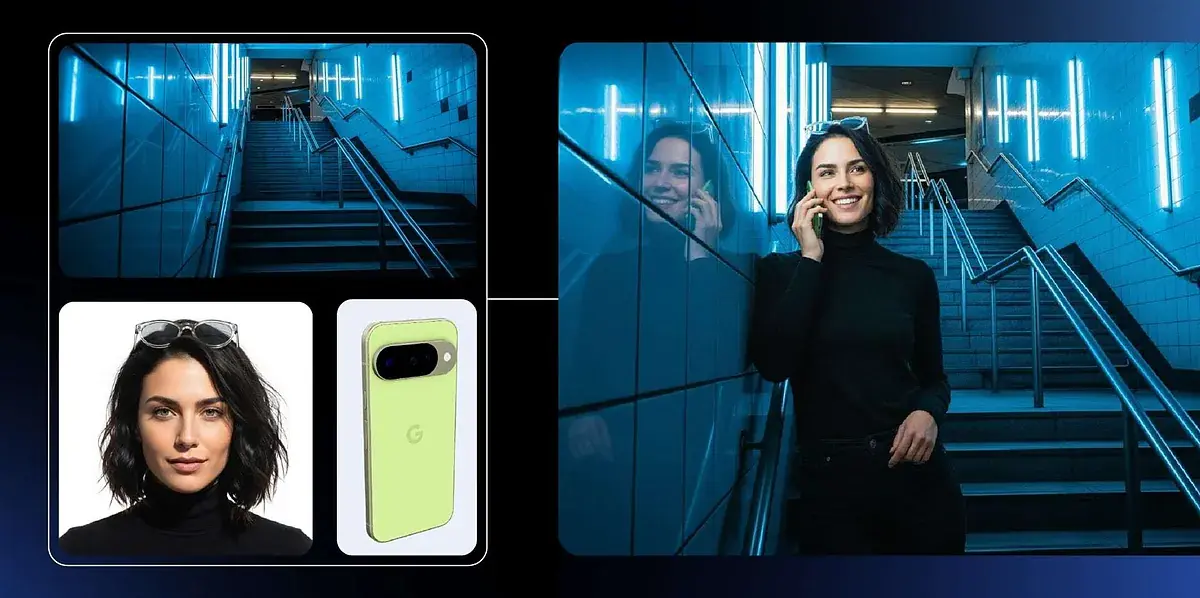
In recent days, the name "Nano Banana" has spread like wildfire in technical forums and networks due to its performance in AI-powered visual editing tests. What seemed like a mystery now has an author: behind it is Google and its new image engine integrated into Gemini.
The company confirms that Nano Banana is the alias for Gemini 2.5 Flash Image , a system capable of generating and retouching photographs using natural language, maintaining style, characters, and objects with a consistency that was previously difficult for these models.
What is Nano Banana and who is behind it?
During its early appearances, the model was featured in LM Arena rankings under the nickname "Nano Banana," sparking speculation and "banana" jokes until Google officially introduced it as part of Gemini. The underlying idea is clear: to unify image generation and editing into a simple, conversational, and fast workflow.
Google emphasizes that its approach relies on Gemini's knowledge of the world and advanced AI models , which helps to understand the context of the instructions and apply more precise changes than those of purely visual generators.
Conversational editing: from prompt to fine-tuning
The model works with commands in natural language and allows you to interact with the image: you can ask "make the sky more dramatic", "remove that sign" or "change the car's color to red" and refine the result in successive rounds without starting from scratch.
This multi-turn interaction reduces the friction typical of traditional tools. According to Google, it's possible to select specific areas to adjust color, lighting, or texture, remove unwanted elements, replace backgrounds, and add objects that integrate seamlessly while respecting shadows and perspective.
In addition to basic retouching, the platform understands instructions such as "place the same character in another scene" or "show the product from various angles," preserving the subject and its appearance with consistency between edits.
Consistency, quality and speed
One of the standout advances is the improvement in visual consistency across successive editions: facial features, hands, pets, or objects remain stable with less distortion, something that historically put generative models in a bind.
Photorealism is enhanced with more natural lighting and textures, and Google claims lightning-fast performance that speeds up creative cycles for tasks such as product variations or themed scenes.
In community testing, the system has climbed the ranks in LM Arena for image editing, placing itself among the engines with the best user experience according to user ratings.
Main tools and use cases
Gemini 2.5 Flash Image includes features designed for both general users and creative teams. Some of the most striking features allow you to compose images from multiple sources and place them in a coherent environment.
- Contextual retouching: color, exposure, texture, or style adjustments without losing key elements of the original.
- Removal and replacement: erase objects, change backgrounds or add elements with light and shadow integration.
- Composition and mixture: combine two photos into one scene and transfer patterns or styles from one image to another.
- Multi-shift edition: chain changes (painting walls, adding furniture, modifying wardrobe) without restarting the process.
In marketing, decoration, fashion, or social media content, the tool is used to quickly create variations, maintain consistent brand resources , and test visual ideas without resorting to traditional software.
Security and usage limits
To minimize abuse, Google applies filters that block violent or sexually explicit content and restricts the editing of real people or public figures. The goal is to reduce the risk of misinformation and deepfakes.
All images generated or edited incorporate SynthID , an imperceptible digital watermark within the file itself that helps verify its origin. In addition, the company mentions further signals and proactive controls to strengthen traceability.
The usage policy expressly prohibits the creation of intimate material without consent and other sensitive categories, reinforcing the focus on responsible AI in Gemini's services.
How to use Nano Banana in the Gemini app
Access is straightforward: there's no need to install anything extra or choose a specific model. Simply open Gemini, upload a photo, and describe the changes . If you want to keep everything except one adjustment, you can start with "In the original photo,…" to make it clear that the rest should be preserved.
Some useful examples: "convert to black and white," "remove the corner post," "add a dog on the bench," or "change the dress to green." The system attempts to maintain the subject's features and proportions while applying the change.
You can also upload two photos and request that the content of one appear in the other, or that the style of a pattern (e.g., butterfly wings) be transferred to a garment or object in the second image.
Availability and access for developers
The functionality is available in the Gemini app for the general public. For professional integrations, it can be accessed via the Gemini API, Google AI Studio , and Vertex AI, opening the door to workflows in enterprises and third-party apps.
In-app use is free with reasonable limits. For developers, Google offers pay-as-you-go pricing ; a cost of $30 per million tokens is mentioned as a reference in the API, with rough estimates placing each image at a few cents, depending on the use case.
Competitive context
The move is aimed directly at rivals like Midjourney and DALL·E (OpenAI). Google's strategy focuses on conversational editing and consistent results, supported by Gemini's contextual understanding.
With the Nano Banana alias now integrated into its ecosystem, the company is trying to close the gap in an area where speed, quality and control are crucial for the end user.
FAQ
Is Nano Banana a standalone app?
No. It's a model within Gemini , so it's used from the app's own interface.
Is there a cost for end users?
The Gemini app offers free use with usage limits. API integrations do incur charges.
Do I have to select the model manually?
No. The selection is automatic when you perform image generation or editing functions in Gemini.
With a focus on conversational editing, subject consistency across shots , and built-in security measures, Nano Banana (Gemini 2.5 Flash Image) is shaping up to be a solid option for creating and retouching images both in everyday life and in professional projects, whether from the Gemini app or through its APIs.
