- Vision and biography: British mathematician who sought to eliminate human error in calculations and applied analytical thinking to science, industry, and statistics.
- Difference Engine: a mechanical design for automatically tabulating functions; a concept tested in 1991 demonstrates the accuracy of its designs.
- Analytical Engine and programming: the first general-purpose computer with memory, a control unit, and punch cards; Ada Lovelace developed algorithms.
- Multidisciplinary legacy: influenced cryptography, statistics, manufacturing, and modern computer architecture, and was recognized posthumously.

In the vast universe of computing, few names shine as brightly as that of Charles Babbage. This 19th-century British genius, often misunderstood in his time, laid the foundations for what we know today as modern computing. But who was Charles Babbage really and why are his contributions to computing still relevant in the 21st century?
Charles Babbage: Life and Work of the Technological Pioneer
Charles Babbage , born in London in 1791, was a mathematician, philosopher, and inventor whose vision transcended the limits of his time. From a young age, Babbage displayed an insatiable curiosity for numbers and mechanisms, a combination that would prove explosive for the advancement of science.
What motivated Babbage to delve into the world of calculating machines? The answer lies in his frustration with human errors in the mathematical tables of the time. These seemingly insignificant errors could have disastrous consequences in navigation and engineering. Babbage dreamed of removing the human factor from these complex calculations.
His life was marked by ups and downs. Despite being recognised as a brilliant academic at Cambridge, where he would later become a professor of mathematics, Babbage often found himself swimming against the tide of conventional thought. His restless mind led him to explore fields as diverse as economics, philosophy and engineering.
Babbage was not an easy man to deal with. His passionate temperament and tendency to polemic won him both admirers and detractors. However, it was this same passion that drove him to pursue his revolutionary ideas with unwavering tenacity.
Among his most notable works are Economy of Manufactures and Machinery (1832), in which he analysed industrial processes with mathematical precision, and The Ninth Bridgewater Treatise (1837), a work that attempted to reconcile science and religion. But it was his designs for calculating machines that would truly mark a turning point in the history of technology.
1. The Difference Engine: The First Step Towards Automation
The Difference Engine was Babbage's first major project in the field of computing. Conceived in 1822, this machine was designed to automatically calculate and tabulate polynomial functions. Sounds complicated? In essence, it was a giant mechanical calculator capable of performing complex mathematical operations without human intervention.
How did this mechanical marvel work? The Difference Engine used the finite difference method to calculate values of polynomial functions. Imagine a series of gears and cogwheels working in perfect harmony to produce precise mathematical results. It was like a mechanical orchestra where each component had its specific role.
Although Babbage never managed to complete the construction of the Difference Engine in its entirety due to technological and financial limitations of the time, his designs were astonishingly accurate. So accurate that in 1991, to commemorate the bicentenary of Babbage's birth, the Science Museum in London built a working version based on his original plans. And it worked perfectly!
The Difference Engine was not just a calculating tool; it represented a conceptual leap in how complex mathematical problems were approached. For the first time, the possibility of automating logical thought processes was raised, a concept that would be fundamental to the future development of computer science.
Interestingly, the Difference Engine also introduced concepts that are now common in modern programming. For example, the idea of storing intermediate results for later use is similar to what we now know as “variables” in programming. Furthermore, the need to sequence operations in a logical manner laid the groundwork for what would later become algorithm design.
Despite its initial failure in terms of construction, Babbage’s Difference Engine proved to be a monumental conceptual success. It inspired later generations of inventors and mathematicians, and set a crucial precedent: the idea that machines could “think” logically and perform complex cognitive tasks.
2. The Analytical Engine: The Dream of a Programmable Computer
If the Difference Engine was revolutionary, the Analytical Engine was downright visionary. Conceived by Babbage in 1834, this machine represented a quantum leap in the concept of computing. What made the Analytical Engine so special?
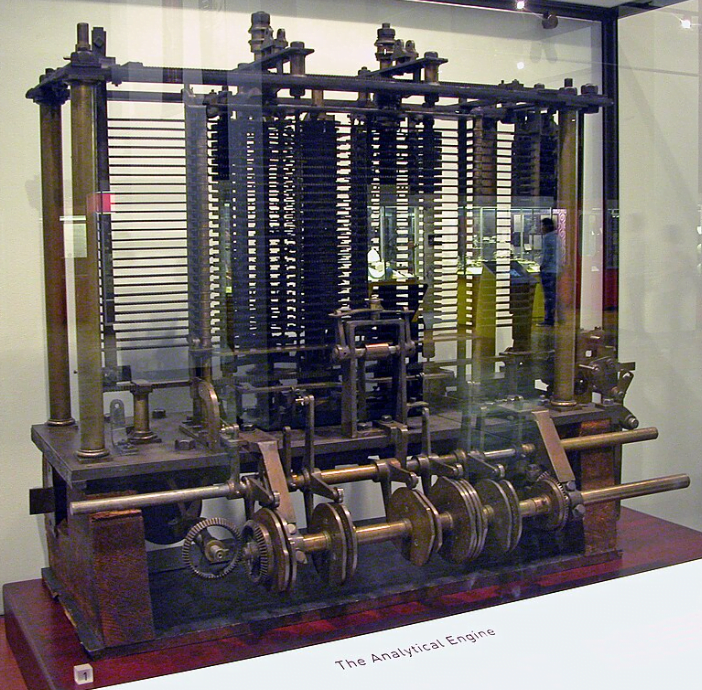
Unlike its predecessor, the Analytical Engine was not designed for a specific task. It was, in essence, the first general-purpose computer in history. Sound familiar? Yes, the basic concept of modern computers was already present in Babbage's mind almost two centuries ago.
The Analytical Engine incorporated several elements that we now recognize as fundamental to computer architecture:
- input unit: It used punched cards, similar to those used in looms, to enter data and instructions.
- Conference proceedings: Called by Babbage "the storehouse", it could store up to 1000 numbers of 50 digits each.
- processing unit: Called "the mill", it was capable of performing basic arithmetic operations.
- Control unit: Directed the sequence of operations based on instructions scheduled.
- output unit: I could print results and even create plates for printing.
Isn’t that amazing? These components are surprisingly similar to those found in modern computers. The CPU, the RAM, the input/output devices… they all have their conceptual roots in Babbage’s Analytical Engine.
But what was truly revolutionary about the Analytical Engine was its ability to be programmed. Using punched cards, it was possible to instruct the machine to perform different types of calculations. This meant that, in theory, the Analytical Engine could tackle a wide range of mathematical problems, not just those for which it was specifically built.
Unfortunately, like the Difference Engine, the Analytical Engine was never completed during Babbage's lifetime. Technological limitations of the time, combined with funding problems and the complexity of the project, prevented its completion. However, Babbage's designs and concepts were so advanced that many consider the Analytical Engine to be the true precursor to the modern computer.
3. The Programming Language: Ahead of its Time
One of the most fascinating aspects of Babbage's Analytical Engine was the development of what we might consider the first programming language in history. How did Babbage come up with this revolutionary idea?
The answer lies in the collaboration between Babbage and Ada Lovelace, considered by many to be the world's first programmer. Lovelace, daughter of the famous poet Lord Byron, was a brilliant mathematician who fully grasped the implications of the Analytical Engine.
In 1842, Lovelace translated an Italian paper on the Analytical Engine and added her own notes, which ended up being three times longer than the original paper. In these notes, Lovelace described how the machine could be programmed to perform complex calculations.
What made this “programming language” unique? Some notable features included:
- Instruction sequences: Lovelace described how operations could be chained together to perform complex tasks.
- Loops: Conceptualized the idea of repeating certain instructions, similar to loops in modern programming.
- Conditionals:Although in a rudimentary way, the possibility of the machine making decisions based on previous results was raised.
- Variables:Different “variable cards” were used to store and manipulate data.
Isn't it amazing? These concepts are fundamental to modern programming, and Babbage and Lovelace conceived them almost two centuries ago.
Lovelace even wrote what is considered the first algorithm intended to be processed by a machine: a method for calculating Bernoulli numbers. This algorithm is so detailed and precise that it could theoretically be run on a modern computer with minimal modifications.
Babbage and Lovelace's vision of a language that could "weave algebraic patterns as the Jacquard loom weaves flowers and leaves" was incredibly advanced for its time. They anticipated the idea that computers could go beyond simple numerical calculations and manipulate symbols, laying the groundwork for concepts such as artificial intelligence and natural language processing.
4. Babbage's Influence on Cryptography
Although Charles Babbage is best known for his contributions to computing, his influence extended to other fields, including cryptography. How did Babbage become interested in the art of secret codes?
It all began with a challenge. In 1854, Babbage learned of the existence of the Vigenère cipher, considered at the time to be “unbreakable.” Intrigued by this intellectual challenge, Babbage set out to crack it.
What did Babbage do that no one had done before? His approach was revolutionary:
- frequency analysis: Applied statistical analysis techniques to identify patterns in the ciphertext.
- Periodicity detection: He developed a method for determining the length of the key used in encryption.
- Conceptual automation:Although he was unable to build a machine to do so, Babbage conceived the idea of automating the deciphering process.
Amazingly, Babbage managed to break the Vigenère cipher, but he kept his achievement a secret! It was not until after his death that his feat was discovered, when military cryptographer Friedrich Kasiski independently published a similar method.
Babbage's contribution to cryptography was not limited to decryption. His ideas on the automation of logical processes, fundamental to his calculating machines, also laid the groundwork for the future development of automatic encryption and decryption machines.
Can you imagine how these ideas influenced the future of computer security? Babbage's concepts of pattern analysis and automation of logical processes are fundamental to modern cryptography and the design of security algorithms.
5. Babbage's Legacy in Statistics and Mathematics
Charles Babbage's brilliant mind was not limited to computing and cryptography. His contributions to mathematics and statistics were equally significant. How did Babbage influence these fields?
In the field of mathematics, Babbage made important contributions:
- Mathematical notation: He proposed improvements in algebraic notation to make it clearer and more efficient.
- Functional calculus: He developed new ideas in the field of function calculus.
- Number theory: He conducted research on properties of numbers, including work on Prime numbers.
But perhaps his most lasting contribution was in the field of statistics. Babbage was a pioneer in the application of statistical methods to practical problems. How did he do it?
- Actuarial tables: Improved the design of life tables used in the insurance industry, increasing their accuracy and usefulness.
- Industrial statistics: Applied methods statistics to the analysis of industrial processes, laying the foundations for scientific management.
- Sampling: He developed sampling techniques that are precursors to modern methods used in surveys and market research.
Did you know that Babbage was also an early proponent of “big data”? He argued in favor of the systematic collection of economic and social data on a large scale, anticipating the importance that data analysis would have in the future.
His book On the Economy of Machinery and Manufactures (1832) is considered a pioneering work in the field of operational research, applying mathematical and statistical analysis to problems of industrial production.
6. Babbage and the Industrial Revolution: Impact on Manufacturing
Charles Babbage was not only a theorist; he was also deeply interested in the practical application of his ideas. His vision extended beyond calculating machines to the vast world of industrial production. How did Babbage influence manufacturing during the Industrial Revolution?
In his work On the Economy of Machinery and Manufactures (1832), Babbage meticulously analysed the production processes of his day. What did he discover? He identified inefficiencies and proposed revolutionary improvements:
- Division of labour: Although Adam Smith had already spoken about this, Babbage took it further. He proposed a division based not only on skill, but also on the strength and dexterity required for each task.
- Standardization: He advocated the production of interchangeable parts, a concept that would revolutionize mass manufacturing.
- QA: He introduced the idea of regular inspections during the production process, not just at the end.
- Cost optimization: He developed methods for accurately calculating production costs, laying the foundation for modern industrial accounting.
But how does this relate to computer science? Babbage's vision of the factory as an integrated system, where each part works in harmony with the others, is strikingly similar to how we think of modern computer systems. His analytical and systematic approach to solving production problems foreshadowed the methods we use today in software engineering and technology project management.
Furthermore, Babbage's idea of using punched cards to control weaving machines (inspired by the Jacquard loom) was a direct precursor to the data entry systems on early computers. Isn't it fascinating how ideas can jump from one field to another?
7. Babbage's Collaborations: Ada Lovelace and Other Visionaries
Although Babbage is often portrayed as a solitary genius, the reality is that his work was enriched by crucial collaborations. The most famous of these collaborations was undoubtedly with Ada Lovelace. But who was Ada Lovelace and why was her collaboration with Babbage so important?

Ada Lovelace , daughter of the poet Lord Byron, was a brilliant mathematician who became deeply interested in Babbage's work. Her collaboration with Babbage yielded extraordinary results:
- Conceptual programming: Lovelace wrote what is considered the first algorithm intended to be processed by a machine, specifically for Babbage's Analytical Engine.
- Vision of potentialWhile Babbage focused on numerical calculations, Lovelace envisioned that machines could manipulate symbols and create music, anticipating concepts of artificial intelligence.
- Documentation:Lovelace's notes on the Analytical Engine are an invaluable source of information on the intended workings of the engine.
But Lovelace was not the only important collaborator. Babbage also worked with:
- john herschel: Astronomer and mathematician, he collaborated with Babbage on several mathematical projects.
- Charles Wheatstone: Inventor of the telegraph, he worked with Babbage on cryptography.
- Michael Faraday:The famous physicist and chemist exchanged ideas with Babbage about electricity and its potential use in calculating machines.
What does this teach us about innovation? That great ideas rarely emerge in isolation. Collaboration and the exchange of ideas are fundamental to scientific and technological progress.
8. Late Recognition: Babbage in the Digital Age
It is a cruel irony of history that Charles Babbage, a visionary so far ahead of his time, did not live to see his ideas put into practice. How has Babbage been recognised in the digital age?
Babbage's real recognition came decades after his death. In the 1940s, when the first electronic computers were being developed, computer pioneers rediscovered Babbage's work:
- Conceptual influenceBabbage's designs influenced the development of von Neumann architecture, which is the basis of modern computers.
- Posthumous constructionIn 1991, the Science Museum in London built a working version of the Difference Engine based on Babbage's original designs, proving that his ideas were feasible.
- Ada programming languageIn 1980, the United States Department of Defense named its new programming language "Ada" after Ada Lovelace, thus indirectly acknowledging Babbage's legacy.
- Awards and acknowledgements:Several institutions have created prizes and scholarships in Babbage's name to recognize innovation in computing.
But perhaps the greatest credit to Babbage is the omnipresence of computers in our everyday lives. Every time we use a smartphone, laptop or any digital device, we are, in a way, realizing Babbage’s dream of machines that can “weave algebraic patterns like the Jacquard loom weaves flowers and leaves.”
Isn't it amazing to think that the ideas of a 19th century man are still relevant in our digital age?
9. Conclusion of Charles Babbage and his contributions to computer science
Charles Babbage was much more than an inventor or a mathematician: he was a visionary who laid the foundations for the digital revolution we are experiencing today. His genius spanned multiple disciplines, from computer science to statistics, cryptography and industrial economics.
Babbage's story teaches us valuable lessons:
- The importance of perseverance: Despite failures and lack of recognition in life, Babbage never stopped innovating.
- The power of collaboration: His partnerships, especially with Ada Lovelace, demonstrated how great ideas often emerge from intellectual exchange.
- The long view: Babbage imagined a future that would take more than a century to materialize, reminding us of the importance of dreaming big.
Today, in a world dominated by digital technology, Babbage's legacy is more alive than ever. Every advance in computing, every new application of artificial intelligence , every innovation in data processing carries within its DNA the seminal ideas of this misunderstood genius of the 19th century.
What would Babbage have thought of our world today, where his dreams of intelligent machines have come true in ways he probably never even imagined? Perhaps he would feel proud, or perhaps he would challenge us to go even further, to keep exploring the boundaries of what is possible.
Ultimately, the story of Charles Babbage reminds us that true genius lies not just in inventing the new, but in imagining the impossible and laying the groundwork for future generations to make it a reality.
And what do you think? How do you think Babbage's ideas will continue to influence the future of technology? What new "analytical machines" will we be designing in 100 years, inspired by the legacy of this visionary?
If you've been fascinated by the story of Charles Babbage and his contributions to computing, don't keep it to yourself! Share this article with your friends and colleagues who are passionate about technology. Together, we can keep Babbage's innovative spirit alive and who knows, maybe inspire the next generation of technological visionaries. Click share now and be part of this fascinating conversation about the past and future of computing!