- Vulnerabilities are technical or human weaknesses that allow attacks against confidentiality, integrity, and availability.
- There are multiple types: software, network, configuration, human factor, cloud and supply chain, in addition to technical failures such as injection, XSS or buffer overflow.
- CVSS assessment and business context are key to prioritizing which vulnerabilities to fix first.
- Effective management combines continuous patching, audits, training, access controls, and automated response.
Security vulnerabilities are the starting point for most cybersecurity incidents. They are not the attack itself, but rather the opening that allows a threat to enter, spread, and ultimately cause real damage to systems, networks, and data. Understanding how they are classified, how they appear, and how they are managed is key for any company that wants to take its digital protection seriously.
In everyday life, a single technical or human error can bring down a critical service in a matter of minutes: from a misconfigured server to an employee clicking on a phishing link. That's why there's so much talk about vulnerability management , patches, CVEs, CVSS, and exploits. Throughout this article, we'll organize all these pieces: definitions, types of vulnerabilities, real-world examples, exploitation techniques, and how to prioritize what to fix first when everything seems urgent.
What is a security vulnerability and why does it matter so much?

When we talk about vulnerability, we are referring to a flaw, error, or misconfiguration in an information system (servers, applications, networks, devices, etc.) that can be exploited by an attacker to compromise security. This compromise can affect confidentiality ( data theft), integrity ( unauthorized modification), or availability (service outage or disruption).
A vulnerability can arise from design flaws, implementation errors, insecure configurations , or even deficient operational processes (for example, failing to revoke access for departing employees). The threat is the action that exploits that vulnerability: ransomware, a denial-of-service attack, a massive credential theft, etc. Without a known vulnerability, it would be much more difficult for an attacker, so their goal is to find them before you do.
Many security reports, especially in Latin America, show that vulnerabilities over a decade old continue to be exploited simply because they were never patched or were underestimated. This reveals a fundamental problem: a lack of updates, poor control of the attack surface, and insufficient awareness at all levels of the organization.
That's why the role of cybersecurity experts is so critical. Their job is to locate these weaknesses, measure their real impact, prioritize them, implement mitigation measures, and monitor them to ensure they don't reappear. To do this, they use automated scanners , configuration reviews, penetration testing, and continuous threat analysis.
There are two main ways to discover a vulnerability: through proactive security testing (audits, penetration testing, scans) or through its exploitation by attackers . If the second scenario occurs, we are no longer just talking about a vulnerability, but a security incident or breach. That's why early detection and preventative controls are so important.
Key concepts in the world of vulnerabilities
To navigate the classification of security vulnerabilities with ease , it is helpful to master a series of terms that appear in technical reports, manufacturer notices, and news of cyberattacks.
Vulnerability : This is the weakness itself. It can be a code flaw, a misconfiguration, or a combination of both. By itself, it's not an attack, but it's a potential entry point for a cybercriminal.
Patch : This is the update or fix released by the vendor to address a specific vulnerability . It may involve changing libraries, adjusting input validations, strengthening access controls, etc. It's the most direct solution, but also the one most often postponed in many organizations.
An exploit is the practical way to take advantage of a vulnerability . It can be a script, a specially crafted file, a command string, or a set of automated steps. It turns theory (the vulnerability) into a real attack.
Payload : This is the "useful malicious code" that executes after exploiting the vulnerability. It can be ransomware, data stealers, silent backdoors, or any other malware. The exploit opens the door; the payload enters and does the dirty work.
Proof of Concept (POC) : This is a proof of concept that demonstrates that a vulnerability is exploitable, usually for research or auditing purposes . It doesn't have to be malicious; it's used to validate that the flaw exists and measure its impact without causing damage to production.
Zero-day : This is a vulnerability unknown to the manufacturer and for which no patch is available . If an attacker discovers it before anyone else, they can exploit it without any detection signatures or specific solutions, making it one of the most dangerous scenarios.
CVE (Common Vulnerabilities and Exposures) : This is the standard identifier assigned to each publicly available vulnerability. A CVE like CVE-2026-6785 allows a specific vulnerability to be identified by a unique code, facilitating tracking and coordination among manufacturers and security teams.
CWE (Common Weakness Enumeration) : Instead of focusing on individual cases, it categorizes patterns of weaknesses (buffer overflow, insufficient validation, authentication errors, etc.). It helps developers understand what types of errors to avoid from the design stage.
CVSS (Common Vulnerability Scoring System) : This is the most widely used system for scoring the severity of a vulnerability from 0 to 10. It takes into account how it is exploited, whether it requires authentication, the impact on confidentiality, integrity, and availability, and temporal and environmental factors. Examples such as Log4Shell (CVE-2021-44228) reach scores of 10, indicating maximum criticality.
General classification of cybersecurity vulnerabilities
A practical way to organize vulnerabilities is to look at where they appear and what they affect . From there, they are usually grouped into several broad categories that help prioritize and assign responsibilities within the organization.
Network vulnerabilities : These affect the communications infrastructure : unnecessary open ports, lax firewall rules, poorly secured VPNs, lack of network segmentation, unencrypted traffic, etc. In hybrid and remote environments, they become more critical due to the increased attack surface.
Configuration and system vulnerabilities : These are flaws that appear when a system is deployed with insecure parameters , default credentials, services that shouldn't be active, or without adequate access controls. They don't depend on the code itself, but rather on how the infrastructure is configured and maintained.
Human vulnerabilities : also known as the human factor . These arise from unsafe behaviors: using weak or reused passwords, sharing credentials via email, downloading files from dubious sources, falling for phishing or vishing scams, etc. They are difficult to eliminate because they have more to do with psychology and culture than with technology.
Cloud vulnerabilities : These arise in cloud environments due to poor storage configurations (public buckets), insecure APIs, excessive permissions on identities, or a lack of continuous monitoring. The speed at which cloud services change makes it easy to lose visibility into your security posture.
Third-party and supply chain vulnerabilities : These stem from tools, libraries, suppliers, or partners that have access to sensitive systems or data. A failure in one of these links can be the gateway to compromising much larger companies, as seen in high-profile incidents.
Most frequent technical types of vulnerabilities
Beyond general categories, it's important to understand the technical types of vulnerabilities that frequently appear in audits and real-world attacks. Many are included in OWASP's Top 10 and are commonly found in global reports.
Buffer overflow : This occurs when an application writes more data than can fit in a reserved memory area. When this space is exceeded, other memory areas are overwritten, which can allow arbitrary code to be executed with the permissions of the vulnerable process.
Race condition : This occurs when the outcome of an operation depends on the execution order of multiple processes or threads accessing a shared resource. If an attacker manipulates this order, they can cause unexpected behavior, such as executing an action twice or bypassing controls.
Format string bugs : These are errors that result from accepting unvalidated format strings (for example, in C, functions like printf). An attacker can inject format specifiers to read or write memory without authorization.
Poor input validation : When data from users, forms, headers, or URL parameters is not properly validated, it opens the door to attacks such as SQL injection, LDAP injection, XPath, XSS, or command injection . It is a common root cause of many critical vulnerabilities.
SQL injection : This involves inserting malicious SQL code where normal text is expected (for example, in a login form). If the application directly concatenates this input into a query, the attacker can read, modify, or delete data , and even take control of the database.
CSRF (Cross-Site Request Forgery) : forces an authenticated user to perform unwanted actions on a legitimate application, typically by clicking on a link or loading a page with a hidden request. It exploits the site's trust in the user's session.
Directory traversal : This involves manipulating file paths using sequences like ../ to access files outside the directory allowed by the application (for example, /etc/passwd in Linux). Without proper path validation, sensitive information can be read, or even code can be executed if scripts are modified.
Command injection : This occurs when an application executes operating system commands using user-supplied data without sanitizing it. The attacker can inject additional commands to delete files, exfiltrate information, or open remote channels.
Insecure deserialization occurs when an application accepts serialized data (objects, structures) and deserializes it without verifying its origin or content. A manipulated object can cause code execution during the reconstruction process.
Hardcoded credentials : credentials, tokens, or keys embedded directly in the source code or binaries. If an attacker gains access to the repository or decompiles the application, they can discover these credentials and use them to pivot to other systems.
IDOR (Insecure Direct Object Reference) : This occurs when an application allows access to resources simply by changing an identifier (for example, a numeric ID in the URL) without verifying if the user has permission. This is a typical case of viewing someone else's data by changing the number in the URL.
Resource management errors : These encompass situations where an application fails to properly manage the use of memory, CPU, storage, or concurrent processes. This facilitates resource exhaustion and denial-of-service attacks , for example, through unlimited requests to an API without rate limiting.
Configuration errors include exposed admin panels without proper authentication, public cloud buckets, unnecessary active services, listable directories, and debug endpoints accessible from the internet. A well-designed infrastructure can become completely insecure due to a single incorrect setting.
Permission and access control issues , also known as broken access control, occur when users can perform actions they shouldn't, whether due to poorly defined roles, insufficient backend validation , or APIs that don't verify who is making the request. These are a common source of privilege escalation.
Information leaks : These occur when systems or applications expose sensitive data in error messages, headers, paths, logs, or HTTP responses . Sometimes it's not a direct attack, but this information helps an attacker map the system, detect versions, or find other vulnerabilities.
Poor session management : This includes improperly generated tokens, sessions that don't expire, incorrect session closure, or insecure storage of credentials in cookies. These types of problems make it easier for attackers to hijack sessions and use legitimate accounts.
Real-world examples of vulnerabilities and affected software
The CVE catalog grows every year with tens of thousands of new entries. Some vulnerabilities have gained notoriety for their global impact and help illustrate what can happen when an organization fails to patch in time or underestimates a security advisory.
A recent example is CVE-2026-6785 , a memory security vulnerability in various versions of Firefox and Thunderbird. While the technical details are complex, the gist is clear: there were bugs that could lead to memory corruption and arbitrary code execution . The fix was released in later versions (Firefox 150, updated ESR versions, etc.), but any system that isn't updated in time remains vulnerable.
Other well-known cases include vulnerabilities with a CVSS score of 10 , such as Heartbleed (OpenSSL), BlueKeep, Shellshock, EternalBlue, and the aforementioned Log4Shell. All of these allowed remote code execution or access to extremely sensitive information and were exploited in massive malware and ransomware campaigns.
Examples of frequently attacked software include Adobe Flash (now obsolete but historically plagued with code execution flaws), Microsoft Windows (with multiple privilege and RCE vulnerabilities over the years), Apache servers , Oracle databases , Adobe Acrobat Reader , Java , and PHP , all with extensive histories of exploits, from buffer overflows to injections and cross-site scripting.
Some specific vulnerabilities have been linked to well-known attacks. For example, CVE-2017-0199 , a remote code execution flaw in Microsoft Office, was exploited by ransomware families such as Ryuk, Emotet, and Dridex, using malicious documents that appeared harmless at first glance.
There are also instances where leaks of cyberespionage tools have exposed previously unknown vulnerabilities. In 2016, the group The Shadow Brokers published a set of exploits allegedly stolen from the NSA, revealing critical flaws in operating systems, applications, and firewalls. These tools were later reused in incidents such as the WannaCry ransomware, which exploited the EternalBlue vulnerability to spread rapidly.
How vulnerabilities are exploited: common techniques
Once a vulnerability is detected, an attacker needs a technique to convert it into effective access . From there, they can deploy malware, move laterally through the network, or extract data. Some of the most relevant exploitation techniques are listed below.
Remote Code Execution (RCE) : This is the "holy grail" for many attackers, as it allows them to execute remote code on the victim's system without physical access. Many exploit chains are specifically designed to achieve this capability, as was the case with Log4Shell or certain vulnerabilities in exposed services.
LFI/RFI (Local/Remote File Inclusion) : In file inclusion vulnerabilities, a vulnerable application can end up loading and executing local or remote files controlled by the attacker . LFI accesses files on the server itself (for example, logs with injected code), while RFI includes content hosted on an external server, allowing direct code execution.
Privilege escalation : Even if initial access is with a limited account, the usual goal is to increase privileges (user to administrator, normal user to root, etc.). This can be achieved through operating system errors, misconfigurations of services, or specific vulnerabilities such as PwnKit (CVE-2021-4034) on Linux systems.
Heap spraying : an advanced technique that involves filling the dynamic memory (heap) with patterns containing the payload, so that when an exploit redirects execution to an unspecified area of memory, the likelihood of it "falling" into malicious code increases. It was widely used in exploits targeting older browsers.
Return-Oriented Programming (ROP) : a strategy to bypass protections like DEP/NX. Instead of injecting new code, the attacker reuses small fragments of legitimate code ("gadgets") present in binaries or libraries, chaining them together with return statements to build malicious logic. It is one of the most robust techniques in scenarios where modern mitigations are active.
Assessment and prioritization: how to decide which vulnerability to attack first
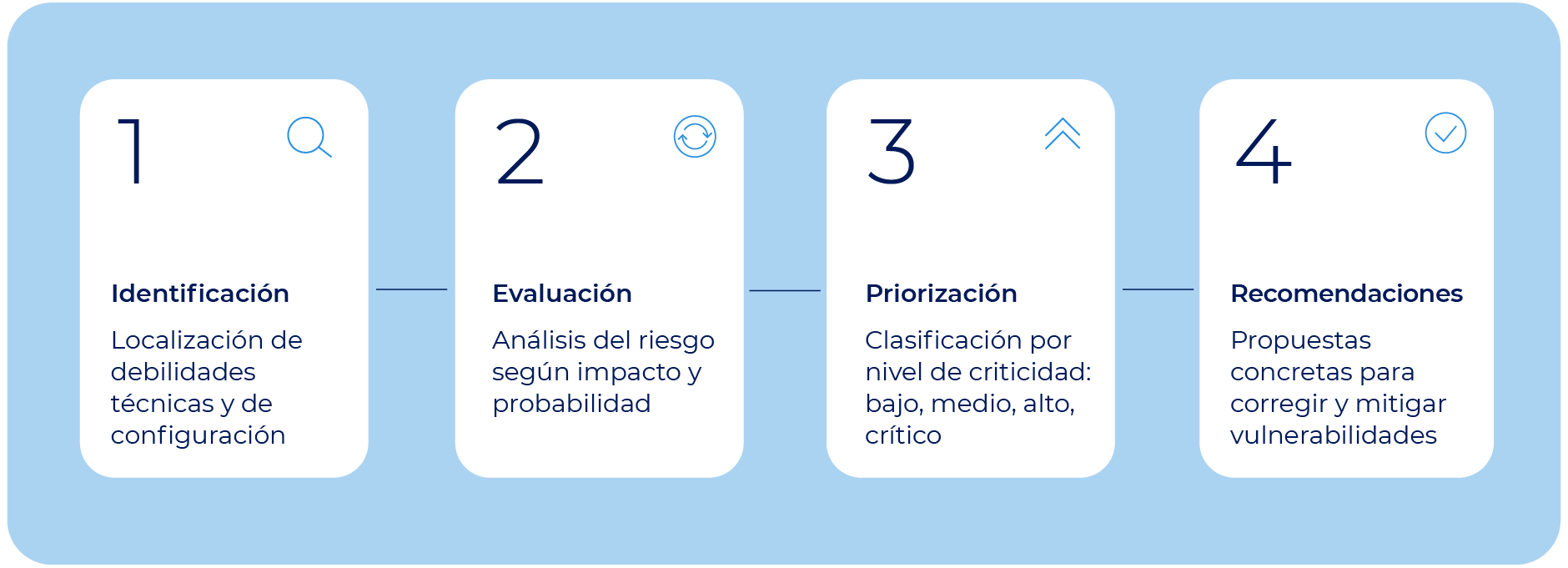
In a typical scenario, a scan or audit might produce a report with dozens or even hundreds of vulnerabilities labeled as severe, medium, or low. This generic classification is useful as a first approximation, but it falls short for making business decisions, especially when there are tight deadlines for going to production.
To refine this prioritization , CVSS and its metrics are used . The "Base" part of CVSS analyzes elements such as the access vector (local, adjacent network, or remote), the complexity of the attack, whether authentication is required, and the impact on confidentiality, integrity, and availability. The more remote and simple the attack, and the greater the impact, the higher the score.
Temporal metrics incorporate factors such as the existence of public exploits, patch availability, and the reliability of vulnerability information. Environmental metrics , on the other hand, consider the specific context of each organization: the number of affected systems, internal security requirements, and potential collateral damage (financial, legal, reputational).
In practice, a vulnerability with a high score that only causes denial of service in a non-critical system may be temporarily acceptable, while a "medium" vulnerability that exposes data protected by regulations may be unacceptable. The key is to cross-reference the technical score with the criticality of the asset and the regulatory context.
In addition to CVSS, many organizations use risk management frameworks that incorporate metrics such as EPSS (exploitability probability), asset criticality, whether it is exposed to the internet or is internal only, and whether compensating controls exist (WAF, segmentation, monitoring, etc.). The goal is simple: to have a clear list of what to patch now, what to mitigate urgently, and what can be planned for the medium term.
Best practices for reducing and managing vulnerabilities
No organization can eliminate all vulnerabilities, but it can drastically reduce its exposure by implementing a series of basic measures, combined with continuous improvement processes.
First and foremost, a robust patch management program is essential : a comprehensive asset inventory, monitoring of security advisories from vendors, rapid testing in pre-production environments, and agile deployment of updates in production. This helps to close the window of exposure to known vulnerabilities.
It is also crucial to conduct regular audits and assessments , both automated (vulnerability scanners) and manual (penetration testing, configuration reviews). These activities allow for the detection of design flaws, legacy configurations, unnecessary exposed services, and human errors that would not appear in a simple scan.
Staff training and awareness are another critical pillar. The human factor remains the weak link in many attack chains. Ongoing training programs, phishing drills, clear password policies, multi-factor authentication, and incident reporting protocols help reduce this risk.
From a technical standpoint, it is advisable to strengthen access controls (principle of least privilege, RBAC/ABAC, periodic review of permissions), segment networks to limit lateral movement, protect management interfaces with VPN or IP filtering, and disable services and test environments in production.
Finally, advanced vulnerability response automation tools and platforms can make a significant difference in organizations with large asset volumes. Solutions that unify findings from different scanners, normalize data, enrich it with threat intelligence, and automate patching workflows or ticket generation help reduce mean time to resolution and prevent critical vulnerabilities from being missed among hundreds of minor alerts.
Ultimately, vulnerability management goes far beyond simply running a scan occasionally. It requires understanding what a vulnerability is, how it's classified, where it appears (code, network, cloud, people, third parties), what exploitation techniques are used, and how to intelligently prioritize based on the actual risk to the business. Organizations that integrate all of this into their culture and daily processes are the ones that ultimately withstand an increasingly complex and evolving threat landscape better.
