- ChatGPT (Purchase Research) offers a highly conversational and educational shopping experience, with broad geographical deployment and integration into multiple workflows.
- Perplexity Shopping focuses on precise product search and impartial comparison, with real-time information and integrated payment via PayPal in the USA.
- AI-powered shopping assistants go far beyond the classic chatbot, using customer data, inventory, and smart recommendations to personalize every decision.
- The choice between ChatGPT, Perplexity, and other AI agents depends on the balance between creativity, factual accuracy, ecosystem, and the type of purchase or research that each user or business needs.
AI-powered shopping assistants have quickly gone from being a novelty to a key component of modern e-commerce . It's no longer just about displaying endless product listings, but about truly understanding each person's needs, answering their questions in seconds, and guiding them to the most suitable purchase with minimal effort.
Within this new landscape, the comparison between ChatGPT's shopping assistant (Shopping Research) and Perplexity Shopping is one of the most interesting debates of the moment . Both represent different approaches to solving the same problem: how to combine search, recommendation, and personalized assistance to make online shopping faster, more convenient, and, why not, more enjoyable.
What is an AI shopping assistant and how does it differ from a classic chatbot?
An AI-powered shopping assistant is essentially a "digital personal shopper" capable of understanding natural language, learning your preferences, and acting in real time to help you choose and buy products . It doesn't just answer a few basic questions; it can guide you through the entire decision-making process.
The main difference compared to traditional chatbots is their autonomy and reasoning ability . While a classic bot operates based on rigid scripts and decision trees, modern assistants perceive the context, learn from each interaction, and are able to suggest the next best step without the user needing to know how to formulate the perfect question.
These AI agents are integrated into general platforms like ChatGPT or Perplexity, as well as within eCommerce websites and apps . There, they can use browsing data, purchase history, real-time inventory, and recommendation models to suggest products, resolve objections, and reduce the typical "I'm lost among so many options" feeling.
The ultimate goal is to reduce friction: fewer clicks, fewer manual searches, and less time wasted comparing product listings one by one . In return, the user receives recommendations tailored to their style, budget, and context (e.g., recurring purchases, gifts, one-off needs), which increase conversion rates and the value of each order.
ChatGPT Shopping Research: OpenAI's Approach to eCommerce
OpenAI has aimed to make ChatGPT more than just a general assistant, adding a specific mode called Shopping Research . This feature is designed so you can ask it about the "best laptop for video editing," "a camera for beginners," or "alternatives to a specific product" and receive answers very close to what a human expert would give you.
Shopping Research combines ChatGPT's powerful conversational model with product data, reviews, pricing, and delivery information . Instead of launching into Google and opening ten different tabs, you can have a conversation where the assistant refines the options based on your responses.
One of its strengths is the use of your conversation history and previous preferences . If in other sessions you've already mentioned that you prefer specific brands, price ranges, or certain features (for example, sustainable products or fast shipping), the assistant can take this into account to adjust the recommendations without you having to repeat it each time.
Furthermore, this approach is designed so that AI can act almost as a representative, doing some of the work for you . It doesn't just offer "here are five options," but can detail the advantages and disadvantages of each product, explain technical concepts, and help you make a decision with clear arguments, especially for complex or high-value purchases.
Another key point is its geographic and multi-platform deployment . The OpenAI ecosystem is available in far more regions and on more devices than Perplexity Shopping's offering, giving Shopping Research a competitive advantage in terms of reach and actual user adoption.
Perplexity's shopping assistant: AI-powered conversational search with a focus on accuracy

Perplexity's shopping assistant relies on several key elements: natural language search, visual product comparison, and a synthesis of relevant information in one place . Unlike traditional results with blue links, it provides direct answers with products, prices, shipping details, and reviews from other buyers.
One of its distinguishing features is that it presents itself more as a "personalized search model" than as an agent acting on your behalf . In other words, it places great emphasis on finding you the best possible options objectively, relying on reviews and opinions, but without making decisions for you or pretending to buy from you.
To personalize recommendations, Perplexity uses your usage history, past searches, and daily habits . With this data, the AI learns patterns about your preferences, typical price range, and brand tastes, allowing it to adjust what it shows you as you continue using the tool.
Currently, Perplexity's shopping assistant is available for free to users in the United States and can be used from the web and desktop computers . The company has announced its launch on iOS and Android, but for now, this geographical and platform limitation is a disadvantage compared to the wider rollout of OpenAI.
A key differentiator of Perplexity is its integration with PayPal through the Instant Purchase feature . This feature allows the assistant to facilitate direct payment via PayPal from the shopping interface once the consultation is complete, further reducing the steps between "deciding what I want" and "paying for it."
Key differences between ChatGPT's Purchase Research and the Perplexity Assistant
Although both assistants share many similarities (recommendations, context, use of conversation history), their philosophy and strengths are not exactly the same . Understanding these differences is key to knowing which one is a better fit for you or your online store.
In both cases, the experience depends heavily on how you phrase your queries and the information you provide . Both ChatGPT's shopping mode and Perplexity can return product listings with images, prices, delivery times, and highlights, but the way they present the results differs.
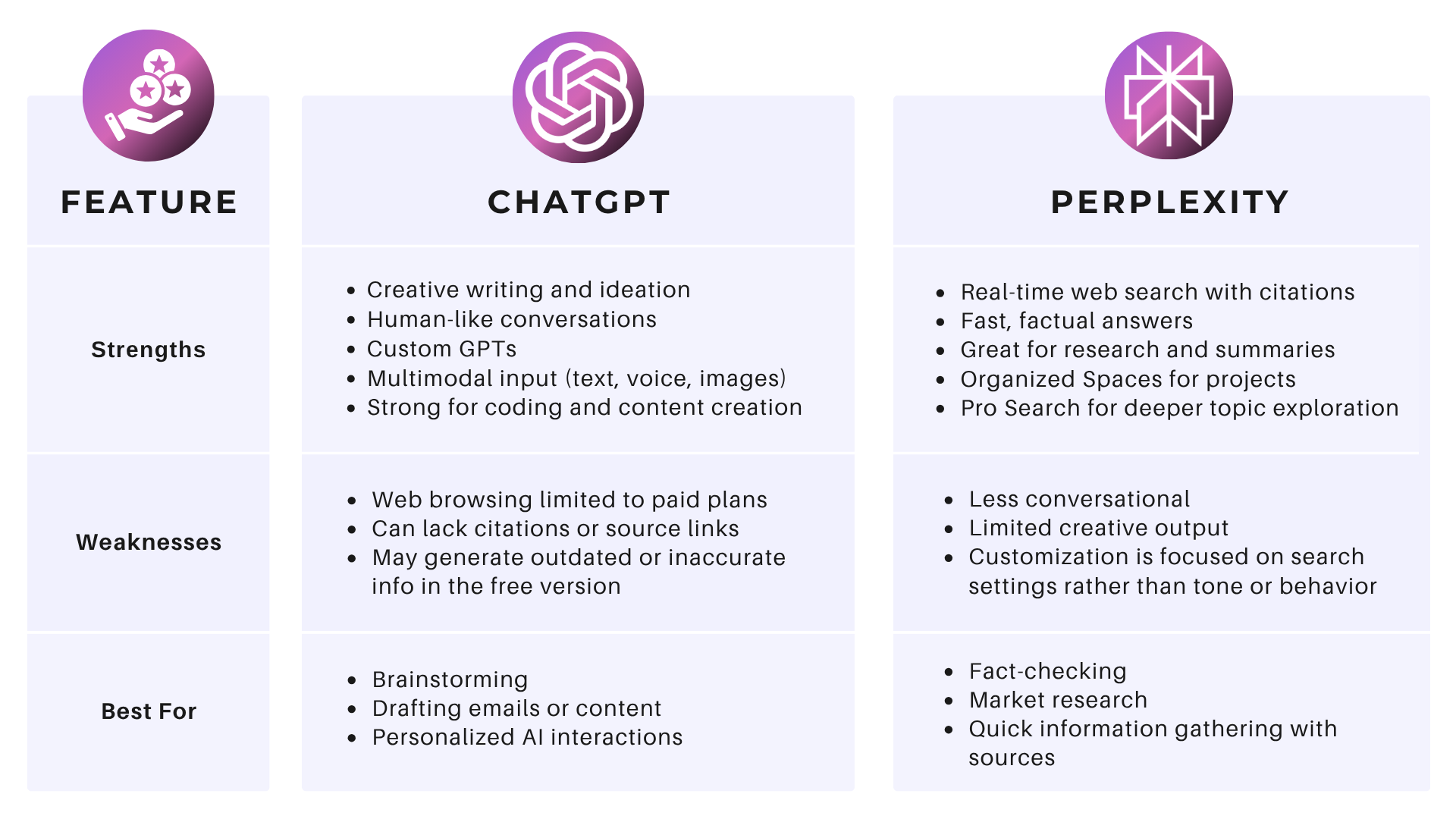
ChatGPT tends to offer more extensive explanations in a very conversational tone , ideal if you want to be told things "like a friend," with concepts explained and details detailing why a product fits your specific needs. It's therefore an AI closer to a personal assistant than a typical search tool.
Perplexity, on the other hand, is highly focused on factual accuracy and conciseness . Its responses tend to be more compact, emphasizing key data and including links or references to the sources used. It's especially useful if you want to quickly compare prices across multiple retailers or view similar products side-by-side without sponsored content that might skew your choice.
Another point of divergence is the level of "action" each assistant assumes . OpenAI's solution approaches an AI that could act on your behalf (for example, managing part of the process for you), while Perplexity's proposal, at least for now, remains closer to a "smart search engine + comparison tool," although it does add an integrated payment layer with PayPal.
Finally, global rollout plays a very important role . ChatGPT's shopping research is already available in many more regions and is not exclusively dependent on the US market, while Perplexity's shopping assistant is currently restricted to the US, awaiting international expansion and fully functional mobile versions.
Beyond ChatGPT and Perplexity: Other Notable AI Shopping Assistants
Although ChatGPT and Shopping Research, on the one hand, and Perplexity Shopping, on the other, receive much of the media attention, they are not the only options in the AI-powered shopping assistant ecosystem . Several enterprise solutions are revolutionizing how online stores guide users throughout their entire journey.
Insider, with its Agent One™ platform, is one of the most advanced examples in the B2B sector . It's an omnichannel suite, used by brands like Adidas, Lexus, and Coca-Cola, that integrates a customer data platform (CDP), intelligent search, merchandising, and recommendation models to create ultra-personalized shopping experiences.
Their Shopping Agent is designed to understand and anticipate user intent, not just react . Instead of waiting for the customer to type an exact term, this agent analyzes historical behavior, contextual data, and real-time inventory to suggest the next best product or action, reducing the feeling of "blind browsing."
Furthermore, the Shopping Agent prioritizes conversations with emotional resonance and a friendly tone . The idea is that browsing an extensive catalog feels more like talking to an expert who knows you than battling endless filters and menus. This emotional connection strengthens trust and brand loyalty.
On a technical level, it integrates enterprise CDP, an NLP-based search tool (Eureka), and Intelligent Recommendation models . This combination allows each interaction to feed into the customer's 360° profile, making future recommendations increasingly accurate and creating a virtuous cycle of continuous improvement.
Insider also complements its Shopping Agent with other specialized agents , such as Support Agent (to resolve doubts and provide support autonomously) and Insights Agent (to offer actionable intelligence on campaigns, anomalies and performance), becoming a comprehensive solution for marketing, sales and customer service.
Other relevant AI assistants and platforms in eCommerce and productivity
In addition to purely shopping-focused assistants, there are general-purpose AI tools that directly or indirectly influence how we plan, research, and execute complex purchases . These include ChatGPT, Gemini, Copilot, Claude, Grok, DeepSeek, and specialized marketing and social media platforms.
ChatGPT, developed by OpenAI, has become the gold standard for its versatility . It can write marketing copy, generate buying guides, answer technical questions, assist with programming, or provide customer support. Its ecosystem of integrations and APIs makes it easy to embed in CRMs, project management systems, or eCommerce websites to automate parts of the buying process.
Gemini, Google's offering, truly shines when you work within the Google Workspace ecosystem . From Gmail, Docs, or Sheets, you can generate emails, document summaries, or data analyses related to suppliers, inventory, or campaigns—incredibly useful for managing complex purchases or collaboratively comparing multiple options.
Microsoft's Copilot stands out for its deep integration with Office 365 and GitHub . For purchasing, finance, or marketing teams that rely on Excel, Word, Outlook, or Teams, Copilot automates tasks such as reporting, cost analysis, proposal writing, and interdepartmental coordination. Currently under development, GitHub Copilot accelerates the creation of internal tools related to logistics or catalog management.
Claude, from Anthropic, is clearly geared towards environments where accuracy and security are paramount . It excels at reasoning, analysis, and handling long documents, making it ideal for reviewing supplier contracts, legal terms, regulations, and technical documentation related to products and purchases.
Grok, the assistant from X (formerly Twitter), is positioned more as a fast, conversational AI with personality . It's useful for quick exchanges and social media contexts, although its focus isn't so much on structured purchasing as on facilitating real-time communication and consultation within social platforms.
DeepSeek presents itself as a more affordable conversational AI alternative , designed for those seeking a powerful text tool at a lower cost than other high-end options. Its use can be well-suited to scenarios requiring numerous customer interactions or automated pre-sales processes without breaking the bank.
Perplexity and ChatGPT beyond procurement: research, planning, and advanced use cases
Both Perplexity and ChatGPT are useful not only for finding the "best product," but also for planning complex purchases and making informed decisions in a wide variety of areas . Imagine, for example, that you want to size a domestic photovoltaic installation.
With a well-designed prompt, you can ask the AI to help you analyze your current energy consumption, compare the suitability of a 5 kW installation versus a 10 kW installation , assess the difference between on-grid and hybrid systems, and list pros, cons, and approximate price ranges. Then, you can request suggestions on what information to ask suppliers for to obtain comparable quotes.
Perplexity excels at these kinds of tasks when you need up-to-date data, figures, or recent statistics . Its ability to search the web in real time and cite sources makes it ideal for quickly viewing current regulations, grants, price comparisons, or other users' experiences.
ChatGPT, on the other hand, is usually better when you want to develop a step-by-step plan, create emails to request information, or generate documents . For example, you can ask it to draft an email to send to several installers, prepare a comparison table with key criteria, or translate technical terms into language you can understand without being an engineer.
In the field of academic and professional research, the combination of both is especially powerful . Perplexity acts as an initial filter for verifiable and current information, while ChatGPT is responsible for synthesizing it, giving it narrative form, and preparing presentations, reports, or client-oriented content.
The AI revolution in online shopping isn't limited to conversational assistants: it also affects how content is generated, social media presence is managed, and campaigns are automated . All of this directly influences how we discover products and make purchasing decisions.
ChatGPT once again stands out as one of the most versatile tools for creating copy, product descriptions, buying guides, and automated responses . Its ability to adjust tone and style to match the brand makes it ideal for social media campaigns, emails, and product pages that better connect with the audience.
Tools like Canva, Picmaker, and Flick add a visual layer powered by AI , generating images, videos, social media graphics, and ad creatives from text. This allows brands to create engaging materials to promote their products and indirectly feed into the recommendation flows of shopping assistants.
Metricool, Jasper, Lately, and similar platforms focus on content management, scheduling, and analytics . Thanks to AI, they can suggest post ideas, optimize text for engagement, measure which types of content generate the most interaction, and even break down long pieces (like an article or webinar) into multiple posts ready for distribution.
Finally, tools like HubSpot Marketing Hub or solutions such as Gmelius introduce AI into marketing automation and email collaboration . By centralizing communication with customers and leads, they facilitate the transformation of information generated by shopping assistants (frequently asked questions, objections, preferences) into targeted marketing actions and improved user experiences.
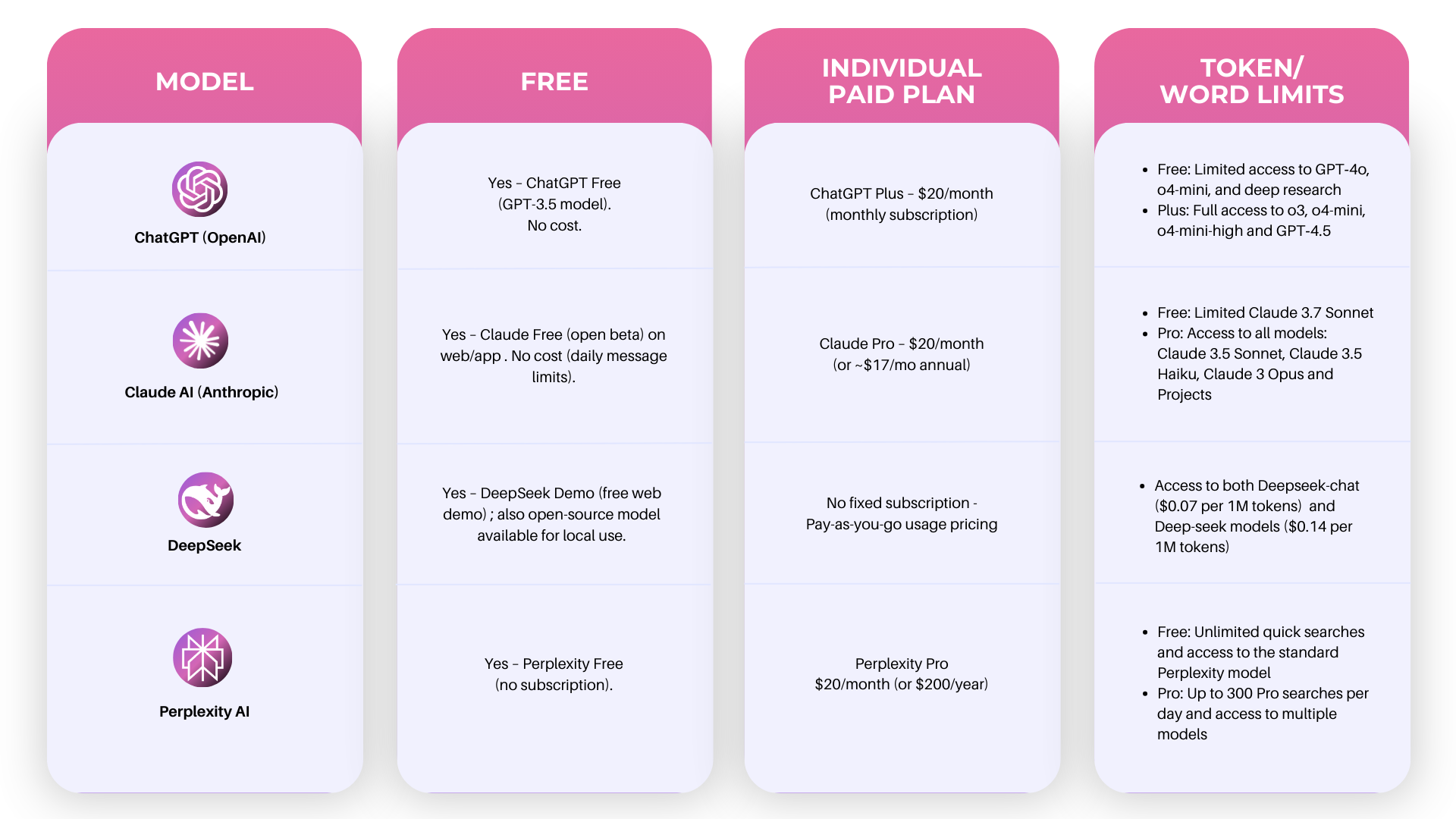
General comparison of AI assistants: strengths, weaknesses, and prices
If we broaden our focus beyond strictly purchasing tools, the landscape of AI assistants becomes even more diverse . Each tool has its niche, and combining them is often the best strategy for getting the most out of artificial intelligence.
ChatGPT offers a free plan and a paid subscription (ChatGPT Plus) for around $20 per user per month . In return, you get an extremely capable generalist assistant for conversation, creativity, and overall productivity, with a very broad ecosystem of integrations.
Gemini, which also offers a free plan and business options starting at around $20-30 per user per month , has as its main advantage its deep integration with Google Workspace. For "all-Google" organizations, it's a very natural productivity tool.
Copilot positions itself within the Microsoft ecosystem with similar pricing levels ($20-30 per user per month) . Its value proposition is clear: to boost productivity without leaving Word, Excel, Outlook, or Teams, in addition to its strong focus on development with GitHub Copilot.
Claude and Perplexity also offer free versions and paid plans starting at around $20 per month . Claude prioritizes security, reasoning, and handling formal documents, while Perplexity focuses on real-time information retrieval with citations, perfect for research, data verification, and purchasing based on rigorous analysis.
Grok, when integrated into X, adds a dynamic and conversational layer with a social media presence , offering a free tier for platform users and advanced options like SuperGrok for a monthly fee. Its primary focus is communication rather than pure eCommerce, but it can also be useful for customer service and community management strategies.
Furthermore, specific eCommerce solutions like Insider (Agent One™), Alby (Bluecore), SAP CX AI Toolkit, and Salesforce's Agentforce demonstrate that AI applied to shopping goes far beyond the typical chat . We're talking about agents capable of managing inventory, personalizing merchandising, automating returns, integrating loyalty programs, and providing omnichannel support from a single infrastructure.
Given this landscape, the “ChatGPT vs. Perplexity” battle in AI-powered shopping isn't so much about who wins, but rather a question of how well it fits into your workflow . ChatGPT (and its Shopping Research mode) offers a more conversational, educational, and globally accessible experience; Perplexity Shopping brings precision, clear comparisons, and a strong focus on unbiased, source-backed research, plus the added benefit of fast checkout via PayPal. Choosing one or the other—or combining them—depends on how much you value conversational depth versus factual accuracy, regional reach, integration with your existing tools, and how you prefer to make purchasing decisions on a daily basis.
