- LLMOps extends DevOps and MLOps to govern the behavior of LLM-based applications in production.
- GenAIOps with prompt flow in Azure integrates repos, pipelines, and continuous evaluation for prompt flows.
- The convergence of ChatOps, LLMOps, and DevOps enables conversational, automated, and observable operations.
- A phased and well-governed adoption reduces security risks, cost, and organizational complexity.

The arrival of generative AI and large language models has completely changed how software is built, deployed, and operated. It's no longer enough to have good DevOps pipelines or apply classic MLOps : when you introduce an LLM into the equation, you enter a realm where the model speaks, reasons, improvises, and sometimes behaves in unpredictable ways.
In this new landscape, teams need to combine DevOps, AI, and LLMOps to manage the entire lifecycle of LLM-based applications , from experimentation and prompt engineering to deployment, monitoring, security, and cost optimization. This article clarifies the complexities and walks you through, step by step, how to integrate ChatOps, DevOps, MLOps, GenAIOps, and LLMOps into a modern operation.
From DevOps and MLOps to LLMOps: why the model is no longer static
For years, engineering teams prioritized automating software delivery and reducing friction between development and infrastructure . This led to the birth of DevOps: continuous integration, continuous deployment, infrastructure as code, observability, and a collaborative culture that eliminated endless handoffs between departments.
When data became part of the product, MLOps emerged as a response to the need for reproducibility and traceability of machine learning models . Practices such as dataset versioning, training pipeline orchestration, drift detection, and continuous evaluation of predictive models were standardized.
The problem is that LLMs break many of the assumptions implicit in DevOps and MLOps . They are not static APIs or simple functions that return a deterministic number: they respond in natural language, mix context, instructions, tools, and real-time data, and can produce two different outputs for the same input.
This means that it is not enough to version the model and its weights ; it is also necessary to control the prompts, templates, semantic security policies, restrictions, connected tools, the injected context, and even the business rules that condition the system's behavior.
What is LLMOps and what does it actually solve?
We can view LLMOps as the operational framework that enables the secure, controlled, and sustainable deployment, maintenance, and scaling of LLM-based applications . It's an umbrella under which DevOps practices, MLOps, and new capabilities specific to generative models coexist.
In essence, LLMOps focuses less on "training the perfect model" and more on governing its behavior in production . This includes how prompt flows are designed and versioned, how LLMs connect to internal data sources, how token costs and latency are monitored, and how semantic risk (hallucinations, information leaks, biases, toxic responses, etc.) is managed.
The needs that LLMOps addresses, and that DevOps/MLOps alone cannot cover, include aspects as varied as conversation traceability, automatic evaluation of response quality, and A/B testing of behavioral variants . We're not just talking about classic accuracy, but also consistency, alignment with the business, and security.
Furthermore, costs are no longer limited to model training and hosting : each prompt, each extended context, and each concurrent call triggers GPU or token consumption on commercial APIs. Without an LLMOps layer to make this spending visible and connect it to equipment, services, and use cases, the bill grows unpredictably.
ChatOps + LLMOps + DevOps: operations become conversational
One of the most powerful trends is the integration of ChatOps and LLMOps within the DevOps culture . Instead of being limited to dashboards, scripts, and pipelines, teams are starting to operate a significant portion of the system through chat channels like Slack, Microsoft Teams, or Discord.
ChatOps proposes that daily operations (deployments, log queries, reboots, configuration changes) be executed by bots within the communication channel itself , transparently to the entire team. Every command, action, and result is recorded in the conversation.
When an LLM is added to that approach, a new layer of intelligence appears: chatbots that understand natural language, interpret intentions, and can trigger complex commands or analyze situations without the operator needing to remember every exact script or flag.
Typical examples of this convergence include a bot, powered by an LLM, reading metrics from Prometheus and logs from Loki when someone types "the service of group X is slow" and suggesting actions such as scaling replicas, doing a rollback, or launching specific tests, all explained in natural language.
At a cultural and operational level, this translates into faster decisions, less manual intervention in repetitive tasks, and a smoother experience for DevOps teams , who go from constantly putting out fires to working on strategic improvements.
Key principles of an LLM lifecycle in production
Running a serious LLM program isn't a one-off project; it's a recurring cycle where every change can alter the system's behavior . While each organization adapts it to its own reality, there are typically six major, self-reinforcing stages.
The first phase is the model training or adaptation , which can range from using a foundational model as is to applying fine-tuning, LoRa, or other tuning techniques with your own data. Here, the important thing is not only performance, but also leaving a complete record: datasets, applied filters, hyperparameters, tokenizer versions, tested architectures, etc.
If this phase is improvised and not documented, the model is born without governance . Afterwards, it will be nearly impossible to explain why it responds the way it does or to replicate a specific result when needed in an audit.
The second stage is deployment, where the model leaves the lab and enters production. In LLMOps, this isn't just about "putting it in a container": you have to decide what hardware to use , how to manage memory for long-running contexts, what cluster topology to apply, and how to scale according to traffic without latency skyrocketing or costs becoming unmanageable.
From there, continuous behavior-oriented monitoring comes into play . It's not enough to just look at CPU and RAM usage; it's necessary to monitor the semantic quality of responses, the stability of the style, the error rate, the evolution of the cost per token, the appearance of dangerous or inconsistent responses, and changes in response times under different usage patterns.
In later phases, optimization and fine-tuning tasks are performed: tweaking prompts, adjusting the RAG, testing model variants, quantizing, conducting A/B testing, changing semantic security policies, or refining business rules . It's an almost artisanal process, where data, engineering, and business come together to decide on priorities.
Finally, all of this is framed within layers of security and governance (access control, auditing, leak prevention, usage limits, regulatory compliance) and within a logic of continuous updating, where the model and its ecosystem are adapted to changes in data, regulations, and internal needs.
GenAIOps and the notification flow approach in Azure
Within the LLMOps universe, there are very specific proposals for structuring this lifecycle. One of the most advanced in the corporate environment is GenAIOps with prompt flows on Azure Machine Learning integrated with Azure DevOps , which offers a very systematic approach to building LLM-based applications.
The prompt flow is not just a prompt editor; it is a complete platform for designing, testing, versioning, and deploying LLM interaction flows , from simple cases (a single prompt) to complex orchestrations with multiple nodes, external tools, controls, and automated evaluations.
A critical feature is the centralized workflow repository , which acts as a corporate library. Instead of each team having their prompts in separate documents or their own repositories, they are consolidated into a single managed repository, with clear branches, revisions, and histories.
In addition, the platform adds variant and hyperparameter experimentation capabilities: it is possible to test different combinations of prompts, models, temperature settings or security policies on multiple nodes of the flow and compare results with clear metrics.
In terms of deployment, GenAIOps with notification flow generates Docker images that encapsulate both the flow and the process session , ready to run in environments such as Azure App Services, Kubernetes, or managed processes. From this base, A/B deployments are enabled to compare flow versions in real-world environments.
Another strength is the management of relationships between datasets and flows. Each evaluation flow can work with several standard and test datasets , allowing for the validation of behaviors in different scenarios before putting something into the hands of end users.
The platform also automatically registers new versions of datasets and flows only when there are actual changes, and generates comprehensive reports in formats such as CSV and HTML to support data-driven decisions, not intuition.
The four phases of GenAIOps with notification flow
The GenAIOps approach breaks down the life cycle into four clearly differentiated stages, which help to avoid the typical chaos of "we try things with AI and see what happens".
The first phase, initialization, focuses on precisely defining the business objective and gathering representative data examples . Here, the basic structure of the prompt flow is outlined, and the architecture is designed, which will then be refined.
In the experimentation phase, the flow is applied to these sample data, and different variations of prompts, models, and configurations are evaluated . Iteration continues until an acceptable combination is found that meets minimum quality and consistency requirements.
Next comes the evaluation and refinement phase, where larger and more varied datasets are used for rigorous benchmarking . Only when the flow demonstrates consistent performance aligned with the defined standards is it considered ready for the next step.
Finally, in the implementation phase, the workflow is optimized for efficiency and deployed to production, including A/B testing, monitoring, user feedback, and continuous improvement cycles . Nothing is ever truly finished: the workflow continues to be adjusted based on real-world usage observations.
This methodology is packaged in a GenAIOps repository template, with code-first, pre-built pipelines, and local and cloud-based execution tools to develop, evaluate, and launch LLM-based applications without reinventing the wheel for each project.
Integration with Azure DevOps: repositories, pipelines, and authentication
To bring GenAIOps from theory to a real organization, integrating it with Azure DevOps is key. The typical template starts with a repository in Azure Repos with two main branches, main and development , reflecting different environments and code promotion strategies.
The sample repository is cloned from GitHub, associated with Azure Repos, and the usual workflow involves creating feature branches from the development directory . Changes are then pushed via pull requests, which automatically trigger validation and experimentation pipelines.
To enable Azure DevOps to interact with Azure Machine Learning and other services, a service principal is configured in Azure as a technical identity . This identity is used in an Azure DevOps service connection, allowing pipelines to authenticate without exposing clear keys.
Typically, this entity has Owner permissions on the ML subscription or worker resource, allowing pipelines to provision endpoints, register models, and update policies in keystores . For increased security, it can be changed to a Contributor role by modifying the YAML steps that handle permissions.
Additionally, a group of variables is created in Azure DevOps that stores sensitive data such as the service connection name or resource identifiers . These variables are exposed to pipelines as an environment, avoiding the need to hardcode critical information into the code.
Configuring local and remote repositories allows the development branch to be protected with branch policies that require a pull request pipeline to run before merging. This pipeline handles build validations and experimentation flows, preventing broken changes from being introduced.
Once the code enters development, a development pipeline is triggered that includes complete CI and CD phases : running experiments and evaluations, registering flows in the Azure ML model registry, deploying endpoints and smoke tests, and integrating on the newly created endpoints.
The same pattern is replicated to a version or release branch, connected to production environments. There, the CI/CD pipelines for production repeat the cycle of experimentation, evaluation, and deployment , but on production-level infrastructure and data, with greater control and additional manual reviews if needed.
A key feature is the "loop human review" included in these pipelines: after the CI phase, the CD is blocked until a person manually approves the continuation from the Azure Pipelines interface. If it is not approved within a specified time (for example, 60 minutes), the execution is rejected.
Local implementation and connection with LLM providers
Not everything happens through pipelines: GenAIOps also supports local execution for rapid experimentation . You can clone the template repository, create a .env file in the root directory, and define connections to Azure OpenAI or other compatible endpoints within it.
These connections include parameters such as api_key, api_base, api_type, and api_version, and are referenced by name within the flows (for example, a connection called "aoai" with a specific API version). This allows the same flow to run locally and in the cloud without code changes.
To use this method, simply create a virtual environment or conda and install the necessary dependencies (promptflow, promptflow-tools, promptflow-sdk, openai, jinja2, python-dotenv, etc.). From there, you can write test scripts in a local execution folder and run experiments on the defined flows.
This cloud/on-premises duality aligns perfectly with a mature DevOps mindset: small-scale testing is done locally, formal validation is performed in pipelines, and then deployments are made to larger environments with controls and auditing . Everything is versioned in Git and connected to Azure DevOps.
Typical tools in a DevOps ecosystem with AI and LLMOps
Beyond Azure's specific proposal, a modern DevOps ecosystem with AI and LLMOps typically relies on a set of tools that cover ChatOps, model orchestration, monitoring, and observability.
In the ChatOps layer, it is common to combine Slack with bots like Hubot , Microsoft Teams with agents based on Power Virtual Agents, or Discord along with frameworks like Botpress or Rasa to build custom assistants that connect with pipelines, monitoring systems, and internal services.
In the LLMOps/MLOps field, platforms such as Kubeflow and MLflow are common for managing pipelines, model records and experiments, in addition to specific tools such as Weights & Biases (W&B) for advanced metric tracking, run comparisons or in-depth visualizations.
Building applications on LLM typically involves using frameworks like LangChain or libraries such as OpenLLM , which facilitate assembling prompt chains, connectors to external data, tools, and multi-step agents. Simultaneously, solutions for LLM-specific observability are emerging, enabling the monitoring of prompts, responses, costs, and quality.
In integration with classic DevOps, tools like Jenkins or GitLab CI remain relevant for the CI/CD part, Kubernetes and ArgoCD for continuous cloud-native deployment , and observability stacks like Prometheus, Grafana and Loki for metrics, dashboards and logs.
Challenges, limitations and progressive adoption
All this deployment of practices and tools doesn't come without a price. The complexity of managing prompts, model versions, and workflow variants is considerable, especially when multiple teams are working simultaneously —a scenario where strategies like GitOps are useful for coordinating changes and deployments.
Furthermore, ChatOps bots and LLMs with actionable capabilities introduce considerable security risks if they have excessive permissions in production environments or if data exposure surfaces are not properly controlled.
Added to this is the reliance on open-source models with sensitive licensing or commercial APIs that can change terms, prices, or limits. And, to make matters worse, robust evaluation of LLMs in production remains an open area, with many questions still unanswered.
Therefore, it makes sense to approach the adoption of LLMOps and ChatOps within DevOps in a progressive and controlled manner , starting by automating repetitive tasks with simple bots (reboots, log queries, build tagging, etc.).
Later on, LLMs can be introduced for support tasks, incident classification, or debugging assistance , for example, explaining errors from logs or proposing mitigations based on internal documentation.
Once the classic ML operation is stabilized, it's time to tackle LLMOps with specialized language models for domains such as customer service, DevSecOps or QA, taking advantage of everything learned in previous phases.
The horizon towards which all these practices point is a conversational, predictive and increasingly autonomous engineering environment , where much of the development and operation is expressed in natural language and AI helps to make proactive decisions about deployments, scaling or rollbacks.
With this puzzle in place —DevOps, ChatOps, MLOps, GenAIOps and LLMOps— organizations have a solid framework to build and sustain LLM-based systems that truly deliver value , maintaining control over quality, costs, security and alignment with the business, instead of remaining at mere prototypes or isolated tests that fall apart as soon as they reach production.
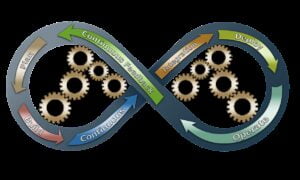
Table of Contents
- 1 From DevOps and MLOps to LLMOps: why the model is no longer static
- 2 What is LLMOps and what does it actually solve?
- 3 ChatOps + LLMOps + DevOps: operations become conversational
- 4 Key principles of an LLM lifecycle in production
- 5 GenAIOps and the notification flow approach in Azure
- 6 The four phases of GenAIOps with notification flow
- 7 Integration with Azure DevOps: repositories, pipelines, and authentication
- 8 Local implementation and connection with LLM providers
- 9 Typical tools in a DevOps ecosystem with AI and LLMOps
- 10 Challenges, limitations and progressive adoption