- The Spain Digital 2026 agenda promotes infrastructure, data and 5G as the basis for a more sustainable and efficient mobility system.
- The Sustainable Mobility Law requires the digitization of control documents and promotes logistics hubs and safe infrastructure.
- AI, IoT, and connected mobility are transforming transportation, but they require large investments, cybersecurity, and common standards.
- Programs like the Digital Training Voucher prepare transport professionals to take advantage of the new digital mobility.

Digital mobility , linked to the Spain Digital 2026 agenda, is fundamentally changing how we move, transport goods, and organize cities. It's not just about adding more technology to vehicles, but about redesigning the transport system to be much more sustainable, efficient, and easier to manage, while meeting international commitments to decarbonization and improved air quality.
This major shift is supported by digital infrastructure, new regulations, vocational training, and substantial European investment . From the digitalization of public transport to the mandatory use of electronic documents for freight transport from 2026 onwards, and including connected and automated mobility, the data economy, and support for digitally empowering the sector, everything points in the same direction: a greener, more innovative, and people-centered mobility model.
What do we understand by digital mobility in 2026?
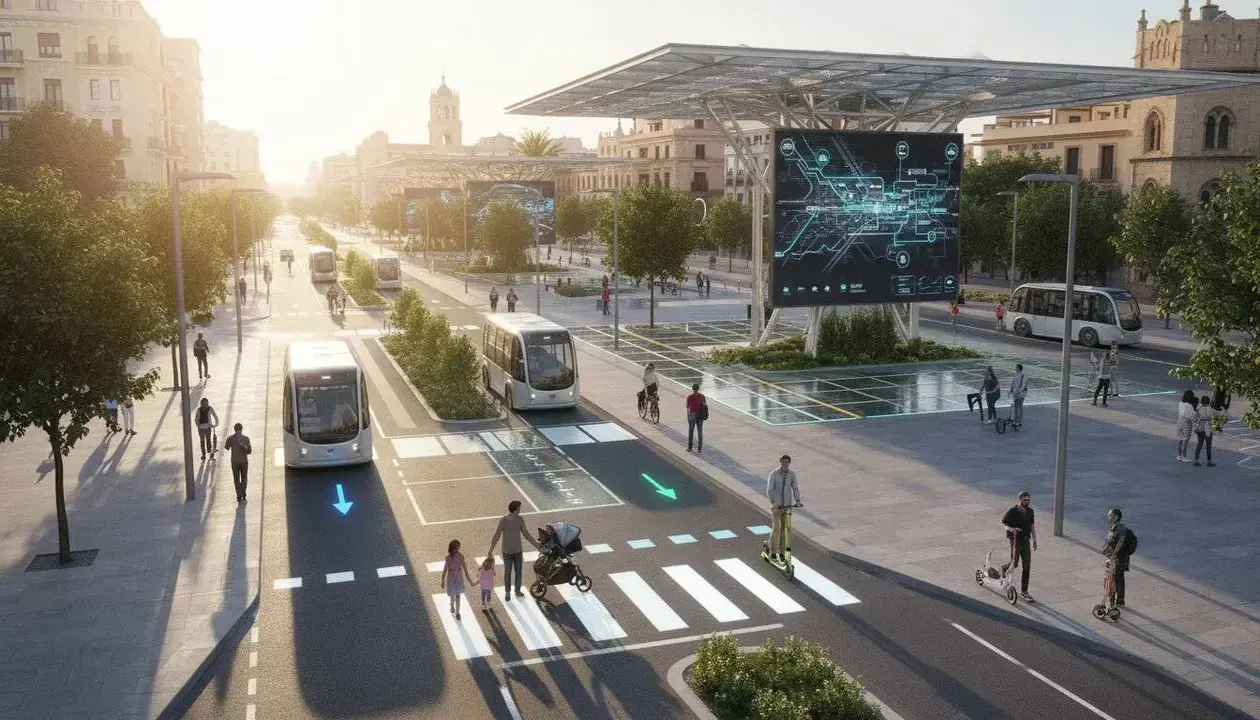
When we talk about digital mobility, we're not just referring to vehicles "full of sensors" or apps for renting a scooter. We're talking about using technologies like artificial intelligence (AI), the Internet of Things (IoT) , the cloud, edge computing, and 5G networks to fundamentally transform the transportation system: how it's planned, how it's operated, and how citizens and businesses use it on a daily basis.
In this new scenario, active mobility and public transport (walking, cycling, metro, bus, train, etc.) are taking center stage as more sustainable options from an environmental, economic, and social perspective. Digitalization must serve to make these alternatives more convenient, reliable, and attractive than private cars, reducing traffic congestion and emissions.
The Spain Digital 2026 agenda considers mobility a key area within its sectoral and sustainable digital transformation strategy . This involves promoting zero-emission solutions, integration between modes of transport (road, rail, sea, air), digitizing logistics, and pushing the automotive industry towards new business models based on data, services, and collaboration between manufacturers, suppliers, and other sectors.
This entire process demands massive digital professionalization in the transport sector: from drivers and logistics operators to infrastructure technicians, public administration staff, and technology companies that support the entire system. Without this "digital muscle," the transformation simply won't take off.
Digital Spain 2026 and its impact on mobility
The Spain Digital 2026 agenda is the roadmap for the country's digital transformation. It is an ambitious strategy that aims to fully leverage new technologies to achieve stronger economic growth, with quality employment, increased productivity, and greater social and territorial cohesion, bringing digitalization to every corner of the country.
This agenda is structured around three main dimensions: Infrastructure and Technology, Economy, and People . It also includes two cross-cutting axes designed for major, driving projects through public-private partnerships and co-governance between the central government and the autonomous communities. Within this framework, both the digitalization of transport and specific initiatives related to sustainable and smart mobility fit seamlessly.
Since 2020 , specific plans and investment programs have been launched at all levels (national, regional, and local) that have accelerated connectivity, R&D, and the digitalization of public administration and SMEs. In 2021 and the first half of 2022, this momentum was particularly strong, with significant transfers to regional governments and municipalities to digitize the public sector and promote digital skills among citizens.
Throughout 2022 and the following years, the rollout of Digital Spain has accelerated , particularly with regard to the digitization of the economic fabric and the development of digital capabilities. This is all financially supported by the Recovery Plan and the European Next Generation EU funds, which reinforce the investments planned in the first phase.
Spain Digital 2026 maintains ten strategic pillars from its initial version and adds two cross-cutting pillars (PERTE and Retech). For mobility and transport, several of these pillars are especially relevant because they address connectivity, cybersecurity, the data economy, public and private sector transformation, sustainability, and digital skills.
The 10 strategic axes and their relationship with mobility
The pillars of Digital Spain 2026 provide the framework for action on sustainable and smart mobility . They are not solely focused on transport, but they permeate it across all sectors. These are the most crucial for understanding what will happen in digital mobility between now and 2026.
Infrastructure and technology: connectivity, 5G, cybersecurity and data
The first block focuses on ensuring that the entire country has high-level digital infrastructure that enables connected, automated, and secure transportation.
In terms of digital connectivity, the goal is for 100% of the population to have access to 100 Mbps by 2025 , closing the gap between rural and urban areas. Without good connectivity, it is not possible to deploy advanced traffic management systems, Mobility as a Service (MaaS), or connected vehicles, especially in less populated areas where transportation options are already limited.
The push for 5G technology is another key pillar. Spain aims to continue leading its deployment in Europe and harness its potential to boost productivity, territorial cohesion, and social progress. The goal is for the entire radio spectrum to be 5G-ready by 2025 , which is crucial for connected vehicles, intelligent transportation systems (ITS), and real-time infrastructure monitoring.
Finally, the data economy and Artificial Intelligence aim for at least 25% of companies to use AI and Big Data within five years. In transportation, this means optimizing routes, predicting demand, adjusting public transport frequencies, improving infrastructure maintenance, and better managing logistics chains based on data generated by vehicles, urban sensors, and users.
Economic dimension: public sector, business and sectoral transformation
On the economic front, Spain Digital 2026 prioritizes the digital transformation of the public sector . Technological infrastructure is already being modernized in key areas such as employment, justice, and social policies, and this transformation will continue to be extended to all levels of government (national, regional, and local) by 2026.
In mobility, this modernization is reflected in more digitized public transport services , electronic processing, the use of mobility data to design policies, and the deployment of solutions such as integrated tickets, journey planning applications, and real-time information for travelers.
In parallel, the agenda promotes the digitalization of businesses and entrepreneurship , with a special focus on SMEs, micro-enterprises, and startups . By 2026, the aim is to accelerate their digital transformation and create a favorable environment for emerging technology-based companies, including those working on mobility solutions, smart logistics, MaaS platforms, and services for connected and autonomous vehicles.
The focus on sectoral and sustainable digital transformation is especially relevant for mobility. Spain Digital 2025 has already launched initiatives in sectors such as agri-food, health, mobility, tourism, and commerce. By 2026, the goal is to accelerate the dual green and digital transition through the Regional Strategic Plans for Transport (PERTE), consolidating profound, lasting, and sustainable structural changes in the economy and society, with transport playing a key role.
Furthermore, the strategy of positioning Spain as a European audiovisual hub also indirectly impacts mobility, by attracting productions and companies that require advanced infrastructure, accessibility and transport services, while promoting environmental sustainability in productions.
People: digital skills and rights in mobility
In the human dimension, the digital skills axis aims to strengthen the capabilities of the working population and the citizenry as a whole. Among the goals are reducing the digital divide, completing the digital transformation of education, ensuring continuous training in digital skills, and increasing the percentage of ICT specialists, while promoting gender parity.
For the transport and mobility sector, this means training professionals in specific technologies: fleet management systems, data platforms, automation tools, urban mobility solutions, etc. Initiatives such as the “Digital Training Voucher in Transport” fit perfectly into this area.
The tenth pillar focuses on digital rights , guaranteeing the protection of workers, consumers, citizens, and businesses in the digital environment. The Charter of Digital Rights, adopted in 2021, serves as a roadmap for a humanistic approach to digitalization, which also applies to the design of mobility services: data protection, transparency in trip allocation algorithms, working conditions in new forms of platform-based work, and so on.
PERTE and Retech: major driving projects in mobility
The cross-cutting themes of Digital Spain 2026 are the PERTE (Strategic Projects for Economic Recovery and Transformation) and the Retech initiative (Territorial Networks of Technological Specialization). Both are fundamental for moving from theory to concrete projects in the field of digital mobility.
The PERTE program aims to promote large-scale projects with a significant multiplier effect on growth, employment, and competitiveness. Eleven PERTE programs have already been approved, mobilizing over €30.000 billion in public investment, many of which have a direct impact on mobility: from electric and connected vehicles to the decarbonization of industry and the modernization of infrastructure.
Retech, for its part, identifies high-impact territorial and economic projects proposed by the autonomous communities, within the priorities of the Recovery Plan. These include initiatives related to mobility data, smart transport platforms , digital logistics, and charging networks for zero-emission vehicles, all co-financed by the central government and the regional governments.
This approach reinforces a clear message: digital mobility 2026 needs cooperation and co-investment between companies, administrations and other agents to achieve the necessary scale and avoid dependence on large dominant platforms from outside Europe.
Specific plans that promote digital mobility
Within the framework of Digital Spain 2026 , specific plans and strategies have been activated that translate the general objectives into actions directly related to transport and mobility. Some of the most relevant are the following.
Plan for Connectivity and Digital Infrastructure
This plan develops the first axis of the agenda and focuses on using connectivity and digitization as tools to close socio-economic, gender, generational, territorial or environmental digital divides.
Building on existing infrastructure, the plan defines reforms and investments to guarantee access to digitalization throughout the country , both in connectivity infrastructure and technological innovation in key sectors, including transport. The aim is to consolidate Spain as one of the EU's digitalization hubs, creating the necessary foundation for deploying connected mobility systems and smart services.
5G technology promotion strategy
5G technology is envisioned as a cornerstone of the new digital mobility , alongside IoT, AI, advanced data analytics, and robotics. The hyperconnectivity that 5G provides enables the coexistence of millions of devices, from vehicles to smart traffic lights, sensors on roads or in ports, and real-time control systems.
In practice, 5G will improve competitiveness and efficiency in the use of resources , increasing the quality of transport services and enabling applications such as autonomous vehicles connected to the infrastructure, dynamic traffic management or smart urban logistics with less environmental impact.
National Digital Skills Plan
The National Digital Skills Plan articulates training initiatives from school to university , job retraining programs and specific actions to close the gender gap and bring digital training to areas in demographic decline.
In the field of mobility, this translates into professionals better prepared to manage intelligent transport technologies , traffic data systems, planning tools, digital logistics platforms, and sustainable urban mobility solutions. The plan involves all ministries and fosters synergies with other government bodies, universities, and the private sector.
National Cybersecurity Plan
The National Cybersecurity Plan aims to have an additional 20.000 specialists in cybersecurity, data and AI by 2025 , taking special advantage of the business hub that revolves around INCIBE (National Cybersecurity Institute).
In digital mobility, this strategy is essential to protect critical transport systems : control centers, intermodal infrastructure, connected vehicles, ticketing platforms, and mobility applications. The updated National Security Framework (ENS) strengthens defense capabilities against cyber threats in the public sector and its technology providers.
Digitalization Plan for Public Administrations
The digitization of the public sector seeks a qualitative leap in effectiveness and efficiency . Among its goals is that by 2025, 50% of public services will be available through mobile apps, facilitating a simpler and more personalized relationship with citizens and businesses.
In transport, this means more streamlined procedures, accessible information and integrated mobility services , from license and permit management to inquiries about public transport, low emission zones, parking reservations or logistics information.
Plan to Boost the Digitalization of SMEs
This plan is designed to accelerate the digitization of SMEs through the adoption of new technologies, process automation, the use of big data, IoT, AI and cloud services.
In the transport and mobility sector, this means that small logistics companies, workshops, local operators or startups can incorporate digital solutions for fleet management, route optimization, delivery platforms or MaaS services, improving their competitiveness and innovation capacity.
Spain's Plan for the Audiovisual Hub of Europe and National AI Strategy
The audiovisual plan aims to strengthen the competitiveness and internationalization of Spanish production, while also increasing the country's attractiveness as an investment destination. Efficient, sustainable, and digitalized mobility is a key factor for these productions and the flow of professionals they generate.
The National Artificial Intelligence Strategy (ENIA), structured around 6 pillars and 30 actions, recognizes AI as a driver of economic growth and a tool for addressing collective challenges such as the ecological transition, social inclusion, health, and well-being. In transportation, AI is applied to traffic management, road safety, predictive infrastructure maintenance, public transport network planning, and energy optimization of electric and hydrogen vehicles.
Digitalization and the new Sustainable Mobility Law
A key element of digital mobility in 2026 is the Sustainable Mobility Law , which introduces profound changes to freight and passenger transport. One of the most significant changes is the requirement that the administrative control document be exclusively digital from October 3, 2026, for both freight and passenger transport (in the latter case, the route sheet).
The law, already approved and published in the Official State Gazette (BOE), stipulates that this document may only be issued electronically ten months after its entry into force . This also encourages the adoption of other electronic documents such as the eCMR, which is in high demand for international transport because it allows cargo traceability and facilitates border crossings without constant physical inspections.
The international transport employers' association has welcomed this measure, although it highlights two major challenges: firstly, the need for a cultural and mental change in transport companies, especially smaller ones; secondly, the importance of all actors in the chain moving towards interoperable systems that increase efficiency throughout the value chain.
The Sustainable Mobility Law also provides for the creation of safe and secure parking areas for professional drivers, including designated spaces for the transport of hazardous goods. The authorities must guarantee these infrastructures, which contribute to road safety, the protection of goods, and improved working conditions.
In addition, transport companies will be required to calculate and report the carbon footprint of their services, implement auditable energy and environmental management systems, and adapt to a series of regulatory measures that will be developed in the coming years.
Vehicles, new urban regulations and logistics hub
In urban areas, new mobility vehicles (bicycles, personal mobility vehicles such as scooters, and also more efficient motorized vehicles) have become very popular, driven by the demand for sustainable options and by technological advances that improve the user experience and operational efficiency.
Even so, private motor vehicles still have a very high modal share, accounting for around 48% in the EU and 45% globally, according to various studies. To correct this imbalance, other more sustainable modes of transport are being promoted: bicycles, personal mobility vehicles (PMVs), and walking, supported by appropriate infrastructure and specific regulations.
Personal Mobility Vehicles (PMVs) have required a clear definition and specific technical requirements to ensure their safe use, an aspect identified as critical by the European Commission in terms of road safety. This regulatory work is integrated with digitalization, as many PMVs and associated services rely on apps and platforms for their operation.
The Sustainable Mobility Law also empowers municipalities to impose fees on vehicles exceeding the limits of Low Emission Zones , strengthening their capacity to manage urban space and reduce negative externalities. For example, exceptions are permitted for roadside assistance vehicles registered in the State Roadside Assistance Registry, regardless of their environmental rating.
Another important new development is the Logistics Hub concept , designed to create a national network of intermodal platforms with the aim of optimizing the flow of goods. These hubs must be accessible to all operators, have facilities for intermodal interchange (road-rail-port, etc.), and be fully digitized, representing a significant opportunity to improve competitiveness and sustainability in the logistics chain.
How digitization is transforming mobility
Major advances in AI, IoT, cloud and edge computing, along with 5G networks, are driving a true revolution in mobility . It's not just about having more devices; transportation is becoming an intelligent system capable of learning, adapting, and optimizing itself in real time.
On the one hand, autonomous vehicles are gaining ground: robotic taxis, connected trucks, driverless delivery systems… All of this opens the door to new business models and different ways of organizing the transport of people and goods.
On the other hand, new mobility services enabled by digital platforms are emerging : shared mobility (car sharing, public bikes, shared scooters), integration of different modes into a single app (MaaS), and unified payment systems. This is changing the way we plan and carry out our daily commutes.
Furthermore, the data generated by vehicles is multiplying exponentially. An autonomous vehicle can produce around 4 TB of data per day . These vehicles are increasingly connected to their physical environment (infrastructure, other vehicles) and digital environment (platforms, cloud services), creating a constant flow of information.
Habits and behaviors are also changing due to digitalization: the rise of e-commerce, teleworking, new travel patterns… All of this modifies demand curves, peak hours and the configuration of transport and delivery routes.
Benefits and challenges of connected mobility
Connected and automated mobility (CAM) can significantly increase safety on roads, railways, and waterways. By optimizing the use of vehicles and infrastructure, it is possible to improve efficiency, reduce congestion, and contribute to lowering greenhouse gas emissions.
CAM also opens up business opportunities, increases competitiveness and facilitates access to transport for the elderly or disabled , profoundly transforming the travel experience in the coming years.
Mobility as a Service (MaaS) , by enabling seamless multimodal travel and offering greener alternatives in a single application, helps decarbonize transport. Leveraging the complementarity between modes (train, bus, bicycle, car sharing, personal mobility vehicles) leads to more efficient use of resources and savings in time and costs for both passengers and operators.
The exchange of mobility data improves synchronization between modes of transport and infrastructure, enables the development of AI-based applications, and helps administrations to monitor transport activity and its impacts, as well as to better plan investments in infrastructure and services.
Furthermore, access to vehicle sensor data is highly valuable to insurers, navigation companies, and road maintenance firms , opening up new avenues for generating economic value and improving road safety.
In parallel, digitalization can accelerate the transition to zero-emission mobility . AI enables improvements in the energy efficiency of electric and hydrogen vehicles, optimizes the location of charging points, and manages bidirectional charging, bringing flexibility to the electricity grid and facilitating the integration of renewable energy.
However, the challenges are significant. Enormous investments are needed in technologies and infrastructure (cloud, edge, 5G, chips for smart vehicles, new automotive operating systems), and the EU remains largely dependent on other regions for some of these technologies.
There is also the challenge of preventing the fragmentation of the European mobility ecosystem , made up of numerous actors of varying sizes and specializations. Establishing common rules, platforms, governance frameworks, and standards is essential to achieve critical mass and reduce dependence on large global players.
Finally, security and privacy must be addressed (protection of personal data, cybersecurity, user acceptance) and the social repercussions must be managed well: changes in employment profiles, new forms of work linked to platforms that must respect labor legislation and ensure social protection, and the need to gain the public's trust in autonomous mobility.
“Digital Training Voucher in Transportation” Program
As part of Investment 3 “Digital Skills for Employment” of Component 19 of the Recovery Plan, the Ministry of Transport and Sustainable Mobility has launched the “Digital Training Voucher in Transport” program . Its objective is to promote digital training for professionals in the transport, mobility, logistics, and infrastructure sectors.
This program is aimed at both workers in the sector and staff from related public administrations , as well as unemployed individuals and students. Its approach is broad and seeks to raise the level of digital skills across the entire ecosystem, from fleet management to urban mobility planning.
The grants are awarded as direct aid of up to €1.000 per beneficiary to enable each person to participate in pre-approved training courses. These courses cover topics such as general concepts of digitalization in transport, key technologies and enablers, document digitization, automation, digital marketing and communication, sustainable digitalization, and digitalization in urban mobility and transport.
The beneficiaries are natural persons who carry out and successfully complete validated training actions, fulfilling the requirements of the regulatory bases included in Order TMA/1126/2023, within the framework of the Recovery Plan financed by the European Union – NextGenerationEU.
The first call for proposals was published in 2024 by resolution of the Secretary of State for Transport and Sustainable Mobility, and in 2025 an amendment to that resolution was approved to adjust aspects of the call. The entire application process is channeled through training providers that wish to include their courses in the register of eligible activities.
These entities submit the application for registration of the training activity and, if they meet the requirements, act as representatives of the students to process the aid and subsequently justify the completion of the training, so that the beneficiary can receive the corresponding amount.
Taken together, all these initiatives – the Spain Digital 2026 agenda, PERTE, Retech, sectoral plans, the new Sustainable Mobility Law, digital skills programs and the deployment of technologies such as 5G or AI – paint a picture in which mobility in the coming years will be marked by digitalization, sustainability and collaboration between administrations, companies and citizens, with the constant challenge of guaranteeing safety, equity and rights in a rapidly transforming environment.
