- Gemini 3 debuts generative interfaces and improves expert-level reasoning.
- Enhanced multimodality with 1M tokens and improved image and video results.
- More capable agents: Antigravity, Workspace integration, and tool usage.
- Wide deployment and enhanced security, with access in app, Search, AI Studio, and Vertex AI.
Google's new generation of AI arrives with a clear ambition: to move from conversing to executing. With Gemini 3, the company takes a remarkable leap in reasoning, multimodality, and agentic capabilities , and also debuts a different way of interacting: interfaces that the model itself generates on the fly to help you achieve your goal without wasting time on intermediate steps.
All of this comes with a redesign of the app, improvements to Google Search, Workspace, and developer tools , and a strong focus on security. There are noticeable changes for everyone, but many of the most significant improvements will be seen in advanced uses: programming, data analysis, working with videos and images, and automation with agents that plan and act under human supervision.
What is Gemini 3 and why does it mark a turning point?
In practice, this translates into more direct and useful responses, a reduction in the "flattery" typical of some chatbots, and a better interpretation of the context , even when working with long or heterogeneous inputs (text, images, video, audio, and code).
In addition, Google has deployed Gemini 3 across multiple surfaces since day one: the Gemini app, the search engine's AI Mode, AI Studio, Vertex AI, the model's CLI, and a new agent platform called Google Antigravity , designed to plan and execute complex software tasks with access to editor, terminal, and browser.
To underscore the scope of the launch, the company recalls the cumulative impact of the Gemini era: the AI-powered View experience reaches billions of people a month, the app surpasses hundreds of millions of users, most Google Cloud customers already use AI capabilities, and millions of developers have built solutions with its generative models.
Generative interfaces and a new user experience
Gemini 3 debuts an app with a cleaner, more modern aesthetic that makes it easier to start conversations and find what you've created in the "My Stuff" folder . The redesign isn't just cosmetic: the big leap forward is generative interfaces , a type of response where the model determines the optimal format and generates dynamic visuals instead of a block of plain text.
Among the first experiments are the “visual design” (a magazine-style view with photos and interactive modules) and the “dynamic view,” designed to explore and personalize results. If you ask it to “plan a 3-day trip to Rome in the summer,” you get a navigable visual itinerary with follow-up questions and interactive elements.
The idea is related to what's called vibe coding : you describe the goal in natural language, and the system creates the interface or code needed to achieve it. So, if a diagram, animation, or interactive mini-app is better than a paragraph, Gemini 3 generates it within the experience, without forcing you to switch tools.
The shopping experience also takes a leap: listings, comparison tables and prices are integrated directly from Google Shopping Graph (with tens of billions of references) to build interactive guides without leaving the flow, in the style of a specialized recommendations page, but generated on the fly by the model.
Another practical improvement is that, in the search engine, a limited group of subscribers can opt for the reasoning-oriented variant of Gemini 3 Pro to receive more comprehensive and substantiated summaries, and not just the synthetic response of the current mode.
Advanced reasoning and Deep Think mode
Google highlights a substantial improvement in high-difficulty tests: it speaks of PhD-level reasoning , with highly competitive results in tests such as Humanity's Last Exam and GPQA Diamond. In numbers, Gemini 3 Pro achieves scores such as 37,5% in HLE (without tools) and 91,9% in GPQA Diamond, and establishes a state-of-the-art performance in mathematics with 23,4% in MathArena Apex.
Gemini 3 Deep Think mode takes things a step further for particularly complex and novel challenges. In internal assessments, it outperforms Pro on multiple fronts: 41,0% in Humanity's Last Exam (without tools), 93,8% in GPQA Diamond, and 45,1% in ARC-AGI when code execution is allowed—a combination of symbolic reasoning, tool usage, and programming designed for difficult problems.
In agentic domains, the model shows good performance in Terminal-Bench 2.0 (54,2%), which measures its ability to handle a computer via terminal, and maintains stable decision-making in prolonged environments such as Vending-Bench 2 , where it achieved a net return of over five thousand dollars in a business simulation during a virtual year.
Beyond the metrics, what's relevant is the change in role: from a responsive assistant to an active agent . Gemini 3 plans, breaks down tasks into steps, requests approval when necessary, and executes with human oversight in the loop. It can sort a Gmail inbox, organize schedules by cross-referencing availability, or prepare a complex workflow by combining reasoning, tool calls, and navigation.
The developer and business community is already seeing tangible improvements: better visual understanding, more reliable code generation , and increased performance on long-running tasks. All of this translates into more useful agents, capable of sustaining projects consistently and staying on track over time.
Multimodality and large-scale context
Gemini 3 Pro strengthens its multimodal understanding and raises the bar for image and video: it excels in MMMU-Pro (81%) and Video-MMMU (87,2%), and shows progress in factual accuracy with SimpleQA Verified (72,1%). The key lies in its ability to combine text, code, photos, audio, and video clips within the same context, interpreting relationships and nuances.
The model handles large amounts of data thanks to a context window of 1 million tokens , enough for lengthy articles, entire classes, code repositories, or multiple documents running in parallel. This enables highly practical applications: from unifying handwritten family recipes (even in multiple languages) and turning them into a cookbook, to transforming scientific articles and long videos into interactive cards and visualizations.
For programmers, Google speaks of a significant leap forward in code analysis, abstract reasoning, and controlled execution. In development assistance scenarios like Code Assist 3.0 , it describes an understanding of the complete repository architecture and an expanded context window of up to 10 million tokens, useful for detecting dependencies that could be broken by a local change.
The model also improves parallel reasoning with visual and textual data, refining the interpretation of tables, diagrams, and interfaces. This advancement is crucial when what matters is not just "seeing" the image, but cross-referencing it with text and numbers to draw conclusions and take action.
As a result, the answers are not always text-based: sometimes the ideal answer is an interactive web app (a calculator, a simulator, or a real-time widget) that allows you to explore the solution more intuitively within the Gemini flow itself.
Agents, development, and the Google Antigravity platform
Gemini 3 is now available to developers in Google AI Studio , Vertex AI, and the CLI, and introduces Google Antigravity , an agent-based development platform with direct access to the editor, terminal, and browser. The system can plan and execute end-to-end software tasks , validating its own code and coordinating with other surfaces in the Gemini family (such as computer control and image editing).
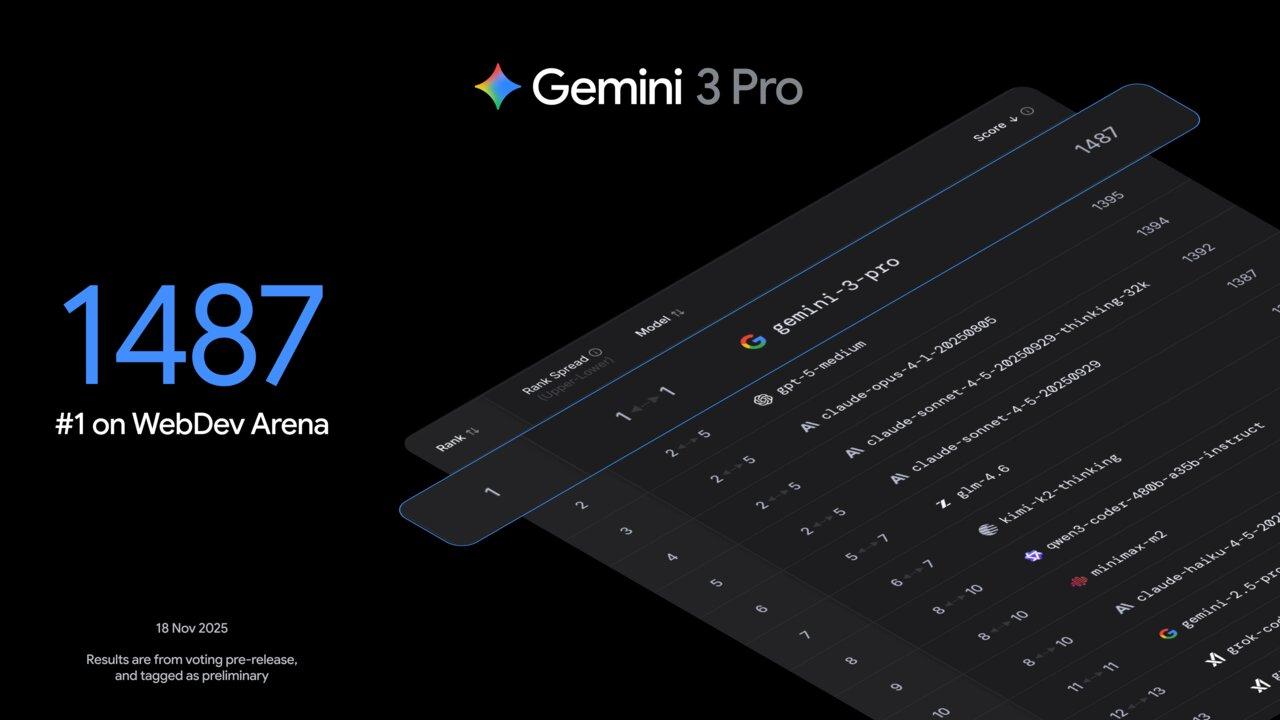
The model leads in benchmarks like WebDev Arena (1.487 ELO), scores 54,2% in Terminal-Bench 2.0, and achieves 76,2% in SWE-bench Verified, excelling in example-free code generation and the creation of rich web interfaces from complex instructions. For businesses, this accelerates the development of customized, agent-based solutions.
Real-world examples are already taking advantage of this: companies that create automated presentations are feeding the model technical documents to generate pieces that previously took an analyst hours to complete. With Gemini 3, that work is reduced to a matter of minutes , thanks to multimodal reasoning and expanded context.
Integration with Google Workspace and the search engine
The most visible impact for teams will come in Google Workspace . Gemini is no longer just a sidebar; it's now integrated as an engine within Gmail, Docs, Sheets, Calendar, YouTube, and Maps. In Gmail, for example, it doesn't just summarize: it drafts, prioritizes, responds, and schedules meetings based on your actual availability. In Sheets, it acts as a data analyst, creating charts and pivot tables based on your questions.
Gemini Vids is also consolidated , capable of generating complete video presentations from Drive documentation, and collaboration with multimodal content is enhanced: the model understands and combines text, images and clips to produce useful assets in less time.
In Search , in addition to AI-powered summaries, certain subscribers can upgrade to Gemini 3 Pro for richer answers based on its analytical capabilities. And in Shopping, Gemini uses Google's Shopping Graph to generate recommendation guides with up-to-date pricing and details without taking you away from the experience.
Another notable improvement is that the search engine can better break down your questions into subqueries that it investigates on your behalf, more accurately understanding the intent and avoiding omissions that previously escaped.
Overall, this integration promises less friction : you ask for what you need and, if appropriate, the model generates the view, table, calendar or miniapp within the same flow, without forcing you to jump between tabs.
Availability, deployment and security
Google claims that Gemini 3 is its most secure model to date , thanks to the most comprehensive set of assessments it has ever implemented. Improvements include reduced vulnerabilities, greater resistance to prompt injection attacks , and enhanced defenses against misuse related to cyberattacks, validated by independent experts and external bodies (such as the UK's AISI ) and specialized firms.
The rollout is massive: end users can find it in the Gemini app and in the search engine's AI Mode, developers in the Gemini API, AI Studio, Antigravity, and CLI , and organizations through Vertex AI and Gemini Enterprise. Some advanced features, such as Deep Think and certain agent capabilities, are initially offered to Google AI Ultra subscribers and will be expanded over time.
A practical note: Gemini 3 Pro is offered free from day one on the app and web, something unprecedented until now, although the upgrade to Pro within Search is currently reserved for paid plans. Furthermore, it can already be tested from Google AI Studio, and its general rollout will be enabled in the coming days depending on the region and product.
Google backs up the rollout with adoption data: the AI experience in the search engine reaches billions of monthly users, the app far exceeds half a billion, more than 70% of Google Cloud customers use AI capabilities, and 13 million developers have created solutions with its models.
Applications in companies and use cases
In corporate environments, Gemini 3 enables the design of customized solutions that integrate agents, automation, and multimodal AI into key processes. This ranges from supporting the development and improvement of data pipelines to creating conversational experiences that handle documents, images, and videos with a unified approach.
Many companies combine these capabilities with cybersecurity and penetration testing practices to protect models and data, and deploy cloud infrastructures (AWS and Azure) that ensure scalability, availability, and compliance. In analytics, dashboards and business intelligence services (for example, with Power BI) are integrated to transform data into actionable decisions, relying on the model's reasoning and the generation of visualizations .
The suite also benefits from grounding with Google Search , which anchors answers to reliable information on current topics, minimizing misinformation. In terms of programming, Gemini 3 understands the repository architecture, suggests changes, and alerts to potentially broken dependencies, saving time for technical teams.
Looking ahead, Google anticipates radical customization : models that privately and securely adapt to your organization's style, tone, and expertise without the need for complex fine-tuning processes . And note: while the average user might not notice all the changes, technical and data teams will see clear improvements in accuracy, speed, and actionability.
Gemini 3 redefines how we work with AI by combining advanced reasoning, practical agents, and generative interfaces: less friction, more context, and the possibility of an interactive experience that takes you from goal to execution with just a couple of well-given prompts.