- Hardware modification to increase RAM from 2 MB to 16 MB using EDO chips.
- Limited impact on original commercial games, but great potential for the homebrew scene.
- Advanced technical requirements involving precision welding and track cutting.
- Optimized compatibility for PU-8 motherboards and SCPH-5500 models.
Sony's legendary PlayStation arrived in our homes in the mid-90s with an architecture that, while brilliant, featured a modest 2 MB of main RAM . Alongside this, the machine managed 1 MB of VRAM for graphics and approximately 512 KB dedicated exclusively to sound. Despite these figures, which seem insignificant today, the console was able to run landmark titles like Metal Gear Solid and Final Fantasy VII thanks to the developers' ability to squeeze every last bit of available memory.
You're probably wondering if it's possible to break through those technical barriers and breathe new life into the hardware. It turns out that some modding enthusiasts have pushed this to the limit, managing to increase the memory eightfold to reach 16 MB. This curiosity stems from the discovery that Sony's arcade hardware did support such a capacity, something that went untapped in the home console versions.

The technical process: from 2 MB to 16 MB
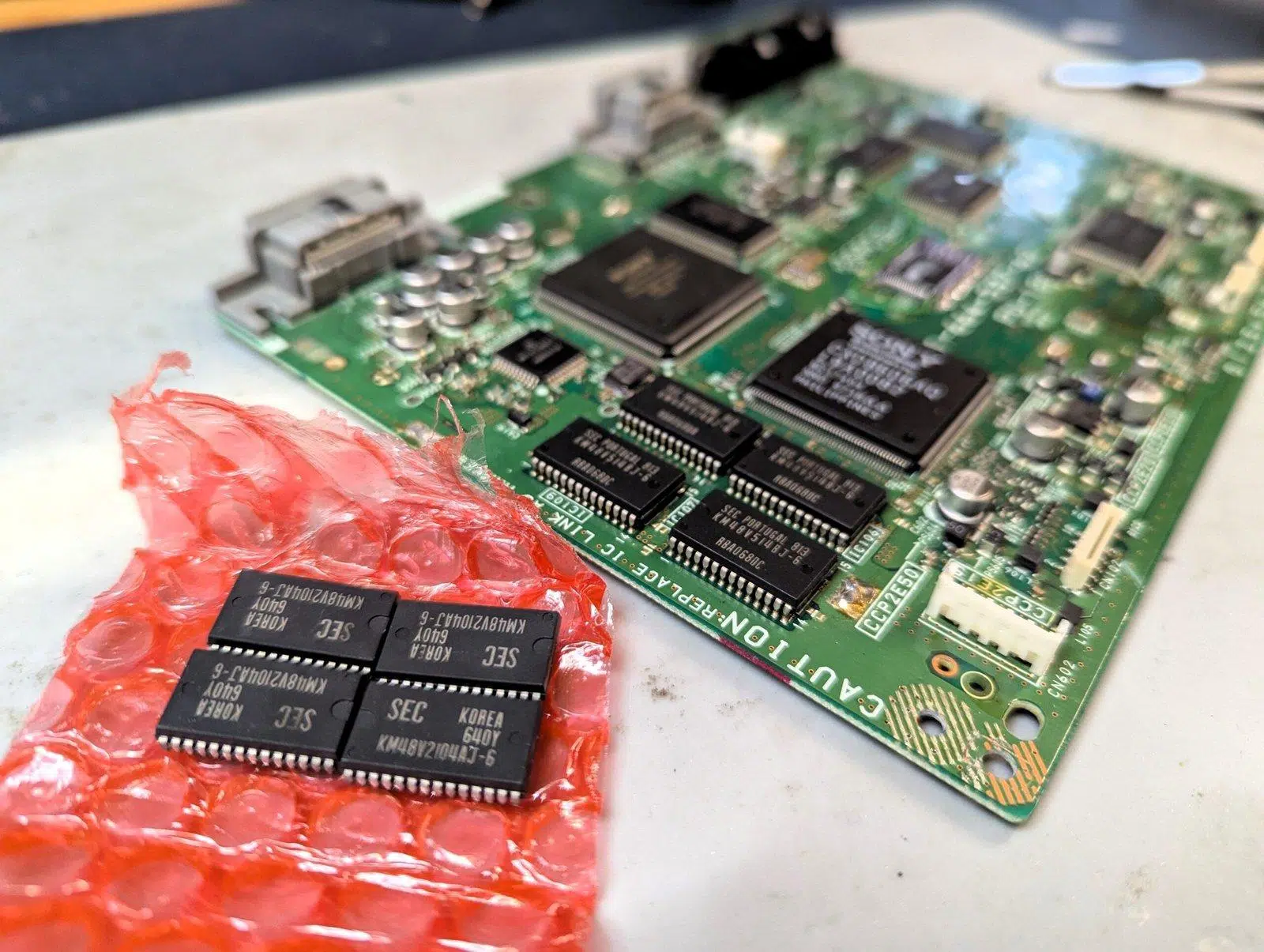
Performing this upgrade is no walk in the park; it requires advanced electronics knowledge. The original PS1 uses four 512KB chips. To achieve the expansion, these components are replaced with eight 2MB EDO RAM modules , often recycled from old PC memory. The assembly involves soldering four chips in place and stacking the other four on top, creating two 8MB banks.
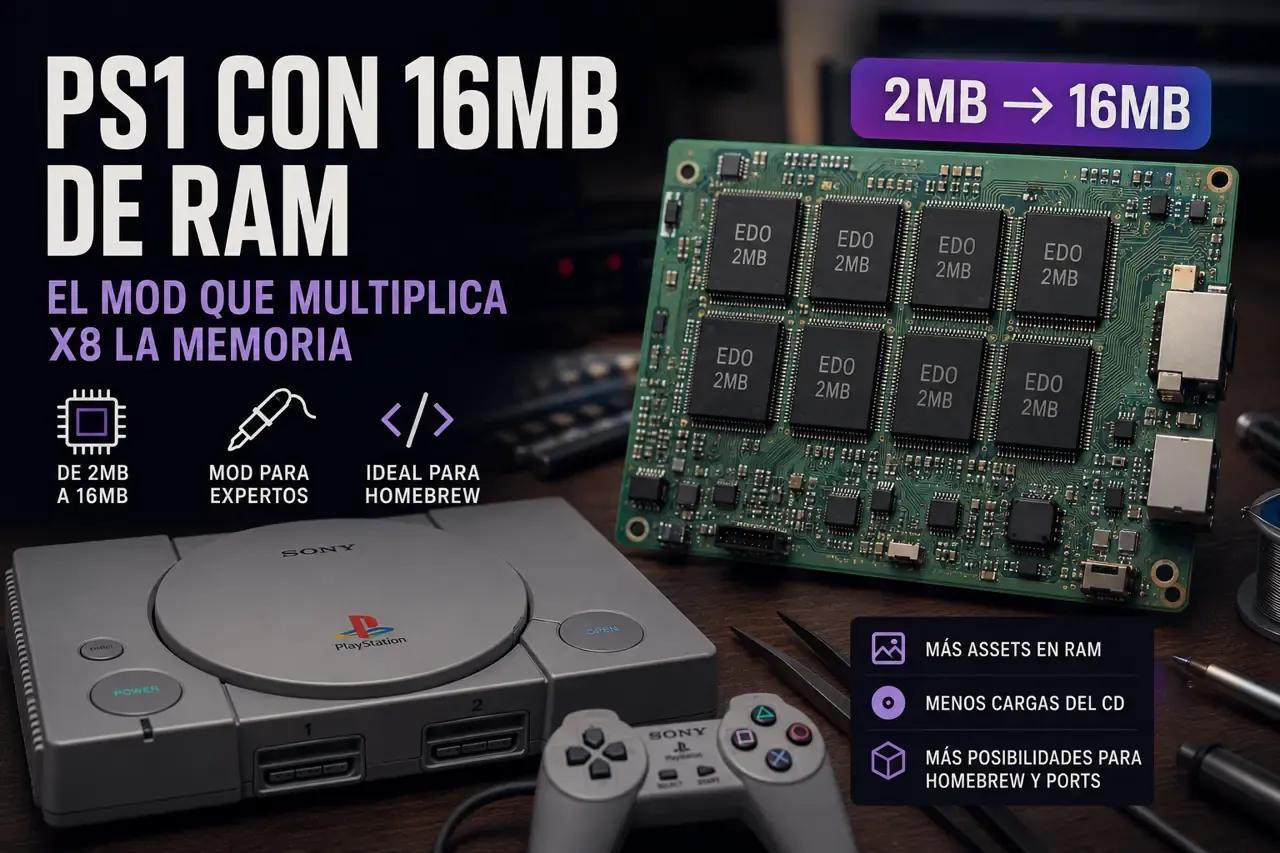
The complexity lies in the fact that the console has no expansion slots. This necessitates direct modification of the motherboard, requiring very precise routing , cutting original traces, and adding extra wiring along with a 22-ohm resistor. To facilitate the process, some modders use a QSB quick-soldering board that helps redirect electrical signals correctly to the new memory banks.
Compatibility and recommended models
Not all PlayStations are the same, as Sony released several revisions of the motherboard throughout its lifespan. The mod works more reliably on older models, especially those using the PU-8 motherboard , which is very common in the SCPH-5500 and 555x versions. If you have a different model, it's crucial to check the motherboard markings before attempting any modifications, as the risk of rendering the console unusable is real.
There are also simpler versions that only increase the RAM to 8 MB, but these are usually limited to very specific hardware. It's important to note that after making this change, certain memory card exploits , such as those based on FreePSXboot, may stop working due to the change in the system's memory map.
Does it really improve game performance?
This is where we need to get real. If you expect your old games to magically start up with higher frame rates or high-definition textures, you're going to be disappointed. Commercial titles were programmed for 2MB and don't recognize the existence of extra RAM . In fact, some games, like the legendary Final Fantasy IX, might stop working or crash because the original code assumes a memory organization that no longer exists.
However, there are some interesting exceptions. Modified versions of some games can take advantage of this space. For example, in Gran Turismo 2, the level of detail of vehicles at medium and long distances has been improved. But, in general, for Sony's original catalog, this mod offers very few practical advantages.
The real treasure: the Homebrew scene
Where this mod truly shines is in homebrew software development and unofficial ports. For programmers in the homebrew scene, having 16 MB of RAM is a dream come true, as it allows for loading many more assets into memory without constantly having to read from the CD-ROM. This eliminates the RAM bottleneck, enabling more complex scenes and larger texture pools.
- Ambitious ports: It allows you to run game versions from other platforms, such as Super Mario 64 adapted for PS1.
- Technical demos: It facilitates the creation of graphics engines that overcome the original limitations of the console.
- Similar projects: In the style of PsyDoom, which expands the sound memory to 16 MB to handle denser maps.
Even though the CPU and GPU remain the same and retain their inherent limitations, the scope for software development increases dramatically. It's a similar philosophy to the one Sega Saturn followed with its memory expansion cartridges, seeking to extend the lifespan of classic hardware through the brute force of RAM.
Having a PlayStation with 16MB of RAM is, nowadays, more of a technical marvel and a tool for developers than a necessary upgrade for the average user. While the installation can be a headache and may cause instability in original games, it opens the door to fascinating experiments and seemingly impossible ports that keep the flame of Sony's first console alive.