- Microsoft Fabric centralizes data, governance, AI, and real-time analytics on OneLake and unified capabilities.
- The platform strengthens governance, security, and cost through Purview, OneLake security, DLP, DSPM, and integration with Azure Cost Management.
- Data Factory, Dataflow Gen2, and migration tools make it easy to move existing workloads and orchestrate complex pipelines.
- Copilot, data agents, MCP and new workloads such as Fabric IQ and Real-Time Intelligence drive advanced AI and automation scenarios.

If you've been working with data in the Microsoft ecosystem for a while, you'll have seen that Microsoft Fabric has become the central hub for modern analytics , unifying everything that was previously spread across Power BI, Azure Synapse, Data Factory, and other services into a single platform. In this article, we'll take a thorough and detailed look at the latest features, roadmap, and practical implications of Fabric for analytics, governance, AI, and real-time analytics.
The idea is that, when you finish reading, you'll have a clear vision of what Microsoft Fabric is offering today, where it's going, and how it affects your organization's data architecture: governance capabilities with Purview, automation with APIs and Git, new AI features, real-time intelligence, security in OneLake, migrations, performance, and much more.
Microsoft Fabric and the Cloud Adoption Framework: governance, costs, and automation
Within the Cloud Adoption Framework (CAF), Microsoft has been publishing a series of guides to align the design of Microsoft Fabric with the design pillars of landing zones . The latest installment in this series addresses three key areas: governance, capacity optimization, and automation/DevOps.
On the governance side, Fabric capacity costs are exposed through Azure Cost Management . This allows for the native integration of F capacity consumption (and other SKUs) into Azure cost dashboards, alerts, and spend analytics. It's not just about seeing the bill: you can cross-reference this information with tags, subscriptions, or resource groups to understand who is spending what and why.
Fabric's technical architecture and business model allow customers to finely control capacity consumption to optimize operating costs . In practice, this translates into several levers:
- Scaling of capabilities F: increase or decrease capacity based on predictable peaks, such as sales campaigns, accounting deadlines, or large data loads.
- Pause and resume capabilitiesFabric administrators can pause an F capacity when it is not needed (for example, overnight or on weekends in non-critical environments) to cut compute costs.
- Surge protectionTwo capacity-level parameters control how background jobs are managed to prevent them from saturating the environment: Background Rejection Threshold and Background Recovery Threshold.
- Capacity reservationsIt is possible to reserve capacity for defined periods to obtain discounts, provided that the expected consumption is rigorously planned.
In the area of data governance, Fabric relies on Microsoft Purview as its central component for cataloging, lineage, and classification . Purview allows users to apply sensitivity labels, view lineage across sources, transformations, and consumption, certify data assets, and drive data quality campaigns, all while integrating Fabric elements (Lakehouse, Warehouse, KQL, Power BI, etc.).
The "Platform Automation and DevOps" component focuses primarily on Git integration, deployment pipelines, and REST APIs . Fabric workspaces can be linked to Git repositories, allowing multiple developers to collaborate on the same data engineering, data science, or real-time analytics project without overlapping work.
Git and Deployment Pipelines enable the orchestration of development, testing, and production lifecycles in a controlled manner : content promotion, change tracking, artifact synchronization, and version management. Since March 2025, these pipelines have supported (in general or preview state) a wide range of element types, including triggers, dashboards, dataflows, data pipelines, datamarts, lakehouses, data warehouses, KQL, notebooks, paginated reports, organizational applications, and more.
In parallel, Fabric exposes a very wide set of REST APIs with which to automate almost any administrative or deployment task: creation of workspaces and folders, bulk migration of items, management of connections and gateways, extraction of definitions, activation of pipelines or notebooks, among other things.
Key updates in analytics, AI, and governance for Microsoft Fabric
The evolution of Fabric is marked by a huge number of preview features and new capabilities that touch virtually every area of the platform . These are grouped and discussed below in a structured way to show their full scope.
AI functions in Data Warehouse and multimodal functions
In the area of relational data, Fabric Data Warehouse incorporates AI functions directly into T-SQL (preview). This allows:
- Classify or categorize text.
- Analyze sentiment.
- Extract structured information from free text.
- Translate text between languages.
- Correct grammar.
The goal is to eliminate the need to leave the SQL context to enrich data with AI . These functions are combined with broader multimodal support in Fabric's AI functions, which can now process images (JPG/JPEG, PNG, GIF, WebP), PDFs, and common text formats, as well as file path inputs.
Utilities such as aifunc.load for ingesting folders into tables with prompt and schema options, aifunc.list_file_paths for traversing file paths, and ai.infer_schema for inferring schemas compatible with ai.extract are included . All of this allows you to transform and enrich data without building complex pipelines from scratch.
OneLake, Delta, Apache Iceberg and multiplatform access
At the storage layer, OneLake remains the unified lake where all of Fabric resides. One of the major improvements is the ability to expose Delta Lake tables as Apache Iceberg tables without moving or duplicating data, so that Iceberg-compatible engines can directly read what's in OneLake.
Furthermore, OneLake now supports Apache Iceberg data written directly by Snowflake and consumed in Fabric via copy-free access . This strategy strengthens interoperability: Fabric is not intended to be a silo, but rather a data hub that other engines can leverage without duplicating storage.
Along the same lines, OneLake supports shortcuts to Azure Blob Storage , OneDrive, and SharePoint, and extends security with access roles, folder, row, and column-level security, and a security model that third parties can respect thanks to the extension of the authorized engine model.
A particularly relevant feature is the federation of the OneLake catalog with Azure Databricks, which enables zero-copy access from Unity Catalog to OneLake tables . This way, OneLake remains the source of truth, but Databricks can query the data directly, synchronizing only the metadata.
SQL Database on Fabric: performance, security, and virtualization
Fabric's SQL database is gaining its own capabilities: ALTER DATABASE SET options , collation support, and full-text indexing in preview. In terms of database performance and cost, there are several improvements:
- Automatic index compaction to reduce storage, I/O and improve query times without having to schedule maintenance jobs.
- Maximum vCores limit to control the use of computing resources (4 or 32 vCores), designed to prevent a workload from consuming too much in shared capacity.
- Custom SQL Pools that give workspace administrators granular control over resource allocation and query routing by application name.
Data virtualization is also enabled in SQL database , which allows querying external data stored in OneLake with T-SQL, joining files in common formats with local relational tables using joins, without having to physically import the data.
In terms of security, SQL database supports Private Link at the tenant level (preview) , which makes it easier to channel data traffic privately and in a controlled manner, integrating with Fabric's overall secure network configuration.
Real-Time Intelligence, Eventhouse, Eventstream and Activator
The Real-Time Intelligence (RTI) module has become one of Fabric's key differentiators. Eventhouse and Eventstream work together to ingest, process, and trigger events in real time from all types of sources, and Activator orchestrates the actions that are triggered under certain conditions.
Among the most powerful new features are:
- Anomaly detection without code with automatic model selection, simple interface and flexible alerts.
- Business Events, which capture key business moments generated from User Data Functions and Notebooks, and allow you to activate alerts, custom logic, flows, AI models or Spark jobs.
- Activator-User Data Functions Integrationso that functions created in Fabric can process events from any source, including internal events from the platform itself and from OneLake.
- Ability to process events with SQL (SQL Operator in Eventstream), allowing the transformation of real-time flows with known SQL syntax.
Relevant connectors are added such as Cribl (for log and telemetry ingestion from multiple sources), a connector with Solace PubSub+, and streaming support over private networks via Azure Virtual Network, VPN, ExpressRoute or private endpoints.
For data schemas and contracts, Eventstream introduces a Schema Registry that defines and validates event schemas for more robust pipelines, and support for the Confluent Schema Registry to connect with Kafka in Confluent Cloud while respecting existing contracts.
Copilot and AI capabilities across the platform
Copilot in Fabric is now available globally, with support for Power BI, Data Factory, Data Science & Data Engineering, and KQL query writing . In addition, specific capabilities have been added:
- Copilot for Dataflow Gen2 (Modern Get Data), which helps to ingest and transform data with instructions in natural language.
- Copilot for Data Warehouse (chat), accessible from a button on the ribbon to accelerate warehousing tasks through dialog.
- Copilot for SQL analytics endpoint, which generates and optimizes SQL queries from business descriptions.
- Copilot on notebooks with knowledge of the workspace context, lakehouse, notebook structure and execution environment, able to generate multistep code, refactor, summarize complex notebooks and diagnose errors with the "Fix with Copilot" option.
- Inline autocompletion (inline code completion) and Notebook Copilot inline code completion (preview), to write Python faster and with fewer errors.
In addition, the AI technology base is being expanded with prebuilt Foundry Tools integrated (Azure OpenAI, Azure Language, Azure Translator), OpenAI plugins for Eventhouse (ai_embed_text and ai_chat_completion), and a series of agents and data agents that allow other applications, including Copilot Studio, to work on Fabric data in an orchestrated manner.
Fabric Data Agents, MCP and developer tools
Fabric introduces data agents capable of orchestrating data access and tools for AI agents, with a Python SDK and direct integration with Microsoft Copilot Studio. This makes it easy to build conversational assistants that work with enterprise data governed in Fabric.
In parallel, the Model Context Protocol (MCP) becomes a key component of the integration between AI agents and Fabric services. There are dedicated MCP servers for Activator and Eventhouse, and a development-oriented Fabric MCP that:
- It allows AI assistants to generate code and content for Fabric items.
- It integrates with development tools such as VS Code and GitHub Codespaces.
- It presents tools for consulting and acting on real-time data in Eventhouse.
For the developer's day-to-day work, there are several pieces to highlight, including the development environment : MSSQL extension for VS Code with support for Fabric's SQL database , the Microsoft ADO.NET Driver and the ODBC Driver for Fabric Data Engineering (connection to Spark SQL via Livy), and a Spark connector for SQL databases that simplifies authenticated access from Spark to SQL databases in Azure and Fabric.
Also included is the Fabric CLI , available as an integrated task in Azure DevOps, which allows you to automate the management of workspaces, items, and deployments without manually installing external tools.
Data Factory, data migrations and orchestration in Fabric
Fabric's data integration layer relies on Data Factory and Dataflow Gen2, which are receiving features to make orchestration smarter, more automatable, and with easier migrations from existing platforms.
Dataflow Gen2: performance, public APIs, and diagnostics
In Dataflow Gen2 we find several features in preview:
- Advanced editing of target queries to adjust the logic at the destination directly from the authoring environment itself.
- Partitioned computewhich allows parts of the dataflow to run in parallel, reducing the total evaluation time.
- Download diagnostics at the execution level, with structured log packages for performance analysis and incident resolution.
- Public APIs for programmatically creating, updating, deleting, scheduling, and monitoring dataflows.
- Public parameters with CI/CD supportwhich allow refreshing dataflows by passing values from pipelines or other sources.
- Recent data for quick access to recently used items in the Power Query ribbon and in Modern Get Data.
All of this is complemented by the ability to programmatically evaluate Power Query via REST , which opens the door to running M scripts as part of automated processes, integrating them with Spark, pipelines, or external tools, taking advantage of Power Query connectors.
Data Factory: adaptive performance, connectivity and dbt
In the more "classic" part of integration, Data Factory within Fabric introduces:
- Adaptive performance tuning for copy activity, which intelligently adjusts performance parameters according to the configuration and execution context.
- Change Data Capture (CDC) support in Copy job, to replicate only changes (inserts, updates, deletes) continuously.
- On-premises gateways with manual upgrade option managed from the Fabric portal, API or scripts.
- recent connection, which adds last-use properties to connections to facilitate auditing and lifecycle management.
- native dbt Job, which allows running dbt projects within Fabric with integrated orchestration, testing, documentation and governance.
- Invoke SSIS Package activity in pipelines, to run SSIS packages from the orchestration itself in Fabric.
The user experience is also enhanced with a SharePoint Site Picker that eliminates the need to manually type URLs, and with MCP support for Data Factory, enabling AI assistants to create and deploy Dataflow Gen2 simply from natural language instructions.
Data migration and replication tools
Microsoft is strongly promoting the migration to Fabric through several specific tools:
- Fabric Migration Assessment for Data Factory, which analyzes the preparation of ADF pipelines and migrates the supported ones to a Fabric workspace with connection mapping.
- Migration Assistant for Data Warehousewhich can now connect directly to the source warehouse to move it to Fabric Data Warehouse.
- Migration Assistant for SQL database, aimed at migrating on-premises SQL Server workloads, with schema import via DACPAC, incompatibility detection and recommendations.
Regarding replication, support is given for mirroring from various operational sources (Azure Database for MySQL, Google BigQuery, SQL Server, etc.) to Fabric, with the ability to control which tables are replicated, restart mirroring processes via REST, and, in the case of Databricks, map Unity Catalog policies to OneLake security.
Also included is a replication connector from Lakehouse using Delta Change Data Feed , which exposes changes from Lakehouse Delta tables to compatible destinations without having to reinvent the wheel with homebrew CDC solutions.
Security, advanced governance, and monitoring in Fabric
One of the biggest concerns for any analytics platform is how to secure data, govern usage, and monitor resource consumption . Fabric is maturing rapidly in these areas.
Security and data protection at OneLake
OneLake adds a complete data access security model with:
- Data access roles for lakehouse with configurable permissions from a folder-based security interface.
- Security support for shortcuts so that third parties can respect the defined policies.
- OneLake data access security API, which allows for automated permission management.
- Extension of the model to external engines (OneLake security authorization for third parties).
In parallel, protection is extended with DLP restrict access over all structured data in OneLake (SQL, KQL, warehouses) and DSPM for AI is introduced for Fabric Copilots and data agents , which monitors AI interactions for sensitive information and risky behaviors, with integration with Purview Audit and eDiscovery.
In the identity plane, features such as item-associated identities (e.g., Lakehouse and Eventstream) via REST APIs appear, which eliminate the owner dependency for certain operations, and the authentication of OneDrive and SharePoint shortcuts through workspace or service principal identities.
Centralized governance and OneLake catalog
The data governance experience is enhanced with a new centralized dashboard in the OneLake catalog , where data owners can see an aggregated view of the items they have created, receive governance action recommendations, and access all available tools to improve security and compliance.
In addition, a OneLake catalog search API is enabled along with an MCP tool, which allows discovering items across the entire Fabric environment from code or AI agents, in a single call, respecting catalog permissions and metadata.
Monitoring of capacities, consumption and work
Fabric provides several layers of observability:
- Workspace monitoring, which creates a database in Fabric where logs and metrics from multiple items are consolidated (including Copy jobs with detailed monitoring).
- Workspace monitoring for Copy jobwith metrics such as throughput, data volume, error codes and times, all geared towards centralized analysis.
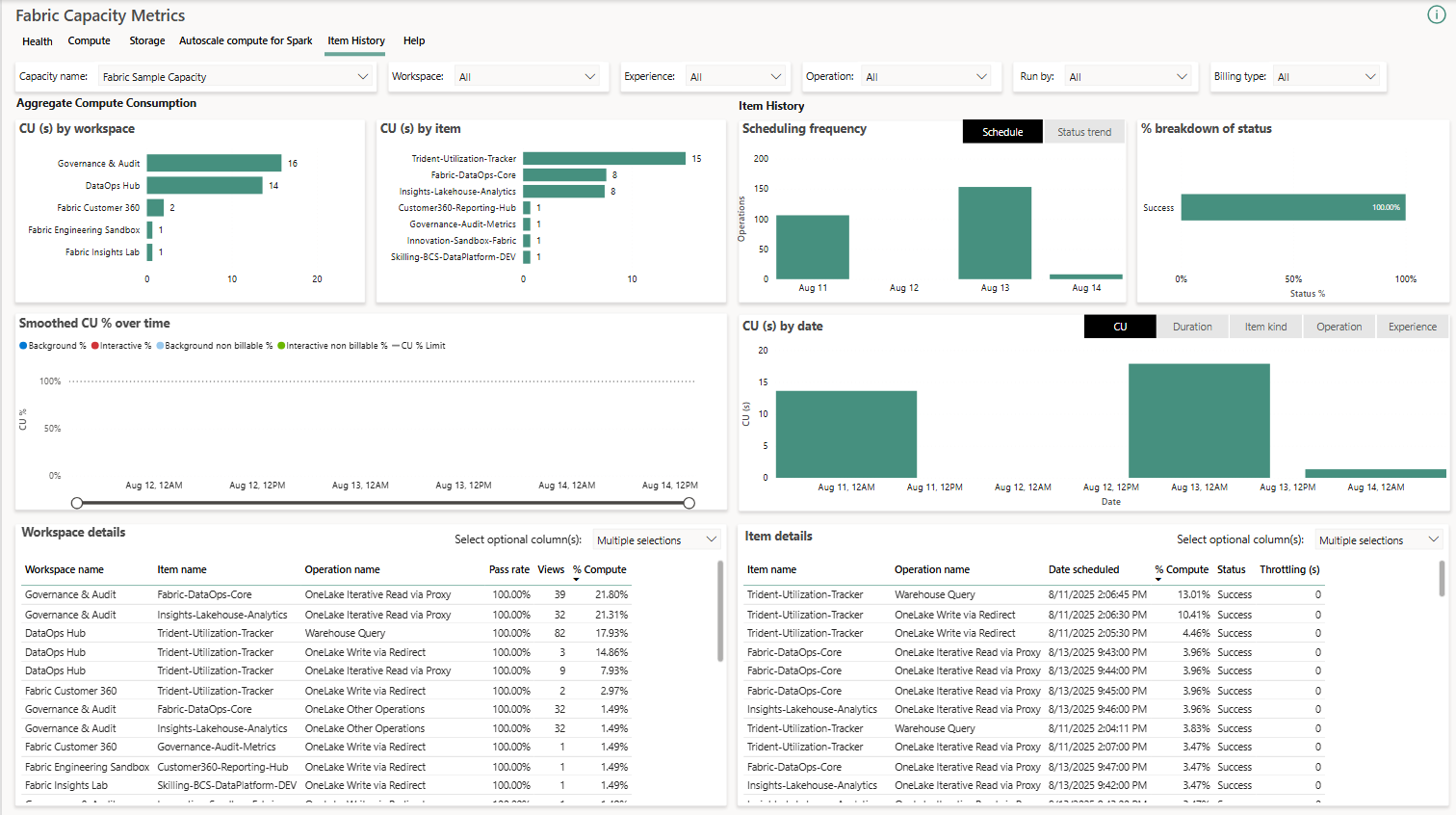
- Item History in the application of capacity metrics, with 30-day views on CU consumption for each item, filterable by workspace and type.
- Workspace-level surge protectionwhich allows setting consumption thresholds per workspace in a 24-hour rolling window, automatically blocking those that exceed them, and marking workspaces as "mission critical" to exclude them from limitations.
Complementing this, an initial set of Fabric Admin APIs is being released , focused on discovering workspaces, items, and user access details, facilitating dynamic inventories and periodic access controls.
Business modeling, planning, and new workloads
Beyond the technical layer, Microsoft is introducing new business-oriented workloads on top of Fabric. One of the most notable is Fabric IQ, which aims to unify business semantics, data, and models for intelligent agents that make decisions based on a holistic view of the organization.
Within Fabric IQ, the following appear:
- Ontology (preview), a type of item where entities, relationships, properties and constraints are defined according to the company's business language.
- Plan (preview), a no-code platform for planning, reporting, analytics, integration, and collaborative management.
In Real-Time Intelligence, the digital twin builder also emerges , an item specialized in modeling digital twins based on real-time data, with the aim of optimizing physical operations, monitoring states, and simulating scenarios.
On the other hand, Fabric IQ workload is introduced as a separate workload, and support tools for governance and semantic alignment continue to expand, closing the circle between data models, business logic and AI/analytics applications.
Performance, user experience, and productivity improvements
To conclude the review, it is worth highlighting a series of cross-cutting improvements that do not always make the headlines, but greatly influence the day-to-day operations of the teams.
In the Spark and distributed computing section, Fabric introduces:
- Fabric Runtime 2.0 (preview) with Apache Spark 4.0, Delta Lake 4.0, Java 21, Scala 2.13 and Python 3.12 on Azure Linux 3.0.
- Spark app comparison toolwhich allows you to select and compare up to four Spark executions in parallel.
- Spark Diagnostic Emitter, which collects logs, metrics, and events from Spark applications and sends them to destinations such as Event Hubs, storage, or Log Analytics.
- JobInsight diagnostics library, a library for analyzing completed Spark executions via APIs (queries, jobs, stages, tasks, executors, event logs).
In the warehouse layer, data clustering is added to improve performance and reduce access costs, IDENTITY columns for surrogate keys, and version control and CI/CD support through SQL Database projects in VS Code (Warehouse source control).
The Fabric portal user experience is also evolving with tabbed browsing and an object explorer , allowing users to open multiple items simultaneously and switch between them quickly. This, along with improvements such as Lakehouse auto-binding in Git and the suite of utilities for Lakehouse maintenance (maintenance activities and SQL endpoint refresh), contributes to a more user-friendly and agile platform.
Finally, features such as bulk import/export of item definitions (for migrations, templates, and metadata backups), REST for folders, parameter support in item activations from Activator, and loading OneLake data into Excel with an integrated catalog, complete an ecosystem that begins to cover virtually all the usual needs of a modern data team.
With this entire set of capabilities—from centralized governance, granular security, and intelligent orchestration, to AI embedded in SQL, real-time analytics, digital twins, and MCP agents—Microsoft Fabric is establishing itself as a complete data platform where the key is no longer just storing and visualizing data, but governing, automating, and leveraging AI to power every part of the data lifecycle . This allows organizations to evolve their architectures gradually, migrating existing systems and enabling new solutions much faster than with traditional approaches.