- They replace the liquid electrolyte with solid materials, eliminating the risks of fire and leaks.
- They offer a much higher energy density, multiplying the autonomy and reducing the weight.
- They allow for drastically faster recharging processes and a longer lifespan.

The race to enable electric vehicles to travel long distances without stopping has focused attention on a technology that promises to be a game-changer. In the midst of the transition to zero-emission mobility, solid-state batteries are emerging as the most robust alternative to overcome the current limitations of conventional batteries.
Many of us still worry about long charging times or the fear of rapid battery degradation. However, the industry is already taking action, and many manufacturers are investing millions so that, in a few years, we'll have cars that not only charge in minutes but are also inherently safer than any current model.

What exactly does this technology consist of?
To understand this leap, we first need to look at what we have now. The lithium-ion batteries we use in our cell phones or Teslas use a liquid electrolyte to allow ions to travel between the anode and cathode. The problem is that this liquid is highly flammable and, over time, structures called dendrites (like tiny metal needles) form, which can cause short circuits.
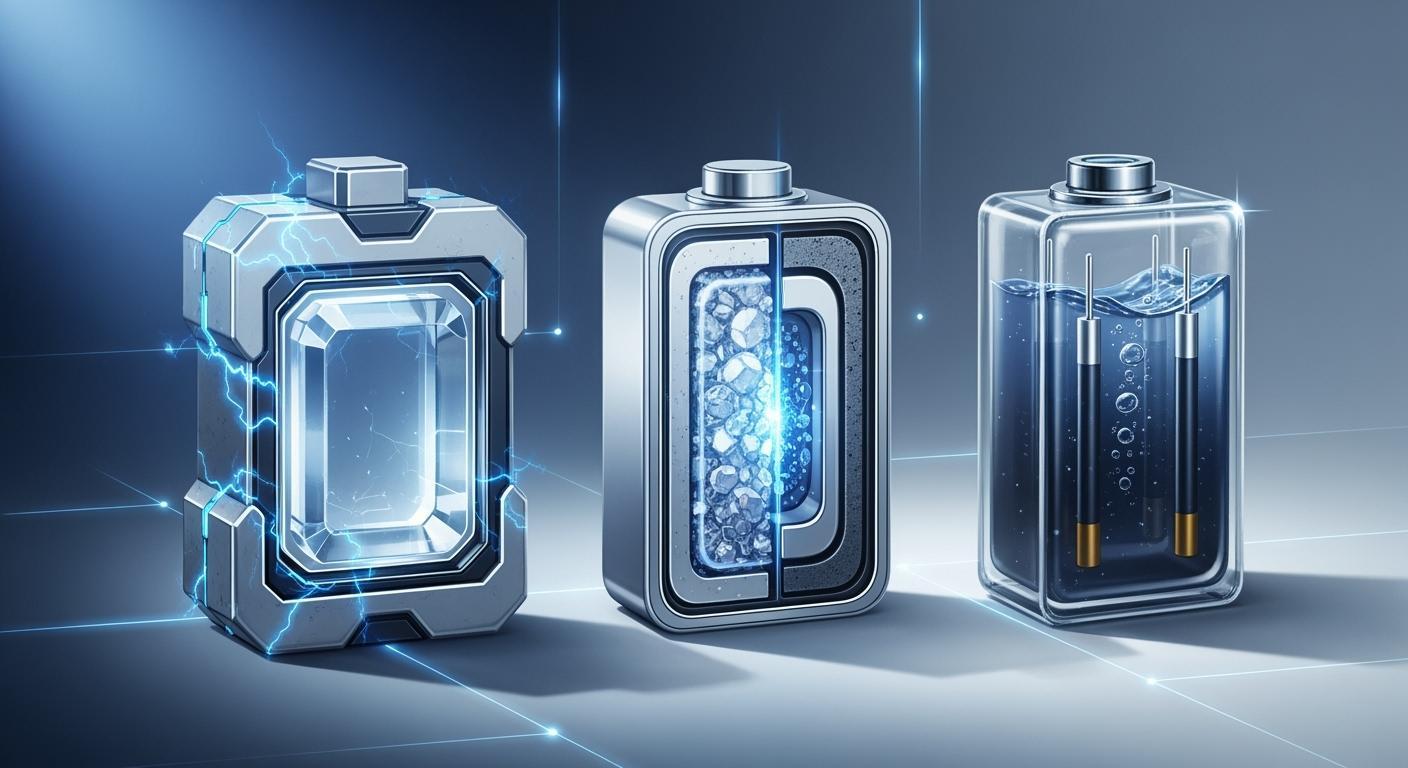
The magic of solid-state batteries is that they eliminate the liquid electrolyte and replace it with a ceramic, glass, or polymer material . Being a solid, there are no leaks and the risk of fire is drastically reduced. Furthermore, by combining the separator and electrolyte into a single unit, the cells are much thinner, allowing significantly more energy to be stored in the same space.
Disruptive advantages over conventional lithium
If we're talking about benefits, the first thing that stands out is energy density. These batteries can store up to three times more electricity than current ones. This means that, with the same weight and size as a 60 kWh battery today, we could have a range that makes long journeys no longer a headache.
- Lightning charges: It is estimated that charging times could be reduced by 33% or even more. Some prototypes already allow charging to 80% capacity in just 15 minutes.
- Total security: By not using flammable liquid electrolytes, the risk of explosions due to overheating is virtually zero.
- Greater longevity: They are much more resistant to chemical degradation, which means the battery will last for many more years before it starts to lose capacity.
- Less weight: Being more efficient, the car doesn't need to carry tons of extra weight, which in turn improves fuel efficiency.

The impact on costs and the environment
A key factor is the battery. Although manufacturing them is currently very expensive, it's predicted that once mass production is achieved, they could be 40% cheaper than lithium-ion batteries. This is crucial for lowering the price of electric cars and making them accessible to everyone, not just those looking for a high-end model.
From an ecological perspective, there's some interesting news. If sustainable extraction methods are used, such as extracting lithium from geothermal wells, the climate footprint could be reduced by 39% . While these methods do require more lithium (up to 35% more), the good news is that they consume significantly less graphite and cobalt , materials whose extraction is particularly problematic.
Other variants: Semi-solid and liquid batteries
Not everything is black and white; there's a middle ground. Semi-solid batteries use a gel that combines the best of both worlds. They are safer than liquid batteries and charge very quickly, although their performance can suffer in extreme cold or heat.
On the other hand, liquid batteries remain the market leaders due to their low cost and ease of manufacture . They perform exceptionally well across a wide temperature range, but they remain the most dangerous in the event of an impact or electrical failure due to the nature of their components.
The roadmap of the major manufacturers
The race is on, and each brand has its own timeline. Toyota and Volkswagen have been among the most optimistic, talking about implementing this technology in their models around 2025. Stellantis and BMW , meanwhile, are aiming for 2026, while the Renault-Nissan group sees a light at the end of the tunnel a little beyond that date.
Some are taking a more cautious approach. Hyundai and Kia have made it clear that their vehicles won't feature this system until at least 2030. Meanwhile, brands like Nio are already experimenting with semi-solid battery versions capable of achieving 1.000 kilometers on a single charge, demonstrating that the theory is already starting to become a reality.
The challenges that remain to be solved
It's not all smooth sailing. The biggest hurdle is ionic conductivity ; getting ions to move quickly through a solid is much harder than in a liquid. Furthermore, there's the problem of the interface: the bond between the electrolyte and the electrode is sometimes imperfect, leading to resistance and power loss.
To address this, researchers are investigating hybrid electrolytes , which combine ceramics (for stability and conductivity) with polymers (for flexibility and ease of manufacturing). It's a long-term investment with some risk, but the reward would be a definitive battery that eliminates range anxiety.
Mass deployment won't be immediate. According to experts, only a small percentage of electric cars will use this technology by 2030, but by 2040, it's likely that one in three vehicles will. The transition will begin with luxury models and critical applications like electric aircraft, where every gram of weight counts and safety is non-negotiable.
The arrival of solid electrolytes promises to transform electric mobility by offering much lighter, safer vehicles with charging capacities similar to filling a gasoline tank, leaving behind the weight limitations and fire risk of current cells.
