- It achieves theoretical speeds of up to 46 Gbps, far surpassing previous generations.
- It implements MLO technology to use multiple frequency bands simultaneously.
- It drastically reduces latency and doubles bandwidth up to 320 MHz.
- It introduces 4096-QAM modulation and expands MIMO spatial flows to 16x16.
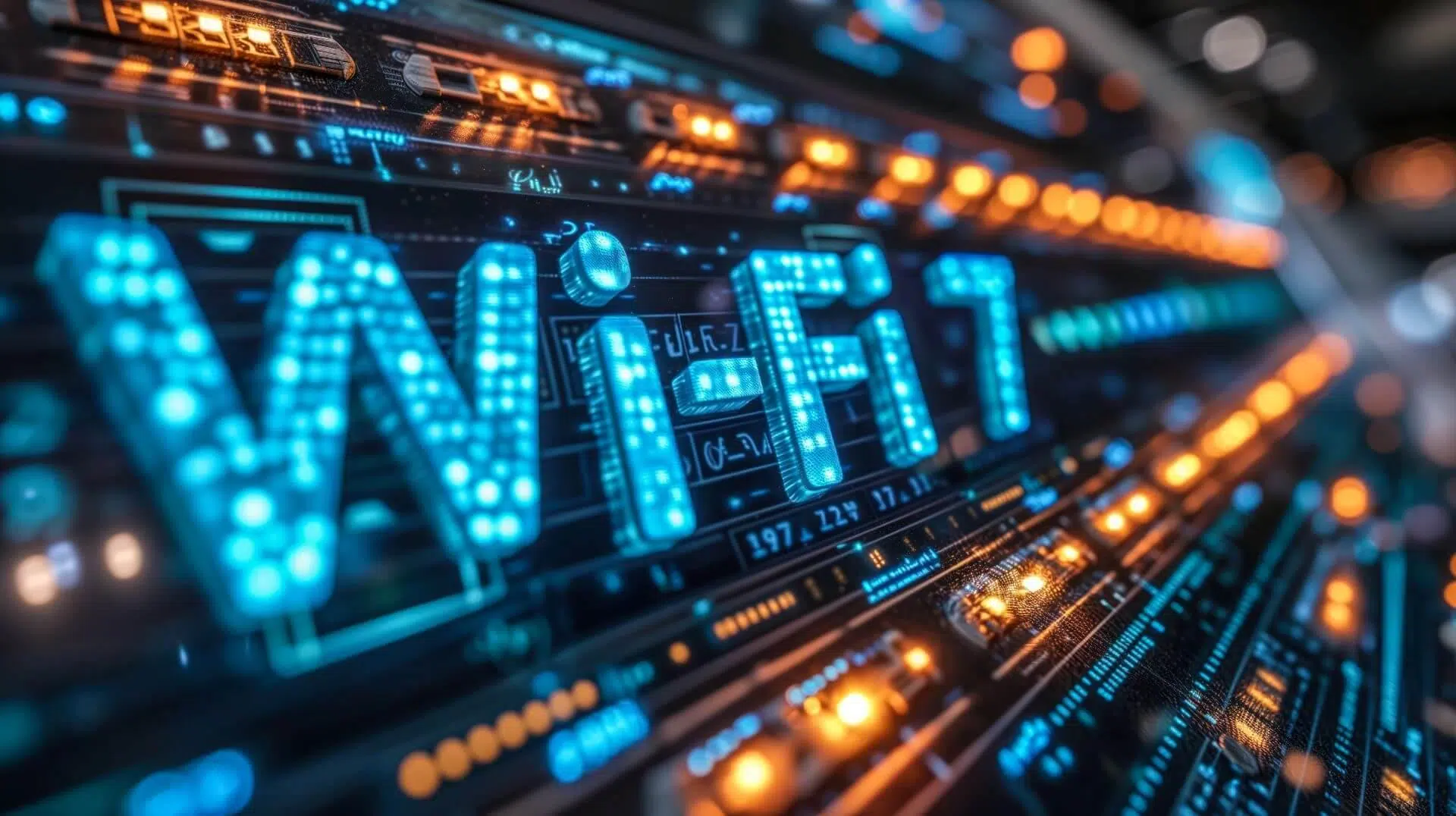
The evolution of wireless networks never stops, and although we're still digesting the implementation of WiFi 6 and its 6E variant, a new player is already here. WiFi 7 is here to break the mold and change the way we connect , promising performance that until recently seemed reserved solely for wired connections.
This new standard, technically known as IEEE 802.11be, was officially unveiled in early 2024 at CES in Las Vegas. It's not just a incremental improvement, but a qualitative leap that aims to eliminate bottlenecks and enable 8K streaming and virtual reality to run seamlessly, making the browsing experience silky smooth.

What exactly is WiFi 7 and how did it come to market?
Essentially, this is the seventh generation of WiFi technology. It was ratified by the WiFi Alliance in 2023 and its rollout began to gain momentum in 2024. To give you an idea of its ambition, this protocol has been designed to offer higher transfer rates and significantly improved energy efficiency compared to its predecessors.
At launch, it already had the backing of giants like MediaTek, Amazon, and TP-Link. However, global adoption has its nuances. In the United States, the FCC regulator has been very permissive, opening almost the entire 6 GHz band, while in Europe the situation is more restrictive. Here, we only have the lower frequency band available , which reduces the number of channels available compared to the American market.

The technological keys: Why is it so fast?
The secret to its power lies in several technical pillars. First, the bandwidth has doubled, going from 160 MHz in WiFi 6 to an impressive 320 MHz in WiFi 7. This allows the "highway" along which the data travels to be much wider, enabling multi-gigabit devices to operate at their maximum capacity.
Another key feature is the 4096-QAM modulation. While WiFi 6 used 1024-QAM, this new version allows for the transmission of 12 bits instead of 10 per symbol, resulting in a 20% speed increase. Furthermore, the MIMO system has evolved, expanding from 8 to 16 spatial streams, which translates to more users connecting simultaneously without network congestion.
The Multi-Link Operation (MLO) revolution
If there's one thing that defines WiFi 7, it's MLO (Multi-Line Operation). Until now, our devices chose one band (whether 2,4 GHz, 5 GHz, or 6 GHz) and stayed there. With MLO, the device can transmit and receive data simultaneously across multiple bands, taking advantage of the differences between 2,4 GHz and 5 GHz WiFi to optimize the connection. It's like being able to use three lanes of the highway at once instead of just one.

This channel aggregation capability not only boosts speed but also drastically reduces latency . For online gamers and those making professional video calls, this means that micro-stuttering and lag spikes become a thing of the past, achieving stability that rivals the perfection of Ethernet cable.
Direct comparison: WiFi 7 vs. WiFi 6 and 6E
To understand the magnitude of this leap, one only needs to look at the numbers. While WiFi 6 routers offer real advantages over previous standards, reaching a theoretical maximum of 9,6 Gbps, WiFi 7 can reach up to 46 Gbps per access point . This is a staggering difference that allows wireless networks to compete with wired standards like USB 4.
- Speed: From 9,6 Gbps on WiFi 6 to 46 Gbps on WiFi 7.
- Channels: Expansion from 160 MHz to 320 MHz.
- Modulation: Jump from 1024-QAM to 4096-QAM.
- MIMO flows: From 8x8 to 16x16 spatial flows.
Regarding security, although WPA3 is already very robust, WiFi 7 is expected to bring with it the implementation of the WPA4 protocol , further protecting our privacy against potential intruders.

What is it really useful for in everyday life?
You might wonder if you really need that much power at home. For basic use, WiFi 6 is more than enough. However, WiFi 7 is the necessary foundation to power the Metaverse and augmented and virtual reality experiences. Without minimal latency and massive bandwidth, these technologies simply can't function properly.
Furthermore, it's the ideal tool for those who consume 8K content or work with large files on NAS networks. It also includes the EPCS (Emergency Preparation Communication Service), which ensures that, in the event of a disaster, emergency services have priority and quality of service on wireless networks.
Compatibility and deployment: Do we have to change everything?
The good news is that WiFi 7 is fully backward compatible . This means you can buy a modern router and your older devices will still connect without problems, although they obviously won't take advantage of the extreme speeds of the new standard.
To get the most out of this technology, both the transmitter (router) and the receiver (mobile phone, laptop, console) need to be compatible. Although the equipment was initially prohibitively expensive, prices are expected to decrease as the technology becomes more widespread . It is estimated that by 2028, billions of devices will be operating under this protocol worldwide.
The technological leap of WiFi 7 redefines wireless connectivity by integrating simultaneous band usage, doubling channel width, and boosting speeds to up to 46 Gbps. With the arrival of MLO and 4096-QAM modulation, latency is reduced to minimal levels, enabling the stable and efficient use of demanding devices and immersive applications in any environment.
