- The growing demand for data and AI is straining the power supply and accelerating the migration from copper to fiber in data centers.
- Copper has higher energy consumption and strong distance limitations compared to fiber, which drives network designs geared towards 400G, 800G and beyond.
- Flexibility is achieved by combining modular design, automation, continuous monitoring, and decentralized electrical distribution through prefabricated conduits.
- Copper-free solutions such as power-over-fiber for GNSS allow data and power to be distributed over fiber, improving synchronization and reducing complexity and costs.
In this context, so-called "copper-free data centers" and architectures that minimize the use of copper are emerging as a powerful way to gain efficiency, flexibility, and sustainability: more fiber optics, power-over-fiber solutions , modular electrical distribution, and designs that make the most of every watt and every meter of cable.
Runaway demand for data, AI, and energy
The global volume of information continues to grow: it is estimated that around 181 zettabytes of data will be created and consumed worldwide in 2025 , almost triple the amount at the beginning of the decade. This surge requires data centers to be much more scalable, capable of increasing computing and storage capacity almost on the fly.
The rise of cloud computing and high-performance artificial intelligence is behind much of this leap. Massive language models, advanced analytics, 5G services, and real-time applications increase bandwidth demands, reduce acceptable latency margins, and dramatically increase the energy requirements of infrastructure.
According to BloombergNEF forecasts, the electricity needs related to AI computing in the United States could more than double by 2035. Executives like Jensen Huang (Nvidia) and Sam Altman (OpenAI) have long warned that trillions of dollars in new infrastructure will be needed to support this new wave of data centers and AI complexes.
However, the bottleneck is no longer so much in space or server technology, but in electricity supply and the capacity of power transmission networks . Transmission infrastructure is outdated in many markets, regulatory processes are slow, and the timelines for connecting new megawatts to the grid stretch for years.
The case of Santa Clara: completed buildings unable to be lit
The situation in some technology hubs is so dire that there are completed data centers, ready to operate, that sit empty for years awaiting power. This is what's happening in Santa Clara, California, Nvidia's hometown and one of the world's computing epicenters.
Digital Realty, one of the world's largest data center developers, applied in 2019 for a permit to build a new facility in Santa Clara. Approximately six years later, the four-story, roughly 40.000-square-meter building remains empty, awaiting full power from the municipal utility, Silicon Valley Power (SVP).
A similar situation exists for Stack Infrastructure (now owned by Blue Owl Capital), with a nearby project of up to 48 megawatts of critical capacity that also remains stalled . Both developers are dependent on SVP completing an upgrade of its electrical system valued at approximately $450 million, with a completion target of around 2028.
Meanwhile, Santa Clara already has more than fifty data centers in operation or under construction , reflecting the extent to which local demand for digital capacity exceeds the growth capacity of the electrical grid. In environments like this, every watt counts, and any technology that allows for energy savings or reduces losses in cabling and distribution becomes crucial.
The problem isn't unique to California: in Northern Virginia, the famous "Data Center Alley" served by Dominion Energy, there are reports of waits of one to three years—and in some cases up to seven—to connect large data centers . In Oregon, Amazon has complained of insufficient power for several projects, illustrating a growing tension between operators and utilities.
What's happening with the data center cabling?
Alongside the power supply problems, the internal design of data centers is also undergoing a transformation: copper-based cabling is falling behind fiber optic-based solutions , especially as transmission speeds skyrocket.
In just a few years, we've gone from 40 Gbps to 100 Gbps as almost standard, and 400 Gbps links are becoming widespread in high-performance deployments. Just around the corner, the industry is already planning leaps to 800G and even 1,6 Tbps , following the Ethernet roadmap set by the IEEE. Maintaining these speeds with copper is becoming increasingly complex, expensive, and energy-intensive.
Today, fiber optics has become the standard across virtually the entire data center network, from the aggregation layer to the core layer, as well as between rooms and buildings. The last bastion of copper is in short links between switches and servers within the rack or immediate area , where twisted-pair cables or DACs are still used for very short distances and moderate speeds.
For years, the demise of copper in the data center has been predicted, and although it has managed to last longer than many expected, the combination of distance limitations, ever-increasing power needs, and the pressure to design energy-efficient data centers is pushing to a new turning point.
Energy consumption: copper's Achilles' heel
One of the biggest problems with copper in high-speed environments is its significantly higher power consumption compared to fiber . Above 10 Gbps, twisted-pair (UTP/STP) deployments have virtually disappeared from mission-critical environments due to design and efficiency limitations.
In a copper link, each end must power the electrical signaling of the channel . 10G copper transceivers typically consume around 3-5 watts each. This may seem insignificant, but when multiplied by thousands of ports, the impact on the data center's energy budget and cooling becomes enormous.
In comparison, copper modules consume almost ten times more power than many equivalent multimode fiber transceivers . Added to this is the indirect cost of dissipating the extra heat generated, which necessitates oversizing air conditioning and thermal management systems, further increasing operating costs.
When the cost of compensating for the additional heat is taken into account, the operating expenses associated with copper can easily double those of a fiber-based infrastructure . In an environment where energy margins are increasingly tight and regulatory pressure on efficiency is growing, this difference is critical.
Signal loss and distance limitations of copper
The other major limitation of copper is signal loss as speed and distance increase . Electrical signals suffer attenuation and are constrained by the capabilities of the ASICs and the compensation techniques required to maintain signal integrity along the link.
At very high speeds, significantly more power is needed to travel even short distances using copper , which completely contradicts the goal of reducing power consumption. Even short-range DAC cables are beginning to show these limitations, complicating designs that were previously relatively simple.
The increasing capacity of switches is also a game-changer. Today, a single 1U switch can serve multiple server racks . At the speeds demanded by modern applications, copper cabling no longer has the capacity to cover all those distances, even in relatively compact corridors, without excessively impacting power consumption.
Therefore, many operators are abandoning the classic "top-of-rack" model based on short copper links and adopting designs with aggregation switches in "middle-of-row" or "end-of-row" positions, supported by structured cabling, mostly fiber optic. This reduces complexity, improves scalability, and helps optimize signal paths and energy consumption.
Towards internal networks geared towards 800G and 1,6T
The Ethernet roadmap to 800G and 1,6T is not a distant ambition, but a practical necessity to respond to the bandwidth explosion, latency reduction, and the rise of AI, IoT, and massive virtualization . Hyperscale providers are already preparing their infrastructures with these leaps in mind.
In this context, structured fiber cabling offers a clear path forward. Architectures based on 16-fiber infrastructures allow for orderly scaling to these high speeds, efficiently using available bandwidth and facilitating link aggregation and deaggregation.
A well-planned 16-fiber design can, for example, allow a single high-capacity switch to serve approximately 192 servers , facilitating tasks such as setting up and managing a server , with notable gains in terms of latency, port utilization, and total cost per bit transported.
Specialized manufacturers indicate that many large enterprise and public cloud data centers have reached a tipping point where investing in fiber "to the server" is the most rational option . They look to hyperscale environments and conclude that replicating these strategies at their own scale is the only way to avoid falling behind.
This doesn't mean copper will disappear completely: there will still be low-bandwidth, very short-distance niches where the price difference justifies its use, especially in small data centers or less demanding scenarios. But its prominence is diminishing, and its use is becoming increasingly specific.
The role of fiber in Latin America and other emerging markets
The transition to fiber-dominated solutions is not limited to major North American or European hubs. In Latin America, fiber optic adoption is growing rapidly , laying the foundation for more modern and efficient data center networks.
Recent OECD data shows that countries like Costa Rica have experienced fiber deployment growth of close to 74% in just one year , while Colombia and Mexico registered increases of 43% and 36% respectively in the same period analyzed.
This leap does not mean that copper will be eliminated from the equation overnight, but it does reflect a clear shift in investment towards fiber infrastructure , especially in those network segments where the advantages in distance, capacity and consumption are most evident.
In practice, what we see is a hybrid ecosystem where fiber is reserved for backbone links, aggregation, and critical network segments , while copper is repurposed in highly localized scenarios. As fiber costs decrease and plug-and-play solutions improve, the economic argument for continuing to expand copper infrastructure weakens.
Flexibility: the key word in data center infrastructure
Beyond the type of cable, the word most frequently repeated in modern designs is "flexibility ." With changing workloads, rapidly evolving technologies, and increasingly volatile energy demands, data centers must be able to adapt without prolonged shutdowns or massive construction projects.
From an electrical standpoint, service continuity is critical: any interruption in supply can lead to data loss, costly service outages, and reputational damage . Therefore, reliability, redundancy, and resilience are fundamental pillars in the design of electrical distribution systems.
At the same time, operators face increasing pressure to reduce their carbon footprint and improve energy efficiency . According to the International Energy Agency, data centers and communication networks already account for between 2% and 3% of global electricity consumption and around 1% of greenhouse gas emissions.
Although estimates vary, all indications are that this figure will increase in the coming years if decisive optimization measures are not taken . In this scenario, having infrastructure that allows for load reconfiguration, added capacity, or the integration of new technologies without redesigning half the building is a key competitive advantage.
Key measures for a flexible data center
To achieve this flexibility, data center operators are relying on several complementary strategies that affect both hardware and management and operations layers. Among the most prominent are modular design, advanced automation, continuous monitoring, and decentralized power distribution.
First, the modular design and infrastructure allow for expanding or reconfiguring data center areas with minimal operational impact . Modular rooms, prefabricated racks, encapsulated hot and cold aisles, and pre-assembled solutions facilitate rapid migrations and reduce risks.
Automation and orchestration also play a central role: intelligent resource management tools allow for load balancing, traffic balancing, optimized server usage, and support for peak demand in real time, with less manual intervention and a smaller margin of human error.
Furthermore, real-time monitoring and analytics solutions provide visibility into energy consumption, temperatures, port utilization, and other key parameters. Predictive analytics algorithms can then be applied to this data to help anticipate failures, detect inefficiencies, and plan expansions more accurately.
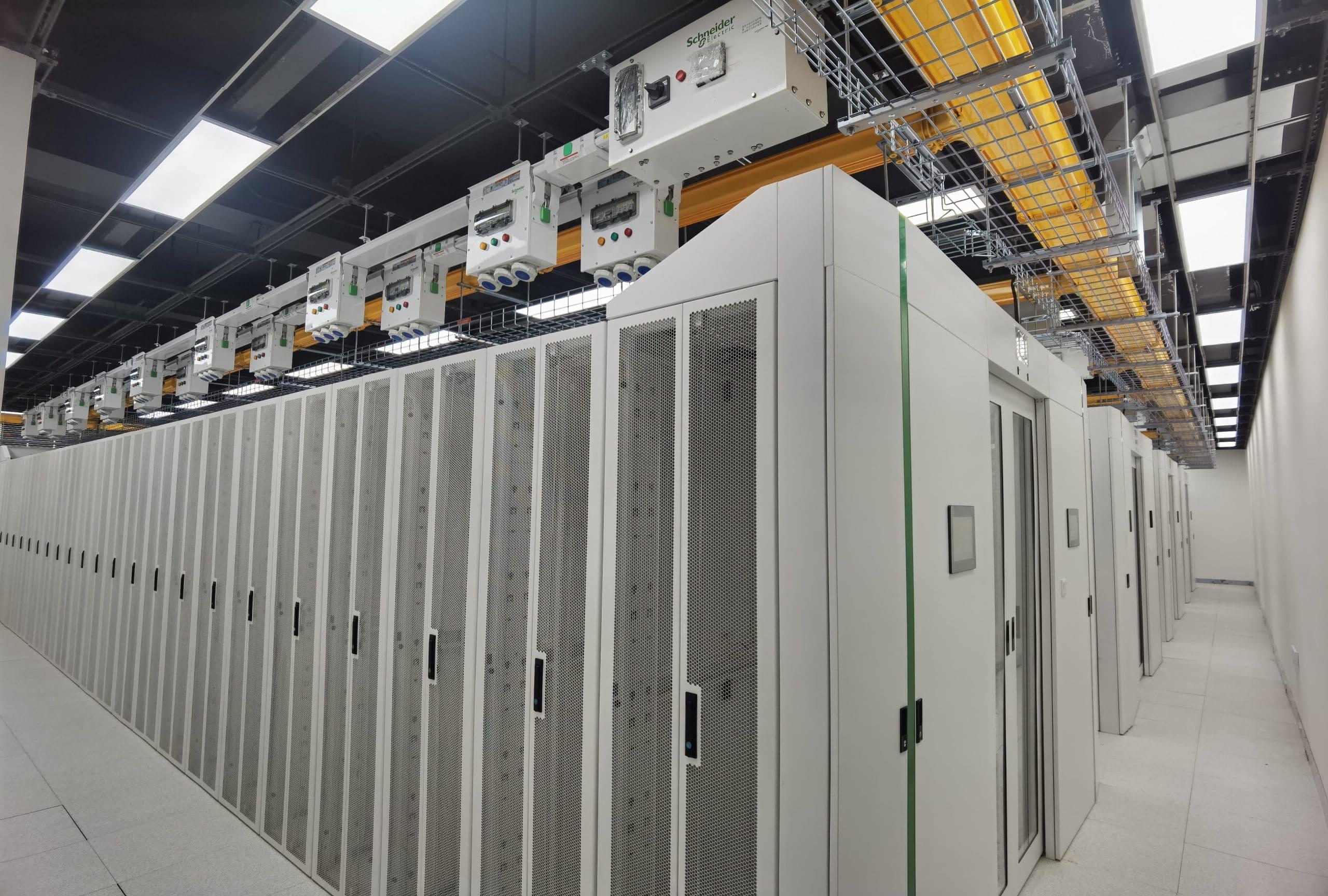
Finally, the idea of a decentralized electrical distribution based on prefabricated electrical conduits is gaining strength , which brings energy closer to where it is needed, reduces losses and makes it easier to grow in modules without service interruptions or major internal works.
Decentralized electrical distribution and prefabricated conduits
Traditional, highly centralized electrical distribution can become rigid and inefficient in large IT rooms. By decentralizing part of that distribution and bringing power delivery points closer to the loads , several advantages relevant to daily operations are achieved.
One of the first benefits is the reduction of transmission losses . If the power lines are shorter and better adapted to the actual consumption, each watt supplied is used more efficiently, and voltage drops and conductor heating are reduced.
It also improves reliability: a decentralized architecture minimizes the impact of a single failure . Instead of a single critical point taking a large area offline, incidents are contained to smaller sections, facilitating redundancy and maintenance without affecting the entire data center.
In terms of scalability, prefabricated electrical conduits allow for the addition of power modules or new branches virtually "on the fly ," with installation times significantly shorter than traditional cabling solutions. This translates into greater agility when incorporating new racks or adapting load densities.
Furthermore, by being able to strategically place the electrical distribution elements within the room , you gain freedom to design corridors, airflows and data cabling routes more efficiently, something especially important in high-density environments where every centimeter counts.
Example solution: I-Line Track Busway channeling
A good example of this approach is the Busway-type prefabricated electrical conduit solutions , such as the I-Line Track Busway , specifically designed for IT rooms and modern data centers. These are robust, modular systems designed to offer safety, flexibility, and efficiency.
The I-Line Track Busway conduit, for example, is certified according to IEC 61439-6 and uses very high-purity copper , around 99,9%, resulting in a conductivity exceeding 98%. This level of conductor quality is key to minimizing losses and ensuring stable power delivery.
Among its features is a plug-in system for quick connection of junction boxes , which allows branch circuits to be connected in just a few seconds thanks to flexible clamps that ensure optimal electrical contact. This drastically reduces installation time and the possibility of connection errors.
It also includes Easy Lock type anchors, an award-winning solution for firmly attaching the boxes to the conduit , as well as joining blocks that guarantee a reliable electromechanical connection between sections, with fixing systems designed for quick assembly in production environments.
The aluminum enclosure incorporates slots that can accommodate additional communication buses or even fiber optic cables , for example, for continuous thermal monitoring of the pipeline itself. Furthermore, the headend monitoring systems allow for the control of energy consumption, load levels, and alarms, providing an additional layer of visibility and security.
Finally, junction boxes typically offer ample capacity to house protection devices, signaling devices, and power outlets , and are designed to be installed and removed with maximum safety, which greatly facilitates maintenance and expansion tasks without compromising operation.
Copper-free data and power links: the bet on power-over-fiber
Beyond replacing copper with fiber in data transport, some manufacturers are going a step further with solutions that eliminate copper even from the power supply of certain equipment , especially in critical synchronization and signaling applications.
A striking example is HUBER+SUHNER, which has developed a completely copper-free data and power link as part of its Global Navigation Satellite System (GNSS) and Power-over-Fiber technology solution. These types of systems are particularly interesting for data centers and 5G environments that require extremely precise time synchronization.
Traditionally, GNSS antennas were fed using copper cables that carried both power and signal , often with an additional dedicated cable just for power. This complicates physical deployment, increases the weight of the cabling, and limits operating distances.
The HUBER+SUHNER GNSS power-over-fiber solution eliminates the need for a separate power cable by using the optical fiber itself to simultaneously carry signal and power to the antenna. This simplifies installation, reduces deployment time, and minimizes reliance on feed channels in hard-to-reach ceilings or recesses.
One of the major advantages of this approach is that it increases the possible distance between transmitter and receiver from a few meters to several kilometers , without the signal degradation and limitations imposed by copper. This allows for much greater flexibility in distributing GNSS signals through the internal fiber optic infrastructure of a building or campus.
Benefits of GNSS and power-over-fiber in data centers
Satellite signals rarely reach highly isolated indoor spaces, such as data center rooms , with sufficient strength due to the shielding provided by the building structure itself. By combining outdoor GNSS reception with internal fiber optic distribution, precise time references can be delivered to the areas where they are truly needed.
This combination allows GNSS signals to be distributed safely, reliably, and robustly throughout the building, improving the synchronization of network equipment, telecommunications systems, and applications that depend on very tight reference times.
By using fiber optic cable as the energy and signal distribution medium, a virtually unlimited time reference distance is achieved, with less susceptibility to electromagnetic interference . Unlike copper, fiber optic cable does not act as a noise antenna, thus improving the quality of the distributed signals.
For providers and operators, this means being able to leverage existing fiber infrastructure , paying only for the capacity actually used and leaving room for future expansion without having to rewire from scratch. It's a clearly "future-ready" strategy that fits well with the philosophy of modular and scalable data centers.
In operational terms, by avoiding additional copper wiring and using the same fiber route for power and signal, installation costs, deployment times and potential points of failure are reduced , something highly valued in environments where maintenance windows are minimal.
This entire set of trends—the migration from copper to fiber, the decentralization of power distribution, the adoption of prefabricated conduits, and the emergence of copper-free power links like power-over-fiber—is pushing data centers toward more efficient, resilient, and scalable architectures . Those who can effectively combine these elements will be better positioned to withstand the explosive growth in data demand, meet sustainability goals, and adapt to the next technological waves without having to start from scratch each time.
