- Power measures the rate at which energy is transformed in an instant and is expressed in W or kW.
- Energy is the total amount consumed over a period of time and is measured in Wh or kWh.
- On the bill, the contracted power is a fixed term and the energy consumed is variable.
- Understanding P = V·I and E = P·t allows us to estimate consumption and optimize electricity contracting.
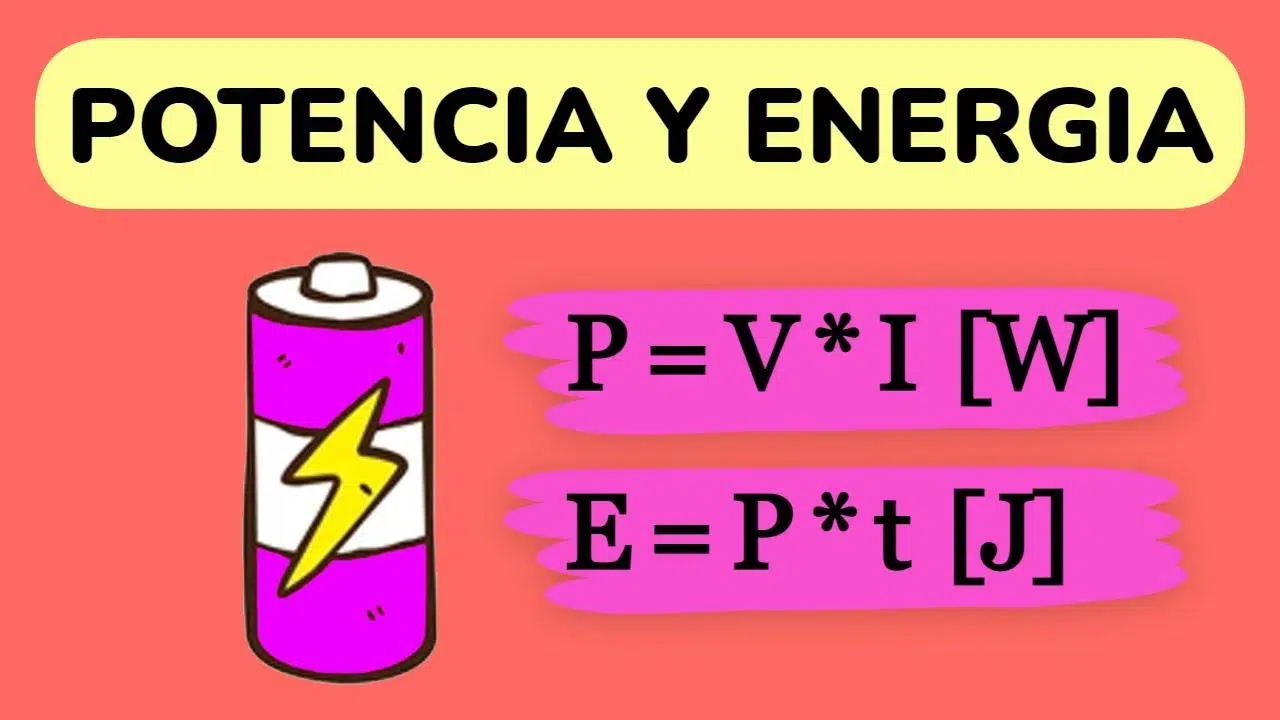
La electrical energy and power These are two concepts we see everywhere: on electricity bills, on appliance labels, in contracts with energy suppliers, and even when talking about renewable energyHowever, it is very common for them to be mixed up and used as if they were the same, when in reality they describe different things and are calculated differently.
Understand clearly What is power (kW) and what is energy (kWh)? It helps you interpret your electricity bill, choose the right contracted power, estimate how much electricity your appliances consume, and make a realistic assessment. a self-consumption system or a battery. Let's break down all these concepts calmly, with simple formulas, numerical examples, and some tricks so you never forget them again.
Electrical power: what it is and how to calculate it
When we talk about electric power We are referring to the speed at which a device transforms electrical energy into another type of energy (light, heat, motion, sound, etc.). Simply put, it is the amount of energy that a device is capable of using or delivering at any given moment.
Power is measured in watts (W) in the International System, although in the domestic and professional sphere it is very common to use multiples such as the kilowatt (kW), the megawatt (MW) or gigawatt (GW)To give you some context, the main equivalencies are:
- 1kW = 1.000W
- 1 MW = 1.000 kW
- 1 GW = 1.000 MW
In a simple direct or alternating current circuit, the electrical power P It is calculated using the most basic formula:
P = I · U
Where I is the current intensity in amperes (A) and U It is the voltage in volts (V). We obtain the result in watts (W), which is equivalent to joules per second (J/s), that is, energy per unit of time.
When you see a light bulb marked 100W, a stove marked 2.000W, or a hairdryer marked 1.500W, what it's telling you is... the power that the device can demand or transform while it is operatingThe greater the power, the greater the "strength" or capacity to do work in the same amount of time.
To make it clear, imagine three low-energy light bulbs 8 W, 15 W and 23 WThey all convert electricity into light and some heat, but the 23W bulb supplies more energy per second, so it illuminates more in the same amount of time. That difference is precisely what makes it so useful. electric power.
Simple examples of power calculation
In practice, power calculations are usually based on the mains voltage and the current flowing through the appliance. If you have a single-phase domestic installation with 220 V (or 230 V, depending on the country), you can safely apply the formula P = V · I.
Imagine a light bulb connected to 220V through which a current flows of 0,45 AThe power will be:
P = 220 V 0,45 A = 99 W (approx. 100 W)
Conversely, if you know the wattage of the bulb and the mains voltage, you can deduce the intensity which passes through it by solving the formula:
I = P/V
With a lamp 100 W At 220 V, we would have:
I = 100 W / 220 V ≈ 0,45 A
These simple calculations are very useful for sizing cables, fuses, or plugs, and also for getting an idea of how much current does each device draw? when you connect it to the network.
Ohm's Law and its relation to power
To complete the picture of power, it is worth remembering the Ohm's lawThis law connects three basic electrical quantities: voltage, current, and resistance. It was formulated by Georg Simon Ohm and is expressed as follows:
R = ΔV / I
Where R is the resistance in ohms (Ω), ΔV is the potential difference in volts (V) and I is the current intensity in amperes (A). From this expression, the most practical ways to solve problems are obtained:
- I = ΔV / R (If you know the voltage and resistance, you can calculate the current).
- ΔV = R · I (If you know resistance and current, you can find out the voltage).
Applying Ohm's Law along with the power expression P = V · I, other ways of expressing power as a function of resistance or current can be obtained. Thus, if you substitute V with R·I, you get:
P = V · I = (R · I) · I = R · I2
This relationship P = R · I2 It is very useful for analyzing how much heat is generated in a resistor or how much the conductors heat up when current passes through them.
Let's look at a very straightforward example: if a resistor of 15 Ω A current passes 30 A, the potential difference will be:
V = R · I = 15 Ω · 30 A = 450 V
In another exercise, if you have a resistance of 100 Ω subjected to a stress of 12 VThe intensity will be:
I = ΔV / R = 12 V / 100 Ω = 0,12 A
Electrical energy: what it is and how it is measured
La electrical power represents the total amount of electrical work performed over timeWhile power is "how much energy per second a device can handle", energy tells us how much electricity it has consumed or generated in a specific period.
In the electrical field, energy can be measured in joules (J)However, in domestic consumption, industrial use, and invoicing, the [missing term] is almost always used. watt-hour (Wh) and, above all, the kilowatt-hour (kWh)This is the information you see on your electricity bill: energy consumed during the billing period.
The fundamental relationship between power, time, and energy is:
E = P · t
Where E is the energy, P the power and t the operating time. If P is expressed in kW and t in hours, E is obtained in kWhYou can work in watts and seconds to obtain energy in joules with these equivalencies:
- 1 kWh = 1 kW · 1 h
- 1 kWh = 1.000 W · 3.600 s
- 1 kWh = 3,6 × 10⁶ J
The key idea is that the Energy accumulates the effect of power over timeA low-power appliance left on for many hours can consume more energy than a very powerful one that is only used for a few minutes a day.
Clear examples of electrical energy
Imagine you only plug in one 100W refrigerator at your home. If you connect it for only one hour on January 1st, the consumption will be:
E = 100 W · 1 h = 100 Wh = 0,1 kWh
If, instead, you turn it on one hour a day for the entire month (31 days), the total is obtained by multiplying that daily energy by 31:
E = 31 100 Wh = 3.100 Wh = 3,1 kWh
In this case the refrigerator power It's still 100W (that doesn't change), but the consumed energy Monthly energy consumption increases with usage time. In a typical household, with many more appliances running (lighting, refrigerator, washing machine, computer, electric heating, etc.), annual energy consumption can easily reach several megawatt-hours (MWh).
Another very illustrative example: a refrigerator 200 W connected to 220V that operates during 5h. Applying the formula:
E = P · t = 200 W · 5 h = 1.000 Wh = 1 kWh
If you have a television of 120 W If switched on for 2 hours, the calculation would be:
E = 120 W · 2 h = 240 Wh = 0,24 kWh
These values are then multiplied by the kWh price that your energy supplier charges you to obtain the amount of the energy portion of the bill.
Analogies to better understand power and energy
Sometimes it's very useful to resort to comparisons with everyday situations to help these concepts stick. There are three classic analogies that work very well: the car, water, and even a lightsaber.
When driving a car, the power can be associated with the instant speed (km/h), while the Energy would be equivalent to the total distance traveled (km). You can go fast (high power) for a short time and cover few kilometers (low total energy), or go relatively slowly (low power) for many hours and cover many kilometers (high accumulated energy).
Something similar happens with a hose and a bucket of water. water flow in liters per second it would be powerWhile amount of water that ends up inside the bucket would be the total liters, that is to say EnergyA very large flow fills the bucket quickly; a small one will take longer, but if you maintain it long enough it will also eventually fill it.
There are more geeky but equally useful comparisons: it has been estimated that a lightsaber would require the order of 28 kW of power to operate. If the hero uses it for 15 minutes, the energy required would be:
Energy = 28 kW · (15 min / 60 min/h) = 7 kWh
If he engages in battle for 3 hours straight, the energy consumed would amount to:
Energy = 28 kW · 3 h = 84 kWh
The power of the saber doesn't change (it remains 28 kW), but the Total energy It increases the longer it remains switched on, which is exactly what happens with any real electrical appliance.
Application of power and energy in solar energy
In a photovoltaic system, the power It is usually expressed in kilowatts (kW) and represents the instantaneous generating capacity of the [unclear]. This power varies throughout the day depending on solar radiation, the position of the sun, and weather conditions.
La energy produced a solar installation is expressed in kilowatt-hours (kWh) and is obtained by adding up the power generated at each moment over a period of time. In a typical monitoring graph, the vertical axis represents the power (kW) and on the horizontal axis the tiempo. The surface under the curve Power is precisely the total energy produced (kWh).
For example, if at a specific hour the system generates an average 3 kWThe energy obtained in that band will be:
Energy = 3 kW · 1 h = 3 kWh
If at the end of the day you see that your installation has supplied 21 kWh, you can estimate the economic savings Multiplying that energy by your energy provider's rate. At a price of €0,18/kWh, the daily savings would be:
Savings = 21 kWh · €0,18/kWh = €3,78
This same reasoning applies to assessing monthly or annual production: it is enough to add up the kWh generated in each interval and multiply them by the cost of the kWh you save by no longer buying that energy from the grid.
Batteries: energy capacity and discharge power
In batteries, two concepts are also clearly distinguished: the energy capacity and maximum powerThe capacity is given in kWh and the usual discharge or charge power in kW.
Assume a battery with 10 kWh capacity and a continuous power of 5 kWThis means it can supply a maximum of 5 kW of power continuously. If you use it at that maximum power, the theoretical discharge time would be:
Time = Energy / Power = 10 kWh / 5 kW = 2 h
That's why we sometimes talk about "2-hour" or "4-hour" batteries, etc., depending on the relationship between their capacity and the power they can deliver. battery power determines how many simultaneous loads it can power (refrigerator, lighting, air conditioning, etc.), while the Stored energy It indicates how long it can handle those loads.
A typical refrigerator may require around 300 W when the compressor is activated. If it runs for an average of 6 to 8 hours a day, its approximate consumption will be around 2 kWh per dayThat energy will have to come, in an isolated or backup system, from the battery or solar panels.
Energy dissipated as heat: Joule's Law
When an electric current passes through a conductor or a component with resistance, part of the electrical energy is inevitably converted into heatThis phenomenon is described by the so-called Joule's Law, which quantifies the thermal energy generated.
The mathematical expression of Joule's Law for energy dissipated per unit time (i.e., thermal power) can be written as:
Q = I2 · R · t
Where Q It is the energy in joules, I the current in amperes, R resistance in ohms and t time in seconds. If you want to express energy in Calories Instead of joules, the approximate conversion factor is used. 1 cal ≈ 4,18 J, which usually approximates 0,24 when we reverse the relationship:
Q (cal) = 0,24 · I2 · R · t
Imagine an electrical device with a resistance of 30 Ω through which a current flows 4 Aconnected to a 120V power supply. If it remains switched on for 10 minutes (600 seconds), the energy transformed into heat in calories will be:
Q = 0,24 · (4 A)2 · 30 Ω · 600 s
Q = 0,24 · 16 · 30 · 600 = 0,24 · 288.000 = 69.120 calories
This effect is responsible for the heating of cables, heating elements of stoves, hobs, toasters and other devices that base their operation precisely on transforming electrical energy into heat.
Power and energy in household electrical appliances
All household appliances include information such as the following on their rating plate: voltage, frequency, rated power and sometimes the average consumption. In countries with a grid similar to Spain's, the typical voltage is 220 230-V and the frequency of 50 Hz.
La nominal power in W The information you see on each device tells you how much energy per second it can transform. This is based on the energy formula. E = P · tYou can also estimate the kWh consumption if you know the approximate usage time. Let's look at a sample table with some common appliances:
| Electrical appliance | Power (W) | Energy consumption in 1 hour (kWh) |
| Vaccum cleaner | 1.000 | 1 |
| Computer | 400 | 0,4 |
| Washing machine | 500 | 0,5 |
| Electric stove | 2.000 | 2 |
| Hairdryer | 1.500 | 1,5 |
If we take the hair dryer For example, with a power of 1.500 W and we use it for one hour continuously, the consumption will be:
E = 1.500 W · 1 h = 1.500 Wh = 1,5 kWh
When comparing, it quickly becomes clear that one 2.000W electric stove It is one of the appliances that consumes the most energy in an hour (2 kWh), while a 400W computer It consumes considerably less (0,4 kWh in one hour). Here again, the difference between instantaneous power y Accumulated energy depending on usage time.
Key differences between power (kW) and energy (kWh)
With all of the above, it can now be made very clear that fundamental difference between electrical power and energywhich is closely linked to time. Although both quantities are related and appear together on invoices and contracts, they do not measure the same thing.
First, the electric power It is an instantaneous quantity: it indicates the rate at which energy is consumed, generated, or transferred at a specific momentIt is measured in watts (W) or kilowatts (kW) and describes “the rate” at which a system performs electrical work.
La electrical powerOn the other hand, it represents the total amount of energy used or produced during a time intervalIt is measured in watt-hours (Wh), kilowatt-hours (kWh), or larger units such as MWh. It is obtained by multiplying the power by the operating time.
We can summarize the main differences as follows:
- Relationship with timePower refers to an instant or an average value over a short period; energy accumulates power throughout the entire period of use.
- Unit of measure: power is expressed in W or kW; energy in Wh, kWh, MWh, etc.
- Impact on the billThe contracted power (kW) is a fixed term that you pay even if you hardly consume any; the energy consumed (kWh) is variable and depends on how much you use the appliances.
In colloquial terms, we could say that the Power is like the width of the highway (how many cars can circulate at the same time), while the Energy is the total number of cars that have passed along it in a day. A very wide highway but almost without cars would have a lot of capacity (a lot of available power) but little total energy circulated.
How power and energy appear on your electricity bill
If you look closely at any electricity bill, you'll see that two distinct terms always appear: the power term and the energy termEach one is calculated and charged differently.
The call hired potency This is the maximum amount of power (in kW) you are entitled to under your contract. This value is fixed and is usually paid as a fee per kW per day or per kW per year, regardless of whether you actually reach that level of usage. Excessive power implies overpaying each month for a capability you may not need.
El energy term reflects the kWh that you have actually consumed During the billing period, consumption is measured by the meter. This consumption is multiplied by your contracted kWh price (which may vary depending on the time of day if you have time-of-use pricing) and, added to tolls and taxes, makes up the variable part of your bill.
Understanding the difference between these two concepts allows you to fine-tune your contracted power according to your habits, avoid automatic disconnections for exceeding your available power, and find tariffs that fit your energy consumption pattern. Monitoring tools and smart meters They help precisely to analyze in detail the power demand curve and the energy consumed, in order to adjust the contract and reduce electricity costs without sacrificing comfort.
When you understand what the terms on your bill really mean, it becomes much easier to assess whether it's worth it to reduce your contracted power, change your tariff, or invest in efficiency measures such as lower-consumption appliances, LED lighting, or even self-consumption systems with batteries.
Mastering the difference between electrical power and energyKnowing how to read the units (W, kW, Wh, kWh), understand simple formulas like P = V · I and E = P · t, and relate all of this to your bill and the actual operation of your appliances, puts you in a much more advantageous position to manage your consumption. Ultimately, understanding how electricity flows and is transformed in your home or business is key to deciding what power capacity to contract, what devices to buy, how to use them, and which investments in efficiency or self-consumption make the most sense for your wallet and the environment.
Table of Contents
- Electrical power: what it is and how to calculate it
- Ohm's Law and its relation to power
- Electrical energy: what it is and how it is measured
- Analogies to better understand power and energy
- Application of power and energy in solar energy
- Batteries: energy capacity and discharge power
- Energy dissipated as heat: Joule's Law
- Power and energy in household electrical appliances
- Key differences between power (kW) and energy (kWh)
- How power and energy appear on your electricity bill