- Google has integrated the Data Science Agent into Colab, making it easier to automate data analysis.
- Powered by Gemini 2.0, the agent allows users to generate functional notebooks by simply describing their goals.
- Available to users 18+ in certain countries, with support for CSV, JSON, and text files.
- Streamline workflow by eliminating repetitive tasks, improving efficiency in data science.
Google has taken a step forward in the field of data analysis by integrating the new Data Science Agent into Colab . This AI- powered tool aims to make the work of data scientists , researchers, and developers more accessible and efficient.
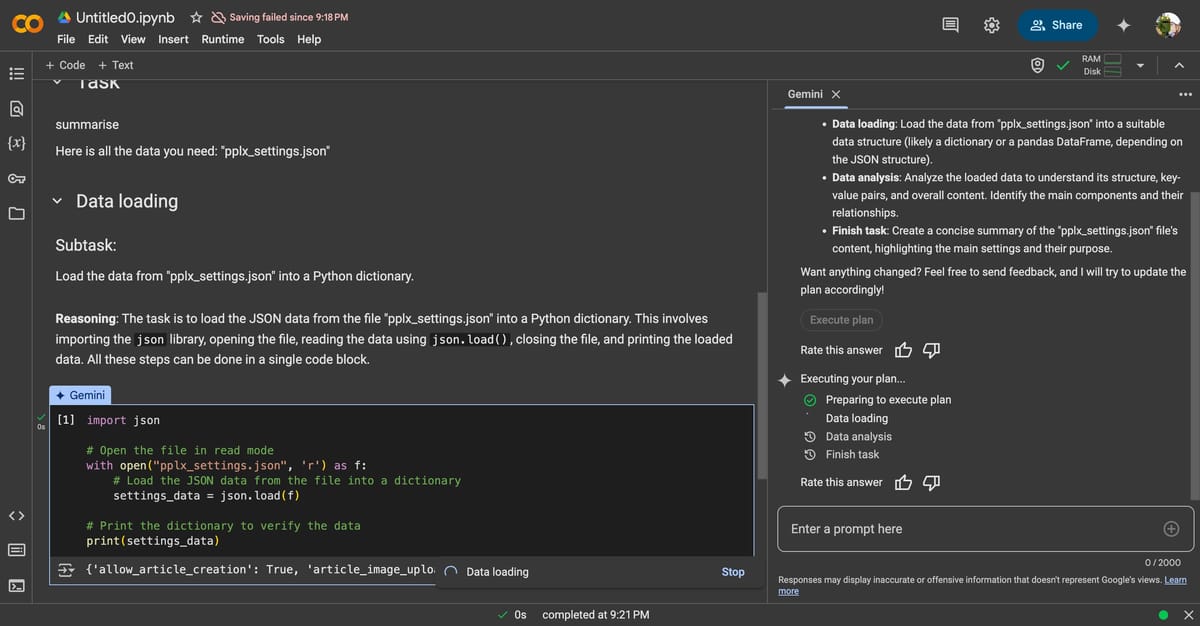
The Data Science Agent automates various tasks within Colab, a Jupyter Notebook-based environment that simplifies Python programming in the cloud. Thanks to Gemini 2.0 technology , users can now upload their data, describe their analysis objective, and automatically receive a working notebook with the necessary code.
Data analysis automation
With this new agent, Google aims to streamline the workflow for data analysts. It eliminates the need to write code from scratch , as it generates the necessary scripts for tasks such as library imports , data processing, and visualization creation.
The tool is capable of performing exploratory analysis , data cleaning, predictive modeling, and statistical testing. It also features self-correction and refinement capabilities for the generated code, making it useful for both experts and those new to data science. For a more in-depth look at this technology, you can consult a guide on Gemini Code Assist.

Ease of use for users
The Data Science Agent is intuitive to use. Just follow these steps:
- Open a notebook in Colab.
- Load a dataset in CSV, JSON or TXT format.
- Describe the analytical task in natural language using the Gemini side panel.
- Run the generated notebook to obtain results and visualizations.
Thanks to its conversational approach, the agent can understand requests like “Visualize data trends” or “Train a predictive model .” This simplifies the process and reduces the time spent on repetitive tasks . For those interested in collaboration platforms, a review of collaboration tools might be helpful.
Impact on the scientific community
Tests have shown that the Data Science Agent dramatically reduces analysis time . A notable example is that of a researcher at Lawrence Berkeley National Laboratory who managed to reduce his data processing time from a week to just five minutes.
Furthermore, the tool has been evaluated in Hugging Face's DABStep benchmark, where it achieved fourth place in multi-step reasoning , surpassing models such as DeepSeek and Llama 3.3 70B. For more information on this type of model, see an analysis of DeepSeek R1.
Future plans and expansion
Google has ambitious plans to improve the tool. Future developments include:
- Support for more data formats and more complex analysis.
- Greater customization capabilities in the generated notebooks.
- Expansion to other environments Google Development.
The tech giant has also indicated that it is gathering user feedback through the Google Labs community on Discord to further refine its features. Additionally, those interested in artificial intelligence development can find valuable information about the new OpenAI operator.

With the addition of the Data Science Agent to Colab, Google aims to democratize access to advanced data analysis tools . By reducing repetitive workloads, users can focus on interpreting results instead of worrying about technical implementation. This innovation marks a new milestone in data analysis automation , making the work of data scientists worldwide easier.