- NotebookLM centralizes and analyzes your documents using AI, providing summaries, guides, and mind maps.
- It works only with the sources the user uploads, ensuring privacy and preventing fabricated responses.
- It allows you to generate personalized audios and podcasts, and share notebooks for collaborative work.

In the digital age, where information flows constantly and time is always scarce, finding tools that can simplify our lives is a true blessing. NotebookLM arrives with the promise of revolutionizing how students, researchers, and anyone who loves learning interact with and organizes their sources, applying the power of artificial intelligence to transform the process of studying and working with documents.
NotebookLM is much more than just a note-taking app. Google has created a platform that centralizes, analyzes, and extracts the essential information from our texts and reference materials, making it the perfect companion for both academic and professional work. If you're looking for a tool that helps you save time, optimize your research, and get the most out of your documents, keep reading because this is for you.
What is NotebookLM and how does it work?
NotebookLM is a free web application developed by Google and powered by artificial intelligence, designed to help you understand complex information, analyze documents, organize ideas, and generate content . One of its unique features is that it only works with the files and sources you upload, ensuring that the analysis and responses are based solely on your information, without consulting the web or external databases.
This tool integrates Google's modern Gemini 1.5 Pro AI model , allowing it to handle large documents (up to 1.500 pages at once) and interpret various formats such as PDFs, Google Docs, text files, presentations, web links, and even YouTube videos . Furthermore, it can generate summaries, study guides, timelines, mind maps, and even podcast-style audio that synthesizes your materials, making it a multifunctional assistant.
The main difference compared to other chatbots like ChatGPT or Gemini is that NotebookLM doesn't "make up" data or respond with information from the internet; instead, it limits itself to the content you provide. So, if you upload your notes, scientific articles, or data, you can ask it about them, create personalized summaries, or ask it to develop study materials.
NotebookLM Options and Features
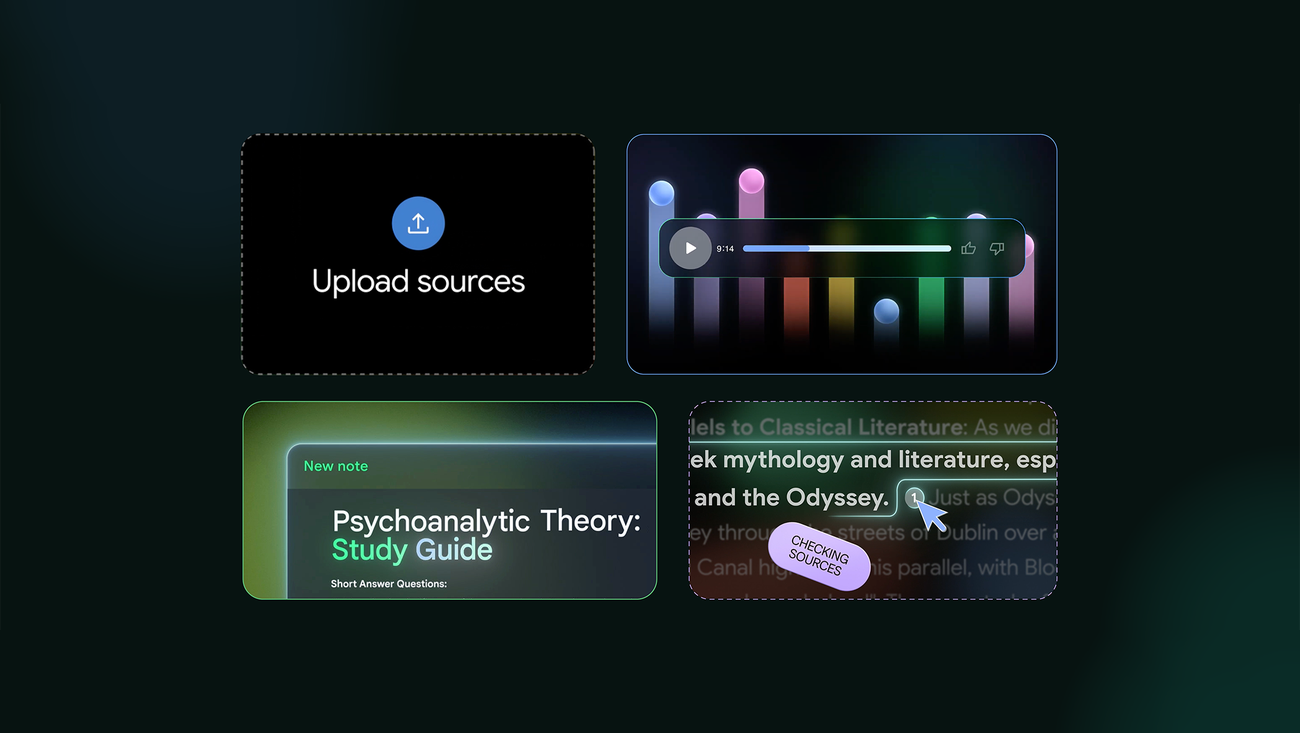
NotebookLM stands out for its versatility and the number of utilities it offers for both the academic and professional worlds. Its main functions are:
- Automatic summaries: Analyze and condense long documents, articles, or other texts in just a few seconds, extracting key points and providing a quick overview of their content.
- Creating study guides: Create personalized guides based on your materials, organizing information, generating frequently asked questions, glossaries of terms, and suggested topics for review or discussion.
- Mind maps and interactive timelines: Allows you to view chronologies of events, processes or relationships between concepts, facilitating the visual understanding of complex topics.
- Smart annotations and assisted chat: You can mark snippets, add notes, ask the AI questions, and hold conversations to clarify doubts, search for specific information, or even ask it to ask you questions to test your knowledge.
- Creating audios and podcasts: NotebookLM can synthesize and convert the content of your documents into audio, simulating conversations between two voices (one male and one female), as if you were listening to a podcast about your own documents!
- Compatibility with different formats: Supports PDF, Google Docs, slides, web pages, links, YouTube videos, and will soon offer support for analyzing images and audio files.
- Interactivity and personalization: You can intervene in the generated podcasts, customize the technical level of the summary, or guide the AI to focus on specific aspects of the material.
- Privacy & SecurityGoogle ensures that the documents and data you upload to NotebookLM are not used to train its AI models nor are they shared. Everything remains private and secure in your account.
Who is NotebookLM useful for?
The potential of NotebookLM is enormous and it adapts to multiple profiles:
- Students: For summarizing long texts, creating study guides, timelines, mind maps, or receiving mock exam questions. It's ideal for reviewing notes and organizing your study time efficiently.
- Teachers: Generation of teaching materials, exams, glossaries, and summaries. It also allows you to share notebooks with students and easily prepare customized resources.
- Researchers: To analyze large volumes of information, compare scientific texts, extract relevant citations, and generate informative reports or podcasts on complex subjects.
- Professionals: Analyze regulations, compare reports, extract data trends, create visual presentations, or collaborate with teams by sharing organized and annotated documents.
- Journalists and content creators: Summarize interviews, analyze large amounts of transcripts, organize documentation for articles or podcasts, and prepare newsletters with selected information.
It's also ideal for users who need to learn or access information without getting lost in piles of documents, taking advantage of AI's ability to structure and present data clearly.
How to Use NotebookLM: Step-by-Step Guide
Getting started with NotebookLM is easy; all you need is a Google account and access to the official website (https://notebooklm.google.com/). The tool is available in over 200 countries and more than 100 languages, including Spanish.
- Access NotebookLM and log in: Log in to the website and use your personal Google account.
- Create a new notebook: Each project is organized into notebooks, where you can group documents and materials related to a topic.
- Upload documents or add sources: You can upload PDFs, text files, presentations, web links, or YouTube videos, and even connect to Google Drive to import files.
- Explore and organize content: Add notes, use mind maps, view timelines, mark important passages, and organize your material to your liking.
- Ask and chat with AI: Use the chat feature to review details, request snippet analysis, request summaries, create study guides, or ask for a personalized audio summary or podcast.
- Create audios or podcastsClick "Generate Audio" and you'll get a spoken summary of the content. You can even participate in the podcast if you choose interactive mode (currently only available in English, but the Spanish function is now available for basic summaries).
- share and collaborate: You can share your notebooks with other people, either as readers or as editors with editing permission.
Competitive advantages and notable new features
NotebookLM has been constantly updated, incorporating new features such as:
- Greater quantity and variety of supported sources, including presentations, links, and soon images and audio.
- Larger context window thanks to the Gemini model, which allows you to understand and summarize large documents or complex data sets.
- Advanced interactivity: You can transform documents into study guides, briefings, or tables of contents, and get answers with citations linked directly to the source fragment.
- Enhanced PrivacyAll activity and documents remain private; Google doesn't use your texts to train AI.
One striking feature is its Audio Overview function , which transforms uploaded documents into comprehensive summary podcasts with two human-sounding synthesized voices, making it easier to consume information in an auditory format. You can now also send specific instructions to adjust the audio to the level of detail or technicality you require, and listen in the background while you continue working on the platform.
Limitations and aspects to take into account
As with any tool based on artificial intelligence, there are certain weaknesses to consider :
- Response Accuracy: Although NotebookLM tries to stick to the information you provide, there may be times when it fails to locate specific data or engages in minor AI-like "hallucinations."
- Output language: While it accepts documents in numerous languages, some of the advanced functionality (such as interactive podcasts) is still primarily in English, although there are increasing options in Spanish.
- Limitations in some formats: Currently, it does not yet allow direct analysis of images, audio, or full videos, although multimodal capabilities are gradually being integrated.
- Response speed: Processing very long documents or generating audio files may take a few minutes.
- Size limits: There are restrictions on the word count per document and notebook (e.g., 500.000 words per source), although these are generous enough for most users.
It's important not to upload documents containing confidential or copyrighted information without permission. While privacy is guaranteed, it's always wise to proceed with caution.
Practical use examples of NotebookLM
It's no coincidence that NotebookLM has become an increasingly popular tool among all kinds of profiles:
- University students: You can upload syllabi and ask AI to formulate practice questions for exams or condense multiple readings into a single, manageable summary.
- Researchers: They have used the tool to compare scientific texts, extract citations for articles, create visual presentations, and even broadcast summaries in podcast format.
- Professors: They can generate study guides for their students and share collaborative notebooks with personalized exercises.
- Architects and engineers: They have leveraged advanced searches to analyze current regulations, prepare technical reports, and compare specifications between projects.
- Marketing professionals: They can upload industry reports and use the automatic summary feature to identify trends and prepare presentations for work teams.
- Journalists: have processed transcripts of interviews or discussions, summarizing hours of recordings into key insights for news writing or newsletter creation.
- Non-profit organizations: have found in NotebookLM an ally to identify community needs and organize critical information in developing grant proposals.
- Creative users: They even use it to manage imaginary worlds in role-playing games, organize game guides, or build chronologies of invented stories.
Cross-platform compatibility and access
NotebookLM can be used both from the official website and through a mobile browser (on any smartphone or tablet). Currently, there is no official native app, but you can create a shortcut on your home screen for easier access from your mobile device.
Access is free for any user over 18 with a Google account, although there is a premium version within Google One that offers improvements such as style customization, collaborative notebooks, the ability to add more fonts and the generation of expanded audio summaries.