- Traditional guide dogs are scarce, expensive, and slow to train, leaving millions of visually impaired people around the world without support.
- New guide robot projects combine sensors, artificial intelligence and GPS to guide, describe the environment and improve user autonomy.
- From Lysa in Brazil to prototypes in China, Spain and the United States, robot dogs are being considered as an alternative or complement to guide dogs.
- Mass production and reinforcement learning point to more accessible and scalable solutions, always keeping user safety as a priority.
People with visual impairments have relied on the white cane and the traditional guide dogs To move around safely, but technology is rapidly changing this landscape. Robot dog and guide robot projects are emerging in various parts of the world, promising a more accessible, scalable, and, in some cases, more precise alternative to assistance animals.
This new generation of assistant robots for the blind combines advanced sensors, Artificial IntelligenceGPS and voice recognition are used to guide users, detect obstacles, interpret the environment, and even "converse" with the person they are accompanying. From Brazil to China, and including Spain, the United States, and Australia, very different prototypes are being tested: some have wheels and look like suitcases, others resemble authentic four-legged robotic dogs, and there are also six-legged ones for added stability.
Why are robot dogs needed as guides for the blind?
One of the main drivers of this trend is the huge shortage of guide dogs compared to the number of people who would need one. In Spain alone there are nearly one million people with some type of visual impairment, and yet there are only about 957 guide dogs actively accompanying them in their daily lives.
On a global scale, the World Health Organization It is estimated that around 314 million people have significant visual impairment, of whom some 45 million are blind. Given these figures, the model based solely on trained dogs clearly falls short, even in countries with well-established and subsidized programs.
The problem is not only one of quantity, but also of cost and training timeTraining a guide dog requires around two to three years of specialized work, and only about half of the animals that begin the process successfully complete it. In countries like Spain, the total cost per dog can be around €30.000, although it is often covered by organizations like ONCE (the Spanish National Organization of the Blind); elsewhere, the cost is around $50.000 per guide dog.
In Brazil the situation is no more encouraging: it is estimated that there are only about 200 active guide dogs for approximately 6,5 million people with visual impairments. In China, the imbalance is even more striking: some 400 guide dogs for more than 17 million blind people, in a context where service pet ownership is relatively recent and where many workplaces, restaurants, and public environments are not exactly friendly to these animals.
Given this scenario, many researchers and entrepreneurs have asked themselves a very direct question: is training and maintaining a guide dog really so difficult? Slow, expensive, and limitedWhy not develop a robotic alternative that can be mass-produced, become cheaper over time, and reach many more people?
LYSA: the wheeled guide robot that was born in Brazil
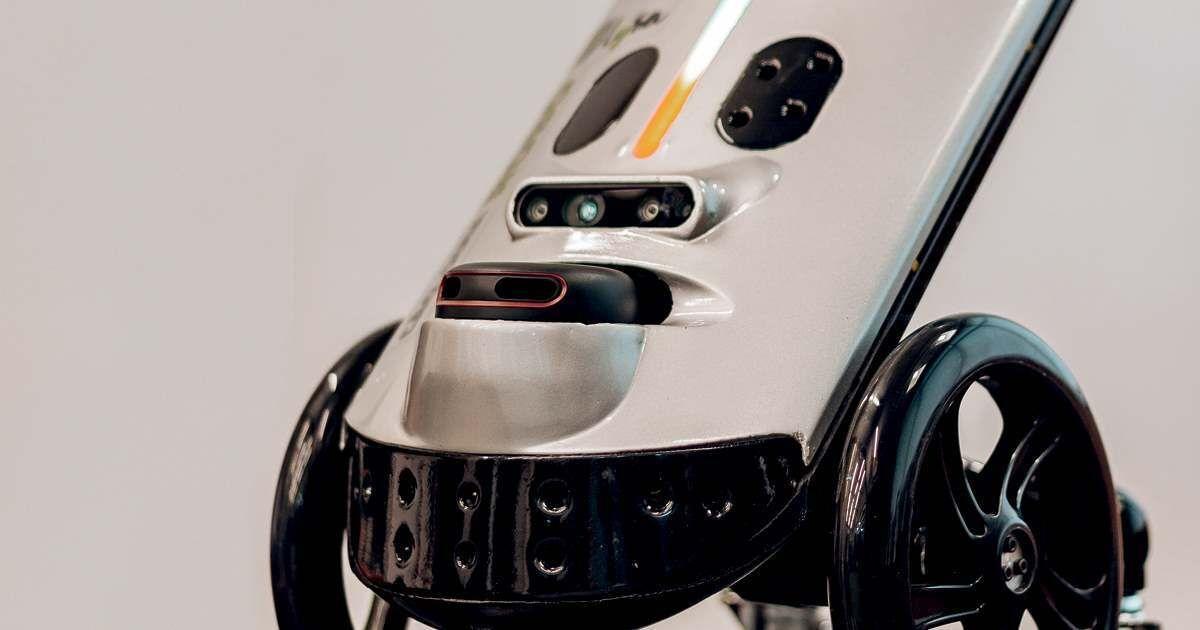
One of the most advanced and concrete projects is LisaVixsystem, a guide robot developed by the Brazilian startup, doesn't resemble a dog. Instead, it's a small suitcase with a retractable handle and wheels, weighs about 4 kilos, and is around 40 centimeters tall. Its design allows a visually impaired person to grasp the handle and move around as if pulling a lightweight trolley.
Lysa is initially conceived for indoor environments such as shopping malls, stores, or airports, and has already begun testing in states like Espírito Santo, Rio de Janeiro, and São Paulo. To operate, the robot combines specific software, a mobile phone application, artificial intelligence, a network of sensors, a camera, and a Lidar laser system, which allows it to detect light and measure distances with great precision.
Thanks to this whole set of technologies, the robot is able to map the environment, calculate routes and guide the user to their chosen destination. During the journey, Lysa provides both acoustic and directional cues, allowing the user to perceive the robot's movement and hear clear instructions on the path to follow.
According to its creator, computer science specialist Nedinalva de Araújo Sellin, Lysa not only detects and avoids obstacles at ground level, but also those at mid-height or above the user's head, such as tree branches or hanging flowerpots, which are often responsible for many accidents with conventional walking sticksIn addition, the robot identifies whether there is a person or a group of people in front of it, and adjusts its behavior accordingly.
Sellin compares Lysa to the so-called smart canes which already exist on the market, noting that the robot offers more precise guidance and a higher level of "intelligence." While the walking stick is limited to detecting obstacles, the robot understands the layout of the environment, plots routes, interprets the presence of other elements, and transmits all that information to the user in an organized manner.
In its current phase, the robot is marketed for indoor use at a price of around 15.000 realThe company has begun receiving orders for both sold units and those loaned to clients for pilot testing. As it is a novel technology, many organizations prefer to thoroughly test it before making large purchases, so Vixsystem combines direct sales with evaluation agreements.
Lysa's story began much more humbly in 2011, when Sellin was teaching robotics at a public high school in the municipality of Serra, in the metropolitan area of Vitória. After noticing that the need for mobility solutions For people with visual impairments, the need was real and urgent. She and her students assembled a first handcrafted prototype using parts from other robots and tested it with about 20 blind people to gather their feedback.
Although that first model was far from being a finished product, many of the participants were willing to buy it as is, which reinforced the conviction that there was a strong and under-met demandFrom there, the entrepreneur began to secure various sources of funding, starting in 2014 with a project from the National Council for Scientific and Technological Development (CNPq), which allowed her to hire two researchers with master's degrees—one in electronic engineering and the other in computing—to advance the design.
During the following years, several prototypes were manufactured and multiple rounds of validation were carried out with more than 200 people with visual impairmentsintegrating their feedback into the final concept of Lysa. In 2017, Sellin's participation in the Brazilian version of the television program Shark Tank earned her 200.000 reais and, perhaps more importantly, media visibility that facilitated the search for more support.
Vixsystem also secured funding from the Financing Agency for Studies and Projects (Finep) and the Foundation for the Support of Scientific Research and Innovation of Espírito Santo (Fapes). In 2021, the project took a significant leap forward when it was selected within the Innovative Research Program in Small Businesses (PIPE) of FAPESP, within the framework of a strategic call related to the internet in collaboration with the Ministry of Science, Technology and Innovation (MCTI), the Ministry of Communications (MCom) and the Internet Management Committee in Brazil (CGI.br).
Thanks to this boost, the company is working on a Lysa outdoor versionEquipped with GPS and designed for use on public roads, the robot faces a greater technical challenge. It must contend with nonexistent sidewalks, intersections, uneven terrain, and a wide variety of urban situations. Sellin acknowledges that the lack of defined sidewalks is one of the main challenges to overcome before the system can be truly viable on the street.
Advantages and doubts compared to traditional guide dogs
The emergence of guide robots like Lysa has generated an interesting debate in the field of visual impairment. From the Dorina Nowill Foundation for the Blind in São Paulo, lawyer Marcelo Panico believes that the idea of a robotic guide is very promisingBut he insists that it must be carefully evaluated, both for its cost and its social implications.
Currently, guide dogs enjoy a high level of social recognition And their access to different environments (transport, shops, public buildings, etc.) is protected by law in many countries. Furthermore, the emotional bond established between a blind person and their guide dog has a direct impact on the user's psychological well-being and self-esteem, something difficult to replicate with a machine.
Panico emphasizes that a guide dog is much more than a mobility tool: it is a constant companion...an emotional support and a facilitator of social relationships. The simple fact that people approach to ask about the dog or show interest in the person generates human interactions that a robot, however sophisticated, cannot offer in the same way.
At the same time, the lawyer acknowledges that the extremely limited availability The lack of guide dogs in countries like Brazil or China excludes the vast majority of people who need them. The cost of training, long waiting lists, and the difficulty of finding suitable animals mean that many people never have access to a guide dog.
Therefore, rather than completely replacing dogs, many guide robot projects are conceived as complement or alternative For those who cannot access an animal, or as a transitional solution while they wait to be assigned one. Some also suggest that, in certain contexts (for example, in complex interiors or in visual information recognition tasks), the robot can provide functions that the dog is not capable of performing.
Four-legged robot dogs: from Boston Dynamics to low-cost versions
In the field of dog-shaped robots, the major global reference is SpotThe quadruped robot, developed by the American company Boston Dynamics, has starred in spectacular demonstrations at technology fairs and is already being used in sectors such as construction and mining for inspection and reconnaissance tasks in difficult or dangerous terrain.
Spot stands out for its amazing mobilityIt climbs stairs, traverses uneven surfaces, maintains its balance when pushed, and can be equipped with cameras and sensors to collect data. However, its price, exceeding $70.000 in the United States, puts it completely out of reach for most users and institutions working with blind people.
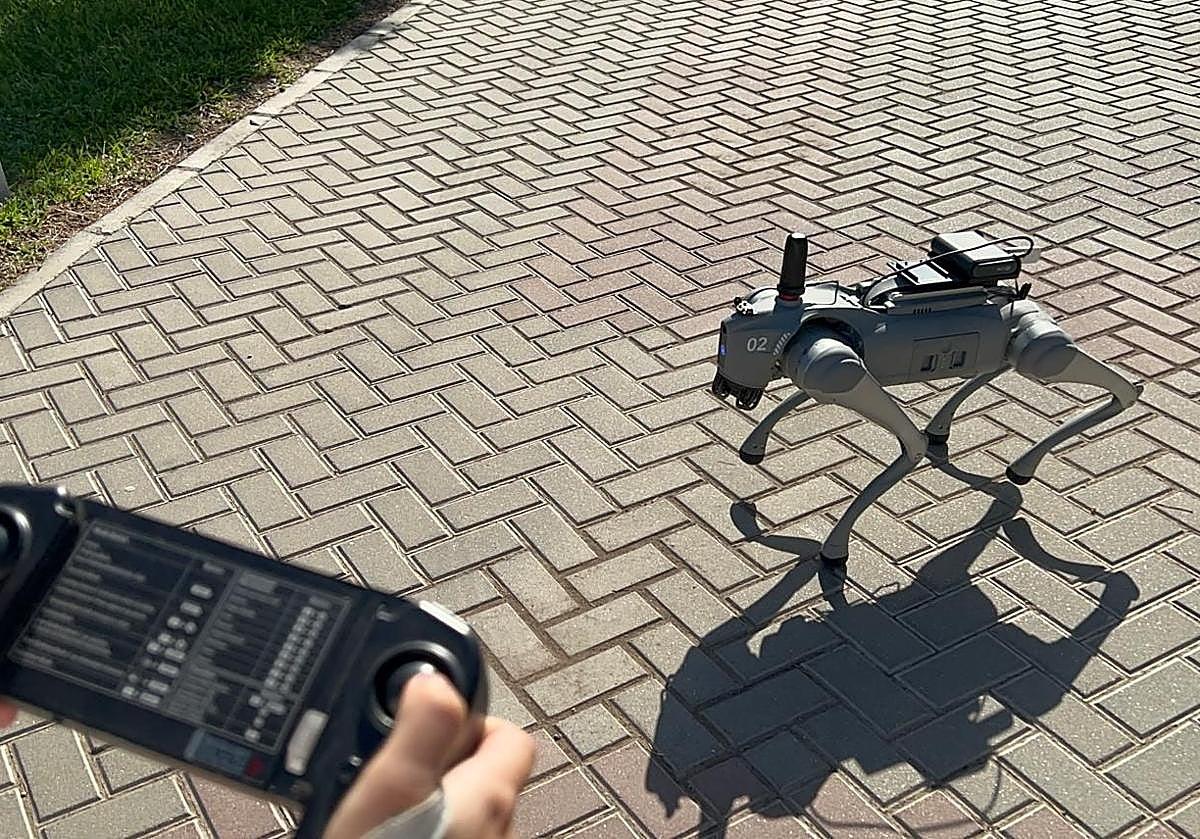
Inspired by this model, several companies in China, Japan, and Germany have developed their own quadruped robotsSome have a more industrial focus, while others are almost like advanced toys. Much cheaper Chinese versions have appeared on the market; for example, Unitre Robotics sells six models of robotic dogs, with a starting price of around $2.700 for the most basic one.
Even so, these devices are not intended as guides for people with visual impairmentsTheir main uses are surveillance, inspection of tunnels and underground spaces, detection of explosives, and other security or maintenance functions. To transform them into true guides, both their software and user interface would need to be redesigned, as well as their behavior adapted to the specific needs of blind people.
In Brazil, researcher Diego Renan Bruno, from the Mobile Robotics Laboratory of the University of São Paulo (ICMC-USP), uses Spot as a reference for his own project. robotic guide dogTogether with his former student Marcelo Assis, he began working in 2017 in the interior of the state of São Paulo, in the municipality of Catanduva, developing prototypes that have evolved over time.
Their first version was built in a very DIY fashion, reusing parts from an old vacuum cleaner. Later, within the Red Bull Basement hacker residency program, they developed a second prototype in 2019, and now they are planning a third iteration that will be a robot with legs, moving closer to the classic idea of a robotic dog.
Bruno argues that, if we are going to talk about a “robotic guideThis robot should behave similarly to a real guide dog, in that it can navigate steps, curbs, and uneven terrain without relying on ramps or completely smooth surfaces. In his opinion, wheeled robots are limited to areas with accessibility comparable to that of a wheelchair, whereas a well-designed quadruped could access many more environments.
The Chinese six-legged robot guide dog: stability and voice recognition
In China, a team from the School of Mechanical Engineering of the Shanghai Jiao Tong University They are developing a very unique robotic guide dog. Its appearance is reminiscent of an English bulldog, although somewhat wider, and it is striking because it has six legs instead of four, a design decision that seeks to maximize stability and smooth movements.
Its creator, Gao Feng, explains that when the robot lifts three of its legs to move forward, the other three form a kind of very stable tripodThis reduces the jolts felt by the blind person attached to the strap. The goal is for the user to experience a smooth and comfortable movement, without sudden jerks that could cause insecurity.
This robot dog is equipped with a battery of sensors and cameras These features allow it to recognize its surroundings, identify traffic signs, interpret traffic lights, and detect different types of obstacles. Furthermore, it integrates a voice recognition system with over 90% accuracy and a response time of less than one second, enabling it to react quickly to the user's verbal commands.
The artificial intelligence that governs the robot is responsible for the route planningThe system interprets voice commands and provides real-time audio alerts about its surroundings, from pedestrian crossings to the proximity of dangerous intersections. It also incorporates a leash-controlled interface, similar to that used with a real dog, to adjust walking speed or indicate changes in direction.
The project is already in the phase of outdoor field testsThe project involves the active participation of blind people who help adjust both the robot's locomotor behavior and the naturalness of its voice commands (currently focused on Chinese). Gao Feng's idea is that, once the experimental phase is complete, the device can be mass-produced, progressively reducing its cost.
Gao himself compares this vision to the automotive industry: a natural guide dog requires years of individualized training and its numbers are necessarily limited, whereas a robot could be produced as a standard industrial good, leading to a potential market of tens of millions of units to meet the global demand for guides for blind people.
Paws 2.0 at the University of Alicante: a robotic guide dog with a vocation for companionship
In Spain, progress is also being made in this area with projects such as Paws 2.0A small quadruped robot is currently strolling around the University of Alicante campus alongside students and curious onlookers. Its name, which means "little legs" in English, reflects years of work by a research team experienced in technologies for people with disabilities.
Paws uses laser sensors, similar to those of a Roomba-type vacuum cleaner but much more powerful, combined with high-precision GPS technology and video processing using artificial intelligence. Thanks to this system, it can map routes within the campus, avoid obstacles in real time, and perform small "tricks" that greatly impress those who see it in action.
The researchers explain that their goal is not to "replace" traditional guide dogs, but to offer a technological complement It can be used while the person waits to be assigned a real guide dog or in environments where an animal isn't the best option. In theory, when Paws is fully developed, a blind person could have a robotic assistant in a matter of days, instead of having to wait years.
Beyond guiding from one point to another, the robot is designed to offer additional servicesExamples include reading a menu in a restaurant, identifying products in a supermarket, locating a store's entrance, or describing the number of people in a room. All this information will be transmitted through a built-in speaker, making it a kind of mobile hearing assistant.
One of the advantages highlighted by those in charge of the project is the high GPS location accuracyThis allows the user to be guided to specific coordinates (such as a particular door within a building), something a traditional guide dog cannot do with that level of accuracy. Furthermore, the robot learns through a neural network capable of recognizing patterns such as traffic lights, objects, types of flooring, or obstacles in its path.
The team at the University of Alicante has previously worked with artificial vision solutions for blind people, such as an application that, based on a photo or video, describes the environment to help locate objects or identify visual characteristics (for example, the color of a garment). Now, that technology is integrated into Paws along with a speaker to offer a most complete assistant.
If everything progresses as planned, in a few years we expect to have a fully functional prototypeHowever, the arrival of a commercial product for homes could be delayed by nearly a decade due to certification processes, real-world testing, and industrial scaling. The project is funded by the University Institute of Computer Science Research at the University of Alicante and Synergy Tech, the company that manufactures Paws 2.0 and other robots with similar features.
The robot guide dog of Binghamton (New York): reinforcement learning and a “smart leash”
In the United States, a group of engineers from the Department of Computer Science at the Binghamton UniversityAt the State University of New York, he is also working on a robotic guide dog designed as a lower-cost, more efficient, and more accessible alternative.
The team, led by assistant professor Shiqi Zhang and also composed of doctoral candidate David DeFazio and third-year student Eisuke Hirota, has been training for about a year. quadruped robot equipped with a visual “eye”During a demonstration in the university laboratories, the machine was able to guide a person through a corridor, responding to both verbal commands and tugs on the leash.
Their approach is based on a unique strap interface combined with reinforcement learning. The robot is trained to interpret the tension and direction of the pulls as command signals, while its vision and navigation systems allow it to avoid obstacles, maintain a safe path, and adapt its gait.
According to Zhang, after about 10 hours of training with the developed system, they are able to obtain robots that move autonomously and navigate through indoor environmentsThey guide people, avoiding obstacles, and at the same time interpret leash pulls as understandable instructions. This represents a significant acceleration compared to the usual two or three years of training for a guide dog.
The project is still far from becoming a commercially ready product, but initial results indicate that a robot dog of this type could drastically reduce training times and costs compared to conventional guide dogs. In the medium term, the team wants to go beyond physical commands and add a natural language interface.
DeFazio points out that the next step will be to equip the robot with the ability to maintain a contextual conversation with the user, understanding complex verbal requests and responding appropriately. They also want to incorporate what they call "intelligent disobedience": if a visually impaired person orders the robot to move toward an area with dangerous traffic, the system should be able to recognize the risk and refuse to obey that order.
Ultimately, the goal is for the robotic dog to act as a responsible self-employed assistantthat interprets the user's intention without losing sight of safety. This will require more years of research and testing in real-world situations, but the path indicated by these initial experiences points toward increasingly intelligent guide robots that are more integrated into daily life.
Meanwhile, the contrast between the cost and time required to train a biological guide dog—around €30.000 or more and two or three years, with only half the success rate—and the few hours of training needed by the Binghamton robot with its reinforcement learning system reinforces the idea that Robot dogs can democratize access to assisted mobility for millions of people.
This entire ecosystem of guide robots and robotic guide dogs, from Lysa in Brazil to prototypes in China, Spain, and the United States, points to a future in which people with visual impairments will be able to choose from very different options: four-legged companions of flesh and blood with enormous emotional value, wheeled robots designed for indoors, advanced quadrupeds capable of moving over difficult terrain, and hybrid systems that combine the best of each world to offer more autonomy, safety, and quality of life.

Table of Contents
- Why are robot dogs needed as guides for the blind?
- LYSA: the wheeled guide robot that was born in Brazil
- Advantages and doubts compared to traditional guide dogs
- Four-legged robot dogs: from Boston Dynamics to low-cost versions
- The Chinese six-legged robot guide dog: stability and voice recognition
- Paws 2.0 at the University of Alicante: a robotic guide dog with a vocation for companionship
- The robot guide dog of Binghamton (New York): reinforcement learning and a “smart leash”