- Programming languages are the bridge between people and machines and allow the creation of software, web applications, mobile applications, video games, and embedded systems.
- There are different types of languages (low and high level, object-oriented, functional) and each one is a better fit depending on the project and the sector.
- Python, JavaScript, Java, C++, C#, Swift, and Kotlin stand out for their high demand in web development, mobile, data science, and video games.
- To learn to program, it is key to master algorithms and basic concepts, combine courses and tutorials with real projects, and collaborate using good practices and agile methodologies.
If you're looking for programming language tutorials Whether you're starting from scratch or want to get up to speed, you're in the right place. The world of development can seem like a maze of acronyms, strange concepts, and constantly changing technologies, but with a good guide, everything becomes much clearer.
Throughout this article you will find a clear explanation about What are programming languages?What are they for, which ones are most commonly used today, how have they evolved, and, above all, how can you learn to program effectively by combining courses, tutorials, and real-world projects? The idea is that, by the end of this article, you'll have a comprehensive overview and know... Where to start and what path to follow according to your objectives.
Online programming courses and tutorials

Today you have at your fingertips a huge amount of online programming courses that allow you to learn at your own pace, from the comfort of your home, and with content created by universities and highly experienced professionals. Educational platforms offer everything from Introductions to HTML developed by the W3C to complete formations of Python designed by universities like Michigan or leading technology companies.
These courses are a great way to laying the foundations of programming And later, you can move into more advanced areas such as data science, artificial intelligence, or the development of complex applications. Many of these can be done for free if you just want to learn, and they allow you to obtain an official certificate If you pay the corresponding fee, it's something interesting for your resume.
One of the great advantages of online tutorials and courses is that You're not tied to fixed schedulesYou can progress at your own pace, review videos as many times as you need, and combine theory with small projects. Furthermore, most platforms present the content progressively, so you move from the fundamentals to practical exercises designed to meet the real needs of the job market.
This format also allows you try different programming languages No commitment required. You can start with a short Python course, continue with some JavaScript for the web, or explore Java if you're interested in the business world or traditional Android development. This way, you can see which language you feel most comfortable with before delving deeper.
What is a programming language?
A programming language is, basically, a set of rules, syntax, and keywords These methods allow a person to tell the computer what to do step by step. Instead of communicating with the machine using only zeros and ones, we use a language closer to human language, which is then translated so the computer can understand it.
These languages serve as bridge between us and the hardwareAnd thanks to them, all kinds of digital solutions are created: desktop programs, mobile applications, web pages, video games, business management systems, or even software that controls industrial machinery and medical devices.
Virtually all the technology we use daily, from a from a web browser to a messaging appIt is built using one or more programming languages. Without them, we would have to write instructions directly in machine language, something extremely complicated and very prone to errorsIt is also impractical for developing medium or large projects.
Machine language and high-level and low-level languages
When discussing levels in programming, a distinction is usually made between low-level languages and high-level languagesMachine language is the lowest possible level: it consists of sequences of bits, that is, very long strings of zeros and ones that the processor understands directly, but which are a real hieroglyphic for a human.
A little above we have the Assembly languageIt remains closely tied to the hardware but replaces zeros and ones with short abbreviations and mnemonic codes. This makes programming somewhat more manageable, but it is still complex and requires a detailed understanding of the system architecture.
In contrast, the so-called high-level languages —like Python, Java, or C++— have a syntax much closer to natural language. They allow you to write instructions in a reasonably intuitive way, and then a compiler or interpreter translates that code into machine language. This reduces the programmer's mental workload and It greatly accelerates development Of applications.
How programming languages work
Programming a computer involves clearly defining what it has to do, in what order, and under what conditions. This is done using... individual instructions and logical structures which, combined, form complete programs capable of solving specific problems.
Instructions, structures and algorithms
When you write code, you are actually designing a algorithmA sequence of logical steps that leads from data input to a specific result. These steps are expressed as instructions such as variable assignments, comparisons, loops, or function calls that encapsulate tasks.
Programming languages provide mechanisms for structure those algorithms clearlyUsing elements such as conditionals (if, else), loops (for, while), functions, and data structures, this allows you to translate your ideas about how to solve a problem into organized code.
Compilers and interpreters
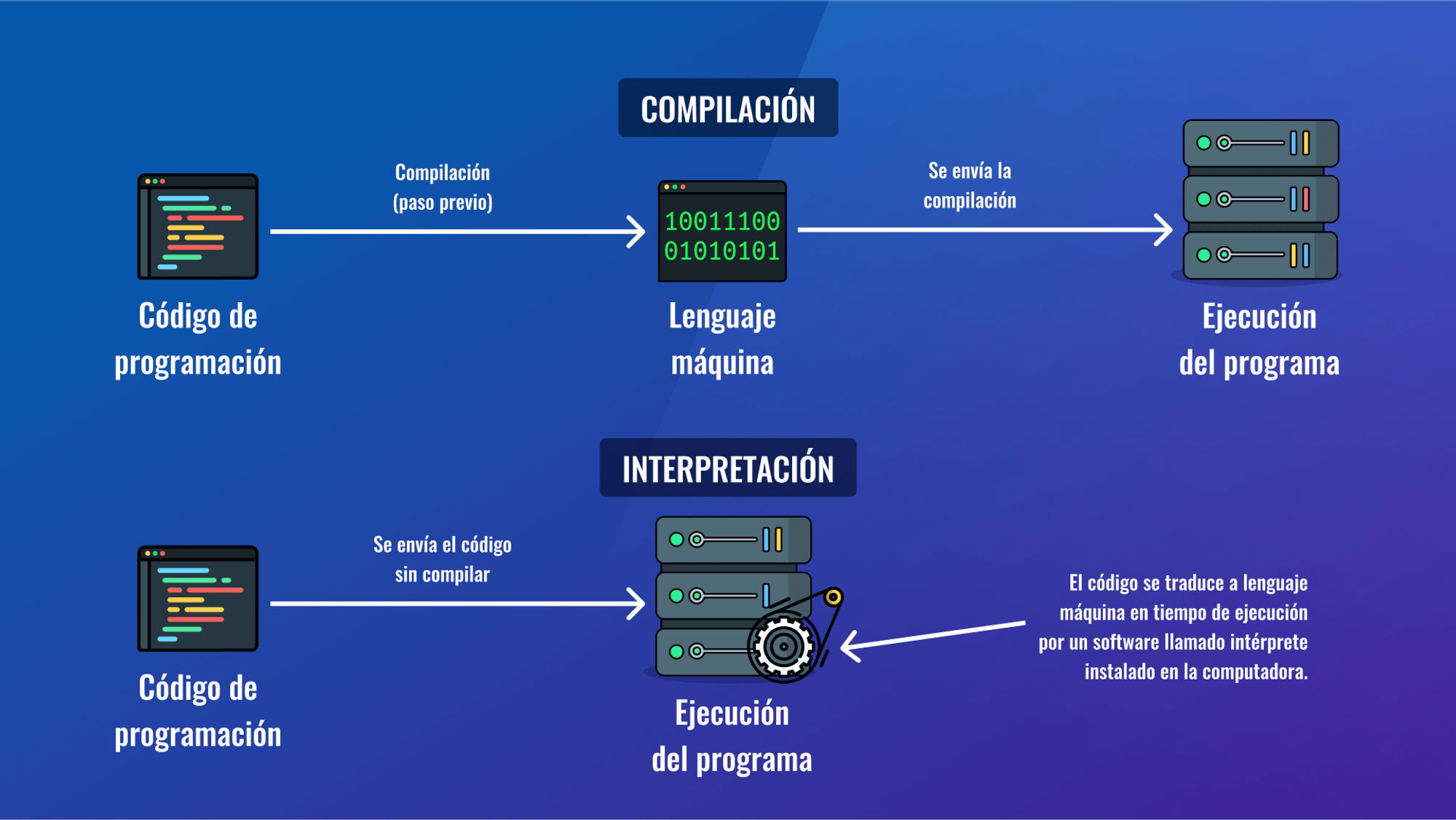
In order for the source code you write to become something that the machine can execute, the following come into play: compilers and interpretersIn compiled languages, such as C or C++The entire program is first translated into machine code using a compiler, generating an optimized executable file.
In interpreted languages, such as Python or JavaScript, a special program called an interpreter is responsible for read and interpret the code line by line at runtime. This usually simplifies the development phase, as it allows for quick testing, although in many cases it is somewhat less efficient than compiled code in terms of performance.
Types of programming languages
The current programming ecosystem is enormous, but languages can be grouped into several families based on how they are used and what paradigm they follow. Understanding these categories will help you to choose the most appropriate language for the type of project you have in mind.
Low-level languages
Low-level languages, such as assemblerThey are closely tied to the specific architecture of the processor. They offer a very precise control over the hardwareThis makes them ideal for situations where performance and memory usage are critical, such as embedded systems or device controllers.
The downside is that they turn out more difficult to learn and maintainEach instruction must be defined almost manually, and any oversight can lead to errors that are difficult to detect. Therefore, today they are primarily reserved for very specific components within larger projects.
High-level languages
At the other extreme are the high-level languages such as Python, Java, or C++. These languages abstract away many hardware details and focus on allowing the programmer to express their solution in a convenient, readable way that is relatively independent of the specific machine on which the program will run.
Thanks to these abstractions, writing code is easier. portable and maintainableWorking with concepts such as lists, objects, strings, or pre-built libraries, this approach is perfect for most business applications, web development, internal tools, video games, and much more.
Object Oriented Languages
Many modern languages, such as Java, C++ or PythonThey allow you to work with object-oriented programming (OOP)In this paradigm, the solution is modeled using classes and objects that represent entities with data and behaviors, which helps to organize the code in a modular and reusable way.
OOP introduces ideas such as The heritage (some classes inherit characteristics from others), polymorphism (different objects respond differently to the same operation) and encapsulation (Internal implementation details are hidden.) All of this facilitates the maintenance and expansion of large programs with multi-person teams.
Functional languages
Functional languages, such as Haskell or Lisp, are based on pure mathematical functions And they avoid, as much as possible, changing states and side effects. Instead of modifying variables over and over again, they work by composing functions that receive data and return results without altering their surroundings.
This approach makes the code more predictable and easy to debugSince the behavior of each function depends solely on its input, functional programming principles, while they may sound theoretical, are gradually being incorporated into many general-purpose languages because they help to write more robust and testable software.
Most popular programming languages
Within the range of options, there are a number of languages that account for a significant portion of job demand and real-world projects. Understanding them will help you decide where to begin your studies. programming language tutorials and which technologies to prioritize.
Python It has become one of the major players in recent years. It is a language highly valued for its clear and simple syntaxIt allows you to write readable code even for those with little programming experience. It's used in web development, automation, data science, artificial intelligence, scripting, and countless other tasks, thanks to its extensive collection of libraries.
On the other hand, JavaScript It is the undisputed king of the client-side of the web. It is the language that makes it possible for pages to be interactive, respond to user clicks and movements, and update without reloading. Along with HTML and CSS, it forms the basic trio for the web interface developmentFurthermore, with environments like Node.js, it has also been extended to the backend.
In the field of high performance, the following stand out: C++ and C#C++ is used in system software, game engines, applications that require high efficiency, and projects where detailed control over memory usage is needed. C#, developed by Microsoft, has a strong presence in desktop applications, web services on the .NET ecosystem, and especially in the video game development with Unity.
Also worth mentioning Ruby, well known for the Ruby on Rails framework for developing web applications with a focus on the productivity and code clarityAnd, in the mobile sector, Swift (for iOS and macOS) and Kotlin (for Android) are modern languages that place a lot of emphasis on security, expressiveness and a good developer experience.
What are programming languages used for?
Programming languages are the foundation upon which virtually all the technology around us is built. Depending on your interests, you can direct your learning towards software development, web development, video games, mobile development, data science, automation and many other fields.
Software and application development
One of the most obvious applications of programming languages is the creation of desktop software and business applicationsLanguages like C++, Java, or Python are used to develop everything from office programs and internal tools for companies to operating systems and advanced utilities.
In the web environment, combinations of technologies such as JavaScript on the frontend And PHP, Python, or Java on the backend allow you to build interactive websites and complex applications that run in the browser but rely on servers and databases. This model is the backbone of many of the services we use daily on the Internet.
Artificial intelligence and data science
The recent explosion of the artificial intelligence and data science This would not be possible without languages like Python or R. Python, in particular, has gained ground thanks to specialized libraries for working with large volumes of data, creating machine learning models, neural networks, and advanced analytics tools.
R, for his part, is very focused on the statistics and data visualizationTherefore, it is widely used in research, scientific data analysis, and environments where numerical interpretation is critical. Both languages allow for the automation of complex analyses and the construction of systems capable of detecting patterns and making predictions.
Video games development
The world of video games is one of the most demanding in terms of performance and optimizationThat's why languages like C++ are so important in the creation of graphics engines like Unreal Engine, which need to push the hardware to its limits to handle advanced graphics, complex physics, and huge worlds.
C# has gained immense popularity thanks to the Unity engine, which facilitates cross-platform game development for mobile devices, consoles, and PCs. This field involves programming not only the visual aspects but also the game logic, the artificial intelligence of non-playable characters, and the systems that control user interactions.
Automation and scripting
Another very common application of programming is the automation of routine tasksLanguages like Bash, Python, or Perl are used to write scripts that perform backups, deploy applications, monitor servers, or manage system configuration without requiring continuous manual intervention.
In systems and DevOps environments, these scripts are fundamental for maintaining large infrastructures operating reliablyBy reducing human intervention, errors are minimized and long, repetitive processes are ensured to always be executed the same way and at the right time.
mobile development
Mobile app development is one of the most dynamic fields. In the Apple ecosystem, Swift is the primary language to create native applications on iOS and macOS, taking advantage of features such as advanced cameras, motion sensors or biometric recognition.
Embedded systems development
Embedded systems are those small computers that are integrated into household appliances, cars, medical devices, industrial sensors and many other devices. Here, languages like C and C++ predominate, allowing for highly precise control of the hardware and making the most of very limited resources.
In these types of systems, it is crucial that the software be reliable, lightweight and efficientThis is because it typically operates for years without interruption, sometimes under demanding conditions. Therefore, the choice of programming language and method is heavily focused on stability and the controlled use of memory and energy.
Evolution and future of programming languages
Programming languages didn't appear out of thin air, nor have they remained frozen in time. From the earliest machine languages to the most recent proposals, there has been constant evolution. to make development simpler, safer and more powerful.
From binary code to high-level languages
In the early days of computing, programming involved writing directly sequences of zeros and ones which the machine interpreted literally. Any change required reviewing enormous lists of bits, and the slightest mistake could cause everything to fail.
To alleviate this situation, the following appeared: assembler languageswhich replaced some of those binary strings with labels and abbreviations that were easier to remember. Even so, it was still a very hardware-like approach and impractical for complex projects.
Over time, high-level languages emerged such as Fortran and COBOLThese early proposals introduced data structures, functions, and a syntax much closer to natural language. They laid the foundation for modern programming and allowed the discipline to grow and expand into more sectors.
Emerging languages: Rust, Go and company
Currently, the following have appeared emerging languages that address very specific problems in modern software, such as memory safety and concurrency. One of the most well-known examples is Rust, which is designed to avoid typical memory management errors (leaks, invalid accesses, etc.) without sacrificing performance close to C or C++.
Another notable example is Go (Golang), created by Google, which opts for a simple syntax and a highly efficient management of concurrent tasksThis makes it a great option for large-scale services, distributed systems, and cloud applications where many simultaneous connections are handled.
Towards smarter and safer languages
Looking ahead, everything points to programming languages continuing to evolve into more accessible, safer, and more tightly integrated with artificial intelligenceTools are being developed that, based on context, suggest code snippets, help avoid common errors, or even automatically correct certain bad practices.
Furthermore, there will continue to be a strong focus on the attendance and securityThese are two key challenges of modern software. Languages and tools that make it easier to write code that takes full advantage of multi-core processors, handles multiple tasks effectively, and reduces vulnerabilities are likely to gain traction.
What you need to know to start programming
If you want to take advantage of programming language tutorials To enter the tech world, it's important not to obsess over choosing the "perfect" language. What's truly crucial is learn the programming process: how solutions are proposed, how algorithms are designed, and how those ideas are translated into code.
Algorithms: Think before you write code
The programming is based on a very simple idea: solve problems through an ordered sequence of stepsThis is what we call an algorithm. Before you start coding, it's a good idea to note down what inputs you receive, what you want to achieve, and what steps need to be followed to get from one point to the other.
Designing the algorithm is like writing the recipe before cooking: you decide first. What are you going to do and in what order?And then you get started with the tools, which in this case would be the programming language. This way of working helps you avoid many mistakes and have a clear plan before getting into the details of syntax.
Basic concepts common to all languages
The good news is that most languages share a number of fundamental conceptsSo, what you learn once you can reuse almost anywhere. These basics include variables, data types (numbers, strings, booleans), control structures (conditionals and loops), and functions.
Once you master these pillars, changing languages is usually more a matter of adapting to syntax details and conventions (where parentheses go, whether semicolons are needed, how functions are declared, etc.) rather than learning everything from scratch. That's why it's more important to understand the fundamentals well than to become obsessed with a specific technology.
Frontend and backend: two sides of web development
In web development, a distinction is usually made between frontend and backendThe frontend is the layer the user sees and interacts with: design, buttons, forms, animations, etc. Its main objective is to offer a pleasant, intuitive and usable experience on different devices.
On this side of the scale we find technologies such as HTML, which structures the content and tells the browser what elements are on the page; CSS, which is responsible for the visual aspect (colors, fonts, margins, layout of elements); and JavaScript, which adds functionality, validates forms, generates animations and allows updating parts of the interface without reloading the entire page.
Frameworks such as Vue.jswhich facilitate the construction of modern, responsive, and modular interfaces. To make the most of these tools, it is important to have a thorough understanding concepts such as callbacks, promises, and objects, since they are the basis of many of its functionalities.
The backend, on the other hand, is all the "invisible" part that runs on the server and is responsible for process data, access databases, authenticate users and coordinate the business logic. Although the user doesn't see it directly, most modern applications wouldn't work without a backend.
Technologies such as Node.jswhich allows JavaScript to run on the server as a runtime environment, and frameworks such as Express.jsDesigned to build robust and scalable APIs and web applications, the backend must ensure that the site responds quickly, handles requests well, and remains stable even under heavy traffic.
How to learn programming effectively
The key question at this point is how to move from theory to practice. There are many ways to learn to program, but some combinations of resources work particularly well for advance quickly and with a good foundation.
Schools, bootcamps and intensive training
One option that has become very popular in recent years is the programming schools and intensive bootcampsThese are training courses lasting a few weeks or months in which you fully immerse yourself in web development or other branches, with structured schedules, practical projects, and mentors to guide you.
In programs of this type, you can achieve this in just about 16 weeks. acquire the necessary skills to work as a junior developer and present yourself to the job market with several real projects under your belt. They also usually include support in the job search, CV review, interview preparation and, in some cases, additional training in English, cybersecurity or new technologies.
Working with other people's code
One of the best ways to learn, once you've mastered the basics, is analyze and modify code that already worksReviewing how someone else has solved a real problem gives you a lot of information about best practices, project structure, documentation, variable and function names, etc.
If you're interested in contributing to open-source projects, you can suggest improvements, fix bugs, or add small features. This not only helps you to reinforce what you have learned and discover new techniquesbut it also exposes you to reviews from more experienced programmers, which accelerates your learning.
Real projects, collaboration and agile methodologies
Beyond the exercises in the courses, it is essential that you consider individual or collaborative projectsEven if they are small: a personal website, a simple app, a bot that automates a specific task, etc. It is in these projects where you really internalize concepts and face everyday problems.
Working in a team, especially if you use repositories on platforms like GitHub, forces you to learn version control, branches, pull requests, and code reviewsThese are key elements in any professional environment. Furthermore, becoming familiar with agile methodologies like Scrum or Kanban prepares you for the reality of most technology companies.
Programming has become the silent engine of many of the world's largest companies and countless startups. Mastering one or more programming languages and understanding the software development process It opens the door to a job market with high demand, competitive salaries, and opportunities for constant growth. By combining good tutorials, online courses, intensive training when appropriate, and plenty of practice with real-world projects and other people's code, you can build a solid profile in a relatively short time, allowing you to navigate the tech sector with ease.

Table of Contents
- Online programming courses and tutorials
- What is a programming language?
- How programming languages work
- Types of programming languages
- Most popular programming languages
- What are programming languages used for?
- Evolution and future of programming languages
- What you need to know to start programming
- How to learn programming effectively