- Aluminium OS is a new operating system from Google based on Android that unifies the heritage of ChromeOS and is designed specifically for PCs, laptops, tablets, and mini-PCs.
- The platform is AI-First: it deeply integrates Gemini models, contextual assistants, and advanced AI features by leveraging new hardware with NPU.
- Google is planning a gradual transition from ChromeOS, with temporary coexistence and possible updates for compatible devices, while maintaining long-term support.
- Its goal is to compete directly with Windows and macOS by offering a seamless experience between mobile and desktop, supported by the enormous Android app ecosystem.

Google is preparing to make a major leap into the PC world with a new operating system called Aluminium OS , a move that aims to finally compete head-to-head with Windows and macOS by bringing Android to the desktop and embracing artificial intelligence from the very foundation of the system. This isn't just a simple visual layer or a one-off experiment, but a new platform designed to run on all types of personal computers and hybrid devices.
This project, known internally as Aluminium OS or ALOS , has come to light thanks to various job postings and leaks detailing its approach: unifying ChromeOS and Android, leveraging the vast mobile app ecosystem, taking advantage of new AI-ready chips, and delivering a seamless experience across mobile, tablet, and PC. All of this will be powered by Gemini AI integrated into the core of the system and boasts a much broader ambition than traditional Chromebooks.
What is Aluminium OS and why is Google creating it?
Aluminium OS is essentially a new operating system from Google based on Android but specifically tailored for desktop environments and more powerful hardware, such as high-end laptops, desktop PCs, advanced tablets, 2-in-1s, and mini-PCs. Its name is explicitly mentioned in job postings for senior positions, such as senior product managers responsible for laptops and tablets.
The project's name itself is clever: "Aluminium" follows the same logic as Chromium (the open-source codebase of ChromeOS), playing on the name of a lightweight metal ending in "-ium." Furthermore, the British spelling highlights the "Al" prefix, a possible nod to Android as the foundation of this new platform. The idea is clear: to reuse the best of the Android ecosystem and shape it into a modern desktop system.
For years, Google has maintained two parallel lines: Android for mobile devices and ChromeOS for Chromebooks . Android overwhelmingly dominates smartphones and tablets, but on personal computers, ChromeOS has never come close to matching the dominance of Windows or the macOS ecosystem. With Aluminum OS, the company aims to stop dividing its efforts and instead focus on a single technological foundation that can scale from mobile to PC.
In practice, this translates into a system that originates from Android, inherits its Linux kernel, frameworks, and application compatibility, but is redesigned from the ground up for large screens, productivity work, and intensive AI use . The goal is for it to not simply look like "Android on a larger scale," but rather a complete desktop environment that leverages the familiarity and extensive app catalog of Android.
This entire move is part of a broader strategy: to gain relevance in the PC market , a space where Google has previously played a secondary role. With new ARM processors for computers, dedicated AI NPUs, and a massive mobile user base, the timing is particularly opportune to try again, but this time with much greater force.
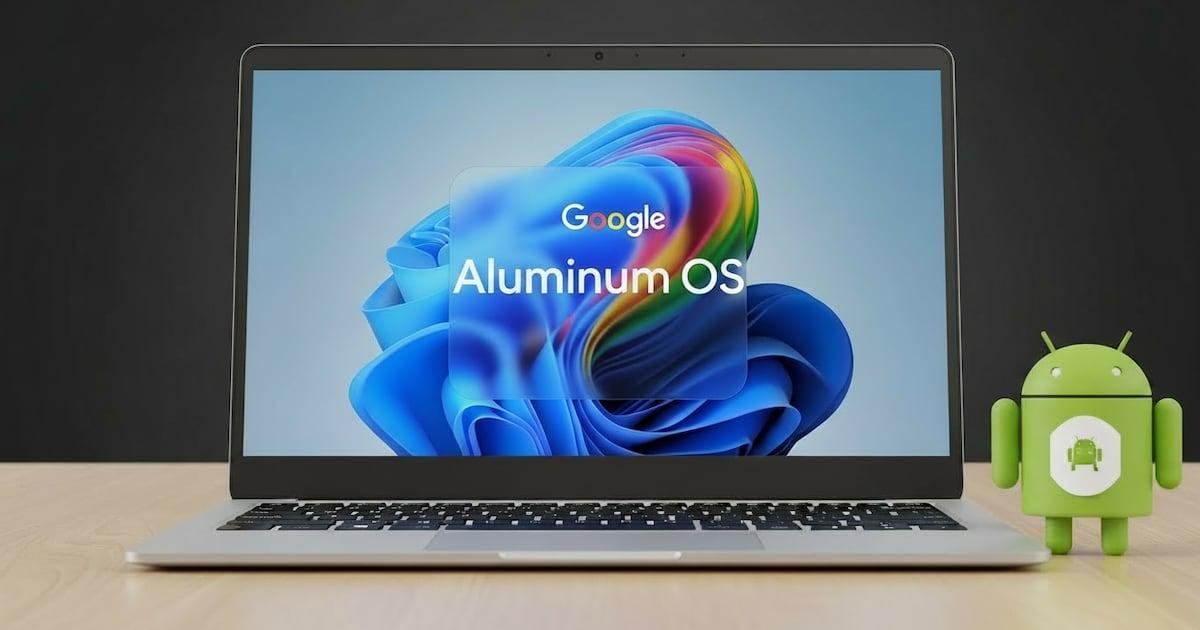
Android and ChromeOS fusion: a single system for mobile and PC
The idea of merging Android and ChromeOS has been circulating within Google for years. Back in 2015, there was talk of a project called Andromeda that aimed for something similar, but it never materialized. Since then, the company has been releasing small pieces: Android app compatibility on Chromebooks, increasingly polished desktop modes in Android 15 and 16, and official announcements about integrating the Android kernel into the ChromeOS core.
In 2024, Android ecosystem leaders confirmed that ChromeOS would adopt key Android components to accelerate AI integration and simplify developers' work. This common foundation allowed for unified libraries, improved cross-device compatibility, and reduced effort in maintaining two separate platforms. Aluminium OS is the next logical step: an AI-first system that brings all of this together under one umbrella.
According to leaks, Aluminium OS is envisioned as a unified operating system that will combine the best of ChromeOS and Android : the security, lightweight design, and cloud-centric approach of ChromeOS, with the flexibility and extensive app catalog of Android. The goal is to achieve something similar to what Apple has done with iOS and iPadOS by integrating them with macOS, but under Google's vision.
The device roadmap itself mentions several categories branded “AL Entry,” “AL Mass Premium,” and “AL Premium .” This classification indicates that the system will not be limited to inexpensive education devices, but will encompass everything from affordable models to high-end hardware ready to compete with machines like the MacBook Pro or Microsoft's Surface.
Although ChromeOS and Aluminium OS will coexist in the market for a while , the underlying intention is for Aluminium to become the natural successor to Chromebooks and the primary platform for Google-branded PCs. Job postings themselves openly mention planning the transition from ChromeOS to Aluminium, ensuring long-term business continuity.
Architecture, ecosystem, and compatible device types
Aluminium OS takes a very different approach than Windows or macOS, as it doesn't originate from the traditional PC world , but rather from the mobile ecosystem. This means its architecture is based on Android: an optimized Linux kernel, established frameworks, and a vast community of developers and existing applications.
From the outset, the system is designed to work across multiple form factors : classic laptops, 2-in-1 convertibles, tablets, detachable devices, box-style mini-PCs, and, foreseeably, other formats that may emerge over time. This flexibility is reminiscent of Android itself, but specifically applied to devices geared towards productivity and desktop work.
Internal testing is being conducted on MediaTek Kompanio 520 chips and 12th-generation Intel Alder Lake processors , hinting at Google's ambition to cover both ARM and x86 architectures. In environments with powerful NPUs, thermal management—and PC thermal paste —becomes especially important.
Unlike ChromeOS, historically associated with low-cost Chromebooks and educational use , Aluminium OS aims to be deployed on a much wider range of machines: from entry-level computers to premium laptops with sleek design and powerful graphics. This also includes compact desktops and mini-PCs geared towards offices and professional environments.
This cross-platform approach allows Google to position Aluminium OS as a genuine alternative to Windows and macOS in almost every price segment, avoiding being pigeonholed into highly specific niches. In turn, the Android foundation makes it easy for many developers to quickly adapt their mobile applications to the desktop with minimal changes.
An AI-First system: Gemini at the heart of Aluminium OS
One of the most distinctive features of Aluminium OS is that artificial intelligence is not an add-on, but rather the core of the system . Google speaks of a system built “with AI at its core,” meaning that Gemini models will be deeply integrated into the user experience, system management, and many productivity tools.
We've already seen how Gemini can run locally on high-end Android phones , leveraging the performance of the CPU, GPU, and NPU to execute complex tasks without always relying on the cloud. Bringing this concept to computers, where power consumption is less restrictive and hardware is typically more powerful, opens the door to much more ambitious AI applications.
In Aluminium OS, AI would play a central role: permanent contextual assistants that understand what you're doing , automation tools capable of chaining together several actions, intelligent suggestions while you write an email or prepare a presentation, real-time translation, more accurate voice recognition, and advanced search among documents and local and cloud content.
Google's vision is for users to stop thinking about opening a specific app for each task and instead ask AI directly to solve problems : "Prepare a summary of this document and share it with the team," "Organize my downloads by relevance and remove the unnecessary ones," "Find all the files where I talk about this project and create a timeline." All of this is supported by the context that the system gathers in the background.
Familiar features from the Android ecosystem, such as Circle to Search or other AI-powered shortcuts , would be brought to a desktop environment where they make even more sense: intelligent selection of on-screen content, advanced visual searches, generation of supporting material for presentations or reports, and a long etcetera that Google will be revealing as the project gets closer to launch.
User experience: from mobile to desktop seamlessly
One of Aluminium OS's main goals is to offer a truly seamless experience between mobile and PC , breaking down the barrier that currently separates learning to use one system on a phone from a different one on a computer. Because it's based on Android, the interface and many interaction elements will be familiar to those who already use an Android phone.
This doesn't mean the interface is simply a "giant Android"; rather, it's an environment adapted to large screens and productivity tasks , with windows, desktops, advanced management of multiple open applications, and full support for mouse, keyboard, and peripherals. The key is balancing the best of both worlds: mobile simplicity with PC power.
Thanks to the common platform, developers can create applications that automatically adapt to the context: a compact touch interface on mobile, a design optimized for mouse and keyboard on PC, and a seamless transition between devices. For the user, this means they can start a task on their phone, continue on their tablet, and finish it on their laptop without worrying too much about formats or compatibility.
Google also wants to enhance the seamless and continuous synchronization of data between devices , leveraging both the cloud and local connections whenever possible. This way, documents, settings, app sessions, and even the state of some processes could be transferred from one device to another with minimal friction.
In parallel, deep AI integration would enable features such as context-based reminders (for example, resuming on your laptop the file you were editing on your mobile), automatic summaries of what you have done during the day on different devices, or recommendations on what task you should attend to at any given time based on your habits.
Differences compared to Windows, macOS and other systems
If we compare Aluminium OS with the industry giants, the first major difference is obvious: Windows and macOS were originally created for desktop computers and only later integrated mobile and AI features, while Aluminium comes from the opposite path, from the Android universe and mobile computing to the PC.
Regarding artificial intelligence, both Microsoft and Apple are pushing hard with Windows Copilot and the new AI-powered features of macOS (including the Apple M5 and its AI-driven approach ), but in Google's case, the idea is for AI not just to be a "layer" or an assistant, but the core organizing principle of the system. From file management to device settings, everything would be governed by the logic of Gemini and its successors.
Another key difference lies in the range of target devices . Windows and macOS are usually associated with fairly defined categories (especially in the case of Apple, which is closely tied to its own hardware), while Aluminium OS is presented as a cross-cutting option that can run on lightweight laptops, powerful desktops, tablets, convertibles, and mini-PCs, covering a very wide range of needs and prices.
Furthermore, Google's system arrives at a time when the market's hardware has shifted towards the concept of "AI-native" computers , with CPUs, GPUs, and, above all, NPUs designed to accelerate local artificial intelligence models. Paradoxically, much of this momentum comes from Microsoft and its partners with the new Windows AI PCs, but Google can directly leverage it with Aluminium OS.
Finally, the Android platform offers a significant advantage in terms of its app and service catalog . Millions of applications are already built on its frameworks, and many of them could be adapted relatively easily to the new desktop environment. This significantly reduces the "cold start" problem that other alternative systems have experienced when trying to attract developers.
Transition from ChromeOS and compatibility with current devices
The arrival of Aluminium OS inevitably raises the question of what will happen to Chromebooks and ChromeOS . Internal documents and job postings point to a gradual transition strategy, where both systems will coexist for a period of time to avoid leaving users, educational institutions, and businesses that currently rely on ChromeOS without support.
Google intends to continue offering devices with ChromeOS and ChromeOS Plus , especially in education and in sectors where extreme simplicity and low costs remain priorities. At the same time, it will be incorporating the new Aluminium OS into new product lines under the AL Entry, AL Mass Premium, and AL Premium labels.
Regarding potential updates, it's possible that certain recent Chromebook models could make the jump to Aluminium OS if their hardware is compatible, especially those based on 12th-generation Intel processors or chips like the MediaTek Kompanio 520, which are already being used in internal testing. However, migrating such a diverse range of devices without disrupting the user experience will be quite a challenge.
The company is aware that a sudden change could generate resistance, so it's aiming for a migration plan with long-term support , where users and organizations can decide when to switch to the new system. During that period, ChromeOS would continue to receive security updates and improvements, although the most cutting-edge innovation would increasingly focus on Aluminium OS.
In parallel, Google will have to carefully manage communication with manufacturers, operators, and partners in the education and business sectors to ensure the transition doesn't disrupt critical workflows . The success of Aluminium OS will depend both on its technical capabilities and how smoothly this transition goes.
Launch, roadmap and future of the PC with Android
The most consistent leaks suggest that Aluminium OS will be officially unveiled around 2026 , possibly at a developer event like Google I/O, and that it will be based on an advanced version of Android (around Android 17). Before then, Google is expected to gradually release SDKs, tools, and betas for developers to adapt their applications.
In the hardware arena, Qualcomm and Google have already hinted at working together on a common technical foundation for PCs and desktop computers , reinforcing the idea that there will be a new generation of Android computers optimized for AI. The codenames of certain Snapdragon chips specifically point to compatibility with future versions of Android designed for PCs.
The timeframe is also interesting for another reason: the industry has already aligned itself around a new generation of "PCs with built-in AI ," where it's almost mandatory for the operating system to take advantage of integrated NPUs. Microsoft has paved the way with its latest Windows versions focused on Copilot, and Google could arrive with Aluminium OS at a time when users already expect these kinds of features as standard.
In the long term, the bet is that the desktop will become one of the great battlegrounds of AI , with Windows and Aluminium OS competing directly in machines as varied as thin laptops, creative workstations, office equipment, mini-PCs connected to the living room TV or hybrid gaming stations.
If this move pays off, Google could transition from being "the king of mobile" to playing a much more significant role in personal computing in general , offering a single ecosystem that spans from smartwatches to desktop computers. The road ahead won't be short or easy, but the scale of the Aluminium OS project demonstrates that the company is very serious.
Everything points to Aluminium OS being Google's most ambitious bet to redefine how we use the PC , mixing the maturity of Android, the lightness of ChromeOS and a deep layer of Gemini artificial intelligence that runs throughout the system; if it manages to offer a smooth transition from ChromeOS, take advantage of the boost of the new hardware with NPU and convince developers and manufacturers, we could be at the beginning of a new stage where so-called "PCs with Android" cease to be a rarity and become a real competitor in the traditional desktop.
