- ADSL uses copper cables and offers limited asymmetric speeds that are highly dependent on distance and the condition of the cabling.
- Optical fiber uses strands of glass or plastic and pulses of light, allowing for greater speed, symmetry, lower latency, and greater stability.
- Fiber requires new infrastructure but its price is usually equal to or better than that of ADSL, making it the best option where there is coverage.
- In areas without fiber, ADSL remains a useful resource, although increasingly displaced by fiber and wireless solutions such as fixed 5G.
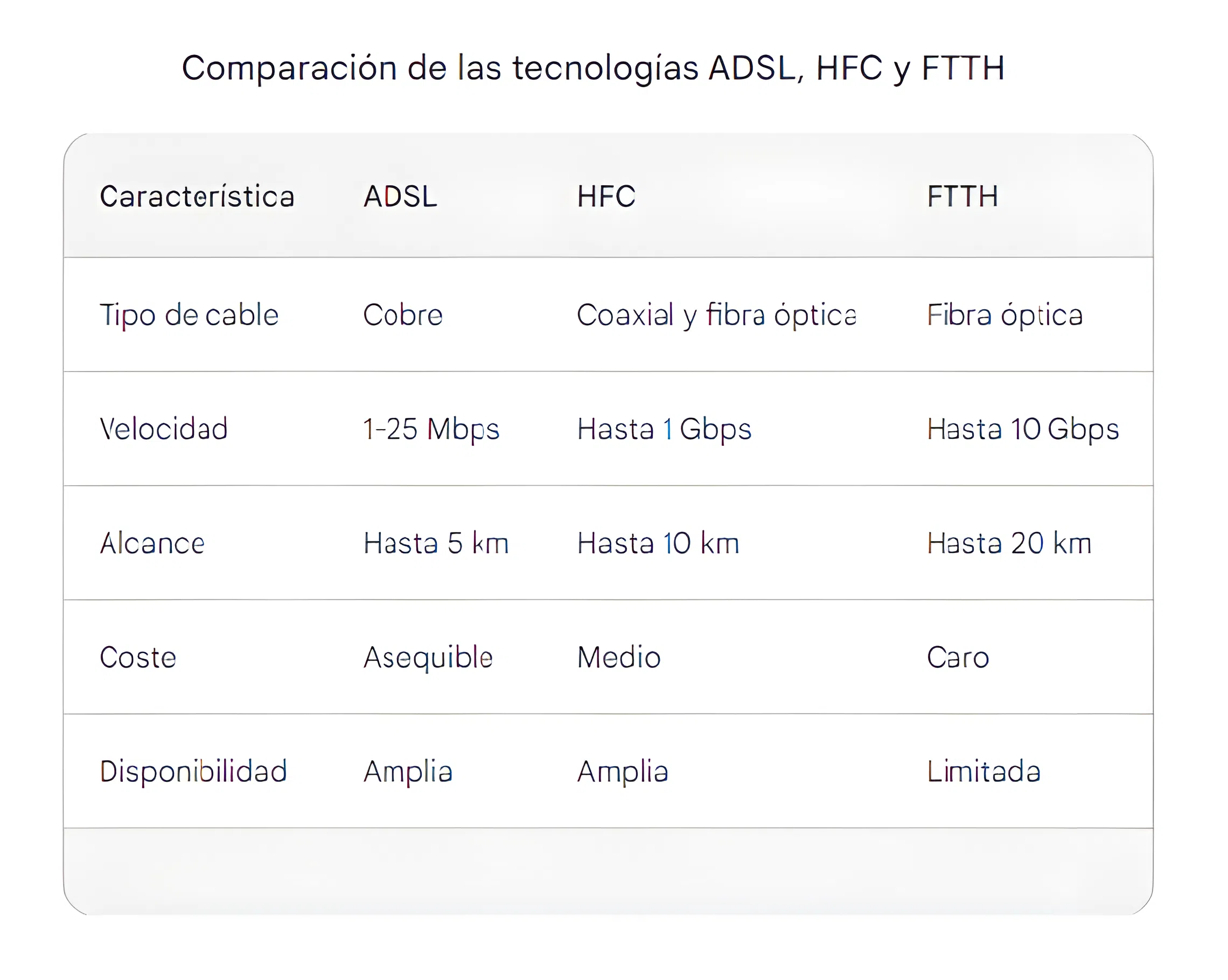
If you're looking at home internet plans, you've probably come across the age-old dilemma between fiber optic and ADSL . For years, ADSL was king of broadband, but fiber has been steadily gaining ground, practically relegating it to the sidelines in many areas.
Even so, both technologies continue to coexist in the market, and it's not always clear what each offers , how they are similar, and especially how they differ. We're going to break down, clearly and with everyday examples, everything you need to know to make an informed choice about the connection that best suits your home or business.
What is ADSL and how does it really work?
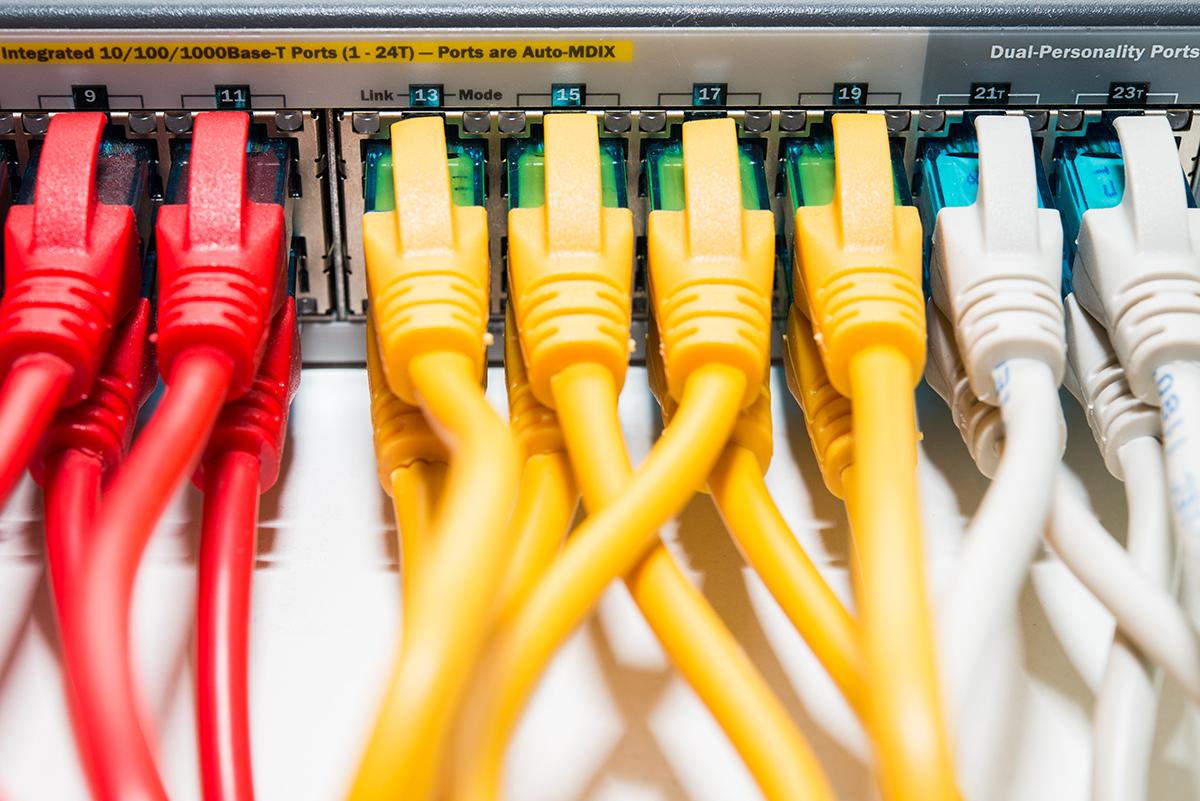
When we talk about ADSL, we're referring to an internet access technology that uses the existing copper telephone cable. Its acronym stands for Asymmetric Digital Subscriber Line , and that gives an important clue: the connection isn't symmetrical; download and upload speeds aren't the same.
This copper cable consists of an encapsulated twisted pair that carries both voice and data . To achieve this, different frequency ranges are separated: one part of the spectrum is reserved for telephone calls and another, much larger one, for the internet connection, so you can browse the internet and talk on the landline simultaneously.
In practice, ADSL relies on several data channels and one reserved for voice . Traditionally, early implementations used two 64 Kbps channels for data and one 16 Kbps channel for telephony, although ADSL technologies later evolved (ADSL2, ADSL2+) to make better use of the cable. Even so, the basic principle remains the same: electrical impulses traveling through copper wire.
For the separation of voice and data to work properly, a small device called a splitter or microfilter needs to be installed in the telephone jacks where you connect your landline phone. This filter allows only the portion of the signal destined for each device to pass through, preventing noise or interruptions while you're browsing the internet.
The biggest problem with ADSL is that its performance is heavily dependent on two factors: the quality of the copper cabling and the distance to the exchange you're connected to. If the cables are old, have shoddy splices, or are affected by moisture, and you're also far from the exchange, the speed drops drastically.
ADSL speeds and limitations

In ADSL commercial offers, it's common to see figures like "up to 20 Mb" or "up to 30 Mb" . That "up to" isn't there arbitrarily: it means that, in the best-case scenario, you could get close to that speed, but normally you'll fall short.
The reason is simple: the further the signal travels through copper wire, the more it degrades . After about 3 km from the telephone exchange, the deterioration is so noticeable that you can go from having a contracted 20 Mbps to receiving only 10, 6, or even 2 Mbps at home. That's why two neighbors on the same street, connected to different exchanges or with cables in worse condition, can have very different experiences with the same ADSL connection.
Furthermore, ADSL, as its name suggests, is an asymmetric connection . This means that the download speed (what you download from the internet: videos, websites, files) is much higher than the upload speed (what you send: photos, videos, cloud backups). A connection advertised as having a 20 Mbps download speed usually only delivers about 10% of that upload speed, or around 2 Mbps.
This asymmetry isn't too noticeable in basic uses like reading news, checking email, or browsing social media , but it becomes very annoying when you want to upload many files, make smooth video calls, or stream live. Uploads become a bottleneck, and the experience suffers.
On the plus side, ADSL has the advantage of leveraging an infrastructure already deployed across almost the entire country . As long as there is a conventional telephone line, it's possible to offer ADSL service, making it a viable option in many towns and rural areas where fiber optic hasn't yet arrived.
What is fiber optics and why does it change everything?
Fiber optics is a much more modern technology that completely replaces copper with extremely thin strands of glass or plastic . Instead of sending electrical impulses, what travels inside the cable are pulses of light generated by lasers or LEDs , which are reflected and refracted within the fiber to encode the information.
This change in transmission medium and method has a dramatic impact: light can carry far more information at much higher speeds with minimal loss, even over long distances. That's why fiber optic networks can now offer home internet connections of 300 Mbps, 600 Mbps, or 1 Gbps without breaking a sweat.
Furthermore, most current deployments use FTTH (Fiber To The Home) architecture , meaning the fiber optic cable physically reaches your home. This results in very similar speeds between what you pay for and what you actually receive, something almost unthinkable in the ADSL era.
Another huge advantage of fiber optics is its immunity to electromagnetic interference . Since photons of light, not electrons, circulate inside the cable, external electric or magnetic fields barely affect it. This translates into less noise, fewer errors in data transmission, and a much more stable connection, even in environments with many electrical cables nearby.
In everyday use, this translates to being able to stream content in HD or 4K, play online games, and make video calls while others at home are using the internet, without constant buffering or endless waits. Fiber optic internet is designed for homes with multiple mobile phones, computers, tablets, smart TVs, and game consoles connected simultaneously.
Speed, latency, and stability of optical fiber
One of the biggest advantages of fiber optic internet is its speed. While ADSL typically offers speeds of up to 20-30 Mbps in the best-case scenario, fiber optic connections for the home start at 50 Mbps and commonly reach speeds of up to 500 Mbps or even 1 Gbps (1.000 Mbps). Some providers also offer intermediate speeds, such as 100, 300, or 600 Mbps.
In addition, many providers offer symmetrical fiber optic internet , meaning the same download and upload speeds. This is a godsend for those who work remotely, upload a lot of videos, back up data to the cloud, or stream live, because upload speed is no longer the major bottleneck.
Another key aspect is the extremely low latency (ping) of fiber optic internet. Because information travels at such high speeds through a very efficient medium, the time it takes for a data packet to travel from your router to a server and back is much shorter than with ADSL. This is crucial for online gaming, video calls, or participating in e-sports competitions , where a few milliseconds make all the difference.
Unlike ADSL, fiber optic performance is hardly affected by distance within typical access network segments. Whether you're closer to or farther from the central office, the speed tends to remain stable, provided the installation is in good condition and there are no occasional outages.
In terms of stability, fiber optic wins hands down: less packet loss, fewer micro-outages, and fewer sudden speed fluctuations . That's why it's the preferred option for sensitive services like internet television, streaming platforms, video conferencing, and cloud applications that require a fast response.
Advantages and disadvantages of fiber optics
Among the main advantages of fiber over ADSL and other technologies, several stand out that are noticeable from the first day of use.
First, fiber optic allows for a very high data flow thanks to its enormous bandwidth. This means that several people can use the network simultaneously for demanding tasks (online gaming, 4K video, large downloads) without easily overloading the connection.
It is also a physically very efficient medium: fiber optic cables are much lighter than copper cables , withstand extreme temperatures better, and are relatively easy to install because they allow for small bend radii. All of this simplifies deployment and maintenance for operators.
In terms of security, fiber optic cables are more difficult to tap without being detected, and they also don't emit electromagnetic radiation , so information is better protected against eavesdropping. At home, this translates into a more robust and predictable connection.
However, fiber optics also has its drawbacks. The most significant is that it requires its own infrastructure : it can't simply "pull" on existing telephone lines like ADSL does. This necessitates substantial investments in fiber optic cable deployment by the companies and explains why, despite the progress, there are still areas without coverage.
In addition , fiber optic transmission and reception equipment (OLTs at exchanges, ONTs or optical routers at home ) is more expensive and requires specialized technicians for installation. Furthermore, fiber optic cable does not carry electricity, so your router must always be powered from your home's electrical grid, unlike some older copper routers that could be partially powered from the line itself.
Advantages and disadvantages of ADSL today
Despite its clear decline, ADSL still has its place and offers certain advantages in specific scenarios . The main one is availability: because it uses existing telephone wiring, it can reach where fiber optics cannot, especially in rural areas or very old neighborhoods.
From the operators' point of view, ADSL requires much less deployment investment because it utilizes existing exchanges and cabling. That's why for years it was the logical choice for providing broadband to a large part of the population at a reasonable cost.
For the average user, ADSL offers have traditionally stood out for their good speed-to-price ratio if internet use was basic: web browsing, email, some standard-definition streaming, and little else. Furthermore, it has always allowed for landline phone calls while browsing without major complications.
On the downside, ADSL can't compete with fiber in almost any aspect: much lower maximum speed, asymmetric connection, higher latency, and greater susceptibility to interference . Its performance depends heavily on the condition of the cable and the distance, and it's easy for the actual speed to fall far short of what's subscribed to.
Furthermore, this technology is being phased out . Many operators have stopped selling new ADSL connections, focusing instead on fiber optics and wireless alternatives like fixed 4G/5G. This means less investment in upgrading the copper network and an increasingly limited future for this option.
Key technical differences between fiber optics and ADSL
If we get down to the more technical aspects, the differences between the two technologies can be grouped into several very specific points. The first is the physical transmission medium : ADSL uses copper and electrical signals, while fiber uses glass/plastic and light pulses.
Secondly, there's the issue of connection symmetry . ADSL, by design, has always been asymmetric: much more download than upload. Fiber, on the other hand, can be offered symmetrically without problems, so you can enjoy speeds of 300/300, 600/600, or 1.000/1.000 Mbps if your provider offers it that way.
Another essential point is sensitivity to distance and interference . With ADSL, the further you are from the exchange and the worse the copper connection, the lower the speed and stability. The signal attenuates and is affected by external electrical noise. With fiber, signal loss due to distance within access ranges is very low, and electromagnetic fields barely affect the light beam.
From a capacity standpoint, fiber offers significantly greater potential bandwidth . This allows it to scale to speeds of several gigabits without having to change the physical infrastructure, simply by upgrading existing equipment. Copper, on the other hand, is practically at its limit in its xDSL variants and doesn't offer much more.
Finally, there's the aspect of latency and quality of service . Fiber provides much lower pings and greater stability even when many devices are connected, which is critical for demanding uses such as online gaming, high-definition video conferencing, or intensive cloud work.
Price differences between ADSL and fiber
A common misconception is that fiber optic internet is always more expensive than ADSL, but the current market proves otherwise. These days, a 20 Mbps ADSL connection often costs the same as a basic 50 Mbps fiber optic connection , and even less with certain promotions.
This is because operators have invested heavily in deploying fiber optic networks and need to recoup that investment. To achieve this, they incentivize customers to abandon copper and switch to fiber , matching or even improving prices in exchange for a far superior technology.
The price difference becomes noticeable when you upgrade to very high fiber speeds , such as 300, 600 Mbps, or 1 Gbps. In these cases, the monthly fee increases, but it does so gradually based on the contracted speed. Even so, for many households, the improved experience more than compensates for the small increase in the bill.
If your budget is tight, it's also worth checking out offers from low-cost operators or MVNOs (Lowi, MásMóvil, Finetwork, etc.), which often only offer fiber and can give you very competitive prices, especially if you combine Internet and mobile in the same package.
In any case, if fiber optic coverage is available in your area, you'll most likely end up paying the same or even less than for an old ADSL connection , enjoying much faster speeds and better stability thanks to the promotions and discounts offered by the operators.
Coverage and availability: where each technology reaches
In terms of deployment, ADSL had a historical advantage because it relied on the copper telephone network that was already in place in practically every corner of the country. This resulted in enormous coverage in both cities and remote towns.
According to official data from recent years, ADSL coverage of speeds over 10 Mbps reaches approximately 70% of the country, with variations depending on the autonomous community. Some very rural areas or those with older infrastructure lag somewhat behind, but in general, ADSL is available in virtually every municipality with a telephone line.
Fiber optics, however, still suffers from significant geographical inequalities . Large cities and metropolitan areas have long enjoyed very high coverage, while many rural or sparsely populated areas still lack FTTH options and have to settle for ADSL or wireless alternatives.
Although the percentage of households with fiber optic access continues to grow year after year, there are still communities where coverage is significantly lower. In some areas, the fiber optic network doesn't even reach half of the homes, forcing residents to stick with ADSL or resort to internet via radio, satellite, or fixed 4G/5G.
Therefore, the first step before making a decision is usually to check the coverage at your address using comparison websites or the operators' websites. If fiber optic is available, it's usually the recommended option; if not, ADSL or 5G can serve as a bridge while fiber optic rollouts are being expanded.
ADSL, fiber and 5G: how they fit together
In addition to the classic battle between fiber and ADSL, a third player has emerged in recent years: 5G as a fixed-line access alternative . It doesn't require running cables to your home; instead, you connect wirelessly to a nearby antenna using a 5G router.
ADSL has become the oldest technology , originally designed to utilize telephone lines. It remains useful where there is no better alternative, but its speed limitations and reliance on copper make it uncompetitive compared to what fiber optics and 5G offer today.
Fiber optic internet has become the most comprehensive option for home internet : it offers high speeds, low latency, symmetrical connections, and excellent stability. It's ideal for homes with multiple devices, remote work, high-definition streaming, online gaming, and heavy use of cloud services.
5G arrives as a wireless alternative with very high speeds and low latency, but its actual performance depends heavily on coverage, network congestion, and physical conditions (walls, metal structures, indoor environments). Furthermore, some 5G plans have data caps or speed reductions after a certain data usage threshold.
If you are lucky enough to have fiber optic internet at your home, the winning combination is usually fiber for fixed internet access and 4G/5G on your mobile , with ADSL remaining as an emergency option in places where the new infrastructure has not yet arrived.
What connection do you need based on your internet usage?
When choosing between ADSL and fiber, maximum speed isn't everything. What really matters is how you use the internet on a daily basis and how many people are connected simultaneously . Some practical guidelines can help you decide.
If your usage is limited to checking news, social networks and email , without high-quality videos or heavy downloads, a decent ADSL connection can do the trick, especially in homes with few people connected.
When you frequently upload content (photos, videos, large files), participate in video calls, or work with documents in the cloud, it's best to opt for a fiber optic connection, preferably symmetrical , to avoid frustration when uploading files. A speed of 50 to 100 Mbps may be sufficient for these situations.
If you watch online TV, HD or 4K streaming platforms at home , and have several devices connected simultaneously, ADSL will fall far short. With a fiber optic connection of 300 Mbps or higher, you'll have plenty of bandwidth for everyone to manage their digital lives without overlapping too much.
In environments with online gaming or competitive e-sports , the recommendations skyrocket: low latency and symmetrical fiber, with speeds of 300 Mb or more to be really comfortable, especially if you share a network with family or roommates.
Don't forget to consider the number of devices that are regularly connected: it's not the same to divide 50 Mbps between two people as it is to divide it between a family of five with mobile phones, tablets, smart TVs, and computers all running simultaneously. In very large homes, it might even be worthwhile to supplement the fiber optic connection with WiFi Mesh systems to provide good coverage to every room.
Given this situation, the current picture is quite clear: fiber optic has become the gold standard for a fast, stable connection that will last for years to come, while ADSL is becoming a temporary solution in areas where fiber or 5G are not yet available. Understanding how each works, its limitations, and how you use the internet is key to choosing the right connection and enjoying one that truly meets your needs.
