- Launch of the Dragonfly C1000 CPU based on Oryon architecture with more than 250 cores and frequencies above 5 GHz.
- Strategic focus on energy efficiency and the deployment of agentic AI, with Meta as the main partner.
- Integration of advanced technologies such as PCIe Gen 7, CXL and the innovative HBC memory to optimize inference.
It turns out that Qualcomm has decided to abandon its safe bets and dive headfirst into the complex world of server processors. With the introduction of its new Dragonfly family, and specifically the C1000 model, the company aims to break the dominance of the usual suspects in the enterprise sector, betting on silicon designed from the ground up to support so-called agentic AI infrastructures , where response speed is the critical factor.
This isn't an impromptu move, but rather a comprehensive strategy unveiled at their Investor Day. The company isn't just bringing raw hardware; it has also fortified its ecosystem by acquiring Modular Inc. to dominate AI software and strengthening ties with giants like Hugging Face. The goal is clear: to offer a complete solution that spans from silicon to software , optimizing every watt to make the deployment of artificial intelligence economically viable at massive scale.
Raw power and cutting-edge architecture
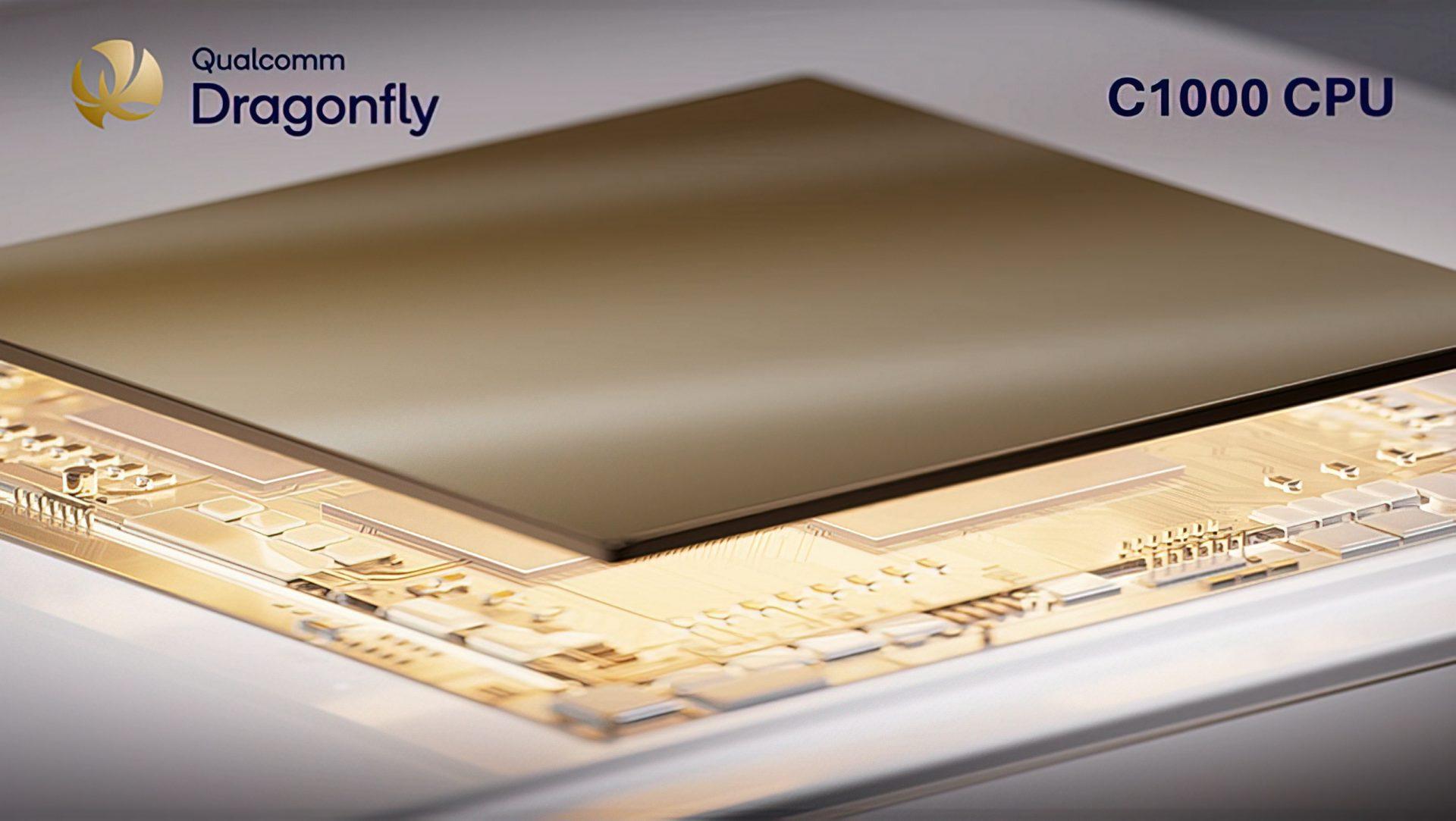
Looking at the specifications, the Dragonfly C1000 is a true beast. It's built on Qualcomm Oryon cores , specifically customized for this environment, and reaches frequencies exceeding 5 GHz. For Qualcomm, this per-core performance is crucial to avoid bottlenecks in interactive tasks where latency can ruin the user experience.
To avoid falling short in multithreaded power, they've implemented a chiplet design that allows for the integration of more than 250 cores into a single processor. Achieving this balance between the raw power of so many cores and the individual efficiency of each one is a considerable technical challenge, but the company assures that its modular architecture allows for scaling both performance and data input/output according to the customer's needs.
In terms of efficiency, the C1000 boasts double the performance per watt of its current competitors. While detailed benchmarks haven't been released yet, the idea is that the total cost of ownership (TCO) will drop dramatically, making data centers much more sustainable and cheaper to maintain.
Extreme connectivity and the secret of HBC memory
To ensure that all that computing power isn't wasted, Qualcomm has equipped the chip with PCIe Gen 7 , achieving a bandwidth exceeding 2 TB/s. Furthermore, support for CXL is key, as it enables memory disaggregation across different nodes, facilitating seamless communication between accelerators and storage.
But what's truly remarkable is the High Bandwidth Compute (HBC) technology . This near-memory computing system, based on 3D stacked silicon, is presented as a superior alternative to HBM. According to the company's data, HBC offers six times the bandwidth per watt of HBM and 200 times the capacity per watt of SRAM, which is phenomenal for moving data in massive language models.
Furthermore, the C1000 is versatile and comes in three distinct flavors: one variant optimized for low-latency agentic orchestration , another general-purpose variant for elastic vCPU loads, and a third configured as an AI head node to get the most out of XPU accelerators with minimal processing overhead.
Reliability, cooling, and Meta's support
When we're talking about industrial-scale servers, a failure can be catastrophic. That's why the chip integrates advanced RAS features, including ECC error correction , fault isolation, and self-healing capabilities. To prevent the processor from overheating under heavy load, it supports both air and liquid cooling, adhering to OCP ORv3 standards.
The bombshell news is that Meta has signed a multi-generational strategic agreement to power its next fleet of servers with the Dragonfly C1000. Mark Zuckerberg has already hinted that this is vital for bringing personal superintelligence to everyone. It's not the only endorsement, as more than 35 partners, including Supermicro, Lenovo, Foxconn, and Samsung SDS, have already backed the strategy.
In the software ecosystem, the alliance with Hugging Face is the piece that completes the circle. They plan to create a workflow where models are automatically deployed from the Hugging Face cloud to the Dragonfly infrastructure, allowing AI agents to operate in hybrid environments (on-premises and cloud) while dynamically optimizing costs and privacy.
Although competition is fierce, with NVIDIA, AMD, and Intel preparing their own chips for 2028, Qualcomm has charted an aggressive roadmap with annual updates. With commercial availability slated for 2028 , the company expects its focus on energy efficiency and vertical integration to make it the new queen of cloud computing, transforming how we manage AI inference on a global scale.