- SparkyLinux 2025.12 "Tiamat" offers a semi-rolling Debian Testing base with modern kernels and several LTS branches.
- It includes GRUB 2.14, Firefox and Thunderbird in ESR version, plus multiple desktop flavors and minimalist editions.
- The new ISOs add mirrors in the UK and USA, special GameOver, Multimedia and Rescue editions, and do not require reinstalling if you already use the rolling branch.
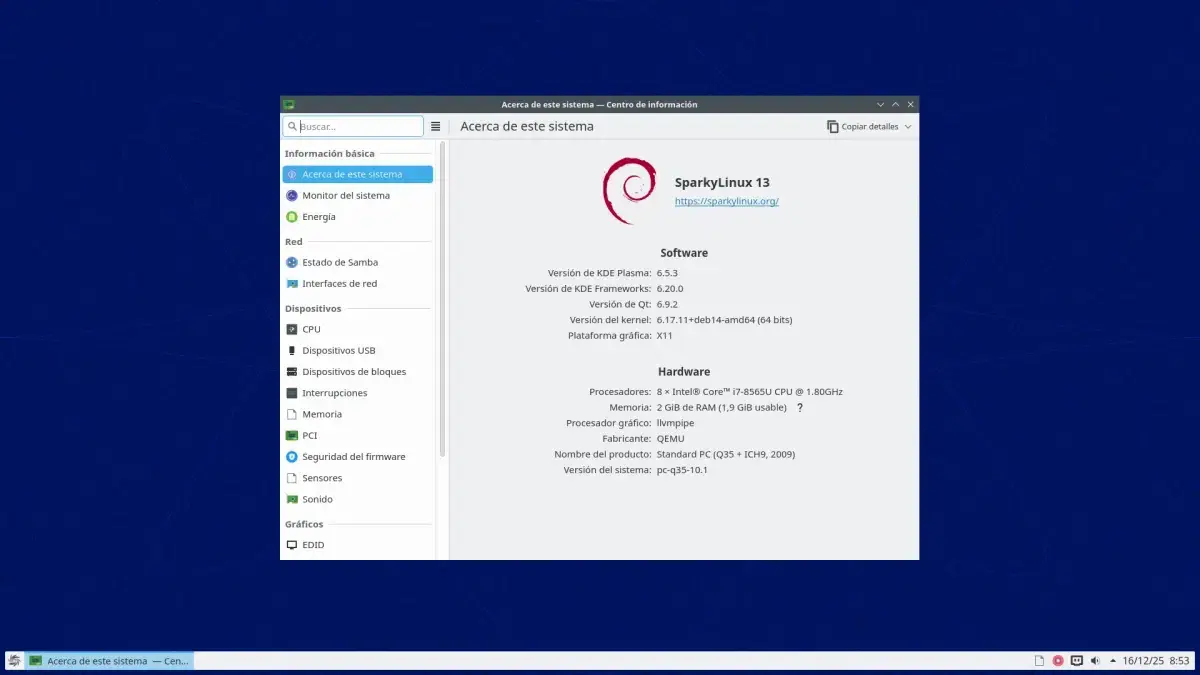
SparkyLinux has long been that distro that many overlook when thinking about Debian, but those who try it often adopt it as their daily system. The semi-rolling update SparkyLinux 2025.12 "Tiamat" reinforces its reputation as a lightweight, fast, and very up-to-date distribution , designed for those who don't want the glacial pace of Debian Stable or the constant frenetic pace of Arch or Debian Sid.
This release brings together a little bit of everything: a solid foundation built on Debian Testing Forky frozen at a specific date, several kernel branches to choose from, desktop environments for almost every taste, separate installation recommendations for UEFI and BIOS, and even special editions geared towards gaming, multimedia, and rescue operations. All of this comes at a very active time for the free software ecosystem , with advancements like Debian GNU/Hurd on x86-64, GNOME pushing Wayland hard, and new VPN solutions based on WireGuard, such as Pangolin, which round out the technical context in which SparkyLinux operates.
SparkyLinux 2025.12 “Tiamat”: Debian Testing base and semi-rolling philosophy
SparkyLinux's 2025.12 snapshot, codenamed "Tiamat," is built upon the Debian Testing (Forky) repositories as they were on December 14, 2025. This "snapshot" of the repository means the distribution captures a consistent and tested state of the package tree, with versions significantly more recent than in Debian Stable (Bookworm) but without descending into the chaos of Debian Sid/Unstable.
The project defines its approach as a semi-rolling branch: it doesn't force you to wait years between major releases like Debian Stable , but neither does it expose you to the daily change carousel of Sid. The idea is to offer a very attractive middle ground for advanced users, developers, and system administrators who want a system that's always fresh, but with a certain degree of restraint to avoid serious problems in production.
In practice, this means you can install the Tiamat ISO today and continue receiving continuous package updates from the rolling repositories, without needing to reinstall every time a new image is released . The ISOs serve as reference points: they mark a stable and documented state of Debian Testing plus all the Sparky tweaks, but day-to-day maintenance is handled through upgrades in the classic Debian style.
This model is a great fit for environments that manage multiple workstations, laboratories, or teams of highly technical users. You get up-to-date software without being stuck in continuous beta , a combination that's often difficult to achieve with other distributions.
Kernels in SparkyLinux 2025.12: 6.17.11 by default and several LTS branches
One of the areas where SparkyLinux takes flexibility very seriously is the kernel. The main SparkyLinux 2025.12 ISO includes the Linux 6.17.11 kernel by default , a modern and thoroughly tested branch that covers most current hardware without any issues.
From the first boot, users can access the Sparky and Debian repositories to install other kernels. At the time of the snapshot, the 6.18, 6.12, and 6.6 series are available , with 6.18 being the newest branch and a long-term candidate within the Linux ecosystem. The 6.12 LTS and 6.6 LTS branches are designed for those who prioritize very long-term stability, such as home servers, production machines, or systems where frequent kernel changes are undesirable.
The project also keeps track of subsequent versions: the repositories contain variants such as 6.18.2, 6.12.63-LTS, and 6.6.119-LTS , reflecting the monthly updates published by the Sparky team in their progress reports. For advanced users, this offers an interesting range of options: opt for the latest version and take full advantage of very recent hardware, stick with a well-established LTS branch, or simply continue with the default 6.17.11 if everything is running smoothly.
This ability to switch kernels so easily is an advantage over distributions that are "married" to a single version throughout their lifecycle. In SparkyLinux, you can tailor the kernel to the specific workload and hardware , whether it's a daily-use laptop, a gaming desktop, a development station, or a machine dedicated to continuous testing.
Key components updated: GRUB, Firefox ESR, and Thunderbird ESR
Beyond the kernel, SparkyLinux 2025.12 comes with a good set of updated base components. The default boot manager is GRUB 2.14, a very recent version taken from the development tree (2.14~git20250718.0e36779), which improves compatibility with modern firmware, UEFI configurations, and different partitioning schemes.
In the area of web browsers, SparkyLinux prioritizes long-term stability: it includes Mozilla Firefox 140.5.0 ESR as the default browser . This ESR (Extended Support Release) branch is preferred in corporate environments, educational institutions, and by users who don't want surprises every few weeks with drastic interface changes or broken extensions. Those looking for the latest features and visual improvements can find the standard Firefox 146 version in the repositories , easily installed with a simple apt command.
Email also relies on the ESR family. Mozilla Thunderbird 140.5.0 ESR comes pre-installed as both the email client and PIM , following the same philosophy of prioritizing stability and long-term maintenance. For many administrators, this is invaluable: fewer unexpected changes, predictable update cycles, and lower support costs on shared desktops.
Overall, this "GRUB 2.14 + Firefox ESR + Thunderbird ESR" stack makes Tiamat a fairly comfortable base for intensive daily use. It doesn't overlook the new features from the Testing version, but prioritizes versions that don't require relearning the tool every two months , something many users appreciate when working on their PCs and not just tinkering with them.
Desktop flavors: LXQt, Xfce, MATE, KDE Plasma and minimalist options
SparkyLinux 2025.12 maintains its commitment to offering multiple editions for amd64 architecture. The idea is that each user can choose the graphical environment that best suits their hardware and workflow , from very lightweight desktops to interfaces packed with options.
Among the full desktop environments , LXQt 2.2 stands out as a lightweight, modern, and highly modular option , ideal for systems with limited RAM, older laptops, or machines where you want to squeeze every last bit of performance out of your system without sacrificing a modern look. LXQt's integration with Qt components and its own tools makes it a very strong contender for those who want something more polished than a bare-bones window manager.
Another very popular option is Xfce 4.20, the classic that balances moderate resource consumption with a high degree of customization . With its panels, applets, and built-in utilities, Xfce remains a safe bet for users who value simplicity, stability, and a traditional workflow with clear menus and quick access.
For those nostalgic for the old GNOME 2, MATE 1.26 remains the spiritual successor to that experience , with a classic menu, top and bottom panels, and a clarity of use that many don't want to give up. It's a good foundation for offices, shared computers, or people who have been using Linux for years and prefer not to reinvent their desktop experience.
At the visually most powerful end of the spectrum is KDE Plasma 6.5.3, the most complete and configurable desktop environment in the suite . It offers a virtually endless number of settings, outstanding integration with Qt applications, and a modern design, provided the hardware is up to the task. It's the ideal choice for users who enjoy fine-tuning every aspect of the system and taking advantage of advanced features such as activities, highly customized virtual desktops, and a tightly integrated application ecosystem.
For those who prefer to build their environment from scratch, SparkyLinux offers two minimalist variants. MinimalGUI is based on Openbox and provides an ultra-lightweight graphical environment with a window manager and the bare minimum needed to start building a custom system. It's perfect for older machines, test labs, or users who want a fast, no-frills desktop with complete control over what gets installed.
The other alternative is MinimalCLI, an edition that boots directly into text mode without a graphical environment . This option is designed for setting up servers, lab systems, monitorless machines, or for those who prefer to install and configure absolutely everything from the command line. It is also an excellent foundation for learning in depth how Debian, and by extension SparkyLinux, works.
UEFI and BIOS installation: Calamares and CLI mode depending on the case
The SparkyLinux team offers several practical recommendations to avoid headaches during installation. On machines with UEFI firmware, it is advisable to use the Calamares graphical installer (visible in the menu as "Sparky Installer") and, very importantly, to perform the process with an active internet connection for better performance, hardware support, and repository configuration.
For older systems with traditional BIOS, the recommendation changes: On amd64 systems with legacy BIOS, it is preferable to use the command-line installer, executing the command sudo sparky-installer from the live session. This method avoids potential problems related to old partitions, unusual MBR schemes, or hardware that doesn't play well with certain aspects of Calamares.
As a practical detail for live sessions, the live user uses the password "live" and the root account comes without a password set , useful information if you need to make preliminary changes or test certain configurations before launching the final installation.
Once the process is complete, SparkyLinux behaves like any well-configured Debian. Keep the system updated through sudo apt update && sudo apt full-upgrade Or, using graphical tools like Synaptic or Discover allows you to enjoy the new features of 2025.12 without reinstalling.
Updates, mirrors, and rolling stream: how to keep up with Sparky
The project maintains constant communication about the system's status and packages. A monthly news and donation report is published, detailing, for example, available kernel versions (such as jumps to 6.18.2, 6.12.63-LTS, or 6.6.119-LTS) and other relevant changes in the repositories. This allows users to stay informed without having to search through each package individually.
To improve download speeds and global availability, SparkyLinux has added two new package mirror servers: one in the UK (UK1) and one in the central US (US1) . This expansion of the mirror infrastructure reduces latency, speeds up updates, and provides an additional layer of redundancy in case of issues with the primary server.
From the user's perspective, the workflow is simple : someone who installs a Sparky rolling ISO and keeps the system up to date doesn't need to reinstall to move from one 2025.xa snapshot to another. Tiamat, in this sense, is simply the recommended "starting point" for new installations, but the rolling road continues seamlessly. This philosophy is what makes the distribution so attractive for work environments that can't afford frequent reinstallations.
The new images of the semi-rolling line can be downloaded directly from the official downloads section on the route /download/rolling/. All the main editions for amd64 are offered there. (LXQt, KDE Plasma, MATE, Xfce, MinimalGUI/Openbox and MinimalCLI) and the updated details of each ISO are indicated, including build date and key components.
Special Editions: GameOver, Multimedia and Rescue
In addition to the standard editions, SparkyLinux maintains a line of "Special Editions" designed for very specific uses: GameOver, Multimedia, and Rescue . Around the same time as snapshot 2025.12, the project released new images of these variants, also based on Debian Testing Forky.
The December special editions draw from the same base of packages as Tiamat, but come pre-installed with a set of tools and settings tailored to their specific purpose . GameOver includes emulators, gaming platforms, and utilities related to electronic entertainment; Multimedia focuses on audio, video, and graphics production; and Rescue is geared towards system recovery, backup, and diagnostics.
The Special Editions suite has been updated with the Linux kernel 6.17 and the packages available in the Debian and Sparky Testing repositories until December 20, 2025 , incorporating most of the changes introduced in SparkyLinux 2025.12. As with the main line, kernels 6.18.2, 6.12.63-LTS, and 6.6.119-LTS are available for those who need to migrate these editions to other kernel branches.
The rolling release philosophy remains unchanged : if you already have a rolling release edition of Sparky installed (either Standard or Special Edition), there's no need to reinstall. Simply keep your system up to date and you'll enjoy the new features included in the 2025.12 family, including improvements to kernels, applications, and system scripts.
Ecosystem context: Debian GNU/Hurd, GNOME, COSMIC, Labwc and more
Although SparkyLinux relies primarily on Debian GNU/Linux for its core, the broader context of the Debian project is relevant. Alongside the release of Tiamat, the Debian GNU/Hurd subproject has made significant strides, including native support for x86-64 architectures . While this is a much more experimental area than the traditional GNU/Linux base, it illustrates the vitality of the ecosystem in which Sparky operates.
On the desktop side, GNOME continues to strongly promote the use of Wayland as the default graphics server , which impacts many distributions, including Debian and, by extension, Sparky. Although Sparky focuses more on other environments (LXQt, Xfce, MATE, Plasma), this shift affects the graphics stack, login sessions, and how some applications and compositors are managed.
The Sparky project is also experimenting with new, lightweight, and modern desktop environments. Recent news includes development images of the Labwc desktop , a lightweight Wayland compositor inspired by Openbox, and the addition of the COSMIC environment, System76's offering that is gaining traction as an alternative desktop with a polished user experience. These flavors, while not part of Tiamat's core, show where future editions of the distribution might expand.
In the area of connectivity and security, the rise of modern VPNs like Pangolin, based on the WireGuard protocol, aligns perfectly with SparkyLinux's technical approach . Thanks to Debian Testing, users have quick access to WireGuard itself, as well as third-party frontends and solutions that simplify its use in desktop or server environments.
All of this context—from the evolution of desktop environments to experiments like Hurd and COSMIC—reinforces the idea that SparkyLinux is situated within an extremely dynamic ecosystem. The distro acts as a bridge between the familiar stability of Debian and the constant innovations of the Linux world , offering advanced users a fertile ground for testing technologies without having to migrate to more radical distributions.
SparkyLinux 2025.12 "Tiamat" presents a very defined proposition: a finely tuned, semi-rolling Debian Testing system with a choice of modern kernels (including several LTS branches), a wide range of lightweight and full desktop environments, specialized ISOs for gaming, multimedia, and rescue, and an improved mirror infrastructure . All of this is wrapped in a philosophy that prioritizes control and transparency over opaque changes. For those seeking a fast, up-to-date, and flexible system without the rollercoaster ride of more aggressive distributions, SparkyLinux remains one of those understated gems worth keeping a close eye on.