- Go expands the use of GPT-5, files, and images; Plus adds advanced reasoning, priority, and upper limits.
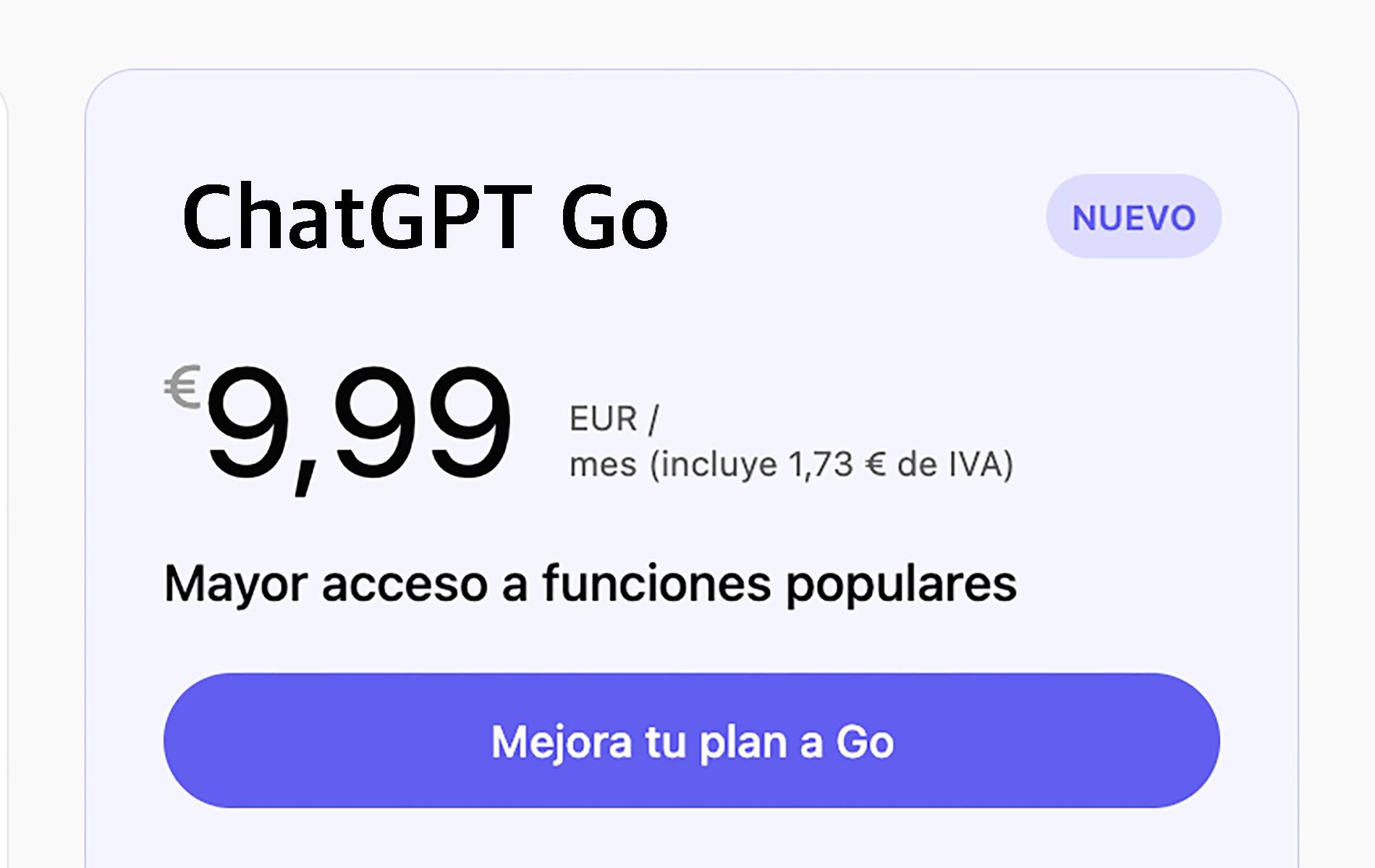
- Prices vary by region: in Spain, Go costs around €9,99 and Plus €23; in India, Go is offered for 399 rupees.
- OpenAI does not publish exact limits: Go unlocks the essentials; Plus maintains maximum stability and access to "legacy" models.
If you've been seeing the new plan in your account for weeks and wondering what's really changed, here's a complete, clear, and straightforward guide to understanding the differences between ChatGPT Go and ChatGPT Plus . I've compiled everything that's being officially communicated and what users are already experiencing on a daily basis so you can make an informed decision about where to invest your money.
The idea behind Go is simple: pay significantly less and unlock annoying limitations of the free version without accessing the full suite of Plus features. However, OpenAI hasn't released all the fine print (exact message limits, image limits, file limits), so you'll also see some gray areas and why certain details vary by country or even billing cycle.
What is ChatGPT Go?
ChatGPT Go is the cheapest subscription in the OpenAI ecosystem for accessing advanced features without reaching the power (or price) of Plus. It sits right in the middle: more than the Free plan, less than Plus, and designed for those who use the chatbot daily and encounter limitations too quickly.
Its main promise is to provide greater access to the current model (GPT-5) and future versions , increase file upload capacity, and accelerate image creation. In other words, you'll be able to chat more, upload more files for AI analysis, and generate more images faster than with the free plan.
The package also includes customization and productivity capabilities such as using custom GPTs and even "projects" or "tasks," as detailed in various communications. However, this is where the first ambiguity arises: some sources list "in-depth research, agent mode, or tasks" as features reserved for Plus, while others mention access to projects and tasks in Go. The prudent interpretation is that Go prioritizes the popular and practical , leaving the more advanced features for Plus and higher versions.
There are two notable omissions in Go: it doesn't include Sora (video generation) and it doesn't offer access to the Codex programming agent. These are high-end features, geared towards professionals or very specific workloads.
Prices and availability
The price of Go depends on the country and applicable taxes. In Spain, you'll find the plan for €9,99 per month (some communications mention "€10 per month" or €11,72 including VAT), while the Plus plan is usually priced at €23 per month (with references to €27 including VAT). In dollars, several sources list Plus at $20/month and indicate Go at $5/month in specific markets.
In India, Go has been promoted for 399 rupees per month (approximately €5), which aligns with the goal of democratizing access to key features of the model without making it a luxury. This launch in India has been presented as the affordable entry point to GPT-5 , offering memory, file uploads, and image generation for everyday use.
In Spain, Go is now available and a banner appears at the top of the ChatGPT interface for eligible users, offering a quick plan comparison. It doesn't replace Plus or Pro; it's an intermediate tier in a catalog that now has four tiers (Free, Go, Plus, and Pro).
Practical details to keep in mind: there is no annual billing (or prepayment for several months) and the use of the developer API is billed separately . Availability by country follows a phased rollout, so what you see in your account may differ from what is reported in other markets.
ChatGPT Go vs ChatGPT Plus: real differences
The key distinction lies in their target audience: Plus is aimed at advanced users and professionals who need stability, priority, and specialized tools; Go is designed for those who want "the essentials expanded" without paying the full price. From there, there are nuances depending on the tool and its limitations.
What you can expect from Go compared to the free version: more chat messages (up to 10 times more in a single conversation), upload more and larger files, faster image generation , and greater memory/context. You'll also get access to custom GPTs and more robust data analysis features with Python support than in the free plan.
What Plus gives you over Go: advanced model reasoning, in-depth investigation tools and connectors, access to still highly demanded legacy models (like GPT-4o and variants), priority during peak demand, and higher limits across the board (messages, images, uploads). Furthermore, Sora and other "high-end" features remain reserved for senior management.
An important note: OpenAI doesn't specify the exact numerical limits (images/day, file size, etc.) nor does it always clearly define what falls under Go and what falls under Plus when we talk about "projects," "tasks," or "agent mode." Real-world experience suggests that Go runs out of file or image upload capacity sooner, but it's a very clear improvement over the free version.
- Go: more use of GPT-5, more files, faster images, expanded memory, custom GPTs; no Sora or Codex.
- Plus: advanced reasoning, in-depth research and connectors, access priority, upper limits, “legacy” models such as GPT-4o.
Advantages of Go compared to the free plan
For those who find the Free plan insufficient, Go unlocks precisely what matters most: more messages with GPT-5 , more image attempts, and more room to upload and analyze documents (PDFs, spreadsheets, etc.). Furthermore, memory and context are more generous, facilitating longer and more coherent conversations.
Some official communications mention up to 10 times more messages than the free tier and a substantial increase in image generation speed. They also mention extended access to analytics tools like Python , which is very useful for exploring data, performing minor transformations, or automating repetitive tasks without leaving the chat.
For students, freelancers, or small businesses, Go acts as a "frustration avoidance" solution: many of the limitations of the Free plan are eliminated without the full upgrade to Plus. If you create summaries, comparisons, analyses, and images daily, you'll notice the difference.
Limits, transparency, and gray areas
Although the message is clear (“more access to popular features and GPT-5”), concrete figures are lacking . OpenAI doesn't publish tables with exact limits for Go vs Plus (messages, file size/volume, image quotas), so you have to read between the lines and rely on real-world experience.
In practice, you'll see that Plus maintains a higher standard across the board: this is noticeable during peak hours (responsiveness and stability), under heavy workloads, or when performing multiple intensive tasks simultaneously. It's also expected that image quality and rendering speed will hold up better on Plus, although the fine print doesn't always explicitly list these differences.
Regarding advanced features: several sources mention in-depth investigation , "agent mode," and "tasks" as privileges of Plus, while others indicate that "projects and tasks" are included in Go. It's very likely that these are overlapping names or shortened versions of the same idea. In any case, if your workflow relies on autonomous agents, chained tasks, or guided investigation, Plus is the safe bet.
Real-life experiences: changing plans and policies
A real-world case recently shared illustrates what can happen when switching plans: when downgrading from Plus to Go , a prorated refund was issued for the unused portion of the plan, but the user was locked into Go for a full month and unable to switch back to Plus until the end of the billing cycle. It was an "expensive but educational experiment," perfect for comparing the two plans in everyday use.
Other communications indicate the exact opposite: the change takes effect after the current billing cycle , and the difference is not refunded. How can these two things be reconciled? Simple: these policies can change by region, payment method, or due to temporary adjustments to the subscription system. Moral of the story: before making a change, check what your account shows at that moment.
Practical recommendations: Take screenshots of what you see on the "Upgrade Plan" screen , check billing cycles, and confirm the terms of the change. If you need Plus for work, avoid trying Go right before a deadline; and if you're on the Free plan and need more resources, try Go for a month and see if it meets your needs.
Who is each plan for?
If your priority is improving your daily workflow without getting bogged down in niche tools, Go is the sweet spot . It lets you use ChatGPT with less friction: more messages, more files, more images, and more memory/context. Students, aspiring creators, and general users will all benefit.
If you need top-tier stability, advanced research tools , connectors, and access to previous models, or if you work during peak hours and can't afford to wait, Plus more than makes up for it. Service priority and higher limits are key differentiators when you rely on the tool for production.
For demanding teams and developers, Pro comes into play: early access to features like Sora, advanced connectors, and very large quotas. Here, the focus is on enterprise, development, and intensive use, with a significantly higher price (around US$200 per month).
Models and access: GPT-5, “legacy” and memory
Go focuses on providing extended use of GPT-5 and improving the most requested multimodal experience (images and files). Plus also retains access to popular previous models like GPT-4 and enables advanced reasoning.
Both Go and Plus promise improved memory and greater context compared to the free version, which is noticeable when having long conversations without losing track. Again, without publicly available figures, the general feeling is that Plus performs better and is more stable in extended sessions or with very long prompts.
How does it compare to what other platforms do (market context)
Tiered segmentation isn't exclusive to OpenAI. For example, Perplexity is preparing GPT-5 Thinking as a high-precision reasoning feature exclusive to its Max plan, with direct comparison to the o3 and o3 Pro from the selector, interface changes (notifications tab and task settings), and no official release date, although it's already in internal testing.
In terms of productivity, Excel has launched the Copilot feature in spreadsheets (using GPT-4.1-mini) to categorize feedback or generate descriptions with natural language prompts. Currently, it is limited to Beta users with a Microsoft 365 Copilot license, offering 100 functions every 10 minutes , no access to external data, and with the explicit warning against using it for numerical calculations or legal matters.
There are also headlines about ethics and creativity: a video game publisher has created AI-generated streamers to promote its title, sparking controversy for replicating real creators without permission and a lack of transparency; and Meta has launched English-Spanish voice translations for reels, maintaining timbre and lip-syncing, available globally wherever Meta AI exists, for creators with more than 1.000 Facebook followers and public Instagram accounts.
In the area of models, another player has announced a version that would merge previous approaches and expand the context window to 128K tokens in chat and API. It features more elaborate reasoning and a different level of verbosity, lacks a clear changelog , and is only partially available (it's not yet in certain repositories, and not all improvements are included in the API).
Frequently asked questions you're asking yourself
Can I make videos with Go? No: Sora isn't included in this plan. If video is essential to your workflow, you'll need to upgrade to a higher plan.
Does Go have advanced reasoning? In Plus, it's explicitly stated. In Go, the model's "advanced" capabilities are not guaranteed , and it's expected to be limited to the essentials of general GPT-5 reasoning.
How much can I upload and how many images can I create per day? Here's the rub: OpenAI doesn't publish exact figures . What they do promise is "expanded usage" compared to the Free plan, and that Plus raises the limits even further.
What happens if I switch from Plus to Go? There may or may not be a prorated refund , and the change may take effect immediately or at the end of the cycle, depending on the country and applicable terms and conditions. Always check your account information before confirming.
Tips for making a decision without going crazy
If most of your work involves chat, summaries, file management, and image processing , and the Free version is holding you back, try Go for a month. If you work with agents, connectors, conduct in-depth research, or need priority during peak hours, Plus is worth it.
Consider the local price including taxes: in Spain, Go costs around €9,99 (€11,72 including VAT) , and Plus around €23 (with references to €27 including VAT). If you find the Go plan for 399 rupees in India or $5 USD in other regions, the savings compared to Plus are very significant.
And don't forget the basics: the API is a separate bill, there's no annual fee, and you might not see the exact same upgrade options as other users. Have screenshots, your billing schedule handy, and a cool head before clicking "Confirm."
Sticking with Go or upgrading to Plus depends on how much you value priority, advanced features, and high limits versus monthly savings. If you're looking for balance and hate "You're temporarily limited," Go is a great option . If you need robust power and crash-proof stability, Plus remains the standard plan. And if you're an enterprise or development-intensive user, there's Pro with cutting-edge tools (including video generation when needed) and the largest quotas.
