- DDoS attacks saturate network resources, servers, and applications, causing unavailability and serious economic and reputational losses.
- There are volumetric, state exhaustion, and application attacks, each targeting different layers of the infrastructure.
- Effective defense requires resilient architecture, continuous monitoring, and anti-DDoS solutions across network, cloud, and edge computing.
- Managed services and the operator's specialist teams improve detection, mitigation, and business continuity in the face of DDoS attacks.
Cybersecurity focused on protecting networks against DDoS attacks has become critical for any company with an online presence. We're no longer just talking about large corporations or critical infrastructure: any organization that relies on its online services can fall victim to a denial-of-service attack.
These attacks not only take down a website or application, but can also cause financial losses, reputational damage, regulatory penalties , and, in many cases, serve as a smokescreen for more serious intrusions. Understanding how denial-of-service attacks work, what types exist, and what specific measures can be taken to mitigate them is essential for maintaining business continuity.
What is a denial-of-service (DoS) attack and what differentiates it from a DDoS attack?
A denial-of-service (DoS) attack is a deliberate action in which a cybercriminal uses a single computer or a very limited set of resources to overwhelm a specific service, typically by directing a large amount of traffic to a specific IP address. The goal is simple: to collapse the server's resources so that it stops responding to legitimate requests.
The classic form of DoS attack involves sending a massive number of packets (data blocks) to the target IP address, exceeding the server's capacity. When the volume of requests exceeds the available memory, CPU, or bandwidth, the system can no longer process legitimate connections, and the service becomes unusable or extremely slow.
Another common strategy is to focus on bandwidth . Instead of trying to exhaust the server's internal resources, the attacker aims to completely fill the bandwidth of the communication line. Even if the firewall or filters block malicious traffic, network congestion has already occurred, and the user experience is severely impacted.
When that same concept is multiplied by hundreds, thousands, or even millions of sources, we go from a DoS to a distributed denial-of-service (DDoS) attack , which is much more complex to detect and contain, because the malicious traffic seems to come from a multitude of different users scattered around the world.
What is a DDoS attack and how do botnets operate?
A DDoS (Distributed Denial of Service) attack consists of using multiple compromised devices to launch a coordinated large wave of traffic against a target: a web server, an API, a DNS, a corporate VPN, or, in general, any service exposed to the Internet.
The attacker has previously infected computers, servers, IoT devices, smartphones, and other connected equipment to turn them into botnets or zombie computers . These devices are controlled remotely using malware, and at a predetermined moment, the cybercriminal orders the entire network to send massive requests to the target until it is overwhelmed.
In practice, this flood can manifest as seemingly normal HTTP requests, DNS queries, UDP packets, or TCP connections . Because the traffic originates from thousands of different IP addresses and can closely resemble that of legitimate users, distinguishing between legitimate and malicious activity becomes much more difficult, and detection becomes a real challenge.
Furthermore, in many scenarios, DDoS attacks are used as a distraction to conceal more serious intrusions . While the IT team focuses on restoring service and containing traffic, attackers can attempt to exploit vulnerabilities, steal data, or move laterally through the internal network.
Therefore, DDoS protection must combine prevention, early detection, and automated mitigation , along with good incident response planning to avoid falling into the trap of focusing solely on service unavailability.
Common motivations behind DDoS attacks
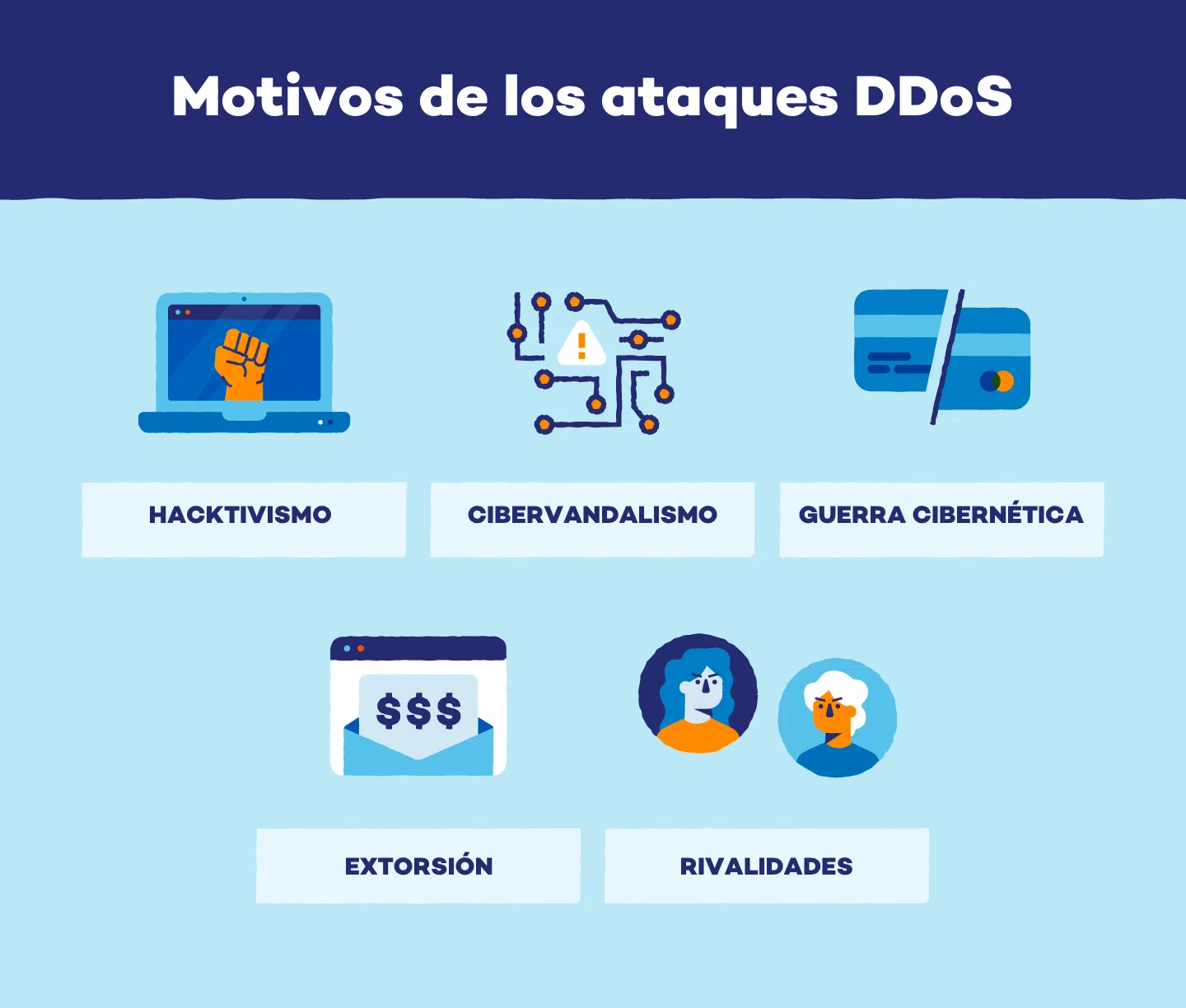
Far from being senseless attacks, denial-of-service incidents are often driven by economic, ideological, competitive, or even personal interests . Understanding why helps to assess the risk and better prepare response plans.
One of the most direct motivations is financial extortion . The attacker launches a DDoS attack against the company, paralyzing its online services, and then demands payment (usually in cryptocurrency) in exchange for stopping the attack. In businesses heavily reliant on their online presence, every hour of downtime can result in significant losses, increasing the pressure to give in to the blackmail.
Attacks motivated by "personal justice" are also common , occurring when an individual or group harbors animosity toward a specific company or organization. These may be disgruntled customers, former employees, or individuals who believe the company has acted unfairly, and they use DDoS attacks as a form of revenge to damage its public image.
In the realm of social justice or hacktivism , certain groups launch DDoS attacks as a form of digital protest. The goal is to raise awareness of a political, social, or environmental cause by paralyzing the websites of governments, media outlets, financial institutions, or companies associated with the controversy they wish to denounce.
At a more critical level , cyberwarfare or digital warfare emerges , where DDoS attacks are used as tools within geopolitical conflicts. Here, the targets are usually critical infrastructure: telecommunications operators, energy companies, transportation systems, healthcare facilities, public administrations, or financial services, seeking to generate instability or pressure on a rival country.
Unfair competition is also present: some companies, in a completely illegal manner, resort to DDoS attacks against their rivals to take down their online stores, stop key promotions or damage the perception of reliability of the attacked brand.
Finally, there are cybercriminals motivated by technical expertise and reputation within the underground community . They seek to demonstrate their skills, share logs of successful attacks, or even use them as a portfolio to later be hired by high-net-worth companies for red team roles or controlled stress tests.
Real impact of DDoS attacks on businesses
The consequences of a well-executed DDoS attack go far beyond a simple temporary outage. Its impact translates into direct financial losses, operational collateral damage, and long-term effects on reputation and regulatory compliance.
From an economic point of view, the unavailability or degradation of the service translates into loss of sales (in e-commerce, online banking, SaaS, etc.), increased returns or cancellations and overload of customer service channels, which are flooded with complaints and inquiries due to the outage.
On an operational level, a DDoS attack can block critical internal applications , disrupt collaboration tools, CRM, ERP, or ticketing systems, drastically reducing productivity. If the attack persists, it is not uncommon for it to cause errors in business processes, loss of ongoing transactional data, or breaches of service level agreements (SLAs) with clients.
Corporate reputation also suffers. News of a successful attack spreads quickly and can lead to a loss of trust from customers, partners, and investors. A single serious incident can trigger regulatory investigations and call into question the organization's cybersecurity maturity.
In regulated sectors, service availability is also a legal requirement . Regulations such as GDPR, PCI-DSS, HIPAA, and, in Spain, the National Security Framework (ENS) require ensuring the continuity of certain services and protecting personal data against prolonged downtime. A DDoS attack that disables critical systems can lead to penalties and notification obligations to authorities.
Therefore, DDoS mitigation cannot be seen as an optional luxury, but as a key piece within the company's overall risk management and business continuity strategy.
Main types of DDoS attacks
DDoS attacks have evolved in volume and sophistication, and today they are generally classified into three main categories: volumetric, state or resource exhaustion, and application-level . Each type exploits different weaknesses in the infrastructure.
In volumetric attacks , the goal is to saturate the available network bandwidth. So much traffic is generated toward the victim that the wide area network (WAN) bandwidth becomes overwhelmed, rendering other services inaccessible. The targeted IP address does not need to be associated with a specific server; it simply needs to be routed on the internet.
Some of the best-known examples are UDP Floods , which send large quantities of UDP packets without any expected response, and DNS Reflection/Amplification attacks , where open DNS servers are used to amplify traffic toward the victim. Even if firewalls drop these packets, if the downstream bandwidth is saturated, the attacker will have achieved their goal.
In state or resource exhaustion attacks , the target is no longer so much bandwidth, but rather the processing capabilities of stateful devices: firewalls, IPS, load balancers, or the TCP servers themselves. These devices maintain connection state tables, and each entry consumes memory and resources.
The classic SYN Flood sends a barrage of SYN packets that open semi-established connections but never fully complete them, filling the table until it can't hold any more entries. Meanwhile, the TCP Connection Flood can use seemingly legitimate TCP connections, but at a rate faster than the firewall can process them, cutting off communication for services behind the firewall and even affecting LAN-DMZ connectivity.
Finally, application-level (layer 7) attacks focus on exhausting specific resources of a particular service, such as CPU, memory, or the number of concurrent sessions on a web server. They tend to be quieter because they can be generated with relatively low traffic volumes and often originate from a single machine.
Typical examples are Slowloris , which opens many HTTP connections to the server and keeps them open by sending incomplete headers for long periods, RUDY , which sends requests with very long and slow bodies, or THC-SSL , which forces numerous TLS/SSL renegotiations to saturate the CPU of the HTTPS server.
The role of the control plane and connection flood attacks
Within a modern network, it's crucial to distinguish between the data plane and the control plane . The former is responsible for forwarding packets at high speed, while the latter handles routing, session management, and protocol decisions. The control plane is, essentially, the "brain" of the network device.
Connection flood attacks are specifically designed to overwhelm the control plane and the systems that manage connections. The attacker attempts to open a massive number of simultaneous sessions to a server or network device (for example, using SYN floods or similar variants), without completing them successfully.
While the target system dedicates resources to managing these incomplete connections, memory and CPU usage become depleted . Eventually, the device can no longer accept new legitimate requests or simply crashes. This can affect web servers, routers, switches, firewalls, and load balancers, so it's advisable to consult detailed analyses of network equipment.
When the control plane is compromised in this way, the impact is not limited to a single service: it can lead to route loss, BGP session drops, VPN tunnel disruptions , and, in general, instability across the entire network infrastructure. Therefore, protecting this control plane is a priority within any serious DDoS protection strategy.
Best practices for protection and mitigation against DDoS
Effective defense against denial-of-service attacks requires a layered approach , combining preventative measures, continuous monitoring, specific technologies, and a clear incident response strategy. There is no single magic bullet, but there is a set of best practices that, when combined effectively, significantly increase resilience.
The first step is to have a well-defined DDoS response plan . This document should specify roles and responsibilities, internal and external communication channels, technical and business escalation procedures, and criteria for involving vendors, operators, or authorities if necessary.
It is advisable to conduct regular risk assessments of network infrastructure and critical applications. This involves reviewing configurations, identifying single points of failure, checking link capacity, updating and patching systems to eliminate known vulnerabilities, and planning for contingency scenarios.
Multi-layered security combines firewalls, intrusion prevention systems (IPS), web application firewalls (WAFs), access control lists (ACLs), rate limiting, and dedicated DDoS mitigation solutions, both on-premises and in the cloud. Each element covers a different type of attack or vector, so that if one fails, another can act as a backup.
Continuous network traffic monitoring is essential for detecting anomalies in real time. Flow analysis tools and machine learning-based solutions allow you to define what constitutes a normal traffic pattern and trigger alerts when sharp deviations are observed in volume, packet size, protocols used, or connection rates.
Collaboration with Internet Service Providers (ISPs) and specialized vendors is another key pillar. Many volumetric attacks cannot even be effectively mitigated from the customer's network because the access links have already been overwhelmed. In these cases, it is essential that traffic filtering and cleanup be performed as close as possible to the attack's origin.
Mitigation techniques: filtering, cleaning, and traffic limiting
Specific DDoS mitigation techniques are combined to separate legitimate traffic from malicious traffic with the least possible impact on user experience. The key is to react quickly and accurately, avoiding both system failures and massive false positives.
First, advanced detection relies on behavioral and protocol analysis. Behavioral patterns are monitored: packet size, request frequency, IP address geographic distribution, and unusual use of certain ports or protocols (TCP, UDP, ICMP). AI and machine learning-based systems learn to distinguish between legitimate spikes (e.g., a marketing campaign) and an ongoing attack.
Once the attack is identified, IP filtering and blocking mechanisms are applied . This may involve blacklisting addresses or ranges associated with the botnet, blocking specific countries if the business allows it, or cutting off incoming traffic based on certain IP reputation criteria.
Traffic routing to scrubbing centers is another widespread technique. All traffic destined for the victim is diverted, usually from the operator, to specialized infrastructure that analyzes it in real time, discards malicious traffic, and forwards only clean traffic to the company via dedicated links or secure tunnels.
In extreme cases, blackholing or null routing techniques can be used , where all traffic (legitimate and malicious) is diverted to a "black route" where it is completely discarded. This drastic option can be useful for protecting part of the network while stabilizing the rest, or as a last resort to prevent an attack from taking down the entire infrastructure.
Additionally, rate limiting allows restricting the number of requests or connections that a single IP address, user, or network segment can make within a given time period. This reduces an attacker's ability to overwhelm the service from a single source and helps contain connection flood or Layer 7 attacks.
Load balancing, redundancy, and anti-DDoS architecture
Beyond specific techniques, it's important to design the infrastructure with a resilient architecture . Load balancing distributes traffic across multiple servers or locations, preventing a single system from becoming a bottleneck and making it harder for an attack to bring down the entire platform at once.
The existence of redundant servers and links allows for continued service of legitimate traffic if one is affected or needs to be isolated during mitigation. When services are distributed across different data centers or cloud providers, the capacity to absorb attacks and redirect traffic increases considerably. Furthermore, it is advisable to conduct network performance analysis.
Depending on the size and needs of the company, different Anti-DDoS architectures can be considered . One option is to deploy protection solutions from the operator's own network (ISP), which will clean the traffic before delivering it over the same contracted communication link. Another alternative, very common when there are offices in several countries and different Internet providers, is to use cloud solutions that create virtual point-to-point links to deliver clean traffic.
These solutions can operate in on-demand mode , activating when an attack is detected, or in always-on mode , constantly inspecting all traffic. Always-on mode offers virtually instantaneous detection and mitigation, at the cost of increased resource consumption and costs; on-demand mode reduces the ongoing cost but may introduce a few seconds or minutes of latency in the response.
In the case of the Spanish public sector and certain critical environments, it is common to require that these solutions be certified under the National Security Scheme (ENS) , which defines strict requirements on operation, infrastructure protection and business continuity, which are reviewed annually.
DDoS protection based on edge computing and managed services
In recent years, DDoS protection services based on edge computing have gained significant traction . These services rely on global networks of distributed points of presence that act as a first line of defense, absorbing and mitigating attacks as close to their source as possible.
Among its main advantages is its scalable mitigation capability : it can dynamically increase the resources needed to deal with massive attacks without the company having to invest in its own hardware. This is especially useful against volumetric attacks that would otherwise overwhelm access links.
These providers typically have global threat intelligence , gathering information from millions of customers and real-time events. This allows them to identify emerging attack patterns, block new botnets, and update their detection systems even before a specific customer is affected.
Additionally, by having a distributed scrubbing center infrastructure , malicious traffic is mitigated with lower latency, since packets are processed at a node close to their point of origin. This minimizes the impact on user experience and reduces the latency added by the cleaning process.
From an economic point of view, edge-based DDoS protection offers better cost-benefit , because organizations take advantage of economies of scale without needing to acquire and maintain specialized hardware or have large internal teams dedicated exclusively to DDoS.
Complementing this approach, operator-managed DDoS protection services provide an additional layer of value. The telecommunications operator sees a significant portion of internet traffic, giving it a unique perspective to detect attacks, anticipate new campaigns, and implement mitigation measures directly on its network.
The value of the human factor: expert teams, training and drills
While technology is essential, a robust DDoS defense also relies on specialized equipment and well-trained personnel . Many security operators and providers have operations centers that monitor attacks 24/7, analyze alarms, and adjust countermeasures in real time.
Having experts dedicated to DDoS detection and mitigation makes all the difference, especially in complex attacks that combine multiple vectors or change tactics during the incident. These teams can adapt the rules, refine the filters, and, above all, minimize the impact on legitimate traffic.
Internal training for IT and security staff is also key. Having advanced tools isn't enough if no one knows how to interpret them or make decisions when time is running out. Training teams to recognize early warning signs, escalate quickly, and coordinate with external vendors reduces average response time.
Drills and controlled stress tests (sometimes with third-party assistance) allow for practical verification of response plans, system resilience, and bottlenecks. Red team exercises and DDoS-specific tests help uncover misconfigurations or unrealistic processes that would otherwise only become apparent in a real attack.
Finally, it's important not to forget the need for general awareness throughout the organization . Business departments, customer service, and communications must know what to do in the event of a widespread outage: how to inform users, what messages to convey, and how to coordinate the response to protect the company's image.
DDoS protection and overall network cybersecurity cannot be solved with a single tool or a magic bullet, but rather with a combination of resilient architectures, advanced technical solutions, operators with global visibility, specialized managed services, and skilled teams . Only by combining all these elements can the risk of a denial-of-service attack jeopardizing business continuity and customer trust be realistically reduced.