- Identifying common faults in both wireless and USB cable connections.
- Performance optimization through application management and system data cleaning.
- Specific power and connectivity settings to eliminate latency on Android devices.
- Verification of the authenticity of hardware in unofficial Android screens and stereos.
Having an infotainment system that guides us along the way and plays our favorite music is wonderful, but when the interface starts to stutter, the experience becomes frustrating. It's infuriating when Android Auto is slow , with animations that look like a slideshow, or when Google Assistant gets stuck thinking endlessly while all we want is to get to our destination.
The strangest thing is that this problem doesn't discriminate; it can happen to someone with an entry-level phone or someone who's spent a fortune on the latest premium model. Sometimes the system runs like a dream, and then suddenly, without us having touched a thing, it starts stuttering and responding with an unbearable delay, turning a peaceful trip into a technological headache.
Common causes after an update
Sometimes a technical irony occurs: we update everything to improve performance, yet the latest version introduces a bug or software glitch that slows down system responsiveness. If you notice lag appearing right after installing a new version of Android or the Auto app itself, you may be experiencing an optimization error and need to fix the "app not responding" error on Android.
In these cases, the most sensible solution is usually to wait for the next patch from Google or the vehicle manufacturer. However, to rule out the car as the problem, it's advisable to test the phone in a different vehicle. Keeping the car's console firmware , the Android Auto app, and the phone's operating system up to date is the first crucial step to avoid performance issues.
Wireless connection problems
Wireless mode offers maximum convenience, but it's also the most prone to failure. If you experience extremely low frame rates , audio cutouts, or steering wheel controls that take 20 seconds to respond, the culprit is usually signal stability. Factors such as overly thick cases, external interference, or even battery health can affect performance, so it's advisable to use battery optimization tricks on Android.
An effective solution is to completely disconnect your phone and car. Simply deleting Bluetooth from your phone isn't enough; you need to go into your vehicle's settings and forget all previously connected devices to start the synchronization process from scratch. If you're a Samsung user, there's a key trick: go into the Smart Wi-Fi settings and disable Wi-Fi power saving , as this usually eliminates latency immediately.
When cable isn't the ultimate solution
Many people think that switching to a wired connection solves everything, and while it's often more stable, it also has its pitfalls. If the system continues to run slowly or disconnects unexpectedly, the problem might lie with the quality of the USB cable . Google recommends high-quality cables no longer than 1.82 meters to avoid signal loss.
If you've tried several cables and the problem persists, the connection port on your phone or car might be dirty or damaged. One way to check is to connect your phone to another device; if it works correctly there, the problem is likely with the vehicle's USB port.
Application and memory optimization
It's not always a connection problem; sometimes it's a matter of overload. Having too many apps installed and active in the Android Auto menu has been observed to negatively impact performance. Paradoxically, simpler phones with fewer apps installed often run more smoothly than powerful devices loaded with software.
If you notice that the lag only occurs with a specific app, such as Waze or Spotify, try clearing that app's cache or reinstalling it. Additionally, it's very helpful to perform a general clearing of the Android Auto cache from your phone's storage menu to remove temporary files that might be interfering with the data flow.
Beware of unofficial Android stereos
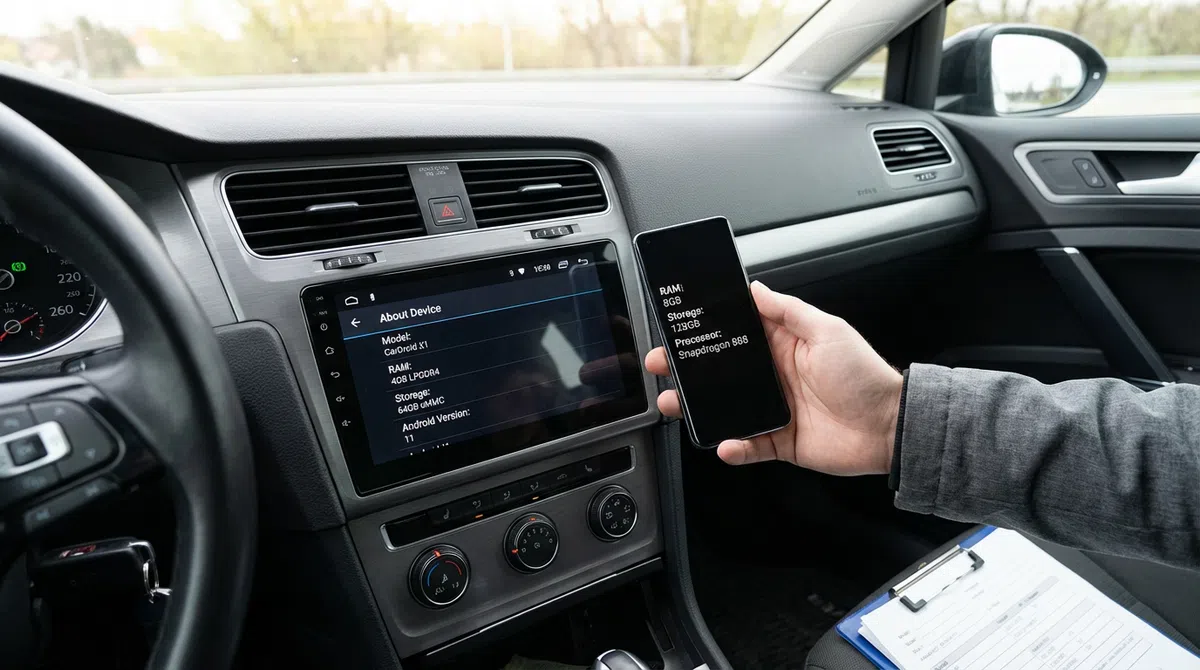
If you've installed a Chinese screen or a generic Android stereo, you might be falling victim to misleading specifications . Some devices advertise 8GB of RAM but actually have much less, causing apps to constantly restart when switching between maps and music.
To verify this, you can run a stress test by opening several resource-intensive apps simultaneously. If the system crashes or the UI restarts , the hardware likely can't handle the load. Tools like H2testw can be used to check if the storage capacity is accurate or if the system has been manipulated to display more capacity than is actually available.
To resolve most of these issues, the ideal solution is to keep the system free of unnecessary apps, check the quality of the cables , disable aggressive power saving features on Wi-Fi, and, in extreme cases, perform a factory reset of the network settings or the Android Auto app to restore the original smoothness.