- The Steam Machine's GPU is technically a cut-down version of the Radeon RX 7600, similar to an RX 7600M.
- Its raw performance is between a Radeon RX 6600 and an RX 7600, approaching an RX 6600 XT.
- It features a Zen 4-based CPU with 6 cores and 12 threads, surpassing the processing power of the PS5 and Xbox Series X.
- It is optimized for gaming at 1080p resolution thanks to its 8GB GDDR6 memory and the use of SteamOS.
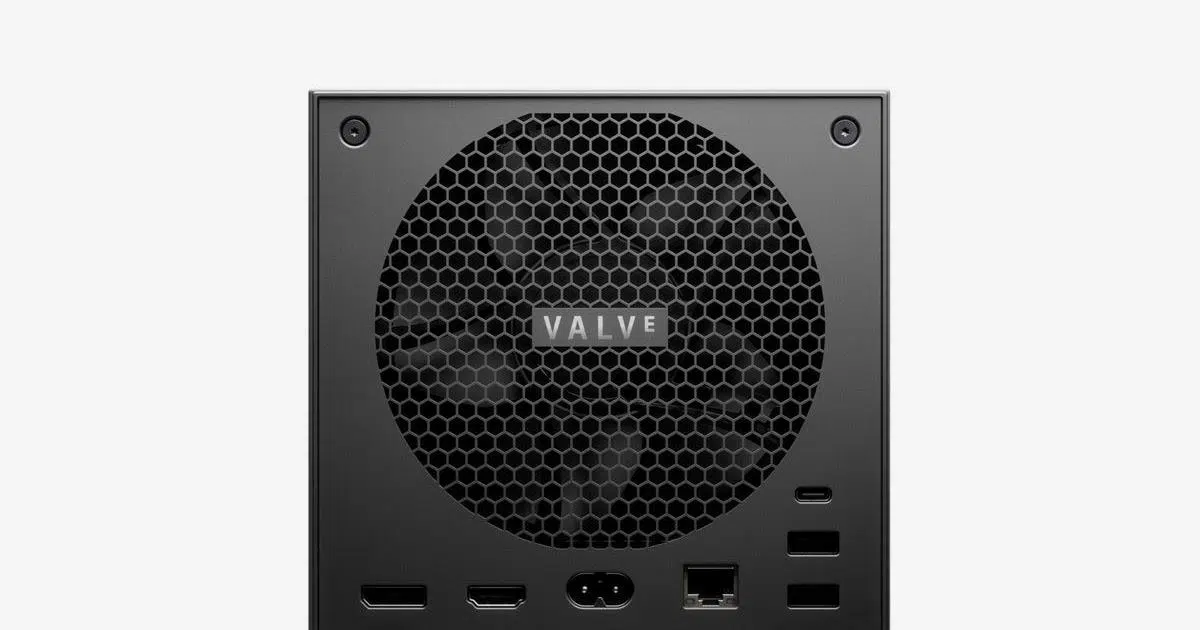
Valve has once again entered the console market with a proposal that seeks to correct the missteps of its first attempt back in 2015. This new machine is not just a shrunken PC, but comes with deep optimization thanks to SteamOS , software that squeezes every last drop of performance from the hardware so that not a single clock cycle is wasted, allowing it to perform better than an equivalent computer running Windows 11.
For those who aren't hardware experts, understanding what's inside this compact chassis can be confusing. The key here is that Valve has opted for low-power components to prevent the console from becoming an oven, selecting parts we'd normally see in gaming laptops but tuned for a living room environment.

What graphics card is the GPU in the Steam Machine equivalent to?
For a quick answer, the Steam Machine's GPU is essentially a cut-down Radeon RX 7600. It's not a standard desktop card; instead, it uses the RDNA 3 architecture with 28 active compute units (CUs), compared to the 32 in the full PC version. This translates to a total of 1.792 shaders , slightly fewer than the 2.048 of the original RX 7600.
Looking at the detailed specifications, we see that it's a carbon copy of the laptop Radeon RX 7600M . Both share TSMC's 6nm manufacturing node, 112 texture units, and 64 raster units. However, Valve's version has a TDP of 110 watts , surpassing the 7600M's 90 watts, and GDDR6 memory at 18 Gbps, giving it slightly higher bandwidth (288 GB/s) and achieving approximately 17,56 TFLOPs in FP32.
In terms of raw real-world performance, tests indicate that it outperforms a Radeon RX 6600 but falls short of the RX 7600. Therefore, the closest desktop equivalent would be a Radeon RX 6600 XT. It's a solution designed to dominate 1080p , as its 8GB of VRAM is the ideal standard for that resolution.
Processor and RAM Analysis
It's not all about graphics; the console's brain is also powerful. It features a CPU based on AMD's Zen 4 architecture with 6 cores and 12 threads. To use a PC analogy, it's practically a Ryzen 5 7500F with a slightly lower clock speed, reaching 4,8 GHz compared to the desktop model's 5 GHz. Furthermore, it boasts a massive 32 MB L3 cache , which is enormous compared to other consoles.
Unlike traditional consoles, there's no unified memory here. The Steam Machine separates the 16GB of DDR5 RAM for the system from the 8GB of GDDR6 VRAM dedicated to the GPU. While this might seem less flexible, it prevents the CPU and GPU from competing for the same bus, reducing data access latency and improving overall workflow efficiency.
Comparison: Steam Machine vs PS5 and Xbox Series
When we compare this machine to Sony and Microsoft's offerings, the latter are starting to feel outdated. The PS5 and Xbox Series X use Zen 2 architecture, which is far inferior to Valve's Zen 4. The Steam Machine boasts approximately 32% higher IPC and four times the L3 cache, ensuring that the processor won't bottleneck any modern games.
In terms of graphics, the battle is closer. The PS5 uses RDNA 1.5 and the Series X RDNA 2. Valve arrives with RDNA 3 , which is technically more advanced and powerful on paper (17,56 TFLOPs versus 10,29 for the PS5 and 12,15 for the Xbox). Even so, in games that rely exclusively on the GPU, the PS5 can still hold its own, but the Steam Machine has the advantage of supporting more modern technologies and better raw performance.
One of its strengths is its ability to handle ray tracing thanks to its 28 dedicated cores. Although ray tracing is very demanding and will lower the frame rate, the machine will be able to run titles like DOOM: The Dark Ages . Furthermore, being based on the RDNA 3 architecture, it is compatible with FSR 3.1 and Fluid Motion Frames , although FSR 4 support will depend on Valve releasing the INT8-accelerated version.
Expected performance and gaming experience
What can we expect when we press the start button? Basically, we can expect to play at 1080p with medium or high settings and maintain a stable 60 FPS in most games. If you're curious to try 4K, it's possible, but you'll have to use FSR in performance mode to lower the base resolution by 50% and significantly reduce the graphics settings so that the 8 GB of VRAM doesn't become insufficient.
Valve has played its cards right based on its hardware surveys. The majority of Steam users use RTX 3060 or RTX 4060 graphics cards , and the Steam Machine's performance falls right into that range (more powerful than a 3060 but slower than a 4060). This means the console will be able to run 70% of PC games with very decent performance, positioning it as an affordable mid-range option.
Knowing that it uses semi-custom hardware and an optimized operating system, the Steam Machine presents itself as a powerful alternative to closed consoles. Although some criticize the fact that the RDNA 4 architecture wasn't used to ensure native compatibility with FSR 4, the combination of a Zen 4 processor and an RDNA 3 GPU makes it a beast capable of running the vast majority of the current catalog in Full HD without breaking a sweat.