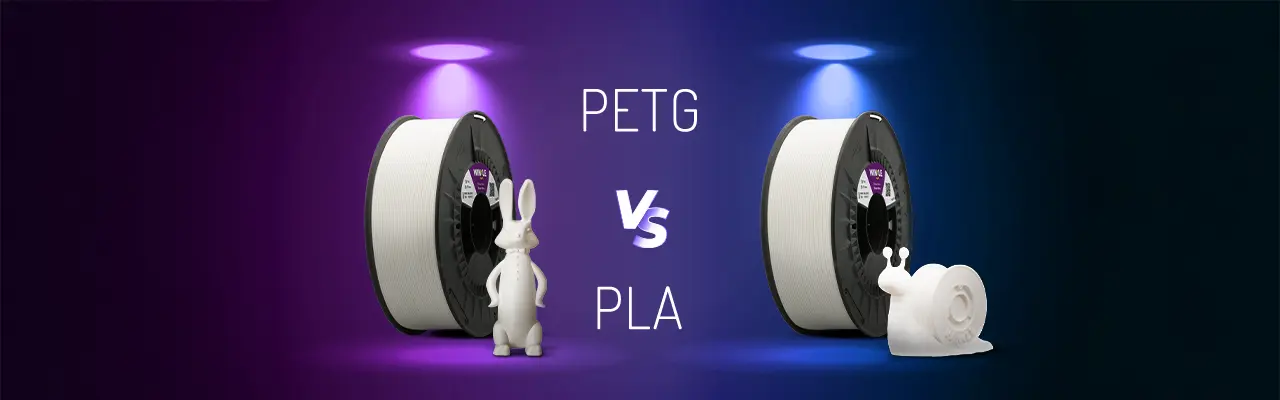
If you've just landed in the fascinating world of 3D printing, you're likely facing a classic dilemma: what material to buy? At first, almost everyone starts with PLA because it's the one recommended everywhere, but there comes a point when you realize that your projects need more than just a pretty piece that bends with heat.
Choosing between PETG and PLA isn't about which is absolutely better, but rather what you want to manufacture . While one is the king of aesthetics and simplicity, the other is the workhorse for those parts that really have to withstand daily wear and tear, especially if they're going to be exposed to sunlight or chemicals.

Detailed PLA Analysis: The Beginner's Favorite
PLA, or polylactic acid, is a polymer derived from natural sources like sugarcane or corn, making it a biodegradable and quite eco-friendly material . For anyone starting out, it's the logical choice since it's incredibly easy to master and doesn't require complex machine setups.
One of its greatest advantages is that it doesn't strictly require a heated bed to function, although using one can help. Furthermore, the fact that it doesn't emit strong odors (it sometimes smells slightly sweet) makes it ideal for printing in rooms without industrial ventilation, provided a window is kept open for air circulation.
In terms of visual quality, PLA is unbeatable. It offers very sharp edges and excellent dimensional accuracy, making it perfect for cosplay figures, rapid prototyping, or any object where aesthetics are paramount. Furthermore, there's an overwhelming variety of colors and specialty filaments available, such as those that mimic wood, marble, or metal.
However, it has one very clear weakness: its low thermal resistance . If you leave a PLA part on your car's dashboard in the middle of August, it will most likely warp, as it starts to soften at around 60°C. It's also not the best option for parts that need to withstand constant mechanical stress without breaking.
Discovering PETG: Strength and technical versatility
PETG (Polyethylene Terephthalate Glycol) is essentially the perfect middle ground between the ease of use of PLA and the robustness of ABS. It combines the best of both worlds , offering significantly greater impact and flexural strength than PLA.
Unlike its simpler cousin, PETG requires higher extrusion temperatures, generally between 230 and 260°C, and a heated bed (between 70 and 90°C) is mandatory to prevent the part from peeling. If you use a PEI sheet, be careful and apply a small amount of glue stick to prevent the part from sticking too tightly and tearing off pieces of the surface.
This material is the undisputed king for outdoor applications . It withstands UV rays, rain, and cold much better, and has a thermal resistance of up to 80°C. Therefore, if you want to manufacture garden supports or car interior parts, PETG is the right choice.
Another important aspect is its excellent layer adhesion , resulting in much stronger parts that are less prone to cracking under pressure. Furthermore, it is highly valued in the food industry because it is water-resistant and many of its filaments are certified for food contact, making it a valuable tool for 3D printing in the culinary sector.
Differences in printing and post-processing
In terms of user experience, PLA wins hands down when it comes to cleanliness. PETG, by its very nature, is more prone to generating the infamous "stringing" or fine strands that remain between the walls of the part, requiring very precise adjustment of the extruder's retraction, something you can optimize using tools like Bambu Studio.
In terms of supports, PLA is much more forgiving. Because PETG has such strong adhesion, removing supports can be a nightmare if you don't leave enough space (at least 0,5 mm) between the support structure and the actual model.
For those who enjoy painting their pieces, PLA is the ideal choice as it sands and paints easily using acrylics. PETG, although it can also be sanded to achieve glossy finishes, is more complex to paint and chemically process.
In terms of toxicity, both are considered safe and non-toxic materials , far removed from the irritating fumes emitted by ABS. Even so, it is always advisable to print in well-ventilated spaces to avoid inhaling plastic nanoparticles.
Application summary: Which one to choose depending on the project?
If your goal is to create a decorative figure, a personalized gift, or a prototype where only the shape matters, go for PLA. It's the fastest route with the cleanest finish , without any technical complications.
Conversely, if you need the part to serve a practical purpose, such as a tool holder, a housing for a heat-generating electronic device, or anything that will be exposed to the elements, PETG is your best bet. Its resistance to fatigue and impact makes it the professional choice for functional parts.
Many advanced users choose to have spools of both. They use PLA to quickly and cheaply validate the geometry and design , and once the design is perfect, they do the final print in PETG to ensure the object is durable and strong in real-world use.
The final choice depends on whether you prioritize aesthetics and simplicity or strength and durability. While PLA is ideal for the art world and collecting, PETG prevails in the technical and practical sphere, allowing us to create objects that truly withstand intensive use without degrading quickly.
