- The B200 stands out for its 180 GB of HBM3e memory and a massive bandwidth of 8 TB/s.
- Introducing the Blackwell architecture with 5th generation Tensor cores and native support for FP4 accuracy.
- It far surpasses the H100 in inference performance, drastically reducing the cost per token.
- It uses the NVLink 5.0 interconnect to achieve bidirectional communication of 1.8 TB/s per GPU.
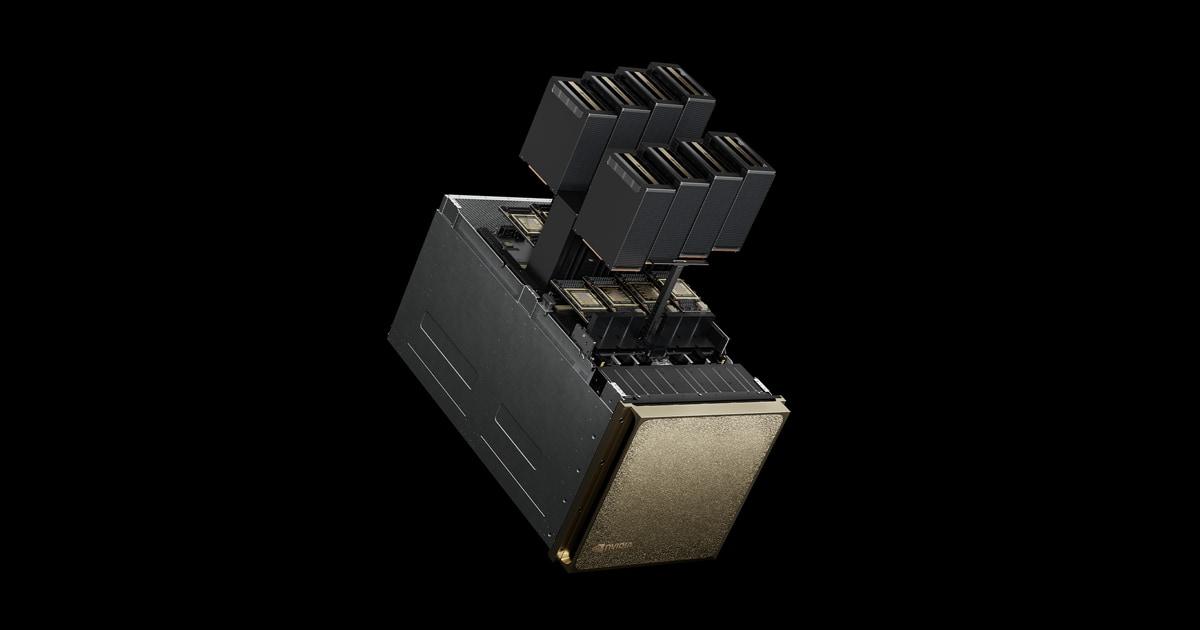
If you're passionate about cutting-edge hardware, you've surely already heard about the quantum leap that the Blackwell series represents . The NVIDIA B200 isn't just another upgrade; it's a processing beast specifically designed to eliminate memory and compute bottlenecks for artificial intelligence.
This card is presented as the crown jewel for data centers, focusing on solving the age-old problem of large language models (LLM). With a disruptive design and power that puts its predecessors to shame, the B200 makes training and deploying models a breeze compared to what we were doing just a couple of years ago.

Technical Specifications and Internal Architecture
Under the hood, the B200 is an engineering masterpiece based on the Blackwell architecture. It utilizes a dual-chip GB100 design, where two dies are fused via a 10 TB/s chip-to-chip interconnect, allowing the operating system to recognize it as a single unit. It is manufactured using TSMC 's 4NP process and houses an astronomical 208.000 billion transistors.
Regarding its rendering configuration, it features 18.944 shader units, 592 TMUs, and 24 ROPs. Its base clock speed is 120 MHz, but it can boost up to 1830 MHz , while the memory operates at 2000 MHz. All this power output results in a TDP of 1000W in its SXM form factor, although some implementations may vary between 700W and 1000W depending on the environment.
Memory and Bandwidth: The Heart of Performance
Where the B200 truly shines is in its data management. It boasts 180 GB of HBM3e memory , a quantity that allows for loading massive models without resorting to fragmentation across multiple GPUs. But it's not just the capacity; the 8 TB/s bandwidth is what makes the difference, being almost 2,4 times greater than that of the H100.
To put it simply, LLM inference is essentially a memory read problem. When generating each token, the GPU must read the entire weight array of the model. With this bandwidth, the B200 can sustain a much higher token generation speed , eliminating the delays that typically appear in models with 70B of parameters or more.

Computing Power and the Leap to FP4
The major innovation is the 5th generation Tensor cores, which introduce native support for FP4 precision . This capability is crucial because it allows for a 50% reduction in memory footprint compared to FP8, effectively doubling the number of parameters that can be processed. In raw terms, the B200 achieves 20 PetaFLOPS in FP4 and 9 PetaFLOPS in FP8.
Compared to the Hopper generation, the leap is staggering. While the H100 falls short in low-precision performance, the B200 offers up to four times the inference performance . This translates to a drastically lower cost per million tokens, making it far more profitable for companies serving AI APIs at scale.
Direct Comparison: B200 vs H100 and H200
If you're wondering whether it's worth making the upgrade, the short answer is yes, provided your builds are large. Compared to the H100 SXM5, which only has 80GB of VRAM, the B200 offers more than double the memory . This means that a 70B Llama 3.1 build in FP16 can comfortably fit on a single card, avoiding the complexity of tensor parallelism.
Even compared to the H200, which was already an improvement in memory (141 GB), the B200 wins hands down with 28% more VRAM and 67% higher bandwidth. Furthermore, the NVLink 5.0 interconnect boosts bidirectional communication to 1.8 TB/s, exactly double that of NVLink 4.0, enabling near-linear scaling in 8-GPU configurations.
Infrastructure and Energy Requirements
We cannot ignore the fact that moving such power requires a serious infrastructure. An eight-GPU B200 system can consume between 7 and 8 kW in processing alone. While air cooling is viable in well-ventilated, high-density racks, direct liquid cooling is strongly recommended to maintain hardware longevity and prevent thermal throttling.
In terms of connectivity, it uses a PCI-Express 6.0 x16 interface , and the software ecosystem is fully compatible with CUDA 12.x and cuDNN 9.x. Any code that already works on an H100 will run on a B200 without changes, although to get the most out of FP4, it's necessary to use TensorRT-LLM 0.17+ or updated versions of vLLM.
Cloud Cost and Availability Analysis
In the GPU rental market, the B200 has positioned itself as a very attractive option. On platforms like RunPod or Spheron, on-demand prices typically range from $5,89 to $9,36 per hour, while spot instances can drop to as low as $5,34. Although the hourly rate is higher than an H100, the efficiency per token is so high that the final cost of the service is usually much lower.
Despite overwhelming demand and millions of units on the backlog for direct purchase, the cloud is the fastest way to access Blackwell. The option of per-second billing allows developers to test their FP4 models without committing to multi-million dollar physical infrastructure contracts.
The NVIDIA B200 redefines what we expect from an AI accelerator, combining massive HBM3e memory with groundbreaking FP4 support and ultrafast NVLink 5.0 interconnect. By far surpassing the bandwidth and capacity limitations of the Hopper series, it becomes the ultimate tool for those managing large-scale language models, optimizing both inference performance and operating costs per token.