- Bluetooth 4.0 introduces Low Energy and lays the foundation for IoT, but 5.0 doubles the speed, multiplies the range, and greatly improves efficiency.
- Bluetooth 5.1 and 5.2 add precise localization and LE Audio with the LC3 codec, optimizing sound quality and power consumption on modern devices.
- Bluetooth 5.3 doesn't increase speed or range, but it refines security, channel management, and energy saving for more stable connections.
- Each version is backward compatible: opting for Bluetooth 5.0 or higher guarantees better current performance and more room for future features.

Bluetooth technology has become indispensable in our daily lives: it connects our mobile phones to our headphones, our laptops to our wireless mice, our TVs to our soundbars, and much more. We use it almost without thinking, but behind that "magical" connection lies a protocol that has been constantly evolving since the late 90s.
When we talk about the differences between Bluetooth 4.0, 5.0, and 5.3, we're not referring to simple name changes, but to significant leaps in range, speed, power consumption, location accuracy, and audio quality. If you're thinking of buying a mobile phone, headphones, a smartwatch, or smart home devices, understanding these versions will help you make a better choice and ensure your purchase is compatible for years to come.
General evolution of Bluetooth: from 1.0 to 5.4 and 6.0
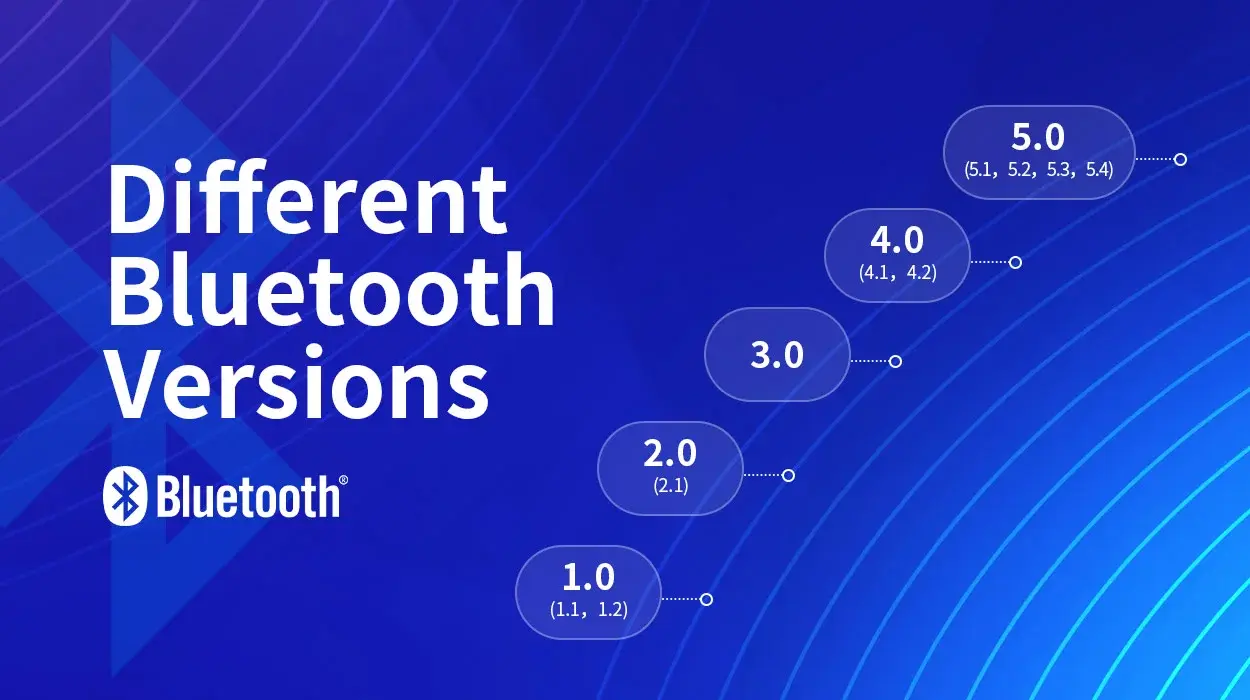
To understand why Bluetooth 4.0, 5.0 and 5.3 are so relevant , it's helpful to quickly review how this standard has grown since its first commercial versions.
The Bluetooth 1.x versions (1.0, 1.1 and 1.2), released between 1999 and 2003, were the first serious attempt to bring short-range wireless communication to the mass market, with speeds around 1 Mbps and a typical range of 10 meters, but with many interoperability, stability and security problems between manufacturers.
With Bluetooth 2.0 and 2.1 (from 2004 onwards), EDR (Enhanced Data Rate) comes into play, raising the theoretical speed to around 3 Mbps and improving power management. In addition, Simple Secure Pairing (SSP) is introduced, reducing the hassle of connecting devices and strengthening encryption.
The leap to Bluetooth 3.0 in 2009 brought the HS (High Speed) designation, allowing the use of a Wi-Fi (IEEE 802.11) link as a "shortcut" to reach up to 24 Mbps in occasional high-volume data transfers, at the cost of much higher energy consumption, something not very compatible with small or battery-powered devices.
Classic versions: Bluetooth 1.0, 2.0 and 3.0

Although today almost everything revolves around Bluetooth Low Energy , the first versions laid the foundations for what we use now and help us understand how we got here.
Bluetooth 1.0 (1999) was the first commercial specification. It allowed basic wireless connections in the 2,4 GHz band with a maximum speed of 1 Mbps and a range of about 10 meters, but it suffered from serious compatibility and stability problems , and the pairing processes were cumbersome and unreliable.
With Bluetooth 1.1 (2001) many of those initial flaws were corrected, the 79 frequency channels at 2,4 GHz were standardized and the handling of link information was improved, resulting in a more mature and commercially usable version, although still limited in features.
Bluetooth 1.2 (2003) incorporates Adaptive Frequency Hopping (AFH) to reduce interference with other networks such as Wi-Fi 802.11b, adds Enhanced Synchronous Connections (ESCO) for voice, and improves link establishment times, while maintaining compatibility with 1.1.
The big leap of the second generation comes with Bluetooth 2.0 + EDR (2004), which raises the effective speed to about 2,1-3 Mbps, improves energy efficiency by finishing transfers sooner and allows for more convenient hands-free use, file sending and wireless peripherals.
Bluetooth 2.1 (2007) introduced Simple and Secure Pairing (SSP) and Sniff Subrating mode, which reduces energy consumption by extending the intervals between connection checks, making headphones and accessories viable that last longer without recharging.
The arrival of Bluetooth 3.0 + HS (2009) marks the maximum speed of the "classic" branch (up to 24 Mbps using an additional 802.11 channel), incorporates MAC/PHY Alternate (AMP) to choose the optimal radio according to the type of traffic and improves power management with advanced power control, although consumption is still too high for the IoT that was about to explode.
Bluetooth 4.0, 4.1 and 4.2: the era of Low Energy
With Bluetooth 4.0 (2010) comes the real revolution: it integrates classic Bluetooth, high-speed mode and, above all, Bluetooth Low Energy (BLE) , designed for devices that need to consume as little power as possible.
BLE allows very fast and short-duration connections , with latencies around 3 ms, ranges of tens of meters and consumption that can be up to 90% lower than those of the classic branch, which means that a small sensor or activity bracelet can work for months or years with a button cell battery ( battery level of Bluetooth devices in environments such as Windows).
At this stage , dual-mode devices begin to become popular , capable of handling classic Bluetooth and BLE on the same chip, maintaining compatibility with classic headphones and hands-free devices while opening the door to wearables, beacons, and IoT sensors.
Bluetooth 4.1 (2013) refines the standard with better coexistence with 4G/LTE networks, more efficient channel management and greater flexibility in the role of devices, clearly thinking about Internet of Things scenarios with direct communication between sensors, mobiles and the cloud.
Bluetooth 4.2 (2014) marks a key step towards Internet-connected IoT: it adds support for IPv6 and 6LoWPAN, allowing Bluetooth devices to be connected directly to the network via a gateway, increases advertising packet capacity tenfold, and improves privacy to make unauthorized device tracking more difficult.
Bluetooth 5.0: the giant leap in range and speed
Bluetooth version 5.0 (2016) is the latest "big leap" in the standard and the foundation of the entire 5.x family. Its focus is on three fronts: speed, range, and data capacity in low-power mode.
On the one hand, it doubles the speed of BLE from 1 Mbps to 2 Mbps, which allows for reduced latency and shorter transmission time , something key to improving audio synchronization and the response of interactive devices.
On the other hand, it introduces "extended range" modes that can theoretically reach up to 240 meters in open spaces, quadrupling the range of Bluetooth 4.2, at the cost of sacrificing some speed or using more robust coding techniques.
Furthermore, the size of advertising packets in BLE increases from 27 bytes to up to 255 bytes , opening the door to beacon applications, positioning and sending information without the need to establish a classic connection, something very useful in shops, museums or guidance systems.
Bluetooth 5.0 also reinforces the idea of a standard designed for IoT devices, wireless audio, and home automation , with better overall energy efficiency and the ability to handle multiple connections and more complex data streams.
Bluetooth 5.1 and 5.2: precise location and LE Audio
Building on version 5.0, Bluetooth 5.1 (2019) focuses on improving location accuracy. It adds features such as Angle of Arrival (AoA) and Angle of Departure (AoD) , which allow the direction of the signal's origin to be calculated, achieving centimeter-level accuracy indoors with the appropriate infrastructure.
These improvements make it possible to develop much more accurate indoor positioning and asset tracking systems , useful in warehouses, hospitals, shopping centers or smart buildings, where GPS does not work well.
It also introduces improvements to GATT caching and periodic advertising management, which helps reduce energy consumption and redundancies in environments with many devices broadcasting data.
Bluetooth 5.2 (2020) , on the other hand, is heavily focused on audio. It's the version that introduces LE Audio and the LC3 (Low Complexity Communication Codec) , a more efficient compression system than the classic SBC.
Thanks to LC3, better sound quality can be achieved with lower bit rates , resulting in less battery consumption in headphones and mobile phones, and the ability to maintain good quality even with less favorable radio links.
Bluetooth 5.2 also introduces isochronous LE channels , which allow real-time audio transmissions to be synchronized to multiple devices simultaneously, opening the door to features such as sharing audio with multiple people from the same mobile phone or television.
Bluetooth 5.3: the refinement of the 5.x family
The Bluetooth 5.3 standard was announced in 2021 and began appearing on commercial devices from 2022. It does not change the maximum speed or range compared to 5.0-5.2, but introduces a series of internal improvements aimed at refining the efficiency, security, and reliability of connections.
One of the key new features is the improved filtering of recurring advertisements . The controller can discard redundant data in ad updates, preventing the retransmission of identical information and resulting in energy savings for both the sender and receiver.
Another important improvement lies in channel classification and selection . Peripheral devices can indicate which channels they prefer to use, so that the central device (for example, the mobile phone) takes this information into account and the least congested frequencies are selected together, reducing interference and dropouts.
In terms of security, Bluetooth 5.3 allows the controller to define a minimum size for encryption keys . If a remote device attempts to negotiate a key that is too short (and therefore insecure), the connection can be blocked immediately, preventing weak links that could be vulnerable.
In addition, mechanisms are introduced to allow devices to seamlessly switch between modes with different bandwidths as needed. For example, if you switch from listening to music to making a call, the system can quickly adjust the link settings to minimize latency in real time.
Many chips that implement 5.3 ( and the chip's firmware ) are also starting to talk about features such as "Intelligent Dual Bluetooth" , which allow simultaneous connections in classic and BLE modes, or even connect two mobile phones to the same speaker if all devices share this standard, bringing more flexible shared audio scenarios closer.
Practical differences between Bluetooth 4.0, 5.0 and 5.3
If we bring all this down to earth, the big difference between Bluetooth 4.0, 5.0 and 5.3 is in how they behave in real use: range, stability, power consumption and future possibilities.
Bluetooth 4.0/4.2 already provides adequate wireless connectivity for headphones, speakers, and wearables, but the range is more limited and the BLE speed is capped at 1 Mbps, which can result in higher latency and slightly higher power consumption for certain audio and IoT applications.
By making the leap to Bluetooth 5.0 , things change considerably: the speed in BLE doubles, the theoretical range quadruples, and the capacity of advertising messages increases significantly, improving the experience in both wireless audio and smart home devices.
The difference between Bluetooth 5.0 and 5.3 isn't radical, but it is noticeable in scenarios with many connected devices. 5.3 manages channel switching better, avoids saturated frequencies, and shaves a few milliseconds off power management and the transition from/out of sleep states , resulting in slightly longer battery life and somewhat more stable connections.
If you compare a mobile phone with Bluetooth 5.0 and another with 5.3, both connected to modern headphones, the sound quality will depend much more on the codec and the design of the headphones than on the Bluetooth version, but with 5.3 you will have better room for maneuver for future LE Audio functions and saturated environments.
Bluetooth 5.3 versus 5.1 and 5.2
Within the 5.x family itself, each version refines a different aspect, so it's interesting to see how Bluetooth 5.3 relates to 5.1 and 5.2.
Regarding Bluetooth 5.1 , 5.3 retains all the advanced location features (AoA, AoD, improved GATT caching, etc.) and complements them with more efficient channel management and connection intervals , which helps save energy and reduce minor signal interruptions.
Unlike Bluetooth 5.2 , which is the key version for LE Audio and the LC3 codec, 5.3 doesn't add a new codec, but it does optimize how connections are established and maintained, so that shared audio transmissions and LE isochronous channels work with less interference and a little less latency.
In practical terms: if you use headphones or soundbars with LE Audio, the difference between 5.2 and 5.3 will be noticeable mainly in the robustness of the connection and power consumption , rather than in a leap in sound quality per se.
Version compatibility and device selection
A key point not to forget is that Bluetooth is backward compatible . When you connect two devices with different versions, the connection is established using the lowest version supported by both.
This means that if you have a mobile phone with Bluetooth 5.3 and headphones with Bluetooth 5.0, the communication will be governed by the capabilities of 5.0, although internally the mobile phone's chip may make additional optimizations in power management and channels.
It also means you don't have to choose between "the advantages of 5.0" or "those of 5.3": each new version includes the improvements of the previous ones . A device with Bluetooth 5.3 brings everything that 5.0, 5.1, and 5.2 offered, plus its own new features.
When buying, the reasonable recommendation is that, budget permitting, you opt for the most modern Bluetooth version available , especially if you want the device to last for several years and want to take advantage of features that are still being rolled out, such as advanced LE Audio or precise location.
However, between a device with good sound and Bluetooth 5.0 and a mediocre one with Bluetooth 5.3, it is preferable to prioritize the quality of the product and its codecs (SBC, AAC, aptX, LDAC, LC3) rather than just focusing on the version number.
Classic Bluetooth vs Bluetooth Low Energy
Since Bluetooth 4.0, the specification has been divided into two main branches: Classic Bluetooth (BR/EDR) and Bluetooth Low Energy (BLE) , which coexist in many dual-mode chips.
Classic Bluetooth is the one historically used for high-quality audio, hands-free calling, car audio systems, and peripherals with higher bandwidth . It operates with 79 channels of 1 MHz at 2,4 GHz, offers speeds of 1 to 3 Mbps, and is optimized for continuous data streams, such as music or calls.
BLE, on the other hand, uses 40 channels of 2 MHz and is designed for short and infrequent transmissions , sacrificing some speed (1-2 Mbps) in exchange for a drastic reduction in power consumption and very fast connection/disconnection times.
With the arrival of LE Audio in Bluetooth 5.2 and later, BLE also begins to take charge of next-generation wireless audio , pushing the classic BR/EDR to a more secondary role in the future, although it will continue to function for many years due to the huge installed base.
For the average user, the important thing to know is that a modern device with Bluetooth 5.x is usually dual-mode , so it can communicate in both classic and BLE modes as needed, and that each version upgrade usually brings optimizations for both.
Looking ahead: Bluetooth 5.4 and 6.0
Although the million-dollar question today revolves around Bluetooth 4.0, 5.0 and 5.3 , there are already even more recent versions that point to where the standard is headed.
Bluetooth 5.4 introduces, among other things, Periodic Advertising with Responses (PAwR) and Encrypted Advertising Data (EAD), designed for massive low-power IoT sensor networks, where thousands of devices communicate with a central point very efficiently and securely.
For its part, Bluetooth 6.0 , introduced in 2024, focuses on high-precision distance measurement through Bluetooth Channel Surveying, in addition to improving scanning, latency, and several internal layers of the protocol, with an eye toward tracking applications, indoor navigation, and time-sensitive data synchronization.
These versions will still take a while to appear on a massive scale in mid-range mobile phones and consumer devices, but they confirm the trend: Bluetooth will continue to improve low power consumption, location accuracy and security , while maintaining compatibility with everything that came before.
Ultimately, this entire journey from the early versions to Bluetooth 5.3 and beyond has a clear objective: to achieve more stable wireless connections, with better sound, less power consumption, and more intelligent features , so that we can forget about cables without worrying about dropouts, batteries that run out in a flash, or pairing problems.
