- IPS panels stand out for their wide viewing angles and good color reproduction, but they offer poorer native contrast and black levels.
- VA panels provide much deeper blacks and far superior contrast, at the cost of worse viewing angles and possible smearing in fast motion.
- For varied gaming and creative work, IPS is usually preferred, while for movies, series, and a more cinematic experience on TVs and large monitors, VA is usually better.
- The ideal choice depends on your primary use: screen sharing and color fidelity favor IPS; powerful blacks and home cinema favor VA.
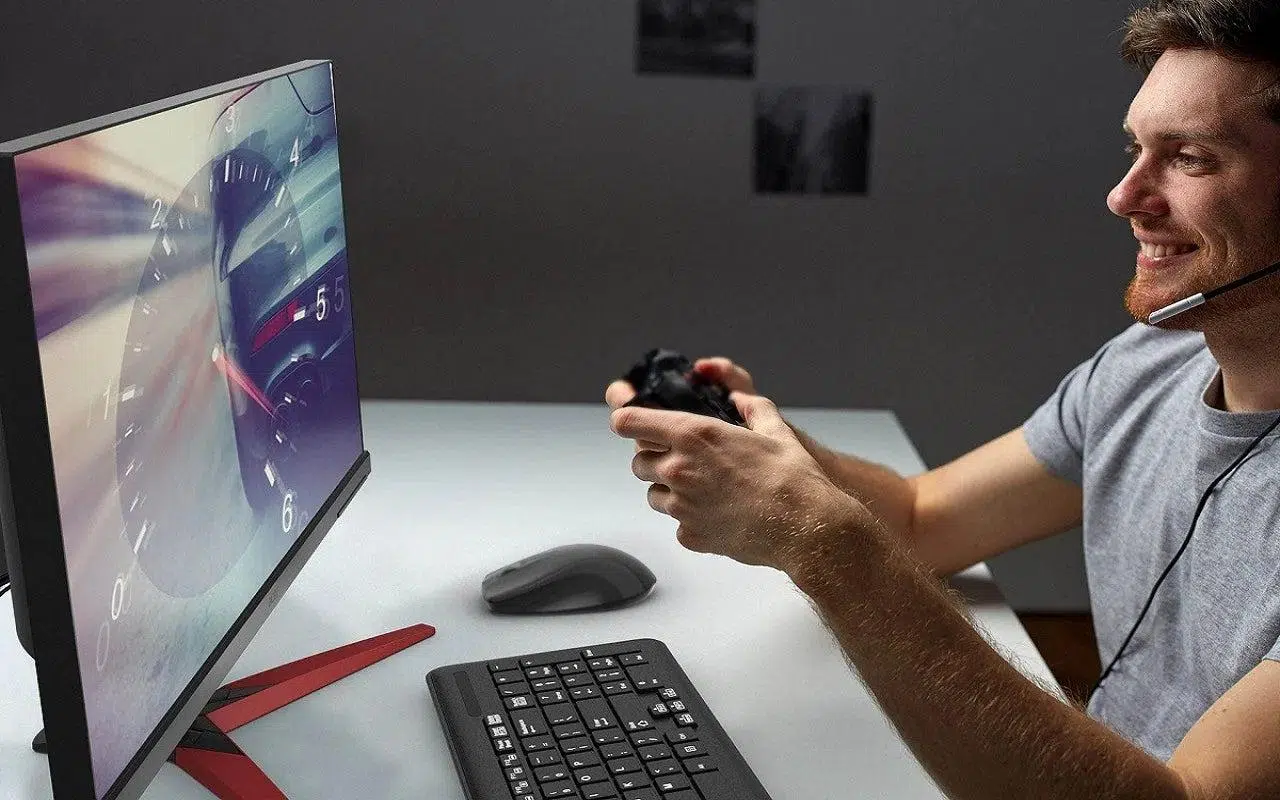
If you're choosing a monitor or TV and you've come across the popular IPS and VA panels, and you're wondering how you're going to connect your monitor , it's normal to have some doubts. Both technologies have very clear advantages and also their drawbacks , and the right choice varies greatly depending on whether you want to play games, watch movies, do design work, or simply watch Netflix while relaxing on the sofa.
Furthermore, things get complicated when you start seeing opinions like: “IPS looks better,” “VA has better blacks,” “X is better for gaming”… and in the end, rather than helping, all that noise makes it even harder to decide . Here we're going to calmly break down the real differences between IPS and VA monitors and TVs, including practical examples of games, movies, and everyday use, so you can clearly see what's best for you, not just in theory, but in your daily life.
Basic differences between IPS and VA panels

Before getting into technical details, it's important to understand the basics: both IPS and VA are LCD-LED technologies . That is, we're talking about screens that use LED backlighting behind an LCD panel; what differs between IPS and VA is how the liquid crystals that modulate that light are positioned and moved.
In an IPS (In-Plane Switching) panel, the liquid crystals are arranged horizontally, parallel to the panel's plane . When voltage is applied, they rotate within that same plane to allow more or less light to pass through. This type of structure promotes better lateral light distribution, resulting in very wide viewing angles and more consistent color reproduction, even when not looking directly at the screen.
In a VA (Vertical Alignment) panel, the crystals are initially positioned vertically, blocking more light when no voltage is applied . When electrically energized, they tilt to allow light to pass through. This alignment method allows the panel to "block" light much more effectively in dark areas, achieving deeper blacks and a native contrast ratio far superior to that of traditional IPS panels.
Translated to what you see on screen, this boils down to this: IPS excels in viewing angles and color accuracy , while VA shines (literally) in contrast and deep blacks . The key is deciding what matters most to you based on your needs.
Viewing angles: a strong point of IPS
One of the aspects for which IPS has earned its reputation is its viewing angles. Most modern IPS panels offer up to 178° horizontal and vertical viewing angles , meaning that the image maintains color and contrast quite well even when viewed from a sharp angle or from above/below.
This is especially useful if, for example, you're watching movies or sports with other people in the living room , or if you're using a shared monitor on a table with several people. In those cases, an IPS TV or monitor allows those not directly in front to see an image much closer to what the person in the center sees, without the colors being washed out as much.
In contrast, VA panels, especially older models or more basic ones, lose considerable contrast and color accuracy when viewed from an angle . This is a typical effect where, when viewed from the side, blacks become grayer and the image appears washed out.
That said, manufacturers have been improving this aspect in mid-range and high-end VA displays, adding layers and special treatments (viewing angle filters, coatings with nanoparticles like Quantum Dot or Triluminos, etc.). With these improvements, some modern VA displays come very close to IPS displays in terms of viewing angles , although historically the advantage still lies with IPS in most models.
Contrast and black level: VA territory
Where VA panels truly excel is in native contrast. A good VA panel can achieve contrast ratios of 3000:1 to 7000:1 or even higher , while typical IPS panels hover around 900:1 to 1200:1. This means that a VA panel is capable of displaying much darker blacks and brighter whites simultaneously.
In practice, if you see a dark scene in a movie or game, on a VA panel you will have much deeper shadows with a greater sense of "true black ," while on many IPS panels those areas appear as a dark gray, causing the image to lose strength and a sense of depth.
IPS displays also have a classic problem: they tend to flatten the darkest levels . In other words, the deepest blacks tend to look very similar, reducing shadow detail. This is compounded by potential light bleed (IPS glow), especially diagonally, which is very noticeable when viewing content with very dark backgrounds in a dark room.
Conversely, a well-implemented VA panel can block light much more effectively when it needs to display black, resulting not only in a lower black level but also a significantly increased perceived contrast across the entire image . This is precisely why many image experts recommend VA panels for home theater and television series, especially if you're going to be watching content in low light.
However, it's important to clarify: in high-end TVs with angle improvement technologies and complex backlighting (such as FALD, Mini LED, etc.), some modern VA panels combine their high native contrast with improved side viewing , leaving IPS panels in a more secondary position for purely cinema and series use.
Color reproduction and gamut coverage
IPS panels have become a standard in monitors for design, photography, and video editing for a clear reason: their ability to reproduce color with great accuracy and very wide color gamut coverage . It's common to see IPS panels that cover 95% or even 100% of DCI-P3, one of the color gamuts used in digital cinema.
Even the simplest IPS panels typically offer 20% to 30% better color coverage than the best TN panels , and they compete very well with many VA panels. The combination of good coverage and wide viewing angles makes the color appear very stable, whether you're sitting directly in front of the screen or moving slightly away from it.
In terms of color depth, many IPS panels use true 8-bit color depth (or 8-bit + FRC), allowing them to display 16,7 million colors quite consistently. This doesn't mean VA panels are bad at color; in fact, modern VA panels can also offer 8-bit color depth and a very wide palette, but off-axis consistency and overall color performance are generally more predictable in IPS panels.
Conversely, some users have noticed that on certain VA models, the colors can appear somewhat more saturated or "intense" out of the box , creating a striking impression in stores, but not always true to reality. This can be corrected with calibration, but by default, IPS color printing tends to be more neutral and accurate.
If you're someone who values above all a reproduction as faithful as possible to what the creator intended (artists, designers, lovers of meticulous graphics in open-world games, narrative adventures, etc.), a good IPS monitor is still a very safe bet , especially if you're also going to use the monitor for office tasks and editing.
Response time and refresh rate for gaming
In the gaming arena, pixel response time and refresh rate make all the difference. TN panels were for years the undisputed kings of speed , with very low response times (1-5 ms) and high refresh rates (120 Hz, 144 Hz or more), at the cost of sacrificing a lot in color and viewing angles.
However, technology has evolved, and IPS panels are no longer "slow" like they once were. Many current IPS gaming monitors match or approach the performance of fast VA panels , with highly competitive response times and high refresh rates (144 Hz, 165 Hz, or higher). For most gamers, they are no longer a bottleneck in terms of speed.
VA panels, for their part, have also improved, offering refresh rates of up to 144 Hz and even higher in gaming models . However, a common weakness of some VA panels is the transition between certain dark tones, where the pixel responds more slowly and the infamous "smearing" appears: a kind of shadow or trail behind moving objects against light backgrounds.
Thanks to their internal structure, IPS displays tend to have a more uniform pixel response and are less prone to smearing, making them very interesting for competitive games, fast-paced shooters, or any title where motion blur is particularly bothersome.
Regarding HDR, the situation is more nuanced: VA panels offer better native contrast, which on paper is ideal for HDR, but IPS panels with good color coverage and brightness can deliver a very convincing HDR experience . In fact, some users believe that the combination of wide color gamut and well-managed moderate contrast in IPS panels results in a very balanced HDR experience, although the IPS vs. VA HDR debate remains very much alive.
Which to choose for gaming: IPS, VA or TN
If you play all kinds of games, from shooters to open-world RPGs, it's normal to be torn between IPS and VA (and you might even still see TN monitors because of their price or speed). Each technology offers a different balance between speed, color, and contrast , so it's worth considering different types of gamers.
For competitive games like FPS, battle royale, or MOBAs, where minimal latency and motion clarity are more important than extreme contrast , a good IPS gaming monitor is usually a fantastic option: very good response times, vivid colors, and wide viewing angles, in case you share the screen or aren't always perfectly centered.
For open-world games, graphic adventures, titles with spectacular landscapes, or games where you like to "contemplate" the environment, the color fidelity and image stability of an IPS panel help everything look as the artists intended . In these genres, you don't need absolute millisecond response times, so IPS is a perfect fit.
If, on the other hand, you prioritize a cinematic feel, with deep blacks and high contrast in dark scenes , a VA gaming monitor can give you a visual experience closer to that of a TV designed for film. However, it's advisable to check reviews and opinions to ensure that the specific model doesn't suffer from excessive smearing.
And TN panels, although becoming less common, still make sense for highly competitive gamers who prioritize speed above all else , often sacrificing color and viewing angles. They are becoming less common as a "primary" option compared to IPS and VA panels, as the latter have narrowed the performance gap without sacrificing as much image quality.
IPS vs VA TVs: movies, series and living room use
When we talk about TVs, the situation changes a bit compared to monitors. In a living room, viewing angles and contrast are key , because you're rarely looking straight at the screen and you tend to watch a lot of dark content: movies, series, streaming films, etc.
In this context, IPS panels have traditionally been used in low-end and mid-range TVs where cost is key and it's important that multiple viewers can see clearly from different positions on the sofa . Their main advantage here is precisely that the color remains acceptable even when viewed from a considerable distance, with fewer abrupt variations than a basic VA panel.
The problem, as we've already mentioned, is that IPS panels have poor black levels and very limited native contrast . For movies and TV shows, this translates into grayish blacks, a lack of impact in dark scenes, and an image that falls short for anyone who values quality, especially when the lights are turned off.
VA panels, on the other hand, stand out for their exceptional contrast and significantly deeper blacks. In a slightly darkened room, a well-calibrated VA television offers an experience much closer to what one expects from a home theater . This is why many mid-range and high-end LED televisions rely on VA panels as the foundation for achieving the best possible image within the LCD-LED technology.
However, for years VA panels have suffered from limited viewing angles, but improvements with viewing angle filters, nanoparticles, and specific coatings have greatly reduced this problem . In some top-of-the-range models, VA panels now offer very competitive viewing angles while maintaining contrast that puts IPS panels at a clear disadvantage for cinema.
Advantages and disadvantages of IPS panels (in TVs and monitors)
To summarize the most important points, we could say that IPS technology is designed to prioritize stable color and good peripheral vision , sacrificing some contrast. This has different implications depending on whether we're talking about a television or a monitor.
Among the main advantages of IPS displays is their typically lower manufacturing cost , which allows for many IPS models to be found in budget and entry-level ranges, both in monitors and televisions. Furthermore, the pixel response time is generally quite good, minimizing ghosting and motion blur.
Another major strength is their wide viewing angle , which makes them very comfortable for environments where several people share the screen, such as living rooms, offices, or setups with multiple workstations. In addition, they have an excellent reputation for color accuracy, especially in monitors geared towards design, photography, and video.
Among the notable drawbacks, the most obvious is its very weak native black level , which results in quite low contrast ratios. This significantly detracts from the viewing experience when watching dark content in dimly lit rooms, where light bleed and IPS glow are more pronounced.
Therefore, the ideal use of an IPS is usually in monitors for office work, creative work, various games that do not require extreme contrast , and entry-level/mid-range TVs where a very demanding cinematic experience is not sought, but rather a more general use: DTT, sports, some streaming, etc.
Advantages and disadvantages of VA panels (in TVs and monitors)
VA panels, on the other hand, are in a different league when it comes to contrast. Their vertical alignment of the crystals allows them to block much more light when displaying black , and this is immediately noticeable in any scene with shadows or dark areas.
The biggest concrete advantage is its excellent native black level and extremely high contrast , which can be several times greater than that of an IPS panel. In terms of perceived image quality, this provides a depth and visual "impact" that is greatly appreciated in movies, TV series, and many video games.
Furthermore, modern VA panels achieve high refresh rates and excellent vertical refresh rates , making them an increasingly common choice in ultrawide or large-format gaming monitors, such as the popular 34-inch ultrawide models. They also offer very good color reproduction, with palettes of up to 16,7 million colors and high brightness in many models.
On the downside, they still suffer from two problematic points: traditionally narrower viewing angles (although, as we have said, much improved in high-end models) and somewhat slower response times in certain transitions, which can cause smearing in fast motion if the panel or overdrive is not properly adjusted.
For all these reasons, VA is especially recommended for those looking for the best possible base in an LED TV for home cinema , as well as for large monitors intended for gaming and multimedia content consumption, where contrast and blacks have a significant impact on the overall experience.
Real-world examples of use: from 24″ to 34″ ultra-wide
When we move from theory to concrete examples, the differences become clearer. Imagine you want a 24-inch Full HD monitor primarily for gaming, but you'll also use it for Netflix and anime. You've looked at VA models and a slightly more expensive IPS model , and you're wondering if the IPS is worth it at that size.
On a 24″ 1080p monitor, the difference in viewing angles and color between a good VA panel and an IPS panel exists, but it's not as significant as with large televisions or monitors of 27″ or more . If you're mostly sitting directly in front of the screen, a decent VA panel will give you very good contrast and deeper blacks, which is great for series and anime with dark scenes, without the viewing angles being an issue.
However, if you highly value color stability when moving around, or are very accustomed to the look of IPS displays, that small price premium for the IPS screen might be justified , especially if you also do some light design or editing work. In this screen size range, the choice is more a matter of personal preference and priorities than a huge price difference.
However, when we move up to 34-inch ultrawide formats, things get more interesting. Many of these models use curved VA panels, and some users have reported that certain VA panels appear somewhat "dull" or with slightly oversaturated colors . This largely depends on the specific model and the factory calibration; it's not true that all VA panels are inherently dull, but they do tend to come with significantly boosted saturation to make a strong initial impression.
On large ultrawide displays, an IPS panel can offer a more homogeneous image across the entire width of the screen , with less color variation between the edges. In contrast, a VA panel will give you significantly superior contrast and deeper blacks, which makes a huge difference in immersive games and widescreen movies. Here again, your priorities come into play: realism and deep blacks versus slightly more accurate and uniform color across the entire screen.
Beyond theory, many users looking for a 34″ monitor for gaming, watching movies, and working end up opting for VA if they want a more “cinematic” experience; while those who prioritize image editing, color accuracy, and multitasking tend to lean towards IPS, accepting the sacrifice in black level.
Featured monitors and televisions with IPS and VA panels
In today's market, you can find a huge selection of TVs and monitors with both types of panels. Among televisions specifically designed for cinema and 4K , there are models that clearly leverage the advantages of one panel type or the other.
A typical example of an IPS display would be a television with NanoCell or similar technology, where the brand focuses on a wide color gamut and excellent image and sound management , with processors capable of identifying voices, effects, and frequencies to deliver immersive audio. In these models, the emphasis is usually on ensuring that everything looks and sounds well-balanced from different points in the room.
In the VA segment, you'll find TVs with advanced color processing and well-developed HDR, where the goal is to enhance the color spectrum, tone definition, and overall image intensity . If they also include sound systems like Dolby Digital, the experience approaches that of a movie theater: deep blacks, vibrant colors, and immersive audio.
Monitors range from 27″ Full HD models designed for general use and some gaming, to dedicated gaming displays with high refresh rates and technologies like FreeSync or G-Sync, available in both IPS and VA panels. Many VA gaming monitors offer 144Hz refresh rates with good contrast, while mid-to-high-end IPS monitors provide an excellent blend of fast response times and vibrant colors.
The important thing to understand is that, beyond the panel technology, backlighting, the image processor, HDR, factory calibration, and usage type also play a role . But choosing the right one between IPS and VA as a "base" brings you much closer to the experience you're looking for.
After considering all of this, the key takeaway is that there's no single winner. IPS panels are a great fit if you prioritize viewing angles, color accuracy, sharing, and a smooth gaming experience without obsessing over perfect blacks . VA panels, on the other hand, take the prize when you enjoy movies, TV shows, and cinematic games where contrast and deep blacks are paramount, and you're willing to accept slightly more limited viewing angles or, in some cases, slightly slower response times. Once you're clear on your priorities, choosing between IPS and VA ceases to be a dilemma and becomes simply a matter of matching the technology to how you actually use your screen.
