- Qualcomm announces the acquisition of Arduino with brand independence and multi-vendor support.
- Arduino UNO Q introduced: dual-brain architecture with Linux and MCU.
- App Lab unifies real-time workflows, Linux, Python, and AI with open licenses.
- Strategy to bring computing and AI to the edge supported by Edge Impulse and Foundries.io.
The move many didn't see coming is now official: Qualcomm has announced the acquisition of Arduino , a milestone that could reshape the open hardware ecosystem and edge development. While no figures have been revealed, statements from both companies point to an alliance aimed at bringing advanced computing and artificial intelligence to a vast and highly active community.
Beyond the headline, there are key nuances: the agreement is subject to customary regulatory approvals and closing conditions , and Arduino will retain its brand, mission, and tools with an open approach. Meanwhile, Qualcomm continues its strategy of integrating hardware, software, and cloud services, supported by recent acquisitions such as Edge Impulse and Foundries.io.
What exactly has been announced
Qualcomm, the American company known for its processing platforms and edge computing solutions , has announced the acquisition of Arduino , the Italian non-profit organization that popularized programmable boards and open-source software. The financial terms have not been disclosed, and several sources indicate that the transaction will need to pass regulatory scrutiny before closing.
In their messages, Qualcomm executives emphasize a central idea: democratizing access to cutting-edge computing and AI for developers worldwide. This move aligns with a roadmap that already included acquisitions such as Foundries.io (embedded systems management and OTA updates) and Edge Impulse (on-device AI and real-world data modeling).
From Arduino's perspective, the commitment is clear: to maintain its identity, the independence of its tools, and compatibility with multiple microcontroller and microprocessor vendors, without abandoning its open-source philosophy. This point has been repeatedly emphasized to reassure its user base.
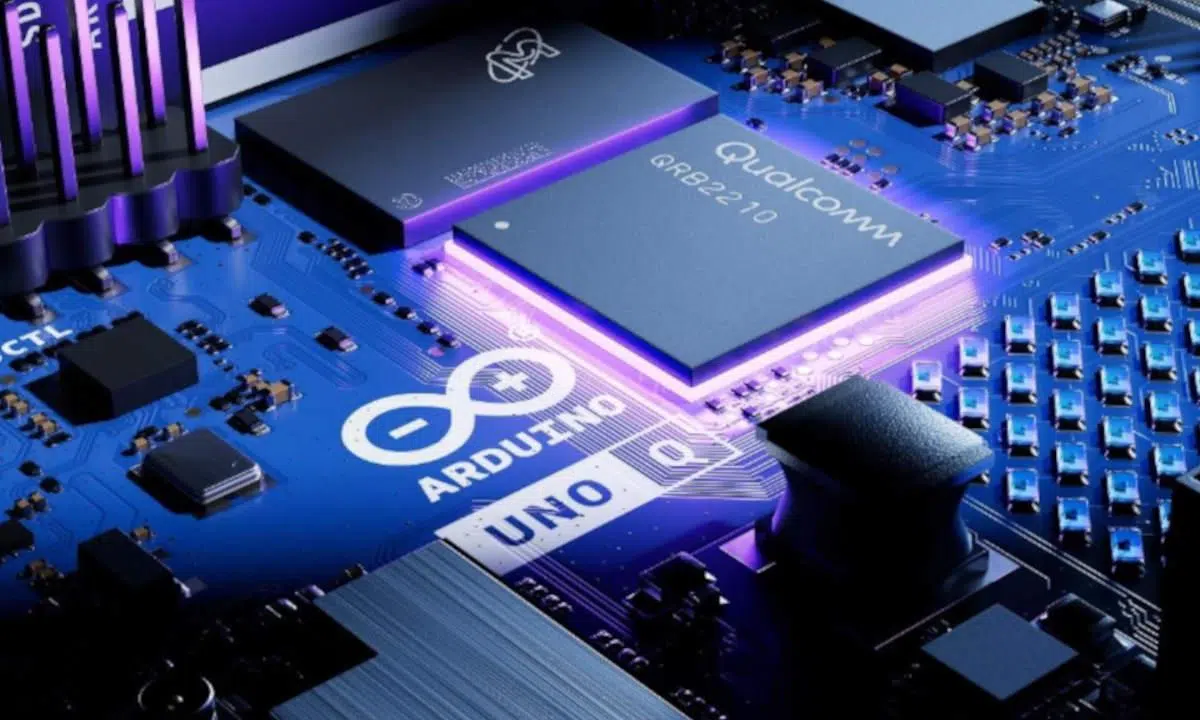
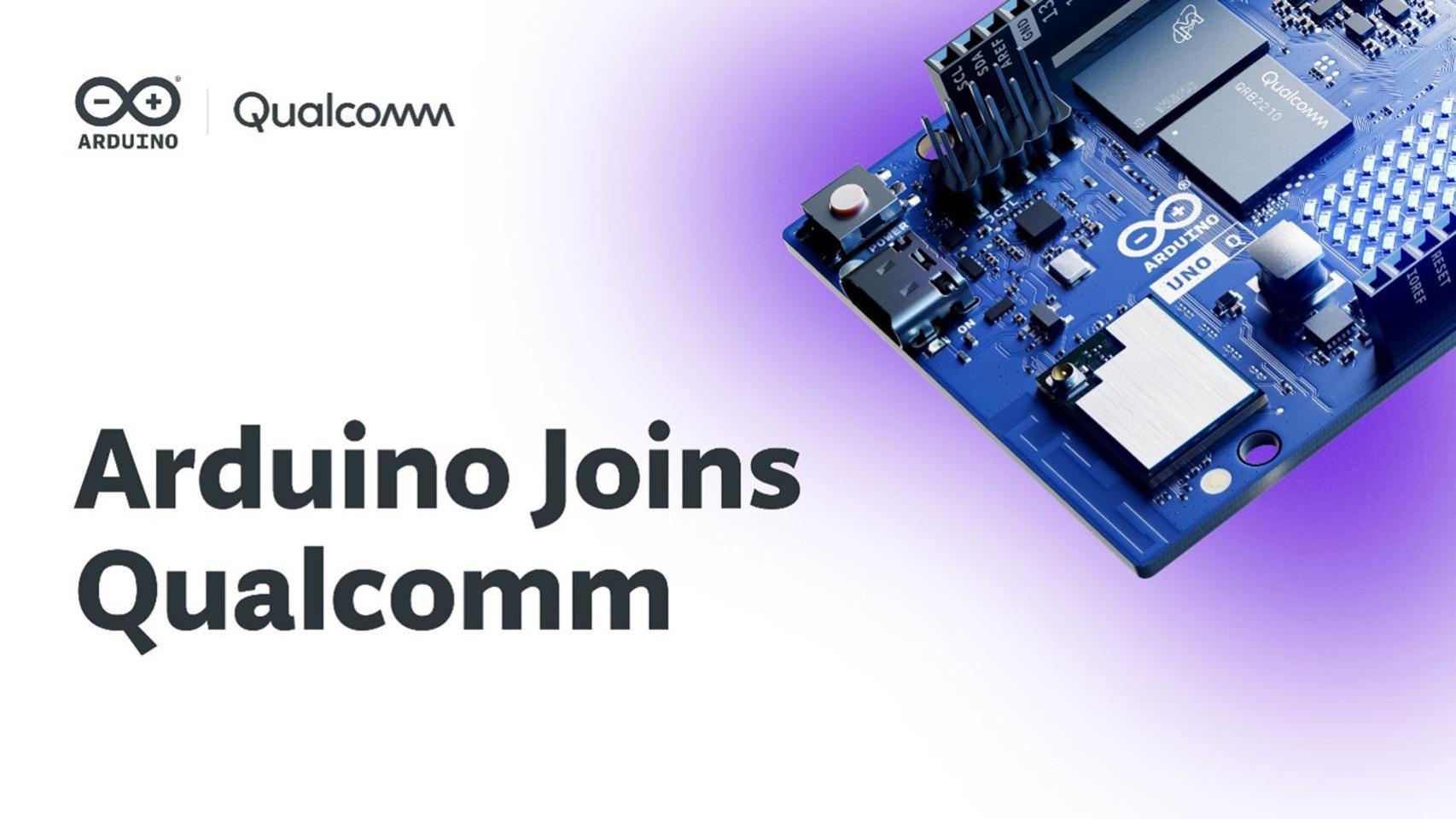
In fact, the announcement doesn't come alone: as the first visible result of this new stage , Arduino UNO Q has been presented , a single-board computer with a "dual brain" architecture that opens the door to AI applications and real-time control on a single board.
One relevant detail circulating in the various reports: there is no official figure for the agreement , and some texts refer to an announced purchase, while others mention it as completed but "pending approval," which reflects the normal closing times for this type of transaction.
Who is Arduino and why does it matter?
Arduino was born in 2005 in Ivrea, Italy, the brainchild of Massimo Banzi, Tom Igoe, David Mellis, and the Spaniard David Cuartielles , with the idea of creating a simple and affordable board that would make it easy for anyone to build interactive devices. The founding question was straightforward: how to make hardware something that everyone could use to create?
The answer began to take shape with the Arduino Uno : an inexpensive board, easy to program via USB, and compatible with a multitude of sensors and actuators. This simplicity, combined with a highly dedicated global community, sparked the maker movement , where thousands of people brought to life projects with lights, motors, and robots that reacted instantly.
Over time, Arduino evolved from 8-bit microcontrollers to more powerful 32-bit solutions, gaining memory and processing power , and expanding from experimentation and education to industrial use cases. This shift crystallized in the professional range, with families like Arduino Portenta , geared towards automation and manufacturing applications.
The reach figures help to understand the phenomenon: we're talking about a community of over 30-33 million users and, in the last 12 months alone, almost 37 million downloads of the development kit. It is, in essence, one of the most popular creation ecosystems on the planet, with a mix of students, hobbyists, teachers, developers, and engineers.
This user base, combined with the evolution of hardware, has driven more companies to use Arduino to connect devices and bring intelligence to the edge: home automation, computer vision, industrial sensors , and more. There, the partnership with Qualcomm can act as an accelerator.
Qualcomm's strategy: hardware, software, and cloud for the edge
With this acquisition, Qualcomm reinforces a roadmap that aims to offer a comprehensive platform encompassing hardware, software, and cloud services , with both open and proprietary options. The goal: to enable any developer to create and scale intelligent solutions without encountering integration complexities.
The latest moves fit together like pieces of a puzzle: Foundries.io brings expertise in device deployment and maintenance, while Edge Impulse facilitates the design of AI models with real data and their optimization for local execution. Arduino adds the key ingredient: a massive community and recognized tools already used in education, prototyping, and business.
The value proposition for developers is clear: access to processing, graphics, computer vision, and AI technologies from a familiar environment, with more options for moving from idea to prototype and from prototype to product. This includes accelerating tasks such as image classification, object detection, or sound recognition on resource-constrained devices.
The focus on edge computing reflects a fundamental trend: bringing computing closer to where data is generated , reducing latency, improving privacy, and containing transmission costs. With more capable devices and unified development frameworks, it's easier to add intelligence to cameras, robots, vehicles, and industrial sensors.
Both sides repeatedly emphasized concepts like "democratization" and "accelerated access" to the tools. In practice, this means more people will be able to build useful solutions at affordable costs , and the barrier to entry for AI at the edge will be lower.
Arduino independence and multi-vendor support
One of the community's key concerns was whether Arduino would become exclusively dependent on Qualcomm chips. The developers have been emphatic: Arduino will maintain support for a wide variety of microcontrollers and microprocessors from different manufacturers, as it has done until now.
It has also been emphasized that the brand, mission, and tools will remain independent , respecting the open philosophy that has defined Arduino since its inception. This means continued open licensing, documentation, and compatibility with the existing ecosystem.
Meanwhile, the more "pro" orientation of recent years continues: the Arduino Pro division and families like Portenta fit with the push towards industry, automation and large-scale IoT deployments, without abandoning boards and kits designed for students and hobbyists.
For Qualcomm, the gain is twofold: diversifying its business and getting closer to the global developer community already working with Arduino. For Arduino, it's an injection of technological muscle and commercial reach that can accelerate its roadmap.
Arduino UNO Q: Specifications, Architecture, and Options
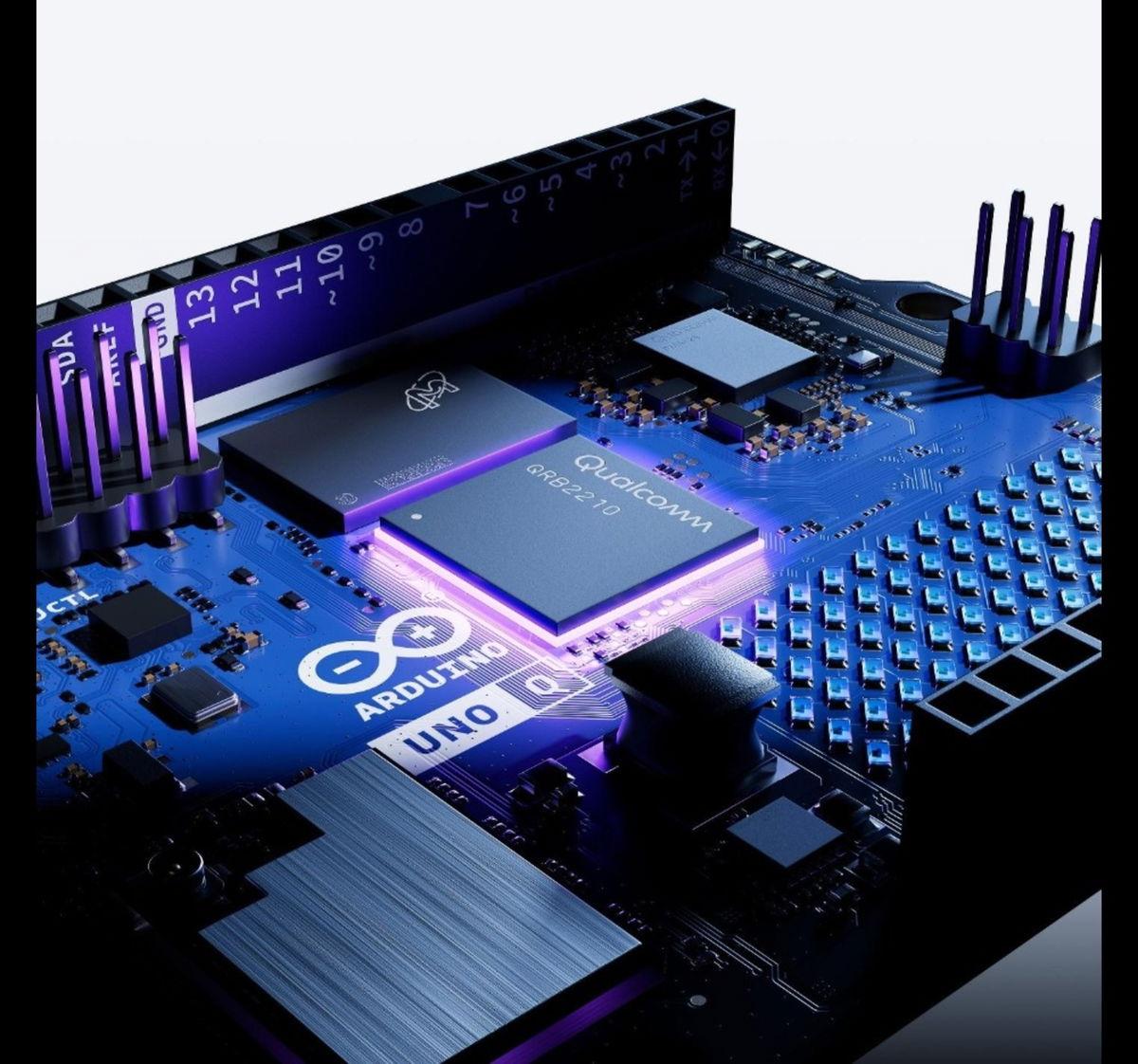
The flagship new product is the Arduino UNO Q , a next-generation SBC (Single Board Computer) that combines a microprocessor for running Linux with a real-time microcontroller on the same board. This "dual-brain" approach allows for the integration of intensive processing (vision, AI, user interface) with deterministic control of sensors, motors, or actuators.
At the heart of the system is a chip from Qualcomm's Dragonwing family, which appears in various sources as the Qualcomm Dragonwing QRB2210 . Some reports also mention the designation QRV2210, but the most frequently used reference is QRB2210, indicating the SoC's positioning for robotics and embedded devices.
The microprocessor features a quad-core Cortex-A53 CPU up to 2,0 GHz , 512 KB of L2 cache, and an Adreno 702 GPU up to 845 MHz . Memory and storage options include versions with 2/4 GB of RAM and 16/32 GB of integrated eMMC, designed to run a full Linux distribution (Debian) and local graphics or AI applications.
Connectivity includes Wi-Fi and Bluetooth , as well as USB-C and the expansion connectors typical of the Arduino UNO family, along with new high-speed connectors. This mix facilitates both classic prototyping and the leap to smart home or industrial automation applications.
On the real-time control side, the board incorporates an STM32U585 microcontroller , ideal for deterministic tasks with low power consumption. The system's strength lies in the fact that the processor and microcontroller work in parallel and coordinate , allowing a single solution to capture, infer, and act with very low latency.
There's a very interesting practical feature: the board can be connected to a development PC or operate independently as a mini-PC . If a monitor, keyboard, and mouse are connected, the user interacts with Debian and the development tools directly on the board, without needing any other equipment.
Regarding availability and price, several sources indicate a launch date of October 25th and two versions: 2GB RAM + 16GB eMMC and 4GB RAM + 32GB eMMC. Prices of €39 and €53 are mentioned for these configurations, while other reports cite an approximate price of €47 . This price range suggests there may be variations depending on the version or market.
App Lab and the new development flow
Alongside the board, Arduino App Lab was unveiled , an environment that unifies work on CPUs, GPUs, and MCUs, simplifying the transition from proof of concept to deployment. The idea is to break down the barriers between real-time systems, Linux, Python, and AI , so developers don't have to jump from tool to tool.
A key strength is its integration with Edge Impulse , which accelerates the creation of machine learning models using real-world data and their adaptation to resource-constrained devices. This is crucial for applications such as computer vision, anomaly detection , and sound recognition.
Regarding licensing, Arduino emphasizes its commitment to open-source design : the UNO Q's open-source hardware schematics and designs are released under CC BY-SA 4.0, and the software, including App Lab, is released under GPLv3 and MPL . This effort to document and release components reinforces the project's historical philosophy.
For those who prefer the classic circuit, the Arduino IDE remains compatible , so there's no need to change established development processes. App Lab adds possibilities for those who want to take full advantage of the hybrid architecture or accelerate iterations.
Impact for education, makers and industry
If Qualcomm and Arduino deliver on their promises, the leap could be considerable: a student could build a vision system with an affordable board , and a teacher could prepare complete practical exercises without struggling with multiple environments. For the maker community, this "dual-brain" approach reduces friction when integrating real-time control with AI inference.
In the enterprise, having a Linux-ready SBC and a supporting MCU facilitates rapid piloting and scaling to production , with room to enhance security, updates, and observability. Support for multiple semiconductor manufacturers remains key to avoiding vendor lock-in.
At the community level, access to Qualcomm's processing, graphics, and computer vision within the Arduino ecosystem can lower the barrier to entry for projects that previously required multiple boards or more expensive hardware. And the fact that the platform remains open preserves the culture of sharing and learning together.
As with any transition, we will need to pay attention to the execution: documentation, examples, and the stability of the tools will be crucial for more users to get on board without getting lost along the way.
Open questions: price, regulatory status and timing
The transaction amount has not been disclosed, and according to various reports, the purchase is pending regulatory approval or other closing conditions. This is the typical process for transactions of this size, but it's worth bearing in mind.
Regarding pricing, there are mentions of two configurations (2/16 and 4/32) and prices of €39 and €53, respectively, while other sources cite around €47. Adjustments based on region, taxes, distribution, or variations between editions are reasonable to expect.
Another concern that has surfaced in the community is whether, with Qualcomm at the helm, Arduino will be marketed more aggressively or lose some of its openness. Those in charge insist that independence and multi-vendor support will continue, that open licenses will be maintained , and that compatibility with the existing ecosystem will not be broken.
Finally, it's worth noting that Qualcomm had already been building an edge computing stack before this announcement, so the integration with Arduino isn't starting from scratch . Its success will depend on real synergies in documentation, SDKs, AI libraries, and CI/CD workflows for embedded systems.
All of the above paints a picture in which the essence of Arduino can be maintained while gaining strength in computing and AI thanks to Qualcomm's support; if the promises of independence, open licenses and broad chip support are fulfilled, the result will be a more powerful platform that does not betray its roots.
